2026.9.7 ‘Cowardly act’: Teens arrested over bike thefts at East Auckland park
Three teenagers have been arrested after bikes were forcibly taken from several young people at a popular East Auckland park, including a 14-year-old who suffered a broken arm.
2026.9.7 Meth-using, speeding driver with baby in car killed two in head-on crash
A unlicensed driver high on methamphetamine and speeding with her baby in the car crashed into another motorist, killing herself and the other driver, a coroner has found.
Peta Kerr, a 33-year-old mother of four, was travelling on State Highway 1 south of Amberley about 5pm on January 28, 2024 with her 7-month-old child in the car.
Coroner Mary-Ann Borrowdale said, in findings released on Monday, Kerr had left Christchurch distressed after telling the baby’s father Leonard Bourton she needed to leave town because she was afraid of associates who were threatening to harm her and take her baby.
Text messages showed the pair had argued acrimoniously the day before her death, throughout the night and into the early morning. The couple were living apart, but Bourton said they were engaged to be married and intended to reconcile.
Kerr was texting with Bourton during the early afternoon and told him she was moving her belongings from her Kāinga Ora flat in Addington to Amberley.
She sent a series of videos and text messages to Bourton about 2.30pm, claiming she had been assaulted but pleaded with him not to tell anyone.
He reported the assault to police, who contacted her.
She told them she was fine and wanted to be left alone.
An ambulance arrived at her flat about 4.15pm but Kerr told them to leave.
Shortly afterwards, she placed her baby in his car seat in her unregistered 2015 Volkswagen Touareg and left for Amberley.
Bryan Kerr, a 51-year-old from New Brighton and no relation to Peta Kerr, spent January 28, 2024 fishing at South Bay, Kaikōura with long-time friend Kurt Skinner.
The pair arrived in Kaikōura about 9am and fished for four hours, smoking a cannabis joint while fishing.
After cleaning their equipment, they left South Bay about 2.30pm.
Bryan Kerr was driving his 1996 Toyota Landcruiser towing a trailer with two jet-skis, while Skinner was in the front passenger seat.
As the vehicles approached one another at the Leithfield culvert, Peta’s Touareg – travelling at about 117km/h – failed to take a sweeping left-hand bend and crossed the centre line, crashing head on into Bryan’s Landcruiser.
Skinner described seeing the Touareg drift across the road towards them.
Peta did not appear to make any attempt to correct the vehicle back into the left lane, he said.
He yelled to Bryan, but there no time for him to take action before being hit, Skinner said.
Other witnesses confirmed Peta had crossed the centre line and drove straight into the Landcruiser and that there was nothing Bryan could have done to avoid the crash.
Both drivers were critically injured and died at the scene. Both were wearing seatbelts.
Skinner was seriously injured and taken to hospital by helicopter.
Peta’s baby was also taken to hospital with minor injuries.
The driver of a third vehicle, following Bryan, tried to avoid the crash and flipped onto its side but the occupant was uninjured.
Postmortems found both drivers died from blunt force trauma consistent with the crash.
Bruises were found on Peta’s body consistent with the video clip she had sent Bourton following the alleged assault.
A separate police investigation into the alleged assault found no evidence one had occurred.
Testing showed Peta had a methamphetamine blood level of 3.9mg/L, which the coroner said was five-and-a-half times the “median recreational-use methamphetamine level”.
The Serious Crash Unit found the road was clear and the weather fine, and neither vehicle had any fault that contributed to the crash.
Peta never held a driver’s license and had also been forbidden from driving.
Bourton said Peta had poor vision and needed glasses, which might have been broken during her claimed assault, and she had not been taking her mental health medications and was exhibiting paranoia.
Coroner Mary-Ann Borrowdale said Peta’s medical history included complex post-traumatic stress disorder, anxiety with depression, borderline personality disorder, substance abuse with possible associated psychotic episodes, and previous suicide attempts and self-harm.
But there was no evidence Peta intended to crash, Borrowdale said.
While Peta had some history of being suicidal, the crash was caused accidentally by a combination of speed, fatigue, upset and intoxication, she said.
Borrowdale made no formal recommendations, but said Peta’s actions “could easily have cost the life of her cherished baby son, in addition to that of Bryan Kerr”.
Borrowdale highlighted unlicensed driving, methamphetamine use, speed, drug driving, fatigue and “emotional overwhelm”.
Driving while distressed was an under-acknowledged hazard and could cause risk-taking, impulsivity, poor judgement, reduced awareness to the environment and slower reaction times, Borrowdale said.
That both drivers had consumed drugs ought to greatly concern road users and lawmakers, she said.
The coroner welcomed the new police roadside drug testing regime.
However, she noted Bryan Kerr’s cannabis use played no role in the crash.
“He had no chance to avoid colliding with the speeding oncoming vehicle in the wrong lane.”
2026.9.6 Frustrated landlord takes tenant to tribunal for not cleaning his dirty, smelly bedroom
2026.9.6 Auckland woman Toni-Ashley Crawford sentenced for Pukekohe murder of Teri Rhind
2026.9.4 17 years’ jail for marae trustee as secret meth syndicate life revealed
A Rotorua marae trustee who led a secret life as the “senior manager” for a major methamphetamine syndicate – the man on the ground allegedly tasked with implementing orders from the overseas-based “supreme commander” of the Comancheros – has been handed a prison term of over 17 years.
Justin Te Kowhai, 55, appeared for sentencing this morning in the High Court at Auckland, bringing a partial end to a joint Customs and National Organised Crime Group investigation dubbed Operation Van that launched a decade ago.
He is the top-ranking of five syndicate participants set to be sentenced today. Underling Russell Harrison, a well-known Rotorua-based musician and former Lotto presenter, will be sentenced at a separate hearing this afternoon.
Notably missing from New Zealand court hearings has been Te Kowhai’s high-ranking Comancheros cousin, Duax Ngakuru, who remains overseas following his 2023 arrest in Turkey.
“Deterrence is particularly important in your case to ensure that others are not tempted to engage in large-scale, commercial methamphetamine trade,” Justice Michael Robinson told Te Kowhai. “That trade can be enormously profitable, but it is immeasurably damaging to our community. It wrecks people’s lives and it wrecks families. ”
Te Kowhai pleaded guilty in late June, just days before he was set to go to trial, to myriad charges including laundering money with Harrison’s help, possessing at least 150kg of methamphetamine for supply and scheming to smuggle more drugs from China, South America and the Pacific Islands.
His successful imports would have been worth tens of millions of dollars on the black market.
Op Van was already up and running in December 2017 when Te Kowhai allegedly helped Duax Ngakuru, and another cousin, Thailand-based Shane Ngakuru, set up shop in New Zealand.
He and co-defendant Jack Phillips helped introduce the Ngakurus to an area Mongrel Mob president, who after a face-to-face meeting agreed to purchase and distribute bulk quantities of methamphetamine that the syndicate would provide, according to court documents.
Phillips, a fellow Rotorua resident who stood beside Te Kowhai in the dock today, was sentenced to 11 months’ home detention. The judge noted he had previous methamphetamine offending in 2006 but since then had been beset by a number of health issues – including a stroke and heart surgery – that would make prison disproportionately difficult for him.
“You have not offended for 20 years,” the judge noted. “You will ot be able to say that now. If there’s a next time, the court might not be so understanding.”
2026.9.4 ‘A lot more work to do’ amid surge in violent crime – Justice Minister
Justice Minister says there’s a swing from time to time in figures but the Government is on track for its targets. (Source: 1News)
The Justice Minister says the Government has more work to do after a survey found an estimated 148,000 people were victims of violent crime in the 12 months to May this year.
2026.9.1 ‘That smell of death’: Surgeon son recalls parents’ double-homicide scene
Almost immediately after arriving at his childhood home in Auckland, vascular surgeon Chi-Ho “Ricky” Kwok sensed something wasn’t right.
A tiny gate custom-built by his father to keep cats off his porch was uncharacteristically askew, their tiny blue Kia wasn’t parked out front and one of the door locks was not engaged. And then, as he stepped into the foyer, he saw it – the unmistakable lump of a body.
The midriff was exposed, rubbish bags were pulled over the feet up to about shin-height and a bloody towel and a jacket covered the corpse’s head, but Kwok could tell by the clothes that it was probably his father. And he could tell by the smell that, although he was a doctor, he was too late to help.
“Medically, I would describe the smell as melena – essentially, the smell of rotting blood, fermenting blood,” he told jurors today as he entered the witness box at the Auckland High Court trial of Lok Fung Lorrence Li, accused of murdering both of his parents.
“He had that smell of death that, working in the profession, you know when someone’s been dead for at least a couple of hours.”
With a steady voice that had only an undertone of a quiver, Kwok recalled his initial decision not to lift the items covering the body’s face.
“My training in the hospital is that when there is a death – and also, I guess, from watching too many CSI dramas – it was a case of don’t touch the body … to preserve the crime scene,” he said, explaining that he did check the outstretched wrist for a pulse and later lifted the towel to confirm death for the 111 operator.
“At that point, my first fear was, ‘Dad’s gone, but where’s Mum?’ Especially because there was no reply when I was calling out for her. My medical instinct was that he was dead already but my mum was missing, and she was hopefully still alive but perhaps unconscious for whatever reason.
“You can’t save the dead, but you can save the living.”
So he frantically went through every room in the house, flicking on lights as he looked for her. When he couldn’t find her, he dialled 111.
Her body would be discovered by police days later, dumped in a bush area in Greenhithe.
Prosecutors say Li, 29, and former co-defendant Shu Man Poon, 45, had shown up at the house with weapons one day earlier – just after 1am on Sunday, November 5, 2023.
The duo shot surgical theatre nurse Fuk-Fu Joseph Kwok, 66, in the head with an airgun and stabbed him repeatedly in the chest and neck. It had been his birthday. His wife, 67-year-old Mei Han Chong, appears to have been beaten to death.
Poon pleaded guilty to murder but is expected to testify later in the trial that he was only reluctantly following Li’s lead because he owed the younger man money. As Li’s trial began yesterday, he pleaded not guilty to murder but admitted he had been involved in the double-homicide and asked to be found guilty of manslaughter.
It is alleged Li hatched a revenge plot against Joseph Kwok following a minor accident a year earlier on the Southern Motorway that resulted in a case before the Disputes Tribunal. Just days earlier, the tribunal had emailed Joseph Kwok’s address to Li against Kwok’s wishes.
Li is also accused of conspiring with Poon to murder his former landlord in a similar revenge plot that was never realised.
The younger Kwok, who now lives in Dunedin, told jurors today he had been expecting his parents to visit his then-home in Hamilton on the day he discovered the body. They were due to arrive for a belated birthday lunch for his father. They were then going to all drive back to Auckland together to catch an early flight to Hong Kong the next day for a family holiday.
Ricky Kwok recalled getting worried when his parents hadn’t arrived by 1pm. He spent the next few hours calling them and sending messages, none of which were answered. It was “extraordinarily unusual” that his mother didn’t answer, he recalled.
Worried that his parents might have crashed on the drive to Hamilton, he called police and asked if there were any major accidents. He also asked police to conduct a welfare check at his parents’ Ellerslie home but was told they couldn’t.
“That is when I decided that I would drive up myself,” he said. “I grabbed all my luggage [for Hong Kong], hoping that it was just a misunderstanding. Maybe it was some phone problem. Maybe there was some change in plan I had missed.”
He arrived at about 7.45pm, and it was getting dark, he recalled. The first thing he noticed was their missing car.
“Oh damn, like ships passing in the night I’ve missed them,” he recalled thinking to himself. “Maybe they’re down in Hamilton and I’m up here in Auckland.”
But it wasn’t too much later that he would discover the horror scene.
Prosecutors also called to testify today Zhihui Zhong, who was in the car with Li during the minor crash with Joseph Kwok in December 2022. He had employed Li for some time as his driver – tasked with taking him to snooker bars, a table tennis club and to his aunty’s house.
“My understanding [is] it was not a big issue,” he said of the crash through a Mandarin interpreter, explaining that Li did not seem mad.
In an interview with police after the Kwoks were kill, Zhong described Li as “a very kind person” who was always willing to help with anything.
“He was a nice person and would never get mad about anything,” he said.
The trial continues before Justice Jane Anderson and the jury.
2026.8.31 ‘If you scream … I’ll kill you:’ Tradie strangled, raped woman after hiding behind bedroom door
Just days before he left New Zealand via a one-way ticket to China, an Auckland construction worker donned dark clothes as he went to a previous worksite after hours, bringing with him what amounted to a rapist toolkit: a roll of tape, gloves, a black ski mask, a heavy-duty nylon strap and a knife with a 30cm blade.
He then broke into the bedroom of a stranger who lived next door to the site, strangling her to unconsciousness, binding and gagging her and holding her captive as he subjected her to a series of degrading sexual acts.
Eventually, she was able to fight him off and scream until he fled through her bedroom window.
For a long time after the terrifying March 2024 incident, police knew the rapist to be Xuesong Zhang, a now-42-year-old who had been living in Browns Bay on a temporary work visa. But they were unable to extradite him to New Zealand until September last year, after he moved to Singapore for another construction job.
Zhang will now stay in New Zealand for the foreseeable future, after pleading guilty to myriad charges today in the High Court at Auckland.
Justice Michael Arthur approved the Crown’s request for two psychological reports necessary to seek preventive detention – a sentence without an end date reserved for those considered New Zealand’s most dangerous criminals. Rape usually carries a maximum sentence of 20 years’ imprisonment.
Prosecutor Matthew Nathan said the Crown hasn’t yet decided whether the rare sentencing outcome will ultimately be sought, but he wants to keep all options open.
“At this point, I think an assessment of risk is in everyone’s interests,” he said.
The judge set a sentencing date for December.
With today’s guilty pleas, a full outline of Zhang’s offending can be reported for the first time.
Court documents state Zhang worked all over the city, but he spent about three weeks on a site in West Auckland next to the victim’s home in late January and early February 2024.
A month-and-a-half later, after spending the day working at a property in Remuera, Zhang drove to the West Auckland construction site and drank three bottles of Tiger Beer in the backyard area.
He then removed his work boots and climbed over the fence to the house where the victim lived with her landlord.
The woman went to use a bathroom adjacent to her bedroom around 8.20pm, and Zhang used the opportunity to hide behind her bedroom door.
He lay in wait, locking the door shut then rushing the woman as she returned to her bedroom.
She screamed, but Zhang pinned her to the bed and covered her mouth with his hand, according to the summary of facts that he has agreed are accurate.
“If you scream again, I’ll kill you,” he told her in Mandarin, placing a hand over her throat and wrapping the tape twice around her head – covering her mouth.
“Once Mr Zhang was satisfied that [the victim] would not scream, he placed both hands around her throat and began to strangle her,” court documents state. “He then used his forearm to apply significant pressure to her neck.
“[The victim] struggled to breathe throughout this, and her vision went black before she temporarily lost consciousness.”
After she blacked out, Zhang closed her bedroom window and pulled the curtains closed. He then resumed strangling her, using both hands.
The victim’s landlord heard the scream and tried texting her, then knocked on her bedroom door when she got no response.
As she did so, the victim was starting to regain consciousness and Zhang brought his knife to her neck.
“If you [can’t] keep quiet and make [me] happy, I will go out and kill [the landlord],” he warned her.
With still no response, the home owner assumed the victim had experienced a nightmare and left.
“If you can make me happy, I will not kill you,” he then told the victim, asking her if she or her landlord had any money.
She could not answer because her mouth remained gagged.
Zhang used the nylon strap to tie her hands then spent the next hour-and-a-half abusing her. As he did various acts, he would sometimes ask for her consent then ignore the fact she was gagged and being held at knifepoint. He licked and kissed the tape over her mouth.
He returned his knife to the woman’s neck several times and also repeatedly ran it over her body.
The incident only ended after Zhang put down the knife on the bed beside the victim’s head and she was able to think quickly, moving her body to cover the weapon. She then squeezed his genitals with all her strength and kicked him away with both legs.
The tape had become slightly dislodged because of saliva from both her and the assailant, so she screamed out as loud as she could.
Hearing the second scream, the victim’s landlord locked her own bedroom door and asked a male acquaintance who lived nearby to come over. She then called the victim repeatedly over the phone, at one point getting an answer but only hearing faint noises.
When the acquaintance arrived 10 minutes later, they both called out to the victim and knocked on her door.
“Upon hearing another person’s voice, Mr Zhang removed the tape from [the victim’s] mouth and untied her hands,” court documents state.
He collected his items and exited through her window.
The victim, by that point, appeared to have passed out again from the exertion of fighting Zhang off. She did not recall anything after that moment, she later told police.
Once outside the building, Zhang walked to his nearby vehicle and called his girlfriend.
The landlord and the other person outside the victim’s door continued to call for her for nearly 30 minutes before calling 111. When police forced entry into her room, just over an hour after Zhang had fled, they found her still “extremely confused and disoriented”.
She was taken to the hospital with numerous injuries, including deep bruises to her neck and wrists.
Despite the head start, Zhang had remained nearby. His vehicle was caught on CCTV driving around the block just minutes after police arrived.
Police later found his work boots at the neighbouring property. DNA also connected him to the crime.
After his extradition one year ago, Zhang sat down with police and denied having raped anyone.
He said he often went to the construction site next door to relax. On the night of the incident, he had drunk beer at the address and played games on his phone before falling asleep, he told the investigators. He was then startled out of his sleep by a noise, leaving behind his boots as he groggily drove away in fear, he claimed.
When told about the DNA match, he suggested that either he had been framed or the woman was a sex worker.
Zhang pleaded guilty today to eight separate crimes relating to that evening: aggravated burglary, threatening to kill, strangulation, unlawful detainment, indecent assault, assault with a weapon, unlawful sexual connection and rape.
2026.8.28 Otago apprentice jailed for creating, sharing child sexual abuse material
A 20-year-old apprentice butcher from Northern Otago has been sentenced to three years and nine months in prison after pleading guilty to 22 charges relating to the creation, possession and distribution of child sexual abuse material.
Bailey Phillips was sentenced yesterday in Oamaru District Court following an investigation by the Department of Internal Affairs’ (DIA) Digital Child Exploitation Team, which uncovered tens of thousands of objectionable files on his devices, some depicting sexual activity involving animals.
Phillips pleaded guilty to nine counts of knowingly possessing more than 29,000 objectionable images and videos, seven counts of knowingly distributing more than 22,000 objectionable files, and six counts of knowingly creating 12 video files depicting the sexual abuse of children.
2026.8.25 Religious leader and wife jailed over Gulf Harbour kidnap, killing
The leader of a fringe religious group Kaixiao Liu has been sentenced to 10 years and five months imprisonment for the manslaughter and kidnapping of one of his followers – 70 year old Shulai Wang.
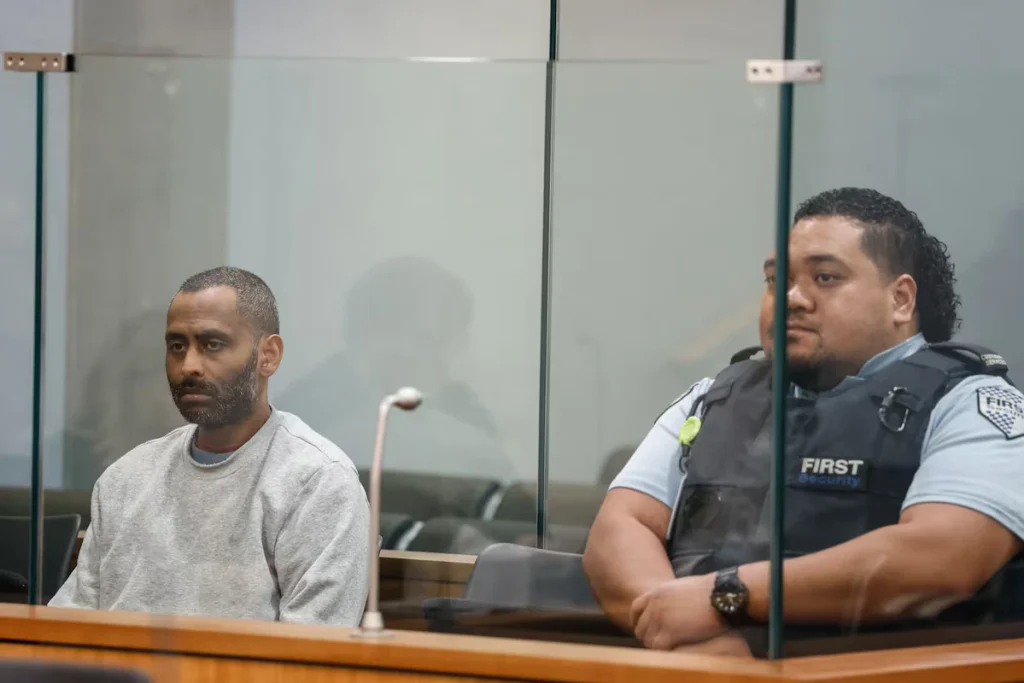
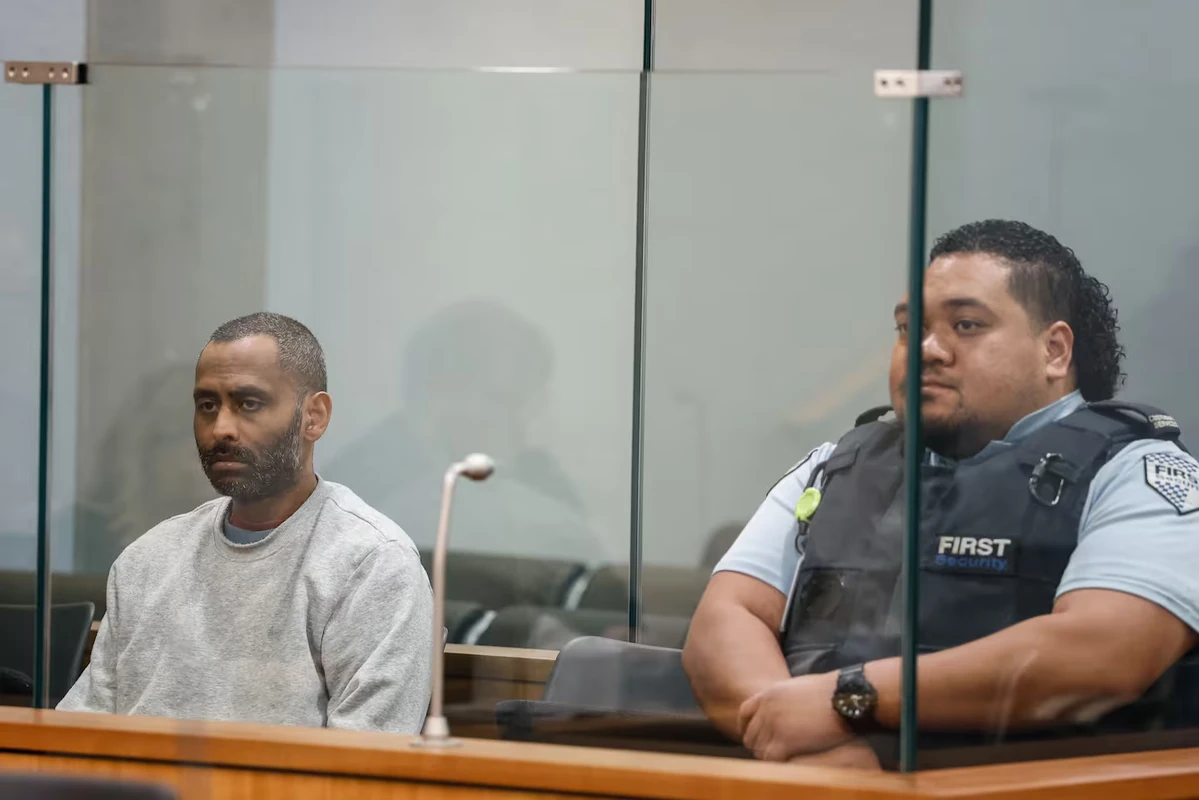
A man charged last month with double murder and attempted murder of a third person on Auckland’s North Shore can now be identified as Marc Anthony Govinden.
The alleged victims were his parents and his brother.
The 41-year-old declined to seek ongoing name suppression today during his first appearance in the High Court at Auckland.
During the brief hearing, Justice Mathew Downs set a trial date for next August and ordered mental health assessments. In the meantime, Govinden is being held at a secure psychiatric facility rather than jail.
Police initially responded to reports of a stabbing at a Birkdale address on the night of July 28. There, they found the defendant’s brother, who was reported as suffering moderate injuries. The defendant was also still there and was arrested.
After talking to Govinden, police conducted a welfare check at his parents’ house 5km away in Glenfield.
There they found Raman and Rooksana Govinden dead. Both were in their late 70s.
“This is an awful set of events,” Acting Detective Inspector Megan Goldie said at the time. “I know this will leave many in our community unsettled, but what I can say at this early stage of the investigation is that the offender and victims are all known to each other.”
Marc Govinden’s uncle, who lives in South Africa, said the family loved New Zealand for its safety.
He described his brother, Raman Govinden, as “a very private person” who wasn’t keen to share any troubling family matters when they’d talk on the phone.
“My brother was a true gentleman,” he said. “He loved his family. They were his priority.”
Raman Govinden has gone to medical school and “had high standards that he kept himself to”, the brother added.
“He was resilient and a fighter. It’s very tragic.”
He described the defendant’s mother as a “loving and caring woman” who had battled cancer earlier in life – resulting in a large age gap in her two sons. He recalled her being worried about safety when the couple visited him in South Africa a little over a decade ago.
It was quite the opposite in New Zealand, he recalled Rooksana Govinden telling him.
“She told me she could leave her house unlocked and just go to the beach,” she recalled.
The defendant’s case is set to be called again at another brief hearing in October. x1200
2026.8.13 Waikato woman Alka Dahiya sentenced for ‘extraordinarily brutal’ knife attack on toddler
Faced with the “stresses and strains” of moving to a new country, a woman carried out the “unthinkable” by attacking a toddler with a meat cleaver.
Alka Dahiya then harmed herself before calling for help.
The victim, who is known to Dahiya but has automatic name suppression, suffered numerous injuries in the attack, including wounds to his neck.
Today, Dahiya appeared for sentencing in the High Court at Hamilton, where she lost a bid for permanent name suppression.
She faced a charge of attempted murder after the attack in Ngāruawāhia on July 16, 2024.
In fighting for a sentence of home detention, her lawyer Richard Barnsdale told Justice Mathew Downs that Dahiya was under many stresses and strains at the time.
He said she had moved to a “strange country” and was learning a new language, which led her to do “the unthinkable”.
The court heard it all unravelled on the morning of the attack, when Dahiya grabbed a large meat cleaver, chosen because it was the sharpest she owned.
She then sat the victim on a yoga mat.
After attacking the boy with the knife, he became unresponsive.
She then harmed herself.
The toddler suffered multiple knife wounds to the neck, including deep lacerations requiring medical treatment, and injuries to his face and wrist.
He also suffered a subconjunctival haemorrhage, caused by either strangulation, suffocation or sustained neck pressure.
Justice Downs said the victim might have suffered a brain injury that could have lasting impacts on learning and behaviour.
“Unsurprisingly, he suffered significant scarring to his neck,” he said.
Dahiya told police she had intended to kill the boy.
She was admitted to Waikato Hospital’s Henry Bennett Centre that day, where clinicians believed she had an adjustment disorder and depressed mood.
Dahiya was given medication and released three days later.
No formal psychiatric diagnosis accompanied her discharge.
She pleaded guilty in July last year but then disputed several facts, including the extent of the injuries and the weapon used.
2026.7.25 ‘Simply beyond belief’: Pensioner jailed over $243k bus fare scam
An Auckland bus driver who dreamed up a sophisticated long-running fare scam that cheated his employer out of $243,000 has blamed his poor decision-making on mental health issues caused by passenger assaults.
Epsom resident Loganathan Manikum Pillay, 67, asked a judge for mercy last week as he appeared in Auckland District Court for sentencing.
He’s now a pensioner who drives an Uber part-time to make ends meet, but he’d be willing to pay $25,000 upfront out of his KiwiSaver and $2000 per month thereafter to slowly reimburse Ritchies, his lawyer said, arguing for 70% in sentence reductions so that his client could have a non-custodial outcome.
But Judge Kevin Glubb, during his last day on the bench before his own retirement, described the proposed repayment offer as “unrealistic” and “simply beyond belief” – especially given Pillay had already squandered all of the stolen fares at SkyCity Casino.
The judge instead ordered a prison sentence, declining to require reparation.
If Pillay wanted, after prison, to clear his conscience by contacting Ritchies and volunteering payments, he should “by all means” do so, the judge suggested. But he didn’t see it as a strong basis for substantially reducing the retiree’s punishment.
Pillay, who had been a bus and taxi driver for most of his career, was hired as a casual worker by Ritches in 2024 to operate one of four buses on the company’s Skydrive route.
For a $20 adult fare, the buses haul passengers directly between SkyCity in the city centre and Auckland Airport. Customers can book tickets online, pay cash or use an Eftpos machine as they embark.
In February last year, Pillay purchased his own Eftpos machine. He registered it under the name “Skydrive”, but all payments went to his own bank account. The scheme worked so well that he repeated it more than 11,500 times over eight months.
He was finally caught after a customer contacted Ritchies about an overcharge and staff were unable to find any record of the transaction. The customer provided a receipt with the terminal number, which after an internal investigation was traced back to the defendant.

A body has been found in the search for missing woman Wolvnie Ding, Auckland police say.
Wolvnie, 20, was last seen walking along Birdwood Rd in Swanson at around 8.20am on July 17.
Police and search teams recovered a body in the Swanson area yesterday.
“While formal identification processes are still underway, police believe the body is that of the missing 20-year-old,” Detective Inspector Megan Goldie said.
“Police extend their deepest condolences to the woman’s family at this incredibly difficult time.”
Family members had been informed and were being supported by police, Goldie added.
“Police would like to thank those who assisted in search efforts.”
Wolvedi’s death would be referred to the Coroner.
2026.7.24 The ‘Hollywood drug’: Why cocaine is gaining ground in New Zealand
2026.7.24 ‘You will be forgotten’: Anger as man who killed Nelson officer jailed for at least 22 years
2026.7.21 Police send in ‘public order teams’ after increase in late-night violence
2026.7.18 Hawke’s Bay slaver, trafficker denied parole
The first New Zealander convicted of slavery has been denied parole for a fifth time, after threatening to “f**k up” a fellow prisoner.
2026.7.16 She had a transplant, ended up on the streets, and died aged 47
Tormented by transience, Caitlin McDonald’s life was as fragile and fleeting as the butterflies she saved from the street. Surviving less than two years homeless in Christchurch, she chronicled her journey in hundreds of YouTube videos filmed on her phone. Jean Edwards reports on her tragic metamorphosis from radiant spirit to rough sleeper, dead at 47.
2026.7.16 Whangārei jury convicts Audrey Thompson of murdering Arthur Tahere
2026.7.7 Red Fox Tavern murder convictions overturned by Supreme Court, James Henry Wilson named
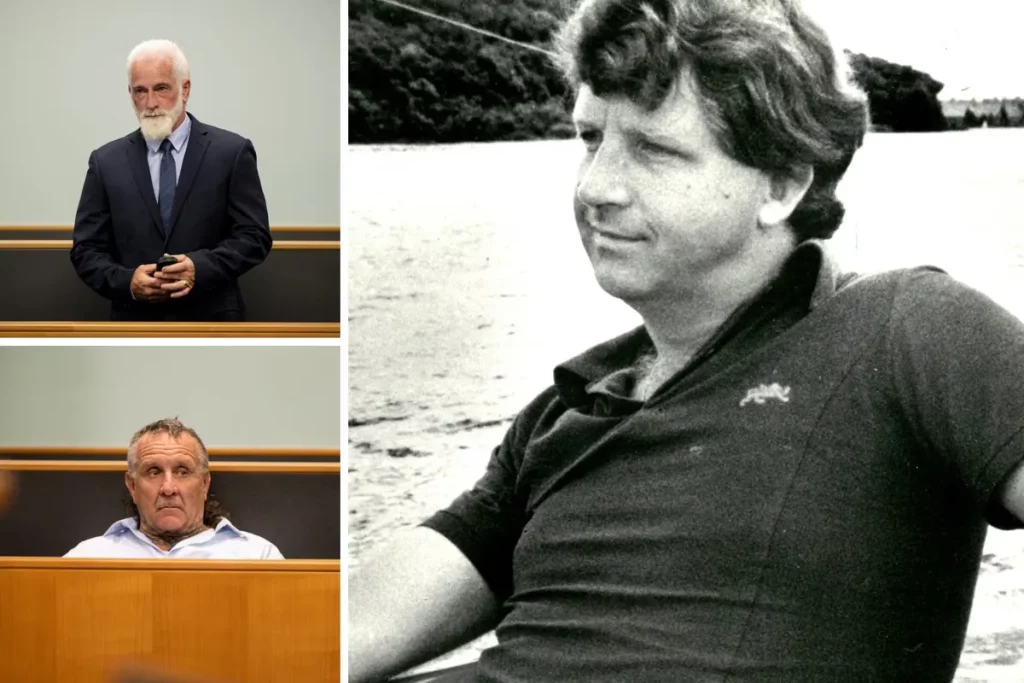
Two men jailed for the nearly 40-year-old cold case killing of a publican have had their convictions tossed out by the highest court in the land.
And one of those now free men, James Henry Wilson, can finally be named after a sustained bid to keep his name secret.
Wilson and Mark Joseph Hoggart were accused of shooting Chris Bush during the armed robbery of the Red Fox Tavern in Maramarua during Labour Weekend in 1987.
They spent seven weeks in the High Court at Auckland in 2021, on trial for Bush’s murder.
The Crown argued Wilson and Hoggart were the two heavily disguised robbers who burst in through a back door of the tavern as Bush and other staff members enjoyed a drink after closing the bar shortly before midnight on October 24.
The defence argued the circumstantial evidence was weak or unreliable and the jury could not be satisfied of guilt beyond a reasonable doubt. They also argued there was a possible alternative suspect.
The trial judge, Justice Mark Woolford likened the circumstantial case to a rope when summarising for the verdict, stating that any one strand alone might not support weight, but all strands combined could, he said.
A jury ultimately found the pair guilty of murder, but the men fought their convictions all the way to the Supreme Court.
One of their arguments in appealing centred around whether the verdicts were reasonable.
In a decision released today, Justice Sir Stephen Kos KC said the Crown failed to establish the necessary standard of proof to find either accused guilty during the trial.
It also failed to prove the shooting wasn’t caused by a third possible suspect, Lester Hamilton, who has since died.
“Standing back, our assessment is that the evidence against Mr Hamilton is of much the same order as that against the appellants,” the justices wrote.
In coming to that decision, they set aside the men’s convictions and entered judgments of acquittal. There will not be a retrial.
‘The fatal armed robbery’
The men were charged with murder in August 2017, nearly 30 years after Bush was shot dead inside the Red Fox Tavern in the Waikato village of Maramarua.
Bush had been enjoying a drink with his staff after closing the bar on the side of State Highway 2, when two masked men entered the bar just before midnight.
Armed with a sawn-off shotgun and a baseball bat, one of the men shot Bush when he challenged them.
The three staff were tied up and the two intruders made off with around $36,000 from the safe.
The case remained unsolved until the late Detective Inspector Gary Lendrum, who worked on the original Red Fox inquiry as a young officer, reopened the file as the most senior detective in Counties Manukau.
The following year, Wilson and Hoggart were charged with murder and then convicted in 2021.
The Crown case was that Wilson pulled the trigger.
Both men were sentenced to life imprisonment.
Despite the convictions, suppression remained in place for Wilson as he battled to overturn his convictions.
In May 2023, the Court of Appeal firmly rejected his appeal on various legal and evidential grounds.
“When viewed cumulatively, the strands of evidence relied upon by the Crown created a convincing case against Mr Wilson,” the appeal court stated.
The three-judge court also lifted the name suppression order, but it remained in place while Wilson exhausted his legal options.
That ended today when the Supreme Court allowed his application to overturn the Court of Appeal’s findings.
The ruling means the Herald can now reveal Wilson’s extensive criminal history – which includes another murder conviction.
In 1999, Wilson was the president of the Filthy Few motorcycle gang in Tauranga.
Better known in the criminal fraternity as “Little Willy”, he shot and killed his former girlfriend Jo-Anne van Duyvenbooden in her own home, before dumping her body a few hundred metres down a slope outside the cottage she lived in.
Two years later, Wilson was convicted of murdering the 32-year-old after a fellow member of the Filthy Few gave evidence against him.
Red Fox: ‘A miscarriage of justice’
In the Red Fox prosecution, the Crown had to establish that the evidence placed Wilson and Hoggart at the crime and that Hamilton wasn’t involved.
“We consider the Crown case failed to establish either to the required standard of proof,” Justice Kos wrote.
Wilson’s counsel, Christopher Stevenson, successfully argued that the inability to use evidence from Hamilton’s neighbour, which he likened to a confession, was a breach of his client’s fundamental right to present a defence.
Justice Kos agreed and said the trial judge was wrong not to allow that to happen, and subsequently ruled five other aspects of evidence from the Crown witnesses inadmissible.
That included a woman noticing a car scoping out the Red Fox on the Friday of Labour weekend, two women’s evidence about the accused’s arrival at their home in the early hours of Sunday morning, a glove – a print of which was found on the safe, a grassy shoe print found inside the tavern near the back door, which the offenders entered.
Wilson and Hoggart’s account of where they were that weekend was also dubbed as “lies” by the Crown.
Kos said that evidence should not have been legitimate parts of the Crown case.
“The jury should not have been asked to consider them as lies to conceal guilt.
“It is true that the issues with the evidence … and discussed in detail … could have led the jury to disregard it or to give it minimal weight.
“The jury may also not have relied on the ‘lies’.
“There nevertheless remains a risk that the jury did rely on the inadmissible evidence and on the lies, and this means there is a ‘real risk that the outcome of the trial was affected’.”
That meant “relatively few strands” were left directly related to the Red Fox, and that there was a risk that the jury considered the evidence directly linking the appellants to the Red Fox to be indispensable to its conclusion and, without it, would not have reached guilty verdicts.
“This constitutes a miscarriage of justice,” Justice Kos wrote.
The judges found that certain evidence should not have been admissible, which meant “the outcome of the trial may have been different without that evidence”.
The court also concluded that, while a reasonable jury could have come to the view that the Crown had excluded the reasonable possibility of Hamilton being one of the offenders, they came to that view through inadmissible opinion evidence of Detective Senior Sergeant Hayward.
“There was thus a miscarriage of justice on both of these grounds, and the appeals must be allowed.”
‘A 30-year plus delay’
Justice Kos said a lengthy delay in deciding to charge an offender was not necessarily an issue if there was sufficient evidence to charge an accused.
“And I have concluded … that there was.
“The real issue is whether the delay has an effect on the reasonableness of the verdicts.”
However, the judges found that although the lengthy delay exacerbated “many” evidential deficiencies given witnesses had died or faced memory issues, a reasonable jury could still have reached guilty verdicts on the remaining admissible evidence.
Lester Hamilton
The decision stated that Hamilton, like the now-acquitted men, had a possible motive to commit the offending, which was to finance his drug habit or a heroin importation plan.
He’d also made detailed plans to rob the Red Fox and possibly carried out a scoping visit about two and a half weeks beforehand.
His plan also included the use of a shotgun and to shoot anyone who resisted.
Hamilton had also confessed his involvement to numerous associates.
The court found that because of the similarities between the evidence against Hoggart and Wilson and that against Hamilton, a verdict of guilty against them “could not have been reasonable unless the Crown had excluded the possible involvement of Mr Hamilton beyond reasonable doubt”.
Wilson’s lawyer said evidence from a neighbour of Hamilton who said, “Well the stupid bastard shouldn’t have moved”, when talking about the Red Fox case, was a statement of confession.
The neighbour was not a criminal, did not know the appellants and had no incentive to be anything but truthful.
The exclusion of the neighbour’s evidence was a breach of Wilson’s “fundamental right to present an effective defence” as it deprived him of the opportunity to call the only living witness without a criminal history or connection to anyone in the case who could say that Hamilton had confessed.
The Supreme Court agreed, stating the trial judge was wrong to have excluded the neighbour’s evidence.
‘The different conclusions reflect the complexity’
Detective Superintendent Dave Lynch said today the offending at the tavern was “a tragic event that resulted in the death of Mr Bush and had a profound impact on his family, friends, staff members who were present, and the wider community”.
“We recognise that today’s decision will be difficult for many people connected to the case, particularly Mr Bush’s family, who have lived with the consequences of this crime for almost four decades.
“The investigation into the Red Fox Tavern robbery and homicide was extensive, spanning many years and multiple investigative reviews.
“Police remain proud of the dedication and professionalism of the investigators who worked tirelessly to seek answers on behalf of the victim, his family, and the community.”
Lynch said the decision didn’t diminish the seriousness of the offending or the commitment shown by investigators over many years.
“Police undertook the prosecution based on the evidence available and in accordance with our obligations under the criminal justice system.”
Police respected the court’s decision and would “carefully review the judgment”.
“The differing conclusions reached by the High Court, Court of Appeal and Supreme Court illustrate the complexity of the evidential issues considered throughout these proceedings.”
—
2026.6.29 Auckland cult leader guilty of killing follower, desecrating body, witness tampering
Jurors have rejected the arguments of an Auckland cult leader and his family that it was “well-intentioned ignorance” and “panic” – not foul play – that led to the corpse of a 70-year-old house guest being dumped near a North Shore harbour two years ago.
Kaixiao Liu, a semi-celebrity in China who moved to New Zealand in 2017, now faces up to life imprisonment after he was found guilty of five charges: kidnapping, manslaughter, attempting to pervert the course of justice, misconduct with human remains and refusing to give police the access codes to his electronic devices during the second search warrant at his Ōrewa home.
His wife, Lanyue Xiao, was found guilty of kidnapping, manslaughter, misconduct with a corpse and attempting to pervert the course of justice. His mother, Dr Xiuyun Li, was found guilty of kidnapping and his father, Jinghui Liu, was found guilty of misconduct with a corpse.
Jurors in the High Court at Auckland deliberated for 11 hours over three days following lengthy closing addresses that took up the first half of the week. They were unable to reach verdicts on three charges: a manslaughter allegation against the cult leader’s mother and both kidnapping and manslaughter charges against the mother.
Justice Mathew Downs set a sentencing date for August.
The sect leader and his wife were arrested in June 2024 at Auckland Airport as they prepared to leave New Zealand for what was described as a short round-trip visit to China. But the investigation had begun three months earlier when a fisherman discovered the body of Shulai Wang wrapped in rubbish bags and floating in Gulf Harbour off the Whangaparāoa Peninsula.
It would take months for police to identify Wang, a Chinese citizen who had overstayed her visa after arriving in New Zealand in August 2023. But the serial numbers on two rice bags filled with rocks that had been used to weigh Wang’s body down eventually led police to Liu and his family.

2026.6.5 Gulf Harbour trial: Defendants’ ‘unconventional’ lives revealed
The content of numerous documents found at a house in the centre of a police investigation into the death of Chinese woman Shulai Wang was heard in court.
It contained revealing details of the “unconventional” lives of residents of the house, including residing women pledging their souls and bodies to a defendant, and what happened in the days before and after Wang’s death.
Black rubbish bags containing a human body were found at the Gulf Harbour Marina in March 2024, and the police later confirmed that it was 70-year-old Wang from China’s Hainan province.
Four family members – Kaixiao Liu, his wife Lanyue Xiao and his mother Xiuyun Li and father Jingui Liu – have each denied the manslaughter and kidnapping of Wang and were facing trial at the Auckland High Court.
The defendants chose to represent themselves, with the assistance of standby lawyers.
The Crown’s case was that Wang came to seek religious instructions from Liu but was locked up in a tent, denied food and medical help after failing to observe rules at Liu’s house, where she stayed.
The Crown also claimed that she might have been put into a suitcase after an unsuccessful escape and later died.
A large number of notes, handwritten in Chinese, were found at the defendants’ house in Orewa, north Auckland, which was translated into English by experienced translator Cyril Young.
Judge Mathew Downs reminded the jury that the notes will be talking about the family’s religious beliefs and living arrangements which can be described as “unconventional”.
He urged the jury to be careful not to allow any emotional reaction to affect their decision-making.
“The defendants are not on trial for their religious beliefs or living arrangements; they are on trial for specific alleged offences,” Judge Downs said.
‘Unconventional’ life
The notes included “Letter of Conversion”, “Covenant”, “Convenant of the soul” and “Convenant of the Body”.
The Crown said earlier that Liu was the head of a religious group, where he was referred to as “Lord”, “Master” or “Teacher”, and Xiao was referred to as “Queen”.
Apart from Liu’s family, the police also found five other women living in the same house, whose names were suppressed by Judge Downs.
The women were described as “very thin” and dirty, who were later deported after overstaying their visas.
One of these women started a “Letter of Conversion” addressing “dear ancestors of the tribe of Judah, descendants of David”.
“I’m grateful to have the opportunity to be converted to the secret LIU family of the tribe of Judah, descendants of David,” the letter said.
In another note titled “Covenant of the Body”, the same woman wrote “I … am willing to enter a mutual love relationship with Mr. KL, build a family and have children with him”.
“I will also love the other few women and be loved by them,” the note said. “I am doing these out of my own free will.”
Same notes titled “Covenant of the Body” were also written by two other women found at the house.
In a notebook where fingerprint of Wang was found, it said “I am grateful to the Lord and the messengers for their unfailing love for La” – the Crown identified “La” as reference to Wang.
“They have always had mercy on La’s arrogance and patiently helped La step by step to stay away from evil and temptation. Leading La to the next station.
“La is very happy. These past few nights, La has felt happy from the heart.”
In another note, “La” wrote “thank you Master for leading the family, young and old to work together to be tested and tempered … Striving hard to get lives ready to go to the next stop/station”.
Earlier on Thursday, the court also heard a note talking about the establishment of a “kingdom” and having “many servants”.
Before and after Wang’s death
Wang’s given name was mentioned multiple times in some notes documenting the day-to-day lives of the household, to including pick and wash vegetables, turn over soil, watering, and childcare.
Some of the notes mentioned that Wang was not kneeling properly or eating too slowly, and someone’s face being struck.
In a note with Liu’s father’s given name that dated March 3, 2024, it said “Shulai’s swollen face couldn’t have been faked”.
“Shulai did not kneel down upright, as requested, yesterday and this morning. Still did not kneel upright after being reminded by family members,” the note said.
It went on to say that she could pretend and be unwilling to accept help, or due to physical strength and illness.
There were also notes talking about Wang being asked to squat, with the help of other women.
Crown identified “Ya”, an author of some of the files, as Li, who kept daily notes about behaviour of the women in the house.
The notes appeared to be recording the good or bad behaviours of women staying at the house and add or deduct points to them accordingly.
There was a note mentioning a tent and a padlock.
“If Shulai was reminded for the first time and did not listen, and Shulai was reminded for the second time and didn’t listen, it will directly affect the following meal,” crown prosecutor Henry Steele read out from a note in court.
“We’ll be back in the home sooner if you follow the rule sooner. It is uncomfortable in the tent. There will be heavy rain in the next few days.
“If you follow the rules, several days in a row, you will receive treatment immediately. Definitely can’t come in under the situation.”
In a note dated March 6, it said that one of the women “called out urgently” as Wang had run to the neighbour’s yard, and a few other people at the house were also notified, including “the Master”.
“With the cooperation of the family, Sulai [Shulai] was quickly carried from the neighbour’s yard into the south yard,” it said. “It was so fast that no passers-by seen.
“Sulai [Shulai] listened to the evil thoughts in her own mind and led herself to destruction step-by-step.”
Some women were awarded points for bringing Wang back and put her under control, a note showed.
Bits and pieces of information on the same date on another note also mentioned that someone being placed on the little black bed to make them repent.
And a note said: “as long as you scream again, you will be tied even tighter, If you scream at night again, you will be put into the suitcase”.
On the afternoon of March, there was “no movement”, the same note said.
Another note dated March 8 talked about rubbish bags, “get rid of the gas/air” and put something to cover it in the boot.
“Remove the clothes … just leave a layer of under clothes,” the note said.
“Need to use two bags, in case one is not enough, 2 bags, 3 bags are fine…”
On the same date, Wang’s name can no longer be seen in the same type of note that record the women’s daily performances, Steele pointed out.
Also on the same date, some women were awarded points for doing a good job cleaning the garage. A note said that two women cleaned the garage for three hours.
A reminder to ‘smile foolishly’
Police earlier identified the garage as an area of interest and was tested for blood, although four small areas had a positive reaction, further testing for blood was inconclusive.
A note reminded people to just “smile foolishly” and not say anything and avoid driving the big white van.
Steele also pointed out notes mentioning the family seeing news of the discovery of the rubbish bag in water.
A note dated March 27, 2024, apparently written by Liu’s father, mentioned concerns about “something happening to God’s family”.
“When you think I am useless and you don’t need me, just like sending me to the airport, send me to the No. 1 bridge and give me two bags of stones,” the note said.
“I’ll walk into the sea by myself.”
Another note followed by entry dated April 16 and 17 mentioned “remember the lesson of that dead person”.
“We wanted to be good to her, but we clashed, we mutually/would mutually wanted to kill,” the note said.
“But she on her own definitely wouldn’t be able to kill us, so it will definitely be her who dies.”
Earlier in court, Xiao reminded the jury to be careful about how they interpret the evidence.
The trial continues at the Auckland High Court and cross-examination from the defendants were expected on Monday.
2026.6.2 Gulf Harbour body trial: Woman’s body weighed less than 26kg
The body of a woman who was found wrapped in rubbish bags in Auckland’s Gulf Harbour weighed just under 26 kilograms, a High Court jury has heard.
A forensic pathologist who conducted the post-mortem on the body, Dr Kilak Kesha, has been giving evidence in court about the death of 70-year-old Shulai Wang.
The Crown earlier said it believed Wang likely died on March 7, 2024, days before her body was discovered by a fisherman on March 12.
Kesha said the post-mortem, completed the day after the discovery, found the body measured 160cm in length and weighed 25.6kg.
He said the body was moderately decomposed and he couldn’t confirm the time of death.
A body loses weight during decomposition, and he couldn’t be sure how much it would’ve weighed at the time of death, Kesha told the jury.
The Crown’s case is that Wang travelled to New Zealand from Hainan Island in China to seek religious instructions from Kaixiao Liu in August 2023, and that she was one of six women who stayed with Liu’s family at their Ōrewa home.
Kaixiao Liu, his wife Lanyue Xiao, and his parents Xiuyun Li and Jingui Liu have each denied the kidnapping and manslaughter of Wang.
The Crown said Wang was starved and punished for breaking the rules of the group, and bound in tape after a failed attempt to escape.
Kesha said the body had bruising on its arms and wrists, parts of the face – around the eyes and cheeks – and on the back of the head, which he believed would have been caused by blunt force trauma prior to Wang’s death.
He said if Wang was alive when she was bound, she would’ve died during the process of being bound into a foetal position with rice bags of stone bound to her chest and abdomen – as she wouldn’t have been able to breathe.
Asked by Crown prosecutor Henry Steele how he’d describe the weight of 25.6kg for a person of Wang’s height, Kesha said the body loses weight during decomposition and he thought the person was small to begin with.
“There was no evidence of prolonged chronic weight loss,” he said.
Kesha said the cheek bones were not prominent, her hair and nails were not brittle, and her teeth were in good condition.
Asked how long it would take for symptoms of weight loss to manifest in someone’s teeth, Kesha said several months.
Asked about the blunt force trauma, Kesha said there was no pattern to the bruising and he couldn’t identify the object that resulted in the bruising.
Kesha said an abscess was found in the abdomen area, but that wouldn’t have caused the death.
Xiuyun Li’s standby lawyer Philip Hamlin asked Kesha during cross-examination whether some of the bruising could have resulted if the woman had slapped herself very hard, to which Kesha said yes.
Hamlin asked if the woman had fallen from a fence, whether that could have caused bruises to her face and head.
Kesha said yes, if it was a hard surface.
Kesha said there were no fractures found on the body.
Earlier, the court heard from the Crown’s opening that the defendants kept detailed diary entries and recordings of their daily lives, including what happened to Wang.
The Crown said the evidence showed a story was concocted to explain Wang’s death.
It said the story evolved from a suggestion that Wang was a traitor and a threat, and that she’d killed herself.
The Crown said Kaixiao Liu told others on March 10, 2025 that, if they were asked to explain events, just say she fell and died, and was wrapped up and buried at sea.
2026.5.29 Gulf Harbour body trial: Grandmother denied knowing dead woman
A jury has been told that a grandmother, who is one of the four charged over the death of Shulai Wang, had told police in an interview she didn’t know the woman, and that other “homeless ladies” lived in their house.
The bruised body of the 70-year-old from Hainan China was found in the water at Gulf Harbour two years ago.
The body was wrapped in plastic bags and bound to two SunRice bags that together contained over 15 kilograms of stones.
Xiuyun Li, 63, who’s facing trial for kidnapping and manslaughter, alongside co-defendants – her son Kaixiao Liu, her daughter in law and her husband – told a detective she had not heard of the name Shulai Wang.
The court earlier heard that immigration records showed Li practised as a doctor in China for 37 years.
The Crown said Wang, and five other women from China, sought religious instructions from Kaixiao Liu and lived “in servitude” to his family in their home in Orewa.
The Crown’s case is that Wang was starved for breaking the rules of the house, and later bound in tape after a failed attempt to escape the house.
All the defendants are self-represented in the trial.
The police interview
On Monday, Li’s standby lawyer Philip Hamlin told the jury that Li spent her time looking after her four grandchildren and barely had any contact with Wang.
On Friday, the jury heard details of Li’s first interview with police following a search of the family’s home on Harvest Avenue, after Kaxiao Liu and his wife were arrested at the Auckland Airport.
Li was not facing any charges at the time and Detective constable Junfan Luo said Li was interviewed as a witness.
The jury was told in a statement read out by Crown Prosecutor Henry Steele and confirmed by Luo, that she was aware that a female body was found on March 12, 2024, and that her son had been spoken to by police.
The statement said Li had nothing to tell police on that matter.
Luo confirmed that when he showed an image of Wang to Li, Li said she didn’t know her and had never heard of this name.
Luo also confirmed that when he showed Li photos of clothes worn by Wang when her body was found – a singlet and blue pyjama pants – Li said she had no idea of these clothes.
Li told police there were five “homeless ladies” in the house and that they did their own laundry, which Luo confirmed after being questioned by Steele.
Li’s statement to police said that the homeless women were brought home at different times by her son and her daughter in law.
When shown images of stones found on Wang, Li said she recognised similar kinds of stones at their house, possibly in the front yard.
Li also told police that her family purchased 10 kilograms of SunRice, as the 25 kilogram packs were too heavy to carry.
Her statement said because there were lots of people living in the house, 10 kilograms of rice lasted them three days.
Li’s standby lawyer Philip Hamlin asked Luo if he’d been taken to Li’s bedroom in the Orewa house during the search of the house in July 2024.
Luo said he didn’t remember.
On Monday, the court heard from Crown Prosecutor Emma Kerr that Li had written in a diary entry about five days before Wang’s body was found in the harbour “there was no more sound coming from her”.
Hamlin told the jury on Monday that Li had no intent to kidnap Wang against her will.
“She had no intent to not look after Ms Wang, or to deprive Ms Wang of the important things in life”.
Hamlin said Li did not hurt Wang.
Police told person in house fell and died
A woman who lived with the defendants told police a person in the house fell and died.
On Friday, the jury heard more evidence about one of the women who lived with the defendants, whose revelation of a person “who is no longer here” had led police to identify Wang.
The woman was among the five women in the house who detectives earlier described as “very thin”, tired and smiling with their hands clasped in prayer, refusing to engage with police.
The identities of the women have been suppressed by Justice Mathew Downs.
The court earlier heard that the woman described other people in the house as her friends.
During Kaixiao Liu’s cross-examination of detective constable He Gong, who’d helped take notes of another detective’s interview with the woman, Liu asked what the woman’s exact words to police were.
Gong said the woman said: “I didn’t look after he or she well, he or she fell over and passed away… it’s nothing to do with my friends”.
Gong said the gender of the person referred to was not specified.
Liu asked if Gong had told the woman that she’d be deported.
“No I didn’t,” Gong said.
On Wednesday, the court heard from an immigration officer that the five women had all overstayed their visas by more than 42 days and had no right to appeal deportation.
They were all deported in August 2024.
The trial continues.
2026.5.27 Gulf Harbour body trial: Accused seeks return of deported women
The leader of a religious group who is one of four people accused of the kidnapping and manslaughter of Shulai Wang, has asked an immigration officer in court whether they can help bring to trial other Chinese women who had lived in his home and were deported.
Kaixiao Liu, his wife Lanyue Xiao and his parents Xiuyun Li and Jingui Liu have each denied the kidnapping and manslaughter of Wang.
They are all self-represented in the trial, accompanied by standby lawyers.
Wang’s body, wrapped in layers of rubbish bags, was found by a fisherman in the waters of Auckland’s Gulf Harbour on 12 March, 2024, eight months after she entered the country.
The Crown said Wang, aged 70, was one of six women who came to New Zealand to seek religious instructions from Kaixiao Liu and lived “in servitude” to Liu’s family in their home in Orewa and called Liu “the lord”.
The Crown earlier said the other women refused to talk to police, and immigration officers told the court that police did not oppose the deportation as the women were no longer needed for the investigation.
It argued that Wang was starved and punished for disobeying the rules of the group and subsequently bound in tape after a failed escape attempt.
On Wednesday, the jury heard that the five other women in the house, also known as the “Ark”, had overstayed their visas when they were discovered by police during a search warrant on the defendants’ home on Harvest Avenue in July 2024.
Crown witness and immigration officer Alexander Ballerau told the jury that the five women were all Chinese citizens and were all unlawfully in New Zealand at the time.
Two of the women’s last date of arrival in New Zealand was January 2020. The other three arrived in 2023.
Ballerau also said that the five women did not speak during their individual interviews with immigration officers and neither did they engage with Mandarin interpreters.
He said three of the women “simply smiled” throughout the interview.
Earlier, the court heard from Crown Prosecutor Emma Kerr that, apart from initial comments, the five women refused to engage with police.
Ballerau said the women were all deported in August 2024.
Asked by Kerr if police were content with the deportation and that the women were no longer needed for the investigation, Ballerau said yes.
During Kaixiao Liu’s cross-examination of another immigration officer, Mohammed Arour, he asked if the officer had any way to “help those ladies come to the trial, because they want to”, adding that it was for “open justice” and the “search of truth”.
He was interrupted by Justice Downs who told him he could not assume in his questions what other people were thinking, and he was urged to rephrase his question.
Arour said the Immigration Minister could over-ride the five-year prohibition that prevented a deported person from re-entering, and that could be applied for through an immigration adviser or lawyer.
Liu asked if it could be done within three weeks, to which Arour said he could not answer that.
Liu’s wife Xiao cross-examined Ballerau on the deportation of the five women.
She asked if they were told about their right to appeal the order, to which Ballerau said that right expired 42 days after the expiry of their visa and they had all overstayed beyond that time limit.
Xiao’s standby lawyer Quentin Duff asked Ballerau if overstayers involved in criminal proceedings would be allowed to stay.
Ballerau said that was correct and that it also applied to witnesses.
Duff asked if the decision to deport the women was discussed with police investigating Wang’s death.
Ballerau said immigration, not police, made deportation decisions. “However, when police advise they’re no longer of interest, we are free to proceed with our processes”, he said.
The trial continues.
2026.5.26 ‘Wrapped in duct tape and folded in half’: Officer recounts gruesome floating bag discovery
One of the first officers at the scene on the day an unidentified body was found wrapped in plastic recalled today how she held on to the gruesome find for about 30 minutes to prevent it from being swept away by the tide.
“I could see a human hand … and what seemed to be a human body folded in half,” Constable Chelsea Cruickshank told jurors during the second day of the manslaughter and kidnapping trial of accused religious sect leader Kaixiao Liu and his family.
Kaixiao Liu, his wife Lanyue Xiao and his parents Xiuyun Li and Jingui Liu have all pleaded not guilty. They’ve opted to represent themselves during the trial, which is scheduled to take up to seven weeks in the High Court at Auckland.
The body discovered in the water that morning was eventually identified as 70-year-old Chinese citizen Shulai Wang, who prosecutors said flew to New Zealand to receive religious instruction from Kaixiao Liu while living at his Ōrewa home with five other women who had immigrated from China for similar purposes.
The sect was called “The Ark” and Wang had somehow found herself targeted after joining, prosecutors said during their opening address yesterday.
The alleged punishments included locking her in a tent at the property, physical discipline, withholding food and being called “evil” by Kaixiao Liu.
Prosecutors have said detectives connected Wang to the group via two 10kg SunRice bags that were filled with paving stones and recovered with her body. The serial numbers on the bags were traced to an Albany Pak’nSave, where it is alleged Kaixiao Liu purchased the rice weeks before the body was found.
In court today, Cruickshank explained how she had been directed to the scene after a fisherman called 111. He had torn a roughly 15cm hole in the bag to see what was inside but abandoned the effort after noticing Wang’s hand.
“He pointed down to the rocks to us, where he had caught the bag with the human hand,” she testified. “The black rubbish bag was half in the water and half caught on the rocks.”
Wanting to disturb the scene as little as possible, the officer waited 30 minutes for a boat unit to arrive with a stretcher to lift the discovery from the water.
“It looked as if the body was folded into the foetal position,” she said, adding that the body seemed to be bound in black tape and covered in plastic rubbish bags. “It was tightly secured around the body, almost like it was vacuum-sealed.”
Because he is representing himself, Kaixiao Liu was able to cross-examine the officer himself after prosecutors Emma Kerr and Henry Steele finished with their questions.
“Were you scared when you saw that scene?” the defendant asked.
The officer said she wasn’t. Although she’d never encountered a body in a bag before, she’d seen plenty of deceased bodies, she explained to him.
“Why did not other male colleagues do this for you?” the defendant followed up.
“Because I just did it. I didn’t mind,” the officer said.
The defendant asked about the positioning of the body, which jurors were handed photos of.
“It looks like they tried very hard to hide it, the way it was wrapped up in duct tape and folded in half,” the officer said.
Jurors also heard from North Shore resident Gareth Bennett, who had been walking his dog in the area at around 8pm the previous evening when he saw something floating in the water. It was black plastic and appeared to be partially submerged, with a corner about the size of two rugby balls exposed, he said.
“It aroused my suspicion,” he said. “I stopped and watched the object float away from the gully … for three or four minutes.”
He then went home but contacted police the following day after learning that a body had been discovered.
The trial continues before Justice Mathew Downs and the jury.
—
2026.6.2 Customs fights to name wealthy family member jailed over child sex abuse files
The member of a wealthy New Zealand family found with graphic and sadistic child sexual abuse material is fighting to keep his identity a secret as Customs urges a judge to lift permanent suppression.
Last August, the man was sentenced to two years and five months’ imprisonment after he admitted knowingly importing and possessing objectionable publications. He was also placed on the Child Sex Offender’s Register.
Judge Maria Pecotic granted him and the family business permanent suppression because of his mental illness and other reasons that cannot be reported.
At the High Court at Auckland on Tuesday, Crown Law lawyer Matthew Davie, acting on behalf of Customs, made submissions to Justice Michael Arthur about how post-conviction name suppression “ought to be exceptional”.
Justice Arthur reserved his decision.
2026.5.26 Texts tip balance as judge acquits husband in marriage rape trial
Warning: This story includes details of alleged sexual offending and may offend some readers.
A judge deciding a case of a man accused of raping his wife says the couple’s text messages supported the husband’s proposition that the relationship was a supportive one, albeit one that was unravelling.
Judge Noel Sainbury’s comments are contained in his reasons for the verdicts, which were released after a recent judge-alone trial in the Wellington District Court, where the man denied six charges of sexual violation and violent offending against his former wife.
During the trial, both gave evidence and conflicting accounts about their marriage of more than 15 years.
She described how the relationship had been rocky from the start but had descended into violence, threats to kill and rape.
He told the court it was a loving, mutual marriage, where they supported each other’s endeavours until the last few years when her mental health deteriorated.
Releasing the reasons for his verdict, Judge Sainsbury said the case turned on his assessment of the credibility and reliability of each.
Judge Sainsbury said that while he heard evidence during the trial of the wife’s PTSD, this didn’t make her evidence any less credible.
There was no evidence that mental illness caused hallucinations or, in itself, created false memories or delusions, he said.
The judge found she was an honest and reliable witness, and her account was plausible.
He also found that other witnesses gave evidence that supported the wife’s account, and her diagnosis of PTSD was consistent with her having suffered the type of trauma associated with the allegations.
“The possibility that this was an abusive, controlling relationship, in which the defendant offended against the complainant in the manner alleged, is an available conclusion on the evidence. But it is not the only available conclusion.”
The judge said the defendant’s evidence was also credible, and he couldn’t discount that it wasn’t true.
During the hearing, the defence provided hundreds of messages the pair exchanged on various forums, including Facebook, WhatsApp and email.
Judge Sainsbury said while he accepted the Crown’s proposition that the text messages didn’t necessarily reflect the true nature of the relationship, that wasn’t the general tenor of the texts.
“While mental illness does not make the complainant’s account less credible, there is weight in the defence position that the complainant viewed the actions of the defendant in a negative light that impacted her ability to be objective and impartial.
“That is also illustrated in her understanding and interpretation of the text messages. The complainant’s reading of the text messages did not fit with what they plainly said.”
Accordingly, the judge said he couldn’t exclude the reasonable possibility that the husband’s evidence was true, and he found the husband not guilty of all charges.
2026.5.24 Jailed South Auckland murderer Beant Singh, who killed his wife, Binderpal Kaur, fights deportation to India

A man behind bars for murdering his wife has tried to stop his looming deportation to India, claiming he would face harm and isolation on return because of his criminal actions.
Beant Singh was sentenced to life imprisonment, with a minimum of 10 years and six months, in September 2022, for killing his wife, Binderpal Kaur.
He strangled Kaur in their South Auckland home on September 20, 2020, after an argument.
The now-53-year-old pleaded guilty to the murder charge three weeks before he was scheduled to go to trial.
Singh had only been in New Zealand for seven years at the time of the killing, and was not eligible for parole until early 2033.
He was served with a deportation liability notice in April 2024 due to his conviction.
That same month, he lodged an appeal against deportation liability on humanitarian grounds.
According to a recently released decision by the Immigration and Protection Tribunal, which considered the appeal, Singh wished to remain in New Zealand once released from prison.
“In essence, he says that, if he were to return to India, he would have no support from family, he would be isolated from the community at large because of the stigma his conviction will carry and he is at risk of being harmed by members of Binderpal’s family, who have threatened him and his family members if he goes back,” the decision summarised.
Feared she would be killed by husband
Shortly before Kaur’s death, she told family she feared her husband would kill her.
She said she had been kicked and slapped by Singh, and she showed photographs of earlier injuries, which she said were at the hands of her husband.
On the evening she was murdered, Singh arrived at a friend’s home in a distressed state.
He said Kaur was bleeding from her nose and he had not called an ambulance.
The friend assumed Kaur had experienced a medical event and, on the way to the couple’s home, the friend called an ambulance.
The ambulance arrived at 9.20pm and Kaur was pronounced dead shortly after.
Authorities said the exact circumstances of what led to Kaur’s murder were unclear, but it appeared an argument ensued that evening after Kaur called family in India.
The couple had attended temple together earlier in the day and gone grocery shopping.
At Singh’s sentencing, Kaur’s family told the High Court at Auckland they believed Singh had punished Kaur for not being able to have children.
Court documents echoed this, stating the couple’s inability to conceive was a source of tension in their relationship.
The court heard they had been married for 10 years and moved to New Zealand in 2013.
Their relationship was described as “volatile”, and the killing occurred in the context of domestic problems, aggression, possessiveness, assertion of control, and violence from Singh towards Kaur.
Killer fears he would be harmed in India
In his challenge against his deportation liability, Singh submitted that the claimed isolation, stigma and risk of harm he may face if he returned to India amounted to exceptional circumstances of a humanitarian nature.
He claimed he did not know why he killed Kaur and said his behaviour was wrong.
Singh said he accepted full responsibility, had “reflected deeply on his actions”, and he understood the consequences.
He claimed he has been compliant with all conditions of his sentence and has had no disputes with inmates or prison staff.
Singh told the tribunal he was “well settled” in New Zealand, no longer had ties to India, and it would be very hard to return there.
“The stigma of being convicted in New Zealand would make it impossible for him to find employment or accommodation. He would have nowhere to live, no work and no family support,” the decision stated, referencing Singh’s submissions.
The tribunal heard Singh’s parents have both died, and he initially claimed to have only one sibling, but conceded under cross-examination that in fact he had seven siblings, of whom two are deceased, and the other five live relatively close to his home village.
Singh alleged Kaur’s family had promised to avenge her death, and that “local gangsters” had threatened his brother that harm would come their way if Singh returned.
He provided the tribunal with statements of support from his brother, the leader of his home village, his former landlord and two former work colleagues.
The statements described him as hard-working, polite, honest and non-argumentative.
Immigration says stigma is inevitable
In opposition, a representative for the Minister of Immigration told the tribunal that while Singh would not, if deported, return to the life he had before, he retained significant ties in the village where he grew up and would have access to an adequate support system.
As to risk, if threats were made, they were made in the immediate aftermath of the death of Binderpal, when emotions were high.
“Anger would inevitably dissipate over time and the appellant has not established that he is genuinely at risk.”
There was no evidence Singh was at low risk of reoffending and he had not undergone any rehabilitation, it was submitted.
The minister’s representative argued Singh did not meet the high threshold for establishing exceptional circumstances of a humanitarian nature, nor would it be unjust or unduly harsh to deport him when the circumstances were weighed against his conviction.
After considering the submissions and hearing from Kaur’s family, who spoke of their ongoing grief and loss, the tribunal noted that Singh’s claim to face isolation if he returned to India was a central part of his appeal.
“It is clearly exaggerated,” the tribunal found, pointing to Singh’s failure to disclose he had more than one sibling.
“The appellant clearly withheld information about his family members to portray a misleading level of isolation upon his return.”
Singh spent 40 years in India, was familar with its society and customs, and has a sizeable extended family he could contact, the tribunal found.
“As to the question of stigma, no country information is provided about the impact of this within the appellant’s specific culture or in the area to which he will return,” the tribunal noted.
“In any event, the appellant’s actions in murdering his wife will attract stigma whether he is in this country or in India.”
The tribunal also ruled Singh had not established he was at risk of harm in India.
It noted that by the time he was released on parole, he would have spent a long time outside of India, but also away from the New Zealand community.
“The tribunal is satisfied that his primary nexus is still, and will remain, to India.”
In declining Singh’s appeal, the tribunal said the challenges he would face, including stigma and difficulty finding work, were an inevitable consequence of his conviction, not exceptional circumstances.
Singh remained liable for deportation once he was released from prison.
2026.5.24 ‘Really needed the money’: Burglars’ $1m spree targeted high-end jewellery, luxury brands
After a period of meticulous planning, Reice Tama Silbery and his alleged co-accused struck a series of homes with one main item in mind – stealing high-end jewellery and handbags.
That planning ultimately paid off for Silbery, the getaway driver, who, over five months, stole around $1 million in property from various locations around the North Island.
Silbery was a father of six and grandfather of one, and hadn’t appeared in court before this spree began in May 2024.
His counsel, Amin Osama, told Judge Noel Cocurullo in the Hamilton District Court that it was when his client discovered meth in his 30s that his life began unravelling.
A chance chat at the pub playing pokies resulted in him helping to steal tens of thousands of dollars’ worth of property from people’s homes.
On one occasion, two Rolex watches, handbags, and other jewellery were stolen from a Flagstaff house, worth approximately $100,000, while eight World War II medals were fleeced from a home.
Given Silbery had pleaded guilty to 37 burglary charges, he knew he was going to jail, but Osama was aiming for up to 60% in discounts in the hope of making that stint as short as possible.
‘Gold, silver, Gucci, Louis Vuitton, Rolex, Burberry’
The first house to be struck was on May 16, 2024.
Silbery drove his co-accused there and eventually made off with
a bag, a gold necklace, other jewellery, and coins.
The next day, they went to another home, andstole roughly $10,000 worth of jewellery.
For each of the 37 burglaries jewellery, cash, Gucci or Louis Vuitton bags or other expensive property was stolen.
The rooms were ransacked as drawers were rummaged through, and boxes and containers searched.
On September 4, the pair hit a house in a different location. When the family returned from the supermarket they found $75,000 worth of belongings – diamond rings and earrings, two Louis Vuitton handbags, a Gucci handbag, a Rolex watch, and a Burberry backpack – gone.
Police searched Silbery’s Huntly home on October 18, and found a plastic rubbish sack containing several valuable handbags in the roof cavity, a small amount of jewellery and some war medals around the house.
He said bags in the roof were not hidden – they were just stored there.
Silbery told police he thought something wasn’t right, but he “really needed the money”.
‘He wasn’t able to make rational decisions’
Silbery had earlier accepted a sentence indication from Judge Cocurullo of an eight-and-a-half-year jail starting point, with a 20% deduction for his guilty pleas.
Osama pushed for a further 40% in discounts for his drug addiction, remorse, attending restorative justice, previous good character, and the impact of a jail term on his children.
“Yes, he’s messed up in a colossal way, but it does not mean that before he did that, he wasn’t a person of good character.”
That was evidenced by the 17 character references from Silbery’s friends and associates in the community, employers, teammates from sporting teams, iwi, along with affidavits from whānau.
His father’s affidavit explained how Silbery’s meth and gambling addictions got so severe that he had to become the guarantor of his house to stop the bank taking it.
Osama said Silbery had a good start to life, and was gainfully employed through his 20s.
“His life started to become undone at the age of 30 when he started taking methamphetamine, and that led to a withdrawal from his community and family, and his isolation and severe addiction emerged to the point where he lost his job, and his partner left him.”
It was in that context that he met his co-accused, Osama said.
As for knowing his actions were wrong, that was overshadowed by his addictions, which hampered his ability to make rational decisions.
Since his arrest, Silbery had been trying to rehabilitate himself in custody, completing courses and getting himself a job in the prison’s kitchen.
“This is very serious offending. Yes, he was caught, but he has done everything right since then. He has expressed his remorse many, many times now.”
Judge Cocurullo said Silbery owed his victims reparation, but he couldn’t pay it, so he declined to order it, stating it would only re-victimise them.
He agreed to allow 50% in discounts, including 15% for his previous good character, and 15% for attending restorative justice, efforts at rehabilitation, and addiction.
Silbery was jailed for four years and three months.
2026.5.17 Judge backs public’s right to know serial child sex offender’s latest crimes
An 83-year-old recidivist child sex offender has been handed another prison sentence after unauthorised interactions with children.
Former teacher Lewis Payne Wells can now be identified after two unsuccessful bids for permanent name suppression in the district court and in the High Court at Auckland.
Wells has been offending against children since 2007, having started at the age of 64, according to court documents. He spent 20 years as a teacher before he was deregistered, but none of his victims were at his school.
His first sentence came in 2010 out of Auckland District Court, when he was ordered to serve four years and six months’ imprisonment for the repeated sexual abuse of an 11-year-old boy, whom he mentored and groomed over a two-year period.
“When he was spoken to in October 2009, Mr Wells said he knew the relationship was wrong and he had taken advantage of the victim’s naivety, but found himself unable to control his sexual desires and activity,” according to a summary of the case published in the High Court at Auckland in 2023.
He was charged again in January 2015 after two public health nurses spotted him grabbing the buttocks of a 9-year-old boy he had met on a footpath a month earlier.
A district court judge ordered a sentence of two years and three months, but it was later reduced on appeal to nine months’ home detention.
Another 9-year-old boy was victimised in August 2017 after he became separated from his aunt at a Briscoes store and was approached by the defendant. CCTV recorded as Wells touched the boy on and off for about 45 minutes, over his clothes.
He was sentenced for that charge in 2018 to six months’ home detention after the judge took into account the 10 months he’d already spent in custody.
Then, in June 2021, he responded to a Facebook community post and offered to tutor a 12-year-old boy – touting his past teaching experience but not mentioning he was on the sex offender registry.
The boy’s mother told Wells his services were no longer needed after a tutoring session in which he tickled the victim.
But he later showed up twice at the family’s home uninvited under the guise of asking about the child’s schoolwork. On both occasions, he groped the child’s bottom.
He was sentenced by the High Court at Auckland in April 2023 to one year and four months’ imprisonment for two counts of indecent assault. He also pleaded guilty to failing to comply with sex offender reporting obligations resulting from his secret Facebook account.
Later that year, the Department of Corrections went back to the High Court at Auckland, asking that Wells be subjected to interim and extended supervision orders. Both were approved.
Extended supervision orders allow authorities to impose parole-like conditions, including curfews and GPS monitoring, for up to 10 years after a sentence has been completed. It’s a measure reserved for high-risk, long-term offenders in an effort to reduce recidivism.
In a report prepared for the hearings, clinical psychologist Charlotte Gibson noted that Wells tended to reoffend about every two or three years, “typically coinciding with him completing his community sentence”.
It turned out to be a prescient prediction.
Wells’ most recent sentencing was in January, when Judge Rebecca Guthrie ordered him to serve 11 months’ imprisonment for having breached his extended supervision order in May and July last year when he had unauthorised contact with minors.
On the first occasion, he showed up at a neighbour’s house where an 8-year-old boy was riding a scooter in the driveway. The boy’s mother came out to speak with Wells after the child reported a stranger had arrived.
“During the conversation, Mr Wells engaged with and focused his attention on the boy, including asking how old he was and what part of the house he lived in,” court documents state.
“Mr Wells said he had noticed children in the property’s swimming pool. He wanted to come inside and view part of the property but was not invited to do so.”
Two months later, he arrived at another stranger’s home, where 6- and 10-year-old siblings lived, and told their mother he was interested in purchasing a nearby cottage.
“As the mother was responding, Mr Wells interjected by telling one of the daughters that he had seen her jumping on the trampoline,” court documents state.
“He bent down to her level and smiled at her. He then placed his foot in the doorway and entered, walked around and made comments about the view. Mr Wells was in the house for about five minutes before leaving.”
During a hearing in March, Wells’ lawyer argued that the district court judge erred in not allowing him to have permanent suppression for the latest charges due to extreme hardship. Naming him, it was argued, could cause a hostile living environment and make it more difficult to comply with his extended supervision order.
Judge Guthrie said there wasn’t enough evidence to conclude he’d face extreme hardship. But even if it was made out, she said she’d decline the request anyway, given the public’s interest in being able to identify him. Judge Guthrie did, however, suppress his address.
Justice Simon Mount, in his appellate decision, agreed Judge Guthrie had taken the correct approach.
“I agree there is a risk that knowledge in the community of Mr Wells’ breaches may result in heightened community concern and potentially adverse comments on social media or elsewhere,” he wrote. “It is logical that Mr Wells may experience some wariness or even hostility in the community.”
But there was “nothing concrete” suggesting his safety was at risk or that the discomfort for him would equate to extreme hardship, Justice Mount added.
“The community has a proper interest in knowing that a person has breached a court order in place to protect children from offending,” he concluded.
“A degree of heightened awareness and concern is understandable and appropriate.
“Community vigilance can support the purposes of the extended supervision regime, and the value of open justice is high in this context.”
Wells’ identity remained suppressed for a month after the High Court decision was released so that he could consider challenging the decision with the Court of Appeal. A notice of appeal was never filed.
2026.5.11 Northland killer dog owner Abel Wira added to child sex offender register
WARNING: This article discusses sexual abuse and may be upsetting to some readers.
A man who once raped a teenage hitchhiker and more recently owned a pack of starving dogs that killed someone has now been convicted for sexually abusing a child.
It is the latest in a string of offences for Far North man Abel Wira who was recently jailed for the manslaughter of Panguru man Neville Thomson after that fatal dog mauling.
It was the first time anyone in New Zealand has been charged with manslaughter as the owner of dogs who attacked a person resulting in death.
Mauled to death
In 2022, Wira came to house-sit Thomson’s home in Panguru while his landlord was in the South Island and brought with him 23 dogs: six adults and 17 puppies.
When Thomson returned, Wira stayed on with his pets, which he kept confined in a caravan, sometimes unfed for days.
On the morning of August 4, 2022, Wira was out running errands while Thomson was home on the phone to his partner.
The dogs, which had not been fed in two days, escaped from the caravan and mauled Thomson to death.
Wira received a three-and-a-half-year prison sentence in October for that offending.
Sexual offending
While that case was moving through the courts, another was on foot in the Kaikohe District Court.
In January this year, Wira went to trial on several historical charges of male rapes female under the age of 12 and unlawful sexual connection.
The jury acquitted him of all but one unlawful sexual connection of a child, during which he made a child perform a sexual act on him.
The victim alleged it happened on multiple occasions.
It is the second time Wira has come before the courts for sexual offending. He has already served a sentence for raping a teenage hitchhiker in 2003.
The teen had been hitchhiking near Springs Flat, just north of Kamo, to Kerikeri when she accepted a ride from Wira.
During the trip north the woman fell asleep and Wira drove to a remote location and locked the car doors when she tried to get out.
When the woman realised she could not protect herself against his strength, she pretended to be unconscious.
Wira then raped her.
She was able to escape and flag down a passing motorist after Wira stopped in Hikurangi.
For that crime, he was jailed for six years.
‘This is all Mr Wira’s doing’
At his recent sentencing in the Whangārei District Court, Judge Greg Davis commended the latest victim for having the courage to come forward.
“None of what has happened has anything to do with you. This is all Mr Wira’s doing.”
Judge Davis said that since Wira offended against the woman she had been physically and mentally “on the run”.
Do you have a justice story we should know about?
Contact the Open Justice team
Crown lawyer Richard Annandale said after Wira was released from prison for his prior bad behaviour, he went on to offend against a child.
“The general proposition I make is the community should see such a picture. That is, a man who has been imprisoned for a long time, being released on parole and then offending against a [child],” Annandale said.
“In the meantime, Mr Wira hasn’t stopped offending.”
Wira’s lawyer, Mathew Ridgley, said the assessment of his end sentence needed to be against his current sentence for manslaughter.
“He was eligible for parole at the time of the manslaughter sentence,” Ridgley submitted.
Judge Davis sentenced Wira to six years’ imprisonment, cumulative to the sentence he is currently serving.
He was also added to the child sex offender register and will be required to go before the Parole Board for release.

A disgraced immigration adviser has been fined a further $25,000 for fabricating an official immigration letter, lying to clients and failing to file visa applications.
“This is one of those rare cases where an adviser must be removed from the profession to protect the public for as long as possible,” said the immigration advisers’ complaints and disciplinary tribunal.
Qian Yu, also known as Heidi Castelucci, breached licence rules in seven cases, including one where she created a residence-qualifying job in return for thousands of dollars.
She forged a signature on a work contract and used an Immigration New Zealand letterhead to deceive a client about the work she had done. She lied to one client for seven months, and did not tell another her practising licence had been suspended.
Yu was engaged as an adviser by Auckland firm Liberty Consulting, owned by her husband Toby Castelucci.
“Ms Yu will be prevented from any form of licensing for two years. The tribunal observes that the period of two years is not an indication that it regards Ms Yu as being fit to return immediately upon the expiration of two years. It is only two years because that is the maximum allowed.”
The tribunal, which cancelled her licence for the maximum two-year period last month, has since ruled on penalties in the remaining cases.
It heard she had experienced a series of personal events and health issues.
“They do not though justify the blatant lie to the complainant about having made an application and then hiding Immigration NZ’s correspondence to cover up that misrepresentation,” said one of the tribunal’s decisions.
Yu was ordered to pay compensation of almost $10,000.
The tribunal was told one client had been awarded $7760 almost a year ago in the Disputes Tribunal, but that had not yet been paid.
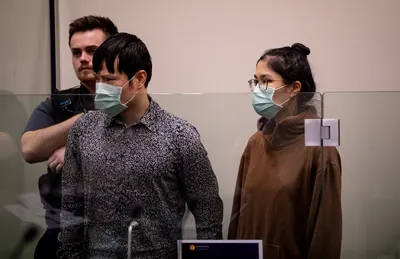
An Auckland family charged with interfering with human remains after a woman’s body wrapped in plastic was found floating off Gulf Harbour will instead be going to trial next month for manslaughter.
Kaixiao Liu, with wife Lanyue Xiao and mother Xiuyun Li, were all initially named one month after the first set of charges were laid in June 2024 following a high-profile international investigation.
Despite widespread media coverage already identifying the family, they were granted interim suppression again in November that year when manslaughter and kidnapping charges were filed. They had not been named in the media since, until now.
A fourth defendant – Kaixiao Liu’s father, Jingui Liu – also received name suppression after he was charged last year.
The Court of Appeal issued a decision today declining ongoing name suppression to the defendants. It follows a similar decision in the High Court last year.
The media remains restricted, however, in reporting details of the appeal.
A fisherman on Auckland’s Whangaparāoa Peninsula found the plastic-wrapped body in March 2024.
Following an exhaustive search that included an Interpol “black notice” – a special appeal to international partners seeking information on unidentified bodies – authorities eventually identified the body as that of 70-year-old Chinese citizen Shulai Wang.
Police allege the defendants had kidnapped Wang in Auckland’s North Shore several days before her body washed up.
A fuller picture of the allegations against the family is expected when the group’s trial is scheduled to begin in the High Court at Auckland on May 25.
All four have pleaded not guilty. They have opted to represent themselves.
2026.4.14 Mother admits she fatally starved toddler, who weighed just 6.23kg

The mother of a disabled toddler who refused to let medical professionals into her house as her son starved to death pleaded guilty to manslaughter today, just minutes before her jury trial was set to begin.
Stormy Lee Ryder, 33, had been aware that 19-month-old Tūwharetoa Tahau – who had cerebral palsy resulting from a brain bleed when he was an infant – had been acting oddly in the weeks before his June 2024 death inside their South Auckland home, according to newly released court documents.
Between early February and his post-mortem exam five months later, his weight had dropped about 27% from 8.53kg to 6.23kg. He was no longer sleeping soundly and had stopped eating all but Weet-Bix and banana yoghurt, and a single bottle a day, Ryder would later tell police, explaining that it had been normal for him previously to drink six to seven bottles.
Paramedics who attended the scene immediately noticed Tūwharetoa was visibly emaciated, with his ribs showing.
But despite the troubling signs, Ryder refused to let two Plunket nurses into her Takanini home when they tried to visit the day before the boy’s death. Later that night, she left Tūwharetoa and two siblings, also toddlers, at home without an adult.
It is not known when she returned, but the agreed summary of facts states she realised Tūwharetoa was “floppy and unresponsive” around 5am the next day. She wouldn’t call 111 until nearly an hour and a half later.
“You love the gear more than your kids,” Ryder’s own mother had told her via text in an argument two weeks before the child’s death. “Gear” is a common slang term for drugs.
Ryder’s lower lip quivered at times today as Justice Grant Powell referred to some of the allegations outside the presence of the jury panel. She started the day seated in an area normally reserved for lawyers, having opted to represent herself at trial.
But she was moved to the glass-enclosed dock, where defendants normally sit, as she changed her plea to guilty.
Justice Powell set a sentencing date for June, ordering that she remain in custody in the meantime.
Surprise twin
Court documents released today outline for the first time how Tūwharetoa had a difficult start to life even before his birth.
Ryder did not seek antenatal care during her pregnancy and Tūwharetoa, along with his twin sister, were born significantly premature. The defendant had not been aware she was carrying twins.
Both infants suffered significant complications due to their early births and spent the first five months of their lives in a hospital newborn intensive care unit.
At two months old, Tūwharetoa suffered another significant setback in the form of a brain bleed and fluid build-up within his brain. If he was lucky enough to survive, the family was told, he’d need long-term care with frequent medical appointments.
“Ms Ryder had significant and extensive community support available to her following the twins’ discharge from hospital,” the agreed summary of facts state.
“She was aware of, and given training sessions for, Tūwharetoa’s significant feeding challenges [for instance using more energy to feed and requiring assistance].
“Upon discharge, the community services available included homecare nurses (Kidz First), a community dietician, a speech and language therapist, a neurodevelopmental therapist, and appointments to see the neurosurgical clinic, the Neonatal clinic, and an ophthalmology appointment.”
Missed appointments
Tūwharetoa was diagnosed with cerebral palsy in August 2023, 10 months before his death. It severely affected his development, with reduced vision and limited control along the left side of his body.
Because of that, community health services remained engaged.
But getting Ryder to stay engaged was another matter altogether.
Between April 2023 and February 2024, Ryder took her son to four medical appointments outside their home but didn’t show up for another 13 appointments.
“Ms Ryder would often have medical appointments rescheduled and then still fail to attend,” the agreed summary of facts states.
On 24 occasions during that same period, she let visiting healthcare or social workers into her home. However, appointments were either cancelled or visitors were turned away from her home 29 times, and on six other occasions, she would only speak with the visitors outside her home.
Despite all that, it appeared Tūwharetoa had been making slow but steady progress up until the last time he was weighed, court documents state.
OT not called in
Ryder appeared to become even more standoffish with those trying to help her after an incident in April 2024 in which a home care nurse asked police to force their way into the defendant’s home.
The nurse had seen children in the home but could not get any adults to come to the door. Ryder was later found asleep in the lounge. The house was messy, there was no power and one child had a heavily soiled nappy.
In the last four months of Tūwharetoa’s life, Ryder took him to one appointment and skipped five others. Of the 19 occasions workers came to her house, they were let inside only five times.
The situation was bad enough that a group of medical professionals held a meeting to discuss what they should do.
“Escalation to Oranga Tamariki was considered, recommended, and a referral was made,” court documents state. “However, it was argued against by other staff and placed on hold on the basis that they felt engagement would worsen following a referral.
“Ultimately, Oranga Tamariki were never engaged with family until after Tūwharetoa’s passing.”
‘Stop being mean’
Court records show that Ryder had become increasingly more isolated in the final month of her son’s life.
She had split with her partner, who was absent from the home and did not assist with childcare, the agreed facts state. And her mother, who had previously visited twice a week to help out, got fed up and stopped coming in early June.
“stop being mean to your kidz I feel sorry for the twins your house has an ugly feeling in it I’m not coming anymore,” Ryder’s mother told her in a text later recovered by police.
Around 10am on June 26, the day before the child’s death, two Plunket nurses showed up and asked to visit with the children.
Ryder, who was hanging clothes outside, said it wasn’t a good day for a visit.
Records obtained from rideshare app Uber show she left the home at 10.59pm that same day. Her children were left at home. She withdrew $120 and just after midnight messaged a private Facebook drug chat group named “Gotwhat ya Need” before deleting the message 10 minutes later.
She dialled 111 at 6.23am to report her son’s unresponsiveness, after first noticing him around 5am.
There was plenty of formula in the cupboard, police would later observe.
The child’s cause of death was later determined to have been complications from starvation and dehydration. Cerebral palsy was deemed a condition contributing to the death, but not related to the disease or condition causing it.
2026.4.4 ‘Vulnerable with men’: Woman who inspired ex to kill blames new beau for swindles
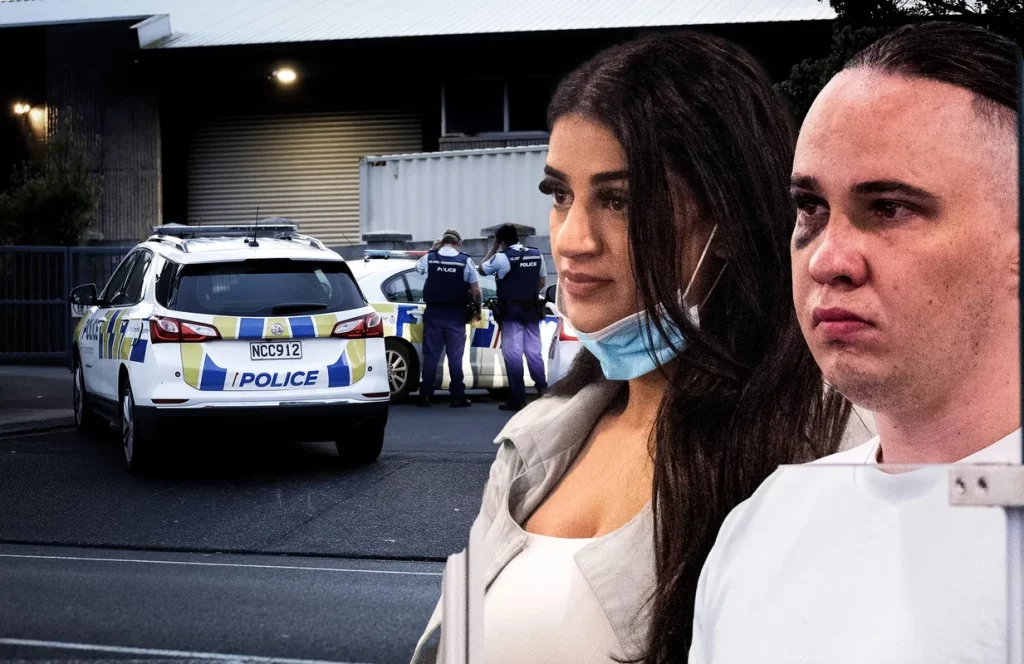
Auckland resident Sandy Younes was serving a non-custodial sentence for helping to cover up a homicide when she turned her attention to a bank impersonation scam in which one victim lost her life savings.
In all, the former personal trainer helped steal $89,000 from two different victims in July and September 2023, nearly $16,000 of which was spent on a Louis Vuitton shopping spree.
Younes – citing a dysfunctional relationship with a mysterious new man, after her previous dysfunctional relationship resulted in a murder investigation – again asked a judge for mercy as she appeared in Auckland District Court for sentencing on the latest charge last month.
In addition to asking for another sentence of community detention, she sought permanent name suppression – suggesting that media coverage of her previous court case contributed to her criminal relapse.
Judge Debra Bell, however, was dubious of the 25-year-old’s explanations for her offending.
She denied both requests.
“The vulnerability of victims means the public has an increased interest in the transparency of these proceedings,” she said, according to sentencing documents released to the Herald this week.
Manipulation and pressure
Younes pleaded guilty last June to a representative charge of money laundering, which carries a sentence of up to seven years’ imprisonment.
Court documents state the two victims were lured by fake emails and texts purporting to be from their banks. Upon calling a number on the messages, they were told by a person pretending to be a bank employee that their accounts had been compromised by scammers.
They were convinced to hand over banking details under the guise of moving the money to a new account that scammers couldn’t touch. But the new account was the scam.
The first victim, who was at retirement age, lost nearly $37,000 – a sum so substantial to her, she told the court, that it caused immense stress and impacted her mental health.
The second victim initially also lost just under $37,000 after she was “manipulated” and put under “extreme pressure” to provide her bank details.
“The stolen funds represented the bulk of her and her husband’s savings and left them with nothing,” Judge Bell said.
“She had to live with the constant fear that the money was lost to her. She not only had money stolen from her, but she also lost time, security and peace of mind. It paid a huge emotional toll on her.”
Younes also got access to the second victim’s credit card details, which she entered into her own phone so the card could be used to make payWave purchases. Younes then arranged for a friend to serve as a mule, using Younes’ phone to purchase three luxury bags, a wallet and an $800 bottle of perfume from the Louis Vuitton store on Queen St, Auckland.
Younes had recruited an 18-year-old she met on social media, described by the judge as a vulnerable young woman, to launder the first victim’s money via the teen’s bank account. She recruited a cousin of her neighbour to help hide the second victim’s money. A third co-conspirator helped her with the shopping spree.
“This shows a very high degree of foresight and planning,” Judge Bell said.
‘Vulnerable’ around men
Defence lawyer Marek Hamlin argued in court his client should not be regarded as the principal offender in the scam.
Younes claimed in a pre-sentencing interview that before the latest crimes she had entered into a relationship with a man referred to only as “Mohammed”, who had initially financially supported her but also got her addicted to nitrous oxide. Younes said Mohammed scammed her first, claiming to have received a large inheritance and asking her to recruit people to help him get around international money transfer restrictions by depositing cash into their accounts.
“You state that when you are with a man you become vulnerable, and further you did not think he would lie to your face,” Judge Bell said.
But that explanation, the judge added, not only contradicts the agreed summary of facts for the case, it also contradicts an affidavit Younes submitted to the court days before her sentencing. In it, Younes said she committed the offences to fund her addiction and to cope with the repercussions of adverse media coverage from her last case.
“I struggle somewhat with that explanation, Ms Younes, given the offending at Louis Vuitton in particular,” the judge responded.
“There is no evidence before me that the items were on-sold. Instead, it appears you were not content with some of the items so you exchanged them at a cost. That offending does not support your account of Mohammed wanting bank account details, nor on the face of it as a direct result of your upbringing, nor to fund your addiction.
“I simply do not accept either of the explanations you proffer.”
Taken advantage of?
The latest sentencing appeared to have echoes of Younes’ previous one, Judge Bell said.
In April 2023, she had appeared in the High Court at Auckland with ex-boyfriend Mandal Sellick, a Mongols-gang-affiliated 501 deportee who fatally shot a man in the stomach after an argument over the purity of drugs that Younes had snorted.
Sellick was tried for murder but the jury instead found him guilty of manslaughter. He was sentenced to 11 years and 10 months’ imprisonment. Younes, meanwhile, had pleaded guilty to a single charge of being an accessory after the fact to discharging a firearm with reckless disregard for the safety of others.
She was sentenced by Justice Kiri Tahana to two-and-a-half months’ community detention and 12 months of intensive supervision.
On the night of the killing, Younes had invited friends over to the couple’s Avondale home. A friend of her brother’s, 28-year-old Mars Rakeem, had offered her what was believed to be a mixture of MDMA and cocaine.
When she complained to her partner a short time later that the drugs had hurt her nose, Sellick thought she had been drugged, possibly with methamphetamine or crack cocaine, and he tucked a loaded pistol into his waistband before going downstairs to confront the group, it was alleged at his trial.
Rakeem, unarmed, was shot a short time later. Sellick claimed it was in self-defence, although the jury and the judge rejected the suggestion.
After the shooting, Younes had demanded others who were there that night help clean up the scene, the High Court judge said. She also used Sellick’s gang connections to threaten witnesses not to say anything and offered them money to keep quiet.
Her lawyer at the time described a “dysfunctional” relationship between the two defendants in which Younes, who suffered low self-esteem because of her difficult upbringing, had misplaced loyalty in Sellick as he had been the first person to treat her with love and respect.
In an interview before the most recent sentencing, it was noted Younes portrayed herself “as the victim of other people’s actions, placing yourself in unfortunate situations”, Judge Bell said.
“It appears this mentality remains the same, as you continuously repeated to the probation report writer this time that you were the victim of the scam, and you did not realise what you were being made to do,” she said.
“You did not disclose any sentiment of remorse or concerns regarding the victims. You have since written a letter to the victims and to the court. You explain in the latter letter that you were taken advantage of. Once again, I struggle with the explanations you provide.”
Last-minute secrecy bid
Younes was initially set to be sentenced last year. At a December hearing, she sobbed when informed of media interest in the case and asked her lawyer to seek permanent name suppression, even though she didn’t have the usual first step of interim suppression.
She hadn’t yet told her family about the charges, the court would later be told.
In January this year, despite a revised March sentencing date looming, she started a fulltime, nine-month hairdressing course.
The defence asked for an end sentence of community detention, which would be less restrictive than home detention. Hamlin noted her course commitment, her mother’s ill health after a recent car crash and other factors, including a doctor’s note suggesting Younes doesn’t cope well with a 24-hour curfew.
Crown prosecutor Sophie-Anne Barry sought home detention and opposed suppression, pointing out the victims also opposed allowing Younes to keep her name secret.
“It involved taking advantage of vulnerable members of the community,” Barry said, arguing that it was serious offending regardless of whether the judge believed the defendant’s claims about Mohammed.
The judge allowed 25% in combined reductions for Younes’ guilty plea, her background and addiction, but she declined discounts for remorse and youth.
Judge Bell acknowledged Younes’ background made for “depressingly familiar reading”. She reported an unstable childhood, partly because of her father’s imprisonment, and developing a drug habit early on as a coping mechanism.
Defence lawyer Tiffany Cooper, KC, who represented Younes in the homicide-related case and at the December hearing before she was replaced, said last year that the defendant had come a long way in recent months.
“Her approach to life is different. She’s sober,” the lawyer said. “She still has a great deal of work to do but she’s started in the right direction, at a point in her life where it might be her last chance to do so.”
The judge imposed a sentence of eight months’ home detention and ordered her to pay $50 per week restitution for the $22,756.50 that was still missing. She agreed with the Crown that the seriousness of the charge meant community detention wasn’t appropriate.
“There is no evidence before me that Mohammed was involved,” the judge said.
“You received a significant personal benefit. You were… the principal organiser of the scam. You acted deliberately to ensure you were not detected.”
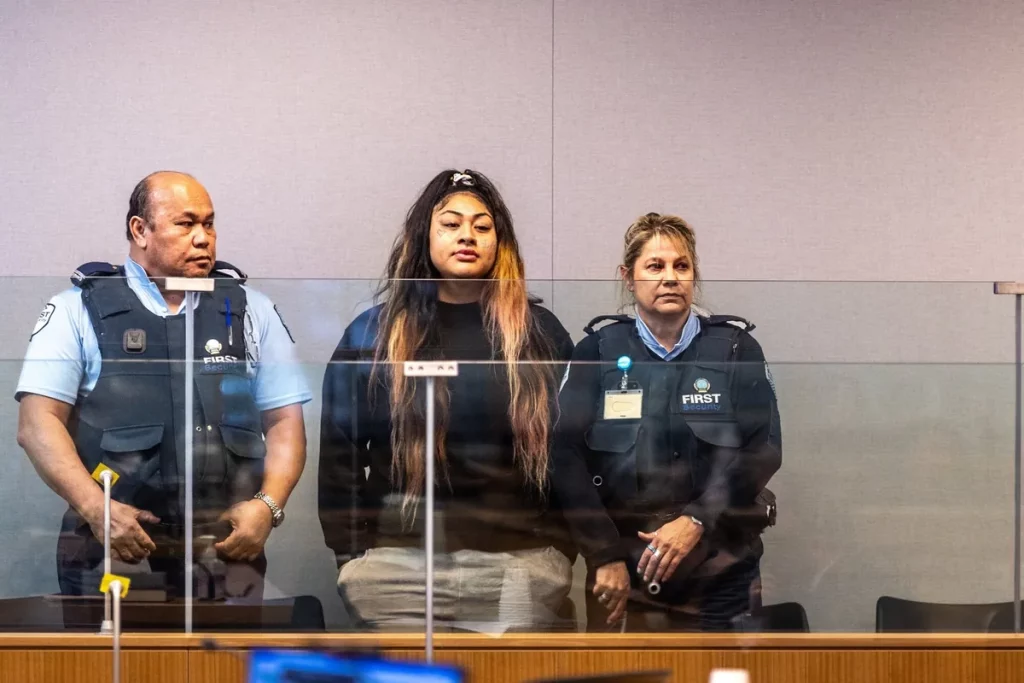
2026.3.20 Defendant foiled her home detention bracelet prior to killing of Auckland businessman
A woman who was jointly charged with murder in 2024 had already been serving a sentence of electronically monitored home detention for an unrelated case when a businessman was stabbed and run over with his own car in East Auckland.
Glenfield resident Amy Joy Parker, 24, had “foiled” her ankle bracelet so that authorities couldn’t track her on the night she met up with the victim, according to court documents released today after she pleaded guilty to a reduced charge of manslaughter in the High Court at Auckland.
She had been set to go to trial in May alongside two others. Murder charges remain pending against her co-defendants, limiting what the media can report.
Victim Ahmed Al-Obaidy was found dead in the middle of Pt England Rd on the night of October 5, 2024.
Investigators found that he had been in contact with Parker via social media in the months leading up to his death. Earlier that day, he had arranged to meet Parker for sex in exchange for cash, alcohol and tobacco, court documents state.
“Should be do this [racial expletive] over…????” she had messaged another person on Facebook after arranging the meeting, suggesting that they “take his car and all of his stuff, ayy”.
Al-Obaidy picked up Parker in his BMW X5 station wagon around 9pm after having purchased beer, wine and cigarettes and having withdrawn $100 cash, court documents state. The two went to one of Al-Obaidy’s vacant rental homes in Unsworth Heights before picking up two other people under the pretence of attending a party together around 10.30pm.
Shortly thereafter, the planned robbery occurred.
“As they were driving, Mr Al-Obaidy repeatedly asked the defendants not to hurt him,” according to the police summary of facts that only Parker has agreed to.
The victim parked the BMW adjacent to Pt England Reserve. Details of what is alleged to have happened next are temporarily suppressed, but the result was that Al-Obaidy suffered two potentially fatal injuries: a single stab wound to his abdomen and crush-type injuries from being run over.
“Ms Parker remained in the front passenger seat throughout the incident,” the summary of facts that she agreed to states. “She did not have a weapon.”
In addition to manslaughter, Parker pleaded guilty today to aggravated robbery. In addition to his vehicle, the victim’s wallet, iPhone and dash cam had been stolen, along with a ring containing “a large number of keys for Mr Al-Obaidy’s business premises”.
The next day, CCTV captured Parker crying and later police came to learn that she had been discussing turning herself in. But she never took the initiative, and in the end it was police who arrested Parker after putting together pieces of the puzzle several days later.
In a subsequent police interview, she admitted being present during the homicide but lied about other aspects of the case. She said she wanted to get help for Al-Obaidy but was unable to.
During today’s brief hearing, Parker laced her fingers together at her waist as she pleaded guilty to both charges. She now faces up to 14 years’ imprisonment for aggravated robbery and up to life imprisonment for manslaughter.
Unlike murder convictions, manslaughter does not result in an automatic life sentence. On rare occasions, it has resulted in non-custodial sentences.
Justice Michael Arthur set a tentative sentencing date for late May but indicated the hearing will likely be postponed to a later date. x1200
2026.3.15 ‘Compassion and unity’: Seven years since Christchurch mosque attacks
Remembrances are taking place in Christchurch today to mark the seventh anniversary and honour the victims of the 2019 terror attacks.
Fifty-one people were killed and 40 others were injured at Al Noor Mosque and Linwood Islamic Centre on March 15, 2019 in New Zealand’s deadliest ever mass shooting.
Commemorations today included a walk-the-talk-for-unity event at the Bridge of Remembrance and a ride-for-unity event around the botanic gardens organised Sakinah Community Trust, an organisation founded by a number of the widows.
A service at the Peace Bell in the botanic gardens began with a minute’s silence, followed by the names of the 51 victims and concluded with a laying of wreaths.
2026.3.15 Changing sexual norms among young people a growing concern — report
A new parliamentary report warns some young people are turning up to hospital with injuries after violent sex but do not realise they may have been sexually assaulted.
The issue was raised in a report by the Justice Committee, reviewing the work of the Executive Board for the Elimination of Family Violence and Sexual Violence.
The committee said it had been told there can be a “fine line” between rough sex and sexual assault and that some young people were presenting to accident and emergency departments rather than specialist sexual assault services.
In some cases, the patients did not consider what happened to them to be rape or sexual assault.
The report said changing sexual norms, particularly among young people, were a growing concern.
Committee members were told practices such as choking and strangulation were becoming more common during sex.
However, the report warned those acts could have serious health effects.
“These practices can have severe health consequences, such as brain injury and PTSD,” the report said.
It also noted evidence shows strangulation and choking could be warning signs of future, lethal violence.
The committee heard one response could be better training for hospital staff.
The board said educating emergency department workers about the signs of sexual assault would help them identify cases that might otherwise be missed and refer patients to the right services.
New sexual violence capability frameworks are expected to be published next year to help health professionals recognise more nuanced signs of sexual assault.
Officials also wanted stronger education for young people about the potential harms of rough sex.
2026.3.12 Hawke’s Bay human trafficker Joseph Matamata loses sentence bid
New Zealand’s most notorious slavedriver and trafficker has failed in a bid to have his sentence shortened.
Joseph Matamata was jailed for 11 years in 2020 for using 13 people as slaves and 10 charges of human trafficking.
But the Court of Appeal has set aside two of the trafficking convictions, because the attorney general had not given delegation for a decision on those charges being brought.
The court had previously ruled the 11-year term imposed by Justice Helen Cull was “lenient in the circumstances”, and declined to cut it down further.
“We are satisfied that the outcome of the recall application should not impact Mr Matamata’s sentence,” said the Court of Appeal judges in yesterday’s decision.
“The number of convictions was a very minor consideration in setting the starting point and was just one of many considerations. Cull J also considered the extent of the emotional and financial harm caused to the victims, the abuse of Mr Matamata’s position of trust and authority in relation to the victims, the number of victims (which remains unchanged), the vulnerability of the victims and the high level of premeditation.”
Matamata has served his minimum term of imprisonment of five years. The parole board twice refused him parole last year and he is due to reappear before the panel in June.
The 71-year-old brought people from Samoa to New Zealand to supply labour to orchards in Hawke’s Bay over 25 years from 1994 to 2019, promising them a better life.
But he kept their wages, restricted their movements and communications, and used threats or violence to control them.
They worked up to 14 hours a day in the fields, seven days a week, completing chores at Matamata’s home late into the evening and beaten up if they broke rules, including speaking to their families in Samoa or leaving his Hastings home without permission.
The oldest victim was in his 50s and the youngest was just 12. The boy described being beaten, stabbed and fed stale food.
“When the bamboo stick breaks, then it’s the belt,” he told police. “When he gets a sore hand from the belt, from holding the belt, then that’s when the stick comes.”
Matamata denied a nine-foot fence around his property was to lock his slaves in. Immigration New Zealand “conservatively estimated” he kept more than $400,000 in wages they had earned.
He used three-month holiday visas to recruit new workers and adopted three young people in 2016.
A 15-year-old girl, who thought she had come to New Zealand for schooling, told the jury she was instead made to look after Matamata’s children, cook and clean.
She said she ran away to Auckland, but Matamata caught up with her and tied her up in his car for the journey back, when she was placed in a storeroom for the night.
2026.3.7 Verdict looms for pair caught with 17.9kgs of pounamu at Auckland Airport

A mother and son accused of attempting to illegally export pounamu to China are nearing the end of a landmark trial at Manukau District Court.
The case is believed to be the first prosecution of its kind by Customs and centres on allegations the pair tried to export more than the legal limit of the culturally significant stone.
Under the Customs Export Prohibition (Pounamu) Order 2021, it is illegal for a single exporter to take more than 5kgs of raw pounamu out of New Zealand without proper consent.
In July 2024, Boyuan Zhang and his mother, Xin Li, were found carrying 17.9kgs of pounamu in luggage bound for China at Auckland International Airport.
Just two months earlier, Zhang’s father and Li’s husband, Jiangbo Zhang, was also found attempting to take pounamu to China.
Customs discovered and seized two stones in his luggage weighing 61kgs in total, but the boarding gate closed before the agency could speak with him.
Now, his family members are under the spotlight, with the trial earlier this week opening with karakia and song from members of South Island iwi Ngāi Tahu.
While not a party to the case, the tribe holds legal ownership of all naturally occurring pounamu within its tribal boundaries under the Ngāi Tahu (Pounamu Vesting) Act 1997.
Zhang directly addressed members of the tribe while giving his evidence.
“I want to say to the friends sitting at the back,” he said. “I 100% respect your culture. Actually, I love the culture. That’s why I love the stone.”
Customs discovered nine stones in total in his and his mother’s carry-on and checked-in luggage.
Exporting pounamu in quantities over 5kgs is only permitted with the approval of the Customs Minister, following advice from Ngāi Tahu.
For raw pounamu sourced from the Arahura River, any export exceeding this limit requires consent from the Mawhera Incorporation, a group representing the area’s original Māori landowners.
The defendants were not travelling alone and initially planned to give some of the pounamu to two others to carry in their luggage.
Xiaoxen Li, a friend of Xin Li, was booked on the same flight and had earlier agreed to carry a 2.6kg stone in her carry-on bag.
But she told the court the plan fell through at the airport, and no pounamu was found in her possession.
Zhang said another person, who 1News is unable to name, was also travelling with the pair to China before catching another flight to London. They had also been expected to carry some of the pounamu.
But that arrangement was abandoned when the defendants realised that person’s luggage would be heading directly to London.
The prosecution asked Zhang whether he accepted that at that point, there was too much pounamu for just two people.
“If you count it as two people, yes,” he said.
Zhang told the court he still believed the weight of the pounamu could be shared between the group, even if the others weren’t carrying stones.
When questioned by Customs officers at the airport, it appeared Li shared the same view.
A recording of the interview was played in court.
“Every person is allowed 5kg, and there were four of us, so really, it was lawful,” she said through an interpreter.
The court heard Zhang weighed most of the stones at home before arriving at the airport and recorded a total weight of “less than 15kg”.
But not all the stones were weighed by him.
Zhang claimed he’d forgotten a stone was already in one of the bags and he didn’t think it was necessary to weigh two smaller stones.
He accepted that it was his idea to get the pounamu to China.
The meaning of “single exporter” is pivotal in the case.
Asked about it, Li said: “Two different concepts – exportation and I carried myself.”
She was then asked if she was saying she didn’t export it because she didn’t sell it for money, to which she replied “Yes”.
Closing submissions are expected in about two weeks, with a verdict to follow.
2026.3.4 Jury returns verdict for K Rd trio who pack-raped German tourist on New Year’s Day
Warning: This story deals with allegations of sexual assault and may be upsetting.
Three young men caught on video whisking an intoxicated teen tourist from a Karangahape Rd bar to a secluded industrial carpark in the early hours of New Year’s Day last year have been found guilty of pack rape.
The defendants – known as B, O and S due to continuing name suppression – took turns nervously standing in the dock in the High Court at Auckland this afternoon as the jury foreman read aloud the unanimous verdicts following roughly nine hours of deliberations that started yesterday.
Justice Mathew Downs ordered the men, who had previously been on bail, to await sentencing in jail. That hearing is scheduled for May.
The judge explained to jurors the concept of “vicarious trauma”, which he said could be triggered by the “exceptionally distressing evidence in this case” – especially the jury’s repeated viewings of CCTV footage that he said showed the rapes as they occurred.
If it was any consolation, he added, “I consider your verdicts entirely commensurate with the evidence”.
The two-and-a-half-week trial centred in large part around CCTV footage – both from outside Central Auckland’s crowded Family Bar and from the conversely empty Avondale carpark where the defendants’ van stopped for about 10 minutes that morning. Prosecutors and defence lawyers promoted vastly different interpretations of what the videos showed.
“The idea that this young backpacker … would want to be driven off to some dark, deserted part of the city … to have sex with these three young men – it just defies logic,” Crown prosecutor Fiona Culliney told jurors during her closing address. “No reasonable, sober person could have believed she was consenting. They had no regard for her at all.”
The 19-year-old was likely unconscious when the trio violated her, but at a minimum, she was so obviously drunk that she could not have consented, Culliney said.
The complainant has only patchy memories of the night but appeared to be in agony as she described to a police interviewer how she woke up to find a man she didn’t know in the process of intercourse, while others in the vehicle spoke to each other in a language she didn’t recognise.
All three men, ages 19 and 20 at the time of the offences, denied the rape charges, but for different reasons.
B, whose DNA was found on the inside crotch of the complainant’s clothes, said he engaged in consensual sexual activity with the woman but did not have penetrative sex. O, whose DNA was found during a gynaecological exam of the victim, admitted to having sex with her but claimed it was she who propositioned him.
S admitted he was also in the van but said he was asleep in the back row throughout the incident. DNA testing for him, which he seemed to encourage during an interview with police, was inconclusive. But a witness told police S had bragged later that morning about all three defendants having sex with a woman who was “too drunk”.
Each defendant faced three counts of rape – one for being the principal offender and two for aiding or encouraging his co-defendants.
B and O were found guilty of all three charges. Jurors found S guilty of a single charge, convicted of raping the woman himself but not of helping his mates.
‘Sinister turn’
The complainant recalled to authorities that, prior to her memories going blank, she had consumed a bottle of wine, two vodka drinks, a glass of prosecco and a Corona as she ushered in the New Year with friends from her hostel.
At some point, she met B on the dancefloor at the K Rd bar and CCTV showed them kissing. That was consensual, prosecutors conceded, even though the complainant said she had no memory of it. But later, as the two exited the club, footage showed the woman swaying, stumbling and needing to be pulled up from the ground by B after sitting down with him.
Prosecutors noted that she appeared at one point to push B away, although she later embraced him again. The defence suggested it was too subtle and too brief to read anything into the push.
Sometime around that point, at 2.44am, she sent her friends a one-word text – “gilde” – which she said was a misspelling of the German word for help. Defence lawyers noted “gilde” could also be translated as “team” or “group”, although the complainant flatly dismissed that usage as uncommon, outdated and a word she had never once used before.
O and S, meanwhile, were standing across the street, watching and waiting for a signal, according to the Crown. A short time later, after B handed them the keys to a mutual friend’s van, they ran off and retrieved it.
When O and S pulled up outside the club in the van, the door was opened from inside before B ushered the woman inside – a sign, Culliney said, of a highly coordinated predatory operation.
“Things took a sinister turn for her when she got into that van,” the prosecutor told jurors. “She had absolutely no idea what they were planning.”
‘A group effort’
Instead of taking her to her nearby hostel, she was driven away from the hustle and bustle of the city centre and to the otherwise empty carpark of an aluminium business in Avondale.
“It’s not a romantic rendezvous spot,” Culliney said, ridiculing O’s testimony from a day earlier that he not only knew about the camera but was thankful for it so jurors could see he is innocent.
The prosecutor described the assertion as “the most startling” of the many lies O told in the witness box.
Prosecutors said the footage, which was at times hard to decipher after having been zoomed 300% and enhanced, showed that B was already naked and on top of the woman in the middle row of seats at the van pulled into the carpark.
O, the driver, is then seen looking back towards the middle row.
“The idea he doesn’t know what’s going on beggars belief,” Culliney said of O’s testimony, describing O as having then walked around the van and “waited his turn” at the middle door.
“Within seconds of [B] finishing … he’s on top of her,” the prosecutor said of O. “No niceties. No changing positions. [She] is unable to move. She was so intoxicated and likely unconscious that she didn’t know this man had sex with her.”
O told jurors the woman had propositioned him for sex while he was still in the driver’s seat.
After less than 90 seconds on top of the woman, O then “casually” walked back around to the driver’s seat, where B was sitting naked, and chatted with him, Culliney said of the video. That, she said, was when S “climbs out from the back and crawls on top of her”, repositioning her body with “no regard for her safety, for her comfort”.
When confronted with the video by police, S said he still wasn’t sure the figure was him even though he acknowledged it was just him and the other two men in the van – and the other two were clearly seen elsewhere. He claimed he had no memory of it.
The CCTV ends with B getting back on top of the woman before the car leaves, Culliney told jurors.
“They’re encouraging each other,” Culliney said. “They’re taking photos. They’re watching each other. This is a group effort.”
‘Please help me’
At 3.43am, after the van had left the carpark, the woman texted her friends in German: “Can someone please help me?” O suggested she was seeking help getting the forgotten address of Hobson Lodge after the group got lost – heading to Hobsonville instead.
At 4.21am, she was left about 35 metres from the hostel.
“They pushed her out – didn’t even let her get her underwear on,” Culliney said. “That’s not the way you behave with a woman if you’ve just had a very lovely. consensual sexual experience.”
B told police he gave her a hug before opening the door for her and bidding her farewell. O told jurors the woman seemed not only happy, but thankful for the ride and apologetic for having gotten them lost.
But witnesses at the hostel said the woman was so inconsolable that she tried to run into traffic, telling one friend repeatedly, “You don’t know what they did to me.” She was taken to the hospital via ambulance after others at the hostel called 111.
The woman estimated there had been three to five men in the van and said “it was more than just one of them” who had been touching her, although she couldn’t give specifics. As a sign of how drunk she was, prosecutors noted that she told police she didn’t think the driver – confirmed to be O – had participated. But he would later admit he had intercourse with her.
A blood test taken at 8.40am, roughly five hours after the incident, showed her to have an alcohol level of 102mg per 100 millilitres of blood – double the legal driving limit. A toxicologist gave a rough estimate that her alcohol level could have been around 180mg – almost four times the limit – or higher while in the Avondale carpark.
A physician specialising in sexual assault cases told jurors she couldn’t do a full, proper exam due to “grossly swollen” genitalia worse than she had ever seen before – although she acknowledged that in itself is not proof of nonconsent.
Culliney argued that the idea the woman would have been “happy” and normal on the way home despite that much pain shows the men’s accounts to be “a complete fabrication” aimed at turning “what was inarguably a terrible pack rape into a fantasy”.
Regret or rape?
Lawyers for all three men pointed repeatedly during their closing addresses to the very high standard needed – “beyond a reasonable doubt” – to find someone guilty of a crime. They also each emphasised the need to resist being swayed by emotion.
Following both of those directions, they argued, would result in a realisation that the evidence presented during the trial fell well short of what was needed for a conviction.
Defence lawyer Petrina Stokes, representing B, spent much of her closing address playing the same CCTV the Crown referred to, but with her own interpretation. How could the kissing outside the nightclub be consensual but then 15 minutes later the woman’s ability to consent disappeared? she asked.
“That just does not make sense here,” Stokes said.
It’s reasonable, Stokes argued, that the woman got carried away inside the van as they continued to kiss and perhaps regretted it later. It’s not reasonable, she argued, to believe the woman was unconscious. The video, she argued, showed the woman’s arms draped over B’s neck.
“Drunk people can and do have consensual sex every day around this country,” Stokes said. “Some may not be able to remember it in the morning, but that doesn’t mean they didn’t consent at the time.”
Annabel Cresswell, representing O, shared similar thoughts.
“None of us want to see a woman crying and that upset after a night out,” she said, acknowledging that it seemed “a bit sordid” with all three defendants in the vehicle.
“At the end of the night … she might have felt silly,” Cresswell added. “They didn’t treat her particularly nicely afterwards.”
But that doesn’t mean she wasn’t consenting at the time, or at the very least acting in a way that led O to reasonably believe she was consenting, the lawyer argued. She urged jurors not to automatically accept the Crown’s interpretation of what could be seen in the CCTV.
“It’s simply not the smoking gun the Crown thinks it is,” she argued. “You can’t see much inside the van [but] the Crown keeps insisting and advising what you can see.
“It’s like The Emperor’s New Clothes. If the Crown keeps shouting you can see something, that doesn’t mean it’s there.”
Lawyer Annabel Maxwell-Scott, representing S, noted that her client was seen the least in both videos. She emphasised that there was no DNA linking him to the woman and the complainant herself had no memory of S having intercourse with her.
The woman did tell police she recalled a man in the back seat, where it has been confirmed S was, closing his belt as she emerged from a blackout. But to convict her client on that, Maxwell-Scott argued, would be “a huge leap”.
As for S allegedly telling a friend that all three of the men had sex with the woman, the defence lawyer noted that the witness who told police that later claimed memory issues as he gave evidence in trial. But even if S did say that, it might be proof only of male bravado, she suggested.
“Teenage men have been known to lie about these things, and exaggerate to their mates,” she said. “It does not prove he actually did have sex with [her].”
‘A whopper of a lie’
But prosecutors suggested jurors should be concerned with the number of lies each man was caught telling in their discussions with police or in the witness box.
She described the men’s explanations, including assertions by all three men that their memories were hazy because they had been drinking for the first time, as a “calculated” attempt to cover up their crimes.
It makes no sense they would have taken a friend’s van when O’s own car was nearby unless they wanted “more room for them to do what they wanted to her”, Culliney argued, pointing out that CCTV shows O and S “sprinting” to the vehicle with “urgency” as B stayed close to the woman outside the nightclub.
“[The woman] had begun to show she was not interested … and [B] knew he had to act fast to get her into that vehicle,” Culliney said.
The prosecutor described O’s claim that he didn’t know S was even in the van until they got back as “a whopper of a lie” and “ludicrous” in light of what was seen on the video.
She also noted that the next day, B went onto the Ministry of Justice website and looked up sexual assault statistics for New Zealand.
“It’s hardly something you do if you’ve just had an incredible, consensual interaction with a girl,” Culliney said.
The men had been set to lose name suppression at the conclusion of the trial. A different High Court judge denied their interim suppression requests last year, but the decision was overturned in December by the Court of Appeal.
Justice Downs said today that he preferred to deal with suppression at sentencing, allowing “the dust to settle” and to give lawyers time to consider if they will file fresh applications for permanent name suppression.
“I should foreshadow that there is obvious public interest in the publication of name,” he told the lawyers, adding later while addressing the defendants: “There is a very real chance name suppression will be lifted come sentencing.”
A teenager who was raped by serial sexual predator Malcolm Rewa was suffocated with a rope before being tied up and gagged with her tights during a horrific attack in which she thought she would die.
But 37 years later, her attacker would be identified after a DNA breakthrough when a swab taken from her body that night was matched with the convicted murderer.
Rewa, who is already serving an indefinite prison term for the rapes of more than 20 women, as well as for one of the nation’s highest-profile murder cases, pleaded guilty to another historical rape earlier this month.
The court heard the long-time inmate, now 72, sexually violated a girl in Auckland in June 1988.
The High Court has today released the police summary of facts, which sets out the chilling events of that night.
2026.2.25 Man admits killing woman on bus by stabbing her 20 times after she ignored him
When an Auckland bus passenger kept her headphones in and declined to engage with an “increasingly more agitated” man who was sitting across from her, the man pulled a knife out of his bag and began stabbing her repeatedly in front of aghast commuters.
Details of the terrifying scene, along the Auckland Transport route 74 line in Onehunga, were made public for the first time today as murder defendant Kael Austin Leona pleaded guilty.
Leona, 38, had been scheduled to go to trial in the High Court at Auckland in less than two weeks. He’ll instead return to the court in May for sentencing.
Newly released court documents state Leona had met victim Bernice Marychurch for the first time about six hours before the October 23, 2024, killing.
They had met outside a Woolworths grocery store in Onehunga around 8.15am before boarding a bus together to Panmure, where they both went looking to purchase methamphetamine. When that effort was unsuccessful, they were able to find and consume methamphetamine in Point England, the agreed summary of facts states.
They then separated in Glen Innes before seeing each other again at the Panmure Bus Station that afternoon.
2026.2.20 Identity finally revealed for female teacher who groomed 11yo student
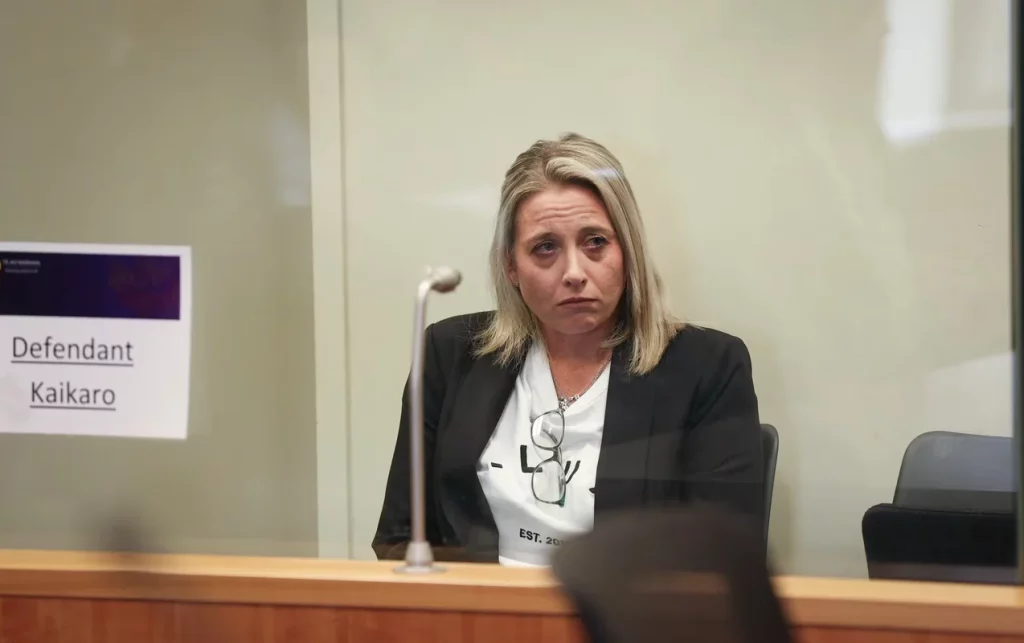
An Auckland primary school teacher who groomed an 11-year-old boy – sending nude photos before spending the night with him – can now be identified, four months after she was sentenced to home detention.
Interim suppression lapsed today for Tamlyn Estee May, 35, after she lost bids in both the District and High Courts to keep her name permanently secret.
May’s lawyer had argued in October that naming her would cause extreme hardship to her own family – some of whom she had not yet revealed the charges to – and that it would risk identifying her victim.
But the victim’s parents told North Shore District Court judge Paul Murray that they strongly opposed continued suppression. The judge agreed the risk was low that their son would be identified by naming May.
A new law that went into effect late last year requires consent from the victim for a person convicted of a sexual offence to receive permanent name suppression. But May was exempt from that law because of the timing of her charges and sentencing.
“The starting point is the principle of open justice,” Judge Murray said, noting that May had already been outed on social media despite interim suppression having been in place for the year leading up to her sentencing.
“Many in the community are already aware of your offending,” he explained, adding that the impact on her family while unfortunate would be a normal consequence of criminal offending rather than extreme hardship.
But she then appealed the decision to the High Court at Auckland.
In a decision issued on December 15, Justice James MacGillivray largely agreed with his District Court counterpart.
“As the Judge [Murray] concluded, ongoing shame and embarrassment are not uncommon for people associated with offenders,” Justice MacGillivray noted.
“There is no evidence that this will amount to extreme hardship for those associated with Ms May.”
But he also noted the advanced state of May’s pregnancy. To reduce stress in her third trimester, he agreed to allow interim suppression to continue until one month after her due date.
“The public interest in open justice and the views of the victim’s family are met by declining permanent suppression, but there is no urgency in permitting publication,” the judge explained.
‘Don’t tell anyone’
May pleaded guilty last year to grooming for sexual conduct with a young person, which is punishable by up to three years’ imprisonment, and indecency with a boy under 12, which carries a 10-year maximum sentence.
The boy was not the defendant’s pupil but attended the same school, which cannot be identified for legal reasons.
Court documents state they messaged each other via social media and Google Docs, used by teachers for grading, for an indeterminate period prior to the boy “asking her out” in August 2024.
Before that, the teacher had repeatedly encouraged the child to do so.
“We would make a good couple,” she wrote at one point, according to the summary of facts she agreed to.
“If you ask me out, I’ll say ‘yes’,” she said at another point.
After the boy did so, the woman repeatedly told him she loved him.
The defendant attempted to cover her tracks by communicating through Snapchat, which auto-erases messages, and by erasing their real-time conversations on Google Docs.
Court documents outlined in detail a 24-day period in August and September 2024 that followed the shift to what the defendant called “dating”.
The two met unsupervised on multiple occasions, including walks at an Auckland park in which she held the boy’s hand.
During one scheduled walk, the two decided to instead go to a home belonging to the defendant’s parents, who were on an overseas trip.
The two wrestled, at which point the teacher grabbed the boy and kissed him.
She also, during that period, sent multiple explicit photos of herself partially or fully undressed, telling him: “Don’t tell anyone, this is just for you”.
On September 6, 2024, she slept in the same bed as the boy while staying at his father’s house, she acknowledged in the agreed facts.
‘Trauma-bonding’
Defence lawyer David Jones, KC, argued during the sentencing hearing that May had been suffering a psychological issue in which she saw herself, as if in virtual reality, as a fellow 11-year-old.
It stemmed from trauma in her own childhood, he said, describing the situation as “trauma-bonding”.
May was born in South Africa but moved to New Zealand as a teenager to flee violence there, the court was told.
“We’re not talking about some sort of predatory behaviour or interest,” Jones argued.
“She had a real interest in helping young people with behavioural issues. And she was of the same ilk. She would regress back to the age where she was 11.”
There was no need for a custodial sentence, or for May’s name to be included on the sex offender registry, he argued.
Jones pointed repeatedly to the case of fellow teacher Myah Adams, who was sentenced in the Auckland District Court earlier that year to a short term of imprisonment before the High Court decided on appeal that she should instead serve home detention.
In that case, Jones said, the offending was much more serious because it involved sex acts on the 15-year-old victim. The most physical contact that was proven in the May case, he said, was that his client and the boy inappropriately held hands.
Crown solicitor Alysha McClintock noted that an important distinction between the two cases is the ages of the two victims. In the current case, she pointed out, the victim was much younger and the defendant older.
Crown Solicitor Alysha McClintock. Photo / Michael CraigCrown Solicitor Alysha McClintock. Photo / Michael Craig
“This offending has caused a large amount of anger and hurt,” she said, describing the conduct as “on a path to doing something more sexual”.
However, she acknowledged that home detention was an option for the judge based on prior cases, including Adams’.
‘Unimaginable betrayal’
Ultimately, the judge agreed to the defence requests to keep May off the sex offender registry and out of prison.
But it came with an admonishment: “Your offending has had wide and devastating impacts.”
The judge pointed to victim impact statements that had been read aloud in court earlier.
“My son’s innocence and trust have been irreparably damaged,” the boy’s mother wrote, describing the “unimaginable betrayal” of a teacher who was inflicting trauma while pretending to help the boy.
“Justice in this case must … send a clear message that such actions are intolerable.”
The boy’s father described the weekly hour-and-a-half round trip he takes each week to take his son to ongoing counselling sessions.
He recalled seeing changes in his son’s behaviour prior to the defendant’s “self-absorbed, manipulating, cold-hearted actions” being exposed.
She had tried to convince the parents to blame the school and suggested she help homeschool the boy – all so she could get better access to him, he alleged.
“She doesn’t have any remorse for the stomach-churning abuse she subjected our son to,” he wrote. “I believe [she] should be banned from going anywhere near any school in this country.”
While acknowledging the family’s frustration, Judge Murray said he had to weigh that against psychological reports finding her to be a low risk of reoffending.
He ordered six months’ home detention, followed by six months of post-detention conditions. It reflected credits for her guilty pleas, rehabilitation efforts, lack of prior convictions and remorse.
2026.2.14 New Zealand restricts the spread of a reviled killer’s views by hampering his attempts to gain fame
WELLINGTON, New Zealand (AP) — In a near-empty courthouse, in front of almost no one, the appeal by New Zealand’s most reviled killer was heard in muted fashion with little mention of the details of the country’s deadliest mass shooting.
Such is New Zealand’s desire to smother the racist motivations of Brenton Tarrant, who murdered 51 Muslims praying at two mosques in the city of Christchurch in 2019. Tarrant, a self-professed white supremacist, referred to other perpetrators of hate-fueled massacres when he committed his attack and other mass shooters have cited his actions since.
Yet it’s rare to encounter the Australian man’s words in New Zealand, the country where he migrated with a plan to amass semiautomatic guns and carry out the slaughter.
Officials have sought to curb the spread of his views, including through a legal ban on his racist manifesto and a video he livestreamed of the shooting. The effort to prevent public exposure to Tarrant is perhaps most apparent in New Zealand’s courts, where he sought this week to recant his guilty pleas.
A three-judge panel in the Court of Appeal in Wellington heard final arguments Friday by Crown lawyers opposing Tarrant’s application to have his admissions in 2020 to charges of terrorism, murder and attempted murder discarded. He is serving life in prison without a chance of parole, but the case would return to court for a full trial if he is allowed to revoke his guilty pleas.
Opposing lawyers say his appeal has no merit
The 35-year-old told the court this week he didn’t want to plead guilty and made the “irrational” admissions during a “nervous breakdown” induced by his solitary and austere prison conditions. But Crown lawyers opposing his appeal bid said in their response Friday there was no evidence for the claims that he was seriously mentally ill.
Experts had ruled Tarrant was fit to enter pleas, and his former lawyers and prison staff didn’t raise concerns either.
“It’s difficult to see what more could’ve been done,” Crown lawyer Barnaby Hawes told the court. Tarrant, he added, “is an unreliable witness and his narrative should be treated with caution.”
The evidence against Tarrant — including his own livestream of the massacre, in which he filmed his face — was so overwhelming that a guilty verdict was assured if he had fought the charges in a trial, the lawyers said.
“Pleading guilty to charges where his guilt is certain can’t be seen to be irrational,” Hawes said.
The subdued hearing defies the tension over the case
One topic nearly absent from the weeklong hearing was any mention of the hateful motivations Tarrant cited for committing the crimes. Lawyers both supporting and opposing Tarrant’s bid avoided reference to his white supremacist views, and proceedings unfolded in the quiet and stolid way New Zealand court cases usually do.
But there were signs the court sought to limit the public’s exposure to Tarrant, as New Zealand’s justice system has done before. Almost nobody was permitted to view the gunman’s evidence and the appeal bid unfolded in front of nine reporters, nine lawyers, a few court staff, and an empty public gallery.
Tarrant was permitted to watch the proceedings by video conference from Auckland Prison, but his image was not visible in the courtroom except when he gave evidence. Apart from in Christchurch, where the bereaved and wounded survivors watched a livestream of the hearing at the local courthouse, the shooter was invisible.
The approach New Zealand has enacted — in which even news outlets name the shooter as few times as possible in each article — stands at odds with the publicity given to trials for racist mass killers before, including widely covered proceedings for the Norwegian murderer Anders Breivik, whom Tarrant years later cited as an inspiration. Crown lawyers urged the appeal judges Friday to thwart the prospect of the matter returning to court in a lengthy public trial, which would happen if the Australian’s bid to recant his guilt was successful.
“Keeping this case alive is a source of immense distress” to the shooter’s victims, Crown lawyer Madeleine Laracy said. “It doesn’t allow them to heal.”
A swift ruling isn’t expected
The judges’ decision will be released later. New Zealand’s appeals court delivers 90% of its judgments within three months of a hearing’s end, according to the Court’s website.
If his bid to revoke his guilty pleas is unsuccessful, Tarrant’s case will return to the appeals court for a later hearing where he will seek a review of his life sentence.
2026.2.11 Rare sentence ordered for teen killer who shot four others amid feud
An Auckland teen who appeared to methodically shoot four other young men at the culmination of a lengthy feud – killing one – has been given a somewhat rare non-life sentence for murder.
Grey Lynn resident Kayden Stanaway, now 20, claimed he fired in self-defence in September 2024 when 18-year-old Maxwel-Dee Repia showed up across the street from Stanaway’s home with four others.
The two enemies had been involved in numerous violent encounters that year, and just that night Repia had threatened to kidnap the defendant’s father, court documents state. Repia and others had also thrown rocks at the defendant’s house earlier that day, smashing a window.
But messaging recovered by police also indicates Repia had arrived that night wanting a one-on-one fight without guns. He was gunned down anyway, dying in the street.
Although the judge, along with prosecutors, accepted that Stanaway was fearful for his safety, it was also agreed by all sides that his firing of the weapon was unreasonable and therefore constituted reckless murder.
“This involved recklessness at the very highest level,” Justice Graham Lang said today as Stanaway appeared in the High Court at Auckland for sentencing.
He ordered a finite sentence of 16 years’ imprisonment, with a stipulation that he serve at least half of that before he can begin to apply for parole.
For the vast majority of murder convictions in New Zealand, defendants are ordered to serve a life sentence with a minimum term of imprisonment of at least 10 years. A life term means that even after release, the defendant is always on parole and can be called back to prison at any time.
But this was one of the exceptions to the rule, Justice Lang said today, noting that prosecutors agreed such an outcome would be “manifestly excessive”.
Nevertheless, the judge added, the shooting “has had catastrophic consequences for his whanau and friends” and must be denounced.
History of animosity
A feud had started between Repia’s group and Stanaway earlier that year after the defendant started dating an ex-girlfriend of someone in the other group, according to the official account outlined in court documents.
Around that period, Repia tried to punch the defendant through a car window, the agreed facts state. The two teens squared off on that occasion but didn’t end up fighting.
The next documented confrontation happened in late February that year, when a 13-year-old friend of the defendant was allegedly beaten up and robbed by Repia and his associates. Stanaway and his associates retaliated by doing the same to one of Repia’s friends.
Stanaway claimed to authorities that on St Patrick’s Day that year, Repia and some others showed up at his home, initially threatening to shoot his 13-year-old sister. When Stanaway and his father confronted the group, armed with a hammer and a crowbar, Stanaway claimed that Repia again escalated the situation.
“Mr Stanaway’s account is that Mr Repia pulled out the apparent firearm and pointed it at [the defendant’s father’s] head, pulling the trigger,” court documents state. “The gun made a clicking sound but no bullets were released.”
Police, however, were never called.
Two weeks later, the defendant claimed, Repia and his associates showed up at the home around 1am “armed with a crowbar and ready for a fight”. They allegedly smashed windows to the house and to Stanaway’s car, tagging it with spray paint.
“Mr Repia and others attempted to enter the house through the front door; however, Mr Stanaway, his father and his cousin were able to hold the door closed and prevent their entry,” court documents state.
Police were later called to report the damage. A short time later, a fragile truce between the two groups was reached.
But animosity reignited four-and-a-half months later, in mid-August, when Repia and his associates allegedly forced their way into Stanaway’s family home and confronted his father and 17-year-old sister. Stanaway was not home, but the group demanded the keys to his new motorbike, the agreed facts state.
The intruders were holding bottles as weapons, Stanaway’s father would later recount. As they left the house, Stanaway’s sister called the police. The defendant’s father called him.
“Mr Stanaway raced home and saw Mr Repia and his associates out on the street near his house,” court documents state. “He witnessed one of the associates assault his friend with a bottle to the head while his friend was on the ground.
“While they were assaulting his friend on the ground, Mr Stanaway drove his car at members of Mr Repia’s group, hitting at least one of them with his car. He then circled back around to where his friend was on the ground, in an attempt to block him from a further attack.
“This continued until the police arrived.”
By August 28, one week before the shooting, Stanaway was sending threats to Repia’s group via social media messages.
“Tell your big homie Max to pull up got a clip with his name on it,” he wrote in one message, referring to ammunition.
A friend of Repia’s, who would later be shot in the face, ended the exchange by sending a photo of himself holding a gun.
‘I’ll kidnap your dad’
Earlier on the day of the shooting, Repia and his mates had filmed themselves chasing Stanaway in his car after randomly coming across him on the road.
Repia and some of the others who would later be shot then went to Stanaway’s home and threw the rocks, documents state. Stanaway’s father called police around 4.22pm, followed by a call to his son.
As the evening progressed, Stanaway stood outside his home with a rottweiler dog and a group of friends who had arrived for his brother’s 14th birthday party.
Stanaway at one point called Repia. In a follow-up message, he wrote: “Or I’ll kidnap your dad.”
At 6.01pm, Repia said he was headed to the house.
“Wait there,” he wrote. “If ur not there then im gna Kidnap ur dad.”
Repia said he wanted “just 1on1s” so it wouldn’t cause as much of a scene. “No fanas,” the murder victim said, using Samoan slang for guns.
Repia and four others parked near the Grey Lynn house about 6.45pm.
“As Mr Repia’s group approached the defendants’ group, a heated verbal exchange ensued that was escalating,” the summary of facts states. “Mr Stanaway alleges that two of Mr Repia’s associates threatened to shoot the rottweiler belonging to Mr Stanaway’s associate.”
Stanaway remained next to the open door of a white Mazda parked outside his home.
“Mr Stanaway, believing that at least one of the complainants had a firearm in their hands, reached into the Mazda vehicle and armed himself with a long-barreled .22 calibre rifle,” court documents state.
He “adopted a standing firing stance by resting his elbows on the roof of the Mazda” and took aim at the group, firing four shots in quick succession.
Repia and his friends scattered as the shots were fired, but he died at the scene from a single gunshot wound to the chest. One of the survivors was put in a medically induced coma and underwent multiple surgeries as a result of a bullet that punctured his nose and travelled into his neck, near his spine. Another was shot in the chin, and a third survivor was treated for a chest wound.
They were between the ages of 19 and 20.
‘My son deserved dignity’
In a series of emotional victim impact statements read aloud by prosecutors today, members of Repia’s family emphasised that he was more than just the person portrayed in the media based on the summary of facts.
“My son mattered,” Repia’s mum said. “He is my son and he deserved dignity and respect.”
She and several of Repia’s aunts described someone who was family-oriented, protective of his siblings and cousins and who was always respectful in their presence.
“He had a large and colourful life,” his mother said. “… He did everything at 100%.”
Aunts remembered a young man who was always willing to help with chores and “brought a warmth” to family gatherings. He had a “contagious, goofy laugh” and an ability to make his loved ones laugh for hours with his silly jokes.
In the months prior to his death, he had talked about wanting to change his path and had recently started attending church, one aunt pointed out.
“Whatever [the] agreement might have been, the result should never have been the loss of a life,” she said.
Another aunt emphasised: “Although it may seem to some in society he was a criminal or a bully, he was beyond what you might read.”
She expressed hope that Stanaway uses his time in prison to reflect on his actions and is eventually able to forgive himself. He took a life, but also destroyed his own, it was acknowledged.
‘Brutal and thoughtless’
Crown prosecutor Fiona Culliney acknowledged that the background between Repia and Stanaway was important for context. But that doesn’t take away from the fact it was a “brutal and thoughtless” shooting, she said.
“In no way does that background justify what Kayden Stanaway did,” she said.
There was an element of premeditation in having the gun at his side before the group arrived, she suggested.
But his young age at the time, combined with his guilty pleas and difficult background mitigated the sentence to the point where life imprisonment wasn’t called for, she said. She argued for an end sentence of between 15 and 17 years’ imprisonment.
Defence lawyer Jasper Rhodes said his client accepted, through his guilty pleas, that his actions that night were unacceptable and unjustified.
He pointed to a psychological report that found Stanaway was likely to have fired out of an incorrect threat assessment caused in part by “PTSD due to the ongoing threats to his family”.
“He was under the genuine belief that the other group had their own firearms and, in theory, were about to use them,” Rhodes said.
The defence sought an end sentence of 14 years.
In settling instead on 16 years, Justice Lang noted that the crime needed to be denounced given it wouldn’t be a life sentence.
He noted that Stanaway had been sentenced in April and again in July 2024 – just months before the shooting – for firearms-related charges.
The ongoing feud “contributed to the perception you were in mortal danger” but there was no evidence that was ever the case, he said.
2026.2.4 ‘Executed for profit’: Trio jailed for teen’s mafia-style killing at pre-dug grave
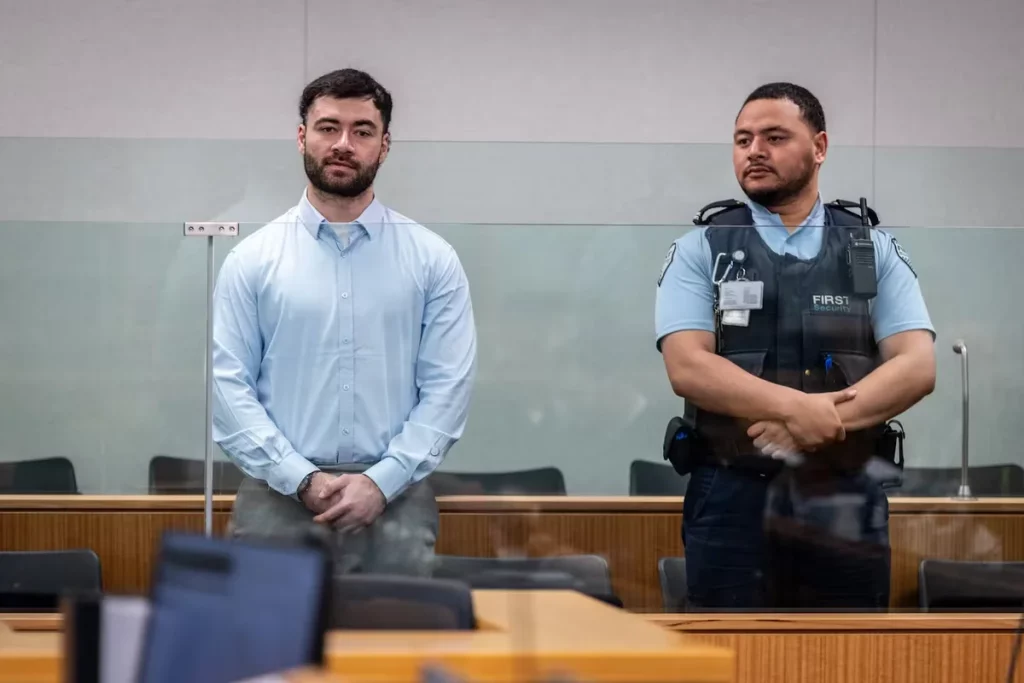
A trio of thieves who lured a young drug dealer to a pre-dug grave for a mafia-style double-cross killing were handed substantial sentences today after a judge noted the unusual amount of callousness needed to carry out the plan.
“It was effectively an execution for monetary gain,” Justice Geoffrey Venning said, going on to describe the killing as “deliberate” and “in cold blood”.
Patched Head Hunters member Zak “Johnny Trigger” Kameta, 28, then-prospect Matthew Snaylam, 22, and 28-year-old construction company boss Hassan Al Fadhli, known to wear “Head Hunters supporter” regalia, were all found guilty of murder at the conclusion of their jury trial in November.
They returned to the High Court at Auckland today for sentencing.
Double-crossed
Nineteen-year-old victim Jayden Mamfredos vanished in April 2023. His body wouldn’t be found in a deep grave outside Al Fadhli’s home until the following year, amid a high-profile missing persons investigation.
The defence suggested during the trial that Mamfredos – armed and unpredictable due to his own meth consumption – had been fatally shot by a mysterious, unidentified Black Power member during a large-scale drug deal that went sour.
Kameta, a digger operator, did conceal the body out of panic but he wasn’t the killer, defence lawyer Ron Mansfield KC argued.
But jurors – and ultimately the judge – preferred the narrative suggested by Crown Solicitor Alysha McClintock, in which there never was a Black Power member.
Instead, the Crown suggested, Mamfredos was lured to the rural North Auckland property with the promise of an easy-money, fake-drug-deal robbery of the fictional Black Power member. He would have arrived, McClintock said, to instead find a pre-dug grave and to realise – too late – that he had been double-crossed by his acquaintances.
Mamfredos, operating under the direction of an imprisoned Bloods member with the street name Raw, unknowingly had a target on his back after obtaining 1kg of methamphetamine worth an estimated $80,000 to $100,000, prosecutors said.
All three defendants were in on the plan, the Crown argued, explaining that Snaylam served as the lookout while Kameta filled in the grave and Al Fadhli actively kept his family away from their home so there wouldn’t be witnesses. They had hatched the plan about 10 days earlier and had even dug a practice grave, it was alleged.
Each faced an automatic life sentence today. Justice Venning’s job was to determine the minimum period of imprisonment before each man can begin to apply for parole.
‘Calculated … planning’
Crown Solicitor Alysha McClintock argued that the judge should impose a minimum period of imprisonment of at least 17 years for all three defendants because the murder involved “calculated or lengthy planning”.
“Jayden Mamfredos was set up and executed for commercial profit in a coordinated plan between these three defendants,” she said. “Significant thought and substantial planning went into this murder. There was nothing spontaneous about it. There was nothing amateur about it.
“The plan that they made worked for quite some time.”
Defence lawyer Annabel Ives argued that a minimum 17-year term would be manifestly unjust, based partly on her client’s age. As a school friend of the victim, he also was 19 at the time of the killing, she said, describing him as “easily led” and “relatively immature”.
He had spent too much time in a kickboxing gym, idolising gang members but has now “stepped back” from his previous associations, Ives said.
Kameta, meanwhile, continues to dispute the jury’s finding, his lawyer said, arguing that the 17-year minimum should not be imposed for his client either.
At 28, he is still a relatively young man, Mansfield said, describing him as a hard-working former business owner who is capable of contributing to society upon his eventual release.
“I ask that the court not see this man as irredeemable,” he said.
Lawyer Justin Harder, representing Al Fadhli, noted that his client wasn’t present during the actual killing so his sentence should reflect his lesser role.
Justice Venning, however, was unconvinced by all three arguments. He ordered an 18-year minimum sentence for Kameta and 17 years for Snaylam and Al Fadhli.
“I accept that both the planning and the callousness of your acts were exceptional in this case,” he explained.
And the callousness continued even after the killing, he said, describing how Snaylam pretended to be a concerned friend in the weeks that followed – deceiving Mamfredos’ mother as she pleaded for help locating her son.
‘Legacy of love’
Mamfredos’ mother said the “senseless, devastating act” was made much worse by the “crushing uncertainty” of the lengthy search for him.
“[It was] nine months of unanswered questions – nine months of living between hope and dread,” she said, describing him as “the heart beat of our home”.
“Without him, there is silence.”
Like all young people, he made mistakes, she said. But he did nothing to deserve what happened to him, she said.
Mamfredos’ mother said the defendants treated him “as if he was disposable … as if he didn’t belong to a family that loved him beyond words”.
She described her son as having left behind “a legacy of love, light and compassion”.
They were sentiments echoed by the victim’s grandmother and younger sister.
“He was our anchor,” Mamfredos’ sister said. “He was our protector, our confidant, our shield.”
She agreed the disappearance made the situation all the more painful, without an opportunity for closure.
“We had a nightmare for 270 days while the people who did this went on with their lives,” she said.
Justice Venning thanked the victim’s family for their statements and said he agreed with his mother that nothing Mamfredos did deserved what happened to him.
2026.2.4 ‘Heartbreaking’: Mentally unwell man killed his stepfather after meds were changed
WARNING: This article discusses violence and may be upsetting to some readers.
Rita Tawhai believes her partner’s death could have been avoided if her son had been placed in a secure facility during his medication change.
“To lose the love of my life is heart‑breaking. To lose my son to a system that doesn’t work is devastating,” she told the court as her son was ordered to remain in a secure mental health facility indefinitely.
Geoffrey Ware was murdered by Jack Korewha, in a tragedy linked to failures across the mental health system, missed warning signs and poor risk management.
Korewha, 27, appeared in the High Court at Whangārei on Tuesday for his final hearing.
On May 9, 2025, only weeks into a change of medication for schizophrenia, Korewha was at his mother’s home she shared with Ware on Mangakāhia Rd in Parakao, Northland.
Ware, 55, was sitting in a lounge chair when Korewha plunged a bone-handled knife into his neck.
Korewha placed the bloodied knife on the bench and left, leaving Ware, who died at the scene from blood loss.
Korewha left in Ware’s car, and was found by police hours later walking along State Highway 14. He had no recollection of stabbing Ware.
He was taken into custody and charged with a minor offence but two weeks later was charged with murder.
For the next six months, the court case progressed through the High Court awaiting mental health reports, and Korewha was formally declared unfit to stand trial in December.
At his disposition hearing, Korewha appeared via audio-visual link from the Mason Centre wearing a hospital gown.
‘I’m angry at the system’
Ware’s partner and Korewha’s mother had her victim impact statement read.
It detailed the double loss Rita Tawhai felt and her frustration her son wasn’t placed in a secure facility while his medication was being changed.
“I had talked with the mental health team and was disappointed they didn’t help sooner,” she said.
“Poor decisions have caused the love of my life to be lost.”
She said since the incident she had been “left to deal with the brunt of it”.
“I am angry at the system, I have been put through the wringer and left to cope with it. I’ve had so-called family and friends blaming me for things I did not do.
“Some are cold-hearted and have no idea what’s going on. The system needs to change for the better of society or this will keep happening.”
‘Reports made for sad reading’
Justice Michele Wilkinson-Smith went into detail around Korewha’s troubled mental health history.
She cautioned Korewha that some of what she was about to read, he might be hearing for the first time, yet he sat through it without a flicker of emotion, staring straight ahead.
Justice Wilkinson-Smith first acknowledged the distress the families had experienced since Ware’s death and thanked them for their views.
Korewha had no history of violence until he was first admitted as an inpatient in a Northland mental health facility in 2021 when he was 21.
“The reports made for sad reading,” she said.
By March 2022 he was on medication for schizophrenia and released back into the community, but by June, he was back.
He absconded twice from the facility, transitioned to a new medication and was released again.
In March 2023, he was reported as doing well and his mental health community order was ceased.
In September 2024, his medication was reduced and then ceased completely, but by April 2025 he was put on a new medication.
“The death of Mr Ware then followed on May 9,” Justice Wilkinson-Smith said.
During that period he was assessed as having an intellectual disorder, but Justice Wilkinson‑Smith said that finding was incorrect as it was made after his schizophrenia diagnosis.
“He has an established history of psychosis which he’s previously been treated by anti-psychotics.
“Previous clinical notes give inconsistent and, at times, contradictory accounts of his poor performance.”
She said he did not meet the criteria for intellectual disability.
Justice Wilkinson-Smith said when Korewha was unwell he would exhibit persecutor delusions, auditory hallucinations, poverty of speech and cognitive impairment.
She said he also had a number of significant risk factors present at the time of Ware’s death.
Since being in the Mason clinic, Korewha “was observed responding to unseen stimuli when he was in his room which included laughing and talking to himself”, Justice Wilkinson-Smith said.
“He is unable to engage in future planning or engage in destabilising. He’s unable to engage in mediation, unable to describe how to manage stress. While it’s treatable, the effect is still not clear.
“His current inability to acknowledge the events relating to the killing of Mr Ware, or to describe his experience or his motivation, presents significant challenges to predict or modify his future risk.”
Justice Wilkinson-Smith said it was in the interests of the public and Korewha that he be detained in a secure mental health facility.
“Any lesser response would not adequately address the risk he has.”
Under the order, Korewha can only be discharged with the approval of the Minister of Health.

A Black Power member has been sentenced to prison after instigating a dangerous shootout with rival gang members that started in Middlemore Hospital’s busy carpark.
The two groups then embarked on a wild car chase through South Auckland in which witnesses said more shots were fired from at least one of the speeding cars.
“Both vehicles were driven in a way that presented extreme danger to the public,” Judge Sharyn Otene said last week as Tipene Adlim Levi Kiel-Pirini appeared in the Manukau District Court for sentencing on his 35th birthday.
She warned his family at the outset of the hearing that prison could be the only outcome given what transpired.
The defendant, however, took the decision in stride. Although he showed no remorse for the Mongrel Mob associates he had shot at, he did express his regret for having put the public in danger.
“Thank you, Your Honour,” he said at the conclusion of the hearing, as his mother wept and his young children repeatedly shouted support: “Love you, Dad!”
2026.1.18 Sophie Elliott’s killer up for parole 18 years after her murder

The man convicted of murdering Dunedin woman Sophie Elliott is up for parole after serving 18 years behind bars.
Clayton Weatherston, then a 33-year-old economics tutor at the University of Otago, stabbed his ex-partner, 22, more than 200 times on January 9, 2008.
He was sentenced to life in prison with a non-parole period of 18 years after being found guilty of her murder following a five-week trial in Christchurch in 2009.
Weatherston, now in his 50s, is eligible for parole at the end of the month and will go before the Parole Board for the first time.
Sophie’s father Gil Elliott told 1News it was a day he was dreading.
“It’s sort of affected me the whole way through, I suppose. You sort of almost count down, you sort of think to yourself ’15 years to go’, ’14 years to go’. It won’t have gone quickly for him, I imagine, but it’s certainly gone pretty quickly for us,” he said.
“He hasn’t had any rehabilitation apparently, and why would he because he doesn’t think he did anything wrong, because he thinks it was all Sophie’s fault.”
‘The whole room seemed to be red’
The gruesome attack took place in Sophie’s locked bedroom in her family home in Ravensbourne, just one day before she was set to relocate to Wellington to start a job with the Treasury.
Her mother, Lesley Elliott, had let Weatherston into their home after he showed up unannounced, claiming to have a farewell gift for her.
“She just started screaming and screaming and screaming,” Lesley said during the trial.
After eventually breaking in, she remembered “the whole room seemed to be red”.
During the trial, Weatherston took the stand in his own defence as he attempted to blame their daughter for his horrific crime. He laughed often under cross examination, telling the Crown prosecutor: “It’s drama. It’s Pride and Prejudice, you’ve seen it; she’s Mrs Bennett and I’m Mr Darcy. It’s Mills and Boon, man.”
But when he was asked about his systematic mutilation of her body after she was already dead, his reply was simply, “I don’t know”.
Weatherston – who had been diagnosed with narcissistic personality disorder by two psychiatrists appearing for the defence – claimed the extreme brutality was manslaughter, not murder, as he had been provoked by Sophie.
At the time of the trial, Weatherston’s use of the partial defence of provocation caused major public outcry. He claimed his tumultuous six-month relationship with Sophie sparked the killing and that she had attacked him first. The provocation defence was abolished in New Zealand just months later.
Outside court after Weatherston’s sentencing in September 2009, Gil said, “He never pleaded guilty and he’s never said sorry.”
A life denied
Gil has prepared a five-page submission opposing Weatherston’s release. He has also applied for a postponement order, meaning Weatherston’s next parole hearing could be between three and five years away if he is denied release this month.
He wants the Parole Board to understand the true dangers of a narcissistic personality.
“They don’t have any conscience, so they don’t have any empathy whatsoever because they only ever think about themselves. We don’t know what went on in his strange mind and I just hope the Parole Board know these sorts of people are unpredictable. If they let him out, then let it be on their heads.”
Gil hopes the man who took his daughter’s life will never regain his.
“Sophie could have been Secretary of the Treasury, I wouldn’t have been surprised at all. She may be married, might have had children. It’s all been denied for her; it’s been denied for our family as well.”
2026.1.7 Whangārei sex attacker Haydn Teoneroa Christy refused release by Parole Board
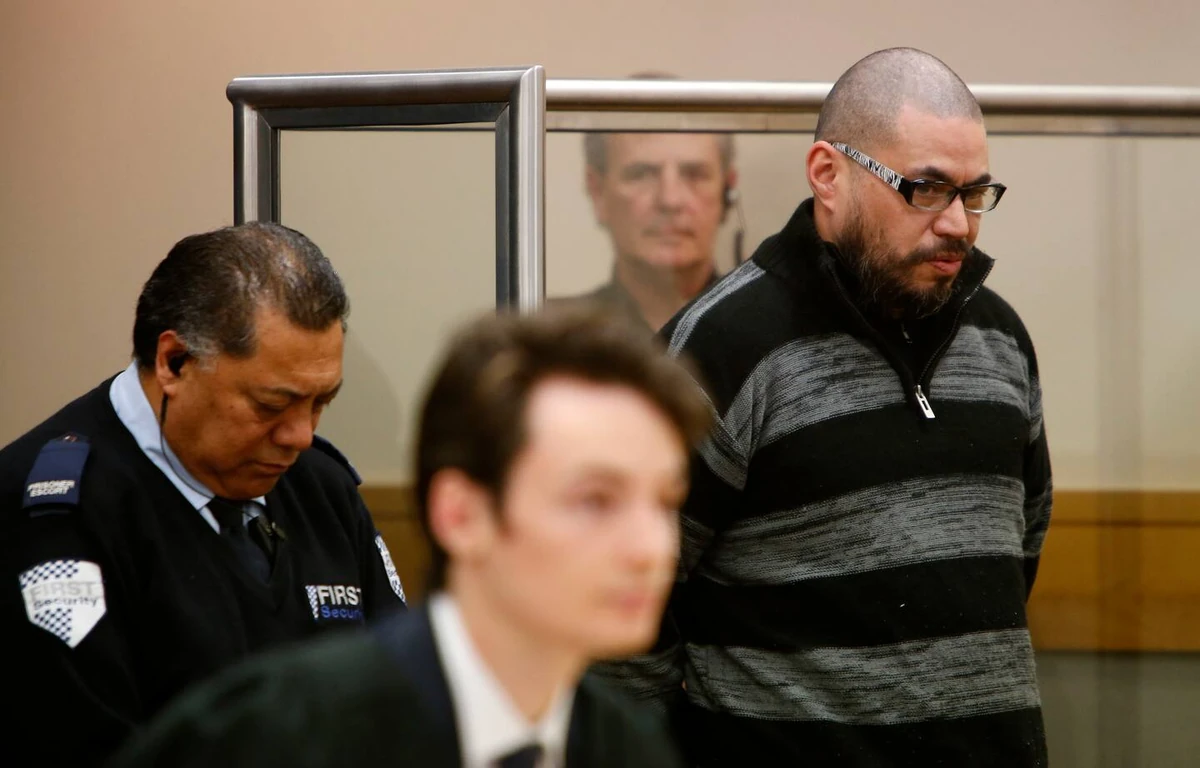
WARNING: This article discusses sexual assault and may be upsetting to some readers.
A man who violently abducted a jogger and took her to his home, where he sexually violated her, is believed to have unresolved issues with power, control and entitlement.
Today, Whangārei man Haydn Teoneroa Christy appeared before the Parole Board for the third time in nine months, during which it was determined he remained a risk to the community.
Christy, who had been deported from Australia for violent crimes, was sentenced in the High Court at Whangārei in 2016 on charges of abduction for the purpose of sexual violation, threatening to kill, wounding with intent to cause grievous bodily harm and four charges of sexual violation by unlawful sexual connection.
His victim had been living in Whangārei for a short time when, early one morning in 2016, she went for a run around the popular walking track, the Hātea Loop.
Christy, then 40, was intoxicated and high on methamphetamine when he saw the woman while driving.
He followed her before getting out of his car and approaching her.
Christy repeatedly punched the woman, wounded her with rocks and then abducted her, taking her in his car to his home, where he sexually violated her.
He played pornography on his television and continued the abuse before threatening to kill her.
After the assaults, he drove the woman to a city street and dumped her.
A member of the public found her and called emergency services. She spent days in hospital recovering from her injuries.
At the time of Christy’s sentencing, the Crown sought preventive detention but the sentencing judge did not impose it as Christy had no history of sexual assault.
He was instead sentenced to 12 years’ imprisonment with a minimum period of imprisonment of eight years.
Christy is now eligible for parole, and at a hearing in May 2025, the board declined his bid for release because the address he proposed to reside at was considered too remote.
A month later, while still incarcerated but living in a self-care unit on prison grounds, Christy tested positive for cannabis.
He was subsequently transferred back inside the wire.
Christy’s parole was again refused in July, and today he appeared before the board for another attempt at release.
At the hearing, he expressed remorse for his offending and, repeating what he had said at earlier hearings, told the board he was no longer the man he was when he committed the crime.
Christy said he had been angry at the world and unable to cope with his life at the time.
He had turned to drugs and alcohol and developed distorted beliefs about his entitlement to, and need for, sex, he said.
“I was using sex as a coping strategy to release stress,” Christy said.
“I’ve learnt a lot in that place with distortion, things going through my head, having my needs met, treating women in a bad way, and having entitlement issues.”
At his parole hearing in July, he presented a safety plan for his release.
Today, the board asked Christy whether he had updated the plan since he was caught smoking cannabis, to which he said he hadn’t.
He was then asked whether he had looked at his safety plan in the last seven months, and again, he hadn’t.
Christy faced pressure from the Parole Board around his former issues with power, control and entitlement.
Panel convener Ann-Marie Beveridge was not convinced he had overcome those issues and pressed him for answers over what happened on the morning of the abduction.
“How long had you been considering kidnapping a person off the street for your sexual purposes?” she asked.
Christy said it was impulsive and he had not been considering it at all.
She then asked why he chose his victim.
“I was intoxicated at the time. I don’t want to blame the drugs and intoxication, I can’t answer that,” he said.
Beveridge then asked why he thought he was entitled to do what he did to the victim, to which Christy said it stemmed from behaviour he saw in men growing up.
Beveridge did not accept his answer and said there were plenty of grown men who had lived similar lives that did not go on to abduct women from the streets.
“I believe I took the rights of that young lady away from her because I believed that the whole world was against me and someone had to suffer,” Christy said.
Beveridge then put to Christy that he was a “power and control” person and said she could not see anything in his safety plan that addressed how he would deal with those issues in the community.
Other board members also pressed Christy on how he would manage situations involving vulnerable women in the future, using an example of being the last person left with a woman at a party.
“First of all, I wouldn’t be in a situation at a party,” Christy responded.
“I’m not even thinking about that lifestyle or being in an environment like that but walking away if I was put in that situation, being assertive to that person and telling them I’m walking away from this.”
The Parole Board took around 20 minutes to deliberate before advising Christy that his parole was declined.
A number of concerns remained for the panel and they wanted to see an updated safety plan and more psychological support in place for him in the community.
Christy will return before the board in April.
2026.1.2 ‘Utterly appalling’: Outrage as Gloriavale sex offender Howard Temple seen at market

Disgraced former Gloriavale leader and convicted sex offender Howard Temple has sparked outrage by attending a community market less than a month after he was sentenced to more than two years in prison.
The 85-year-old was then released on bail hours later pending an appeal.
His attendance at the Moana market today on the West Coast has “disgusted” members of the public, former Gloriavale members and families of his victims.
Last year Temple pleaded guilty to 12 charges of sex offending against six girls over a period of 20 years.
The charges spanned more than 20 years and were described by Judge Raoul Neave as “excruciating” for the victims.
On December 12, Judge Neave sentenced Temple to 26 months behind bars.
Within minutes of decision being handed down Temple’s lawyer Michael Vesty filed an appeal in the High Court.
A judge then granted his elderly client bail pending that appeal.
It is understood that his bail conditions stipulate that he is to live at a property owned by Gloriavale away from the main site.
Before his sentencing his conditions stated he could return to the grounds of the community to work at commercial business and attend worship meetings.
Temple was photographed around midday by a member of the public.
The woman said she is friends with a number of former Gloriavale members and was “appalled” to see Temple at the market.
“It is absolutely abhorrent – regardless of what his bail conditions are, the optics are absolutely terrible,” she said.
“It is utterly appalling – he was jailed for indecently assaulting young girls.
“It is very unlikely someone like that would offend in that situation, but the impact of seeing someone like him there would have on any of his victims or people who have left Gloriavale is huge.”
The woman said, in her opinion, Temple’s presence at the marked demonstrated he felt he could just do what he wanted. She said she felt “disgusted” by it.
The woman was alerted to Temple’s attendance by a friend who is related to one of the victims.
“My friend who is staying with me saw him and told me she went into panic mode seeing him,” the victim’s relative said.
The woman who took the photo approached a current member of Gloriavale and asked him what he thought about Temple attending the market.
“I said to him that Howard Temple was jailed for sexual offending and that the optics were terrible … he said ‘no he wasn’t’,” she said.
“I said that he was jailed and then released on bail and was currently a convicted offender. He said ‘but he didn’t indecently assault people … there’s what the court says, and then there’s the truth’.
“I said, ‘okay, well, we’re not going to agree on that, buddy’. I told him that he can believe what he wants, but at the end of the day, having Temple there makes people really uncomfortable.
“The police said he’s allowed to be there if he had an adult supervisor – but still.”
A spokesperson said police would not comment on the situation.
The Herald has reached out to Temple’s lawyer.
2026.1.2 Officer hit by bottle as 1000 youths clash with police in Coromandel holiday spots
An officer was hit by a bottle after police attempted to break up an unruly crowd of about 1000 youths in Whangamatā last night.
Eight youths were arrested after fireworks were fired at people and officers were physically obstructed as they tried to intervene.
Eastern Waikato Area Commander, Inspector Mike Henwood, said at about 10.30pm officers were called to Williamson Park in the Coromandel Peninsula town.
As police attempted to disperse the crowd, bottles were lobbed at the officers. One officer was hit, but was not injured.
Fireworks were also being fired into the crowd of people.
Henwood said repeated instructions given over a loudhailer to leave the park were ignored by those gathered, forcing officers to intervene and move the crowd on.
In nearby Pāuanui, police encountered another large group of about 300 youth near the Surf Club Reserve.
While officers were arresting a person for lighting fireworks in a dangerous manner, a number of those present became physically obstructive, further escalating the situation.
Seven youths were arrested in Whangamatā and one in Pāuanui.
Henwood said after relatively quiet New Year’s celebrations, this behaviour was disappointing.
“Not only does this behaviour put my team at risk – it also puts other attending youth at risk.
“New Year’s Eve heading into New Year’s morning was particularly uneventful, with most people celebrating the New Year in a safe and orderly manner.
“It is disappointing that after a good night, it is then ruined by intoxicated youth in denial that New Year’s is over.”
Henwood said police continue to urge anyone who witnesses antisocial or dangerous behaviour of any kind to make a report of the incident immediately by calling 111.
“It’s great that people want to come and enjoy our Coromandel beaches over the summer period, and we encourage everyone to celebrate the New Year – but it needs to be done in a safe and respectful manner,” Henwood said.

Police have arrested and charged two men and two youths after an aggravated robbery in Thames which led to a high-speed pursuit spanning more than 100km before it ended in Hamilton.
Officers were called to a business on Pollen St at around 8am after reports of an aggravated robbery. Before police arrived, the alleged offenders fled in a vehicle, later abandoning it on a nearby street and switching to another car.
Initial inquiries helped police identify the second vehicle, which was soon linked to reports of dangerous driving. This allowed officers to track the group’s movements as the chase unfolded.
The vehicle was spotted in the Hamilton suburb of Nawton at around 10.10am, with the Eagle helicopter deployed from Auckland to assist.
Two people were seen being dropped off near Waikato Hospital and were arrested shortly after. The remaining two continued in the vehicle, which was successfully spiked around 11.30am on Bartholomew Dr before stopping on Sunnyside Rd.
The pair allegedly tried to flee in a third vehicle but were intercepted and taken into custody.
In a statement this evening, police said two men, aged 20 and 18, along with two 14-year-old boys, are charged with aggravated robbery, unlawfully using a vehicle and failing to stop for police.
“An investigation into the incident continues and further charges are likely to follow,” said detective senior sergeant Scott Neilson.
Neilson thanked the members of the public who assisted the victim, who was “understandably shaken”.
发表回复