
2026.6.29 Woman found dead in flat the day after she was released from Cheshire prison
Margaret Berry had numerous convictions and a history of mental health problems
A woman was found dead in her home the day after she was released from a Cheshire prison. Margaret Berry, 43, of Crescent Close, Wrexham, had received an 18-month suspended sentence order for a theft offence in August 2024.
She had previously been issued with a Criminal Behaviour Order for persistent shoplifting in Wrexham city centre. Back in 2007 Ms Berry was charged with a burglary at the Abermorddu home of Elsie Hughes, a month before the 90-year-old was murdered in September 2005.
She denied the charge and was formally cleared of the charge at the start of a trial at Mold Crown Court in December 2007. No one has been convicted of Elsie’s murder.
Margaret Berry, 25, of Barbara Street, Burslam, Stoke-on Trent, was charged with burglary at the home of retired school dinner lady Elsie Hughes in Hawarden Road in Abermorddu, between Mold and Wrexham, on August 15, 2005. On 19 February 2025, Ms Berry appeared in court, charged with burglary offences. She was resentenced to 20 weeks imprisonment and taken to HMP Styal in Cheshire.
She had a history of mental health problems and on admission to Styal told a nurse that she had chronic obstructive pulmonary disease (COPD – a group of lung conditions) and asthma, and was prescribed an inhaler. Ms Berry was released from prison on April 15.
She was accused of committing an assault on May 15 and recalled to prison for 14 days. The 43-year-old was prescribed methadone to treat opioid withdrawal symptoms, with a gradually increasing dose.
On May 29, Ms Berry was released from Styal and provided with naloxone, to reverse the effect of a potential opioid overdose. She was seen by healthcare staff before leaving the prison but refused to have her clinical observations taken.
She attended a probation appointment on the day she was released and did not raise any issues or concerns regarding her physical health. On May 30 at 4.16pm, a neighbour visited Ms Berry’s flat and found her unresponsive.
The neighbour called the emergency services and alerted a nearby police officer. Police attended and found Ms Berry on her sofa with no signs of life.
Paramedics attended and pronounced life extinct. Her death saw a probe launched by the Prisons and Probation Ombudsman. They investigate deaths in custody and those that occur within 14 days of a person’s release from prison.
A post-mortem report concluded that Ms Berry died from pneumonia with COPD. Toxicology reports indicated that Ms Berry had consumed methadone at a concentration consistent with high therapeutic use. While this level is not considered an overdose, it can increase the risk of arrhythmia (irregular heartbeat)and respiratory depression (slow breathing), particularly when combined with other substances.
Pregabalin was also detected within the therapeutic range, and the pathologist concluded that it may have contributed to the overall effects on respiration.
A report by Adrian Usher, Prisons and Probation Ombudsman, concluded: “In the days leading up to, and on the day of Ms Berry’s release, she did not reportany concerns about her physical health. Healthcare and prison staff did not observe her to be physically unwell.
“She declined clinical observations upon release and didnot raise any health concerns when she subsequently attended her probationappointment.
“The clinical reviewer was satisfied that Ms Berry received appropriate medication to treat her asthma and COPD. However, she noted healthcare staff did not liaise directly with her community GP regarding these conditions. She also found no evidence of a discharge letter being provided to the GP, which raised concerns about continuity of care for her respiratory health.
“The clinical reviewer found that Ms Berry received regular reviews while prescribed methadone and had a comprehensive substance misuse care plan and release plan in place. Healthcare staff ensured the community mental health team was aware of Ms Berry’s release and that a follow-up appointment was arranged.
“The clinical reviewer found appropriate support was in place to manage Ms Berry’s substance misuse and mental health needs.
“Overall, the clinical reviewer concluded that Ms Berry’s care at Styal was of a good standard and equivalent to that which she would have received in the community. She made one recommendation, which did not impact her assessment of equivalence, which the Head of Healthcare will wish to address.” Join the North Wales Live Whatsapp community
2026.6.29 Rochdale rape gang ringleader cannot be deported due to loophole as ‘depraved paedophile’ set for prison release
Shabir Ahmed has lived in the UK long enough to qualify for an exemption in the Immigration Act 1971
A grooming gang leader cannot be deported back to Pakistan despite being stripped of his British citizenship due to a loophole in legislation.
Shabir Ahmed is set to be released from prison on Thursday but is unable to be deported due to a provision in the act that exempts Commonwealth citizens who arrived in the UK before 1973 from removal.
The 73-year-old was jailed back in 2012 for multiple rape and child sexual offences in Rochdale.
However, due to the policy in the Immigration Act 1971, Ahmed has lived in the UK long enough to qualify for the exemption.
Ahmed was identified as one of the nine men from Rochdale and Oldham who were found guilty of exploiting girls as young as 13 at two takeaway restaurants in the Heywood area of Rochdale.
He was convicted at Liverpool Crown Court in August 2012 of two rapes, aiding and abetting rape, sexual assault and trafficking for the purposes of sexual exploitation.
The jury was told that Ahmed had treated his victim as a “possession” using her for his own sexual gratification and that the girl had been abused on “an almost weekly basis”.
During his appearance in court, Judge Mushtaq Khokhar was forced to have Ahmed removed from the dock before passing sentence as he was persistently interrupted by the defendant.
He shouted: “It’s all lies. It’s all concocted by the police.”
It was previously revealed Ahmed was employed as a welfare rights officer by Oldham council.
A review found officers had failed to disclose to his employers there had been multiple concerns raised about him and his arrest for the sexual assault of children.
Paul Waugh, Labour MP for Rochdale, told The Telegraph: “This depraved paedophile should have been deported to Pakistan years ago.
“The people of Rochdale want him booted out of the country and it’s simply unacceptable that the government of Pakistan are refusing to take him back. If the Citizenship Act needs to be amended to do that, ministers should look at doing just that.”
A spokesman from the Home Office said: “Our thoughts are first and foremost with the victims of these appalling crimes.
“Ahmed’s horrific crimes were at the heart of the grooming gangs scandal that represents one of the darkest moments in our country’s history. The most vulnerable people were abused and exploited at the hands of evil child rapists and must face the full force of the law.
“On his release he will be on the sex offender’s register for life, ordered to stay away from his victims and banned from contacting any child or young person.
“As well as facing strict curfews and restriction zones, his every movement will be tracked, forced to wear an electronic tag. Should he breach his conditions, he will be immediately locked up.”
London, Oldham, Bradford and Keighley are to be the first towns and cities investigated by the grooming gangs inquiry.
The scandal-hit probe is looking at how grooming gangs operated in England and Wales and the actions of police, councils, health services, social care services and schools.
The announcement confirmed the capital and parts of West Yorkshire will join Oldham, in Greater Manchester, in being the first areas to face so-called local investigations, where serious failures have been identified in the response to child sexual exploitation by grooming gangs.
The inquiry said it will look “in detail at what happened in a specific place, including how children were identified and protected, how organisations responded, how victims were treated, and what needs to change”.
The Mayor of London welcomed the grooming gangs inquiry’s focus on London, saying “marking your own homework is not good enough”.
Sir Sadiq Khan said it was important “no stone is left unturned” as the inquiry sets about its work.
The Labour mayor previously came under fire for suggesting there was no indication of rape gangs operating in the capital and that the issue in London was different from other areas.
Sir Sadiq said: “It’s really important that we have the victims and survivors at the fore of our minds.”
2026.6.28 Al-Fayed survivors complain to watchdog about Met Police’s handling of case
Police watchdog deciding what further action to take on complaints made this week by late Harrods owner’s victims
Survivors of abuse at the hands of the late Harrods owner Mohamed Al Fayed have complained to a watchdog about how the Metropolitan Police handled allegations.
More than 400 claims of sexual misconduct have been made against Al Fayed, dating between 1977 and 2014, including rape and human trafficking.
The Independent Office for Police Conduct (IOPC) is assessing three victims’ complaints about the Met made this week.
It is already investigating one serving and four former Met officers for potential misconduct relating to the case.
The ongoing probe, led by the Met’s Directorate of Professional Standards under the watchdog’s direction and control, involves other reports made by four victims.
2026.6.13 Car thieves jailed for stealing high-value vehicles in nationwide crime spree
‘These men worked together to steal high-value cars but made the mistake of targeting Cheshire residents’
Four men have been jailed for their role in a crime spree covering multiple counties in which they targeted more than a dozen cars from driveways.
Cheshire Police have confirmed that four men – Asad Ali, Hassan Ali, Kian Brisban-Drawles and Mohammed Haroon – were jailed after admitting conspiracy to steal cars across the country.
The crime spree occurred between May 1, 2025, and July 25, 2025, according to an investigation by Crewe Proactive CID.
Officers identified that 14 cars were stolen from driveways in Staffordshire, Leicestershire, Birmingham, Hampshire and Cheshire.
The four men were found to be responsible for the crimes and were jailed for:
Hassan Ali, 26, also from Emington Crescent, Birmingham – Four years and two months
Asad Ali, 24, from Ermington Crescent, Birmingham – Four years
Mohammed Haroon, 29, from Roon End Road, Birmingham – Three years
Kian Brisban-Drawles, 25, from Nafford Grove, Birmingham – One year and nine months
The “gang of thieves” first came to the attention of the police after cars were stolen from driveways in Congleton, Sandbach and Haslington.
Chester Crown Court heard that the men had used a device to read the signal from the car keys in the house to open the car door and start the engine.
These so-called relay devices have become more common in recent years as criminals use more sophisticated methods to steal vehicles with a lesser chance of being detected.
Cheshire Police stated that the device was found in a car belonging to Mr Haroon when he was arrested.
A car used in their crimes was found to be registered to Hassan Ali, although it was also used by his brother, Asad. The police explained that the keys were found on Hassan.
DC Ben Harrington, from Cheshire Police, said the four men were now all “facing the consequences of their actions”.
He added: “These men worked together to steal high-value cars but made the mistake of targeting Cheshire residents.”
A search of the address listed with Hassan and Asad in Ermington Crescent, Birmingham, uncovered a “large amount” of car parts in the garage.
These parts were identified as having been linked to the stolen cars from various parts of the country.
Officers were able to link the men to the crimes through phone analysis, CCTV cameras and other investigative methods.
The force found that the four men were also talking about the cars and their crimes in messages found on their phones.
2026.6.10 Pride flags set on fire and torn down but defiant LGBT+ group marches on
An LGBQT+ event is installing extra security measures after a Pride banner was burnt by homophobes just a few days after it was put up.
Residents in Rushden, Northamptonshire, were left ‘devastated’ after the banner, which was made for a three-day Pride event, was left with big, black holes scorched through.
It had lasted just four days after it was erected on some local railings last Wednesday, with the burn marks appearing on Saturday.
And it is not the group’s first banner. Their original one suddenly disappeared after being placed outside of Asda on Washbrook Road.
—

2026.6.10 Belfast ‘knife attacker’ due in court after night of riots across the city
The suspect in the Belfast ‘knife attack’ which sparked a night of violent disorder across the city will appear in court later today.
A 30-year-old Sudanese national is charged with attempted murder, having a bladed article and making threats to kill.
He was detained after Monday’s attack in the north of the city, which witnesses described as an ‘attempted beheading’.
Grim footage shared online appeared to show a knifeman pinning another man to the ground and aiming several blows towards his head.
The victim of Monday’s knife attack, a man in his 40s named locally as Stephen Ogilvie, remains in a serious condition in hospital receiving treatment for serious eye, face and back wounds.
Riots erupted on Tuesday night in Belfast after calls to protest from far-right accounts circulated on social media.
Houses and cars were set on fire, as was a Gilder bus in the east of the city, prompting public transport services to be suspended.
In Lendrick Street, several cars were set alight and Northern Ireland Fire and Rescue Service (NIFRS) officers had to remove some residents from houses after they caught fire.
Several houses and vehicles were set on fire near the Ligoniel Road area of Belfast, and a police car was set alight in Portadown.
An NIFRS spokesperson said it had been a ‘busy evening responding to a high volume of fire calls’.
The spokesperson added: ‘Between 7pm and midnight, our Regional Control Centre have managed 256 calls resulting in attendance at 62 incidents.
‘The majority of these incidents were in the Greater Belfast Area where an additional 21 fire appliances from across Northern Ireland were required to meet demand.’
Police Service of Northern Ireland (PSNI) Assistant Chief Constable Ryan Henderson said officers had worked alongside partner agencies ‘responding to incidents as they arise and helping to keep people safe’.
Northern Ireland’s First Minister Michelle O’Neill condemned the ‘outright thuggery’ in the city, adding: ‘Groups of masked men burning families out of their homes is nothing less than disgusting cowardice.’
Deputy First Minister Emma Little-Pengelly said: ‘Taking frustration at the evil actions of a person out on those who had no part in it is utterly wrong.’
Meanwhile, Northern Ireland Secretary Hilary Benn said: ‘The scenes of disorder we have witnessed in some parts of Northern Ireland this evening are only damaging communities and putting innocent lives at risk.
‘There is no justification at all for this type of destruction and thuggery.’
The PSNI has launched a ‘critical incident’ in response to the incident. Detectives have said there is no indication Monday’s knife attack was terror-related.
Footage of the incident shows people, including one with a hurling stick, intervening to stop the man attacking the victim in the Kinnaird Avenue residential area close to the busy Antrim Road in north Belfast.
A kitchen knife was recovered from the scene.
The suspect entered Northern Ireland across the Irish border in February 2023, having flown to Dublin from Paris.
He claimed asylum upon arrival and in September 2023 was granted leave to remain in the UK until 2028. x1200
The man who was stabbed in a knife attack in Belfast which sparked riots across the city has been identified by neighbours as Stephen Ogilvie.
Mr Ogilvie, believed to be in his 40s, was attacked on Monday evening after allegedly being attacked by a 30-year-old Sudanese asylum seeker.
Graphic footage was shared across social media after the alleged attack, which took place on Kinnaird Avenue in northern Belfast.
The 30-year-old accused is also charged with possession of an article with a blade or point in a public place and making threats to kill.
Neighbours told the Daily Mail that Mr Ogilvie, who is in hospital receiving treatment for his severe injuries, was living in the same block of flats as his alleged attacker.
One neighbour said: ‘He’s a vulnerable person, apparently. There’s a lot of information swirling around as to what happened. Nobody knows for sure why Stephen was attacked.’
Another resident said some of the neighbours ‘look out’ for Mr Ogilvie. He said the suspect had only lived in the block for around a week or so, claiming it was ‘social housing’.
The suspect is due to appear at Belfast Magistrates’ Court later today.
Detectives have said there is no indication Monday’s knife attack was terror-related.
The clip of the attack showed people, including one with a hurling stick, intervening to stop the man attacking the victim. Police later recovered a kitchen knife from the scene.
What do we know about the suspect?
Police have revealed details on the arrested man’s immigration status and how he travelled to the UK.
The Sudanese national entered Northern Ireland across the Irish border in February 2023, having flown to Dublin from Paris.
The suspect claimed asylum upon arrival and in September 2023 was granted leave to remain in the UK until 2028.
Prime Minister Sir Keir Starmer said: ‘The horrific attack in Belfast last night is sickening.
‘I have absolutely no tolerance for abhorrent scenes of violence like this on our streets.
‘My thoughts are first and foremost with the victim, and I thank the first responders, including members of the public who intervened.’
2026.6.9 Michelle Dewberry clashes with Chris Philp over ‘disgusting’ Belfast knife attack
Chris Philp has clashed with Michelle Dewberry over the Tory responsibility of a Sudanese man suspected of attempted murder in Belfast.
Speaking to GB News, the Shadow Home Secretary told Michelle: “I was police minister at the time with responsibility for police in England and Wales. I think Suella Braverman was home secretary and Robert Jenrick was immigration minister, so you’d have to ask them about that.”
2026.6.9 PLEA FOR HELP ‘He’s dead, get here now!’ traumatised witness reveals how Belfast ‘attempted beheading’ unfolded and dramatic 999 call
A WITNESS has revealed how a horror knife attack unfolded in Belfast and the moment she shouted to 999 “he’s dead, get here now.”
Mum Karen Mulholland watched in horror as the knifeman appeared to launch the savage attack on a man near her home while her children were indoors on Monday night.
The victim, a man in his 40s, suffered significant injuries to his eyes as well as slash wounds to his neck and back.
Harrowing footage appears to show the attacker slashing at the man’s face and neck while horrified onlookers yelled: “Get off.”
One witness could be heard shouting: “He’s trying to cut his head off.”
Speaking to the Irish Sun, Karen told how the violence erupted just moments after her children came in from playing outside.
She said: “We were just sitting in the house with the children and heard a car flying down the street.
“It’s kind of normal here, they get over the bump and then they hit the speed and then they go down.
“But then my partner shouted, they’re squealing out there, I heard something’s happened.”
Karen rushed outside after hearing the commotion.
She said: “I put my shoes on, run out and I got to the corner just before the wee bump on the road and looked across and seen a man on top of another man.
At first she believed the pair were fighting but seconds later she heard the chilling sound of the “ding” as the knife hit the concrete.
Karen recalled: “My partner shouted, what’s wrong?
“I said, they’re fighting each other.
“And just as I shouted, I turned back and I heard the blade hitting the floor, the knife, the ding.
“And I just shouted, he’s stabbing him, he’s stabbing him, you need to ring the police.”
As panic spread through the street, Karen urged another passer-by to call emergency services.
She said: “Another [man] with a high-vis vest came over to me and I said, you need to ring the police.
“It was cursing and whatever, I was getting very wound up.
“I was squealing that he’s stabbing and that’s when all the neighbours heard me shouting and screaming.”
The witness was then handed a phone after 999 had been dialled.
Karen said: “I was on the phone to the police.
“Don’t know what I was saying to them, but I just said, it’s Connaught Avenue, North Belfast.
“He’s being stabbed, just need to get here.”
She added: “When my partner came back, I seen the life drain from him and he went, ‘He’s dead, he’s dead’.
“And we’re on the phone to police and I’m squealing, he’s dead, you just need to get here, get here now.”
The witness then watched as brave members of the public rushed to intervene.
She said: “I seen a couple of cars and a guy in a blue tracksuit jumping out and swinging.
“And I’m shouting, beat him, get him off him.”
Among the heroes was young dad Maitiu Mág Tighearnán, known as Matt, who had just returned home after a night out when he discovered the terrifying scene unfolding outside.
Grabbing a wooden hurley stick, used in the Irish sport of hurling, he charged towards the attacker.
Dramatic footage showed Matt striking out with the stick as he and two other men desperately tried to stop the assault.
Karen said she feared for her partner’s safety as the chaos unfolded outside her home – but moments later, cops arrived at the scene.
Karen said: “My kids are at the door and they’re all waving up.
“Everybody in the street’s waving up to try and get them up there.
“And then the cops came away, tried to get it all under control.”
The mother revealed just how close her children came to witnessing the bloodshed.
She said: “Ten minutes before that incident happened, my youngest boy just came into the house from his friends down the street.
“Well, three of my boys just came in.”
Karen also recalled hearing the victim’s desperate cries during the ordeal.
She said: “I could hear the screams of that man’s voice saying, ‘What did I do? What did I do? What did I do?’”
Police have since charged a 30-year-old man with attempted murder, possession of an article with a blade or point in a public place and threats to kill.
He is due to appear before Belfast Magistrates’ Court on Wednesday.
It comes after PSNI Chief Constable Jon Boutcher said the suspect is a Sudanese asylum seeker who travelled to Belfast in February 2023 before later being granted leave to remain in the UK.
Detectives have recovered a kitchen knife from the scene.
Officers also said the actions of courageous bystanders and officers who intervened “undoubtedly” saved the victim’s life.
2026.6.9 STREET CLASHES Moment ugly scenes break out at Glasgow protest in wake of Belfast stabbing as chaos erupts and cops swoop
PROTESTS erupted into chaos last night as hooded thugs clashed with police in Glasgow in the wake of the Belfast knife attack.
Police were forced to swoop in a bid to disperse large crowds as tensions spilled over during demonstrations in the city and across Scotland.
At least one passer-by appeared to be attacked and racially abused as he made his way along Buchanan Street.
Footage from the incident shows chaotic scenes in the city centre as the demonstration seemed to spill out of control.
Hundreds of protesters took to the streets across the country on Tuesday evening after the horrific “attempted beheading” in Belfast.
A man in his 40s suffered “significant” injuries to his eyes in the brutal attack, along with slashes to his neck and back, with the alleged attacker said to be a 30-year-old Sudanese man.
Protesters gathered at Buchanan Street in Glasgow following the shocking incident.
They also took part in demonstrations in Edinburgh and Ayr, with many wearing face coverings, chanting and waving Saltire and Union Jack flags.
But during the Glasgow march, some ugly scenes unfolded where hooded thugs appeared to have attacked a passer-by.
The incident seemed to spill over into surrounding streets with dozens of hooded protestors spotted marching through surrounding streets.
A number of police vehicles have been spotted parked up on Argyle Street.
Officers were seen speaking to people and trying to deescalate the situation outside St Enoch subway station.
More chaos then unfolded as hooded protesters and cops were running up Buchanan Street.
One person was then huckled to the ground by officers, near the Nike Shop.
Police divided the group into two and dispersed them in opposite directions on Buchanan Street.
A helicopter was witnessed overhead throughout as police attempted to get the situation under control.
On Wednesday morning, First Minister John Swinney said Scotland must stand against racism, hatred and intimidation following the scenes across the country.
Mr Swinney said: “The scenes we saw in Glasgow, Edinburgh and Ayr last night are unacceptable.
“Scotland is a welcoming nation and those who choose to make their lives here are valued members of our communities.
“Racism, hatred and intimidation have no place in Scotland. We must stand against it.”
It comes as protests also erupted in Belfast after the horror “attempted beheading” that rocked the nation.
Furious demonstrators have torched a bus and set fire to bins following outrage over the attack.
It comes after a suspect was arrested on suspicion of attempted murder after an attack in Belfast.
Officers were scrambled to Kinnaird Avenue in the north of Belfast at around 10.30pm yesterday after receiving reports of the knife attack.
Harrowing footage appears to show a knifeman slashing the victim’s neck and face with a blade as onlookers yell “get off”.
Heroic bystanders and cops stepped in to intervene, “undoubtedly” saving the victim’s life – with one passerby tackling the attacker with a hurling stick.
Cops later confirmed they had arrested a Sudanese man in his 30s, who is understood to have lived in the area and had leave to remain after crossing the border from the Republic of Ireland.
He was held on suspicion of attempted murder.
PSNI Chief Constable Jon Boutcher said the suspect is believed to have travelled from Sudan to Paris, and then from Paris to Dublin, on unknown dates, before taking a bus to Belfast in February 2023.
He then immediately claimed asylum, before he was given leave to remain in the UK in September 2023.
2026.6.9 Brutal stabbing attack in Belfast sparks calls for anti-immigration protests in Northern Ireland
Northern Ireland police said Tuesday they had detained a man over what British Prime Minister Keir Starmer branded a “sickening” stabbing attack in Belfast. Graphic video of the incident was shared online by figures on the far right of British politics, who have called for mass anti-immigration protests.
The Police Service of Northern Ireland (PSNI) identified the suspect as a Sudanese man in his 30s, after initially saying he was believed to be Somali. The police said a kitchen knife was found at the scene.
Video posted online shows a man straddling another man lying in a street and slashing him several times in the head and neck with a knife in what appears to have been an attempted beheading. Several people are seen intervening and tackling the perpetrator as police officers arrive.
Calls for demonstrations across Northern Ireland on Tuesday evening quickly gained steam online. Numerous social media accounts urged people to come out and “protest against mass immigration into their communities.”
Hundreds of protesters, many masked, began gathering at various locations in Belfast Tuesday night. Some torched a bus and other vehicles, and blocked roads. Smoke rose from different parts of the city, which was being overflown by police helicopters, according to AFP journalists. Northern Irish police and British authorities had earlier issued repeated calls for calm.
The stabbing came a year after racially motivated riots rocked Northern Ireland following a sexual assault, and a week after far-right-led protests over the way police responded to a young white student who had been fatally stabbed by a British Sikh man in southern England.
Starmer called Monday’s attack in Belfast “horrific” and “sickening.”
“I have absolutely no tolerance for abhorrent scenes of violence like this on our streets,” he said on X. “My thoughts are first and foremost with the victim, and I thank the first responders, including members of the public who intervened.”
Police say no info yet to suggest terrorism
The Northern Ireland police said the suspect in the Belfast stabbing was detained on suspicion of attempted murder.
The victim, a man in his 40s, was in serious condition in a local hospital after sustaining serious slash wounds to his face, eyes, neck and back, the police said.
Assistant Chief Constable Ryan Henderson said the PSNI had declared the “deeply concerning assault” a “critical incident.”
“We have commenced an investigation to establish a motive,” he said, adding that the “brutal attack will have sent shockwaves through the community, causing real concern.”
“At this stage, we have no information to suggest that this was a terrorist-related incident,” Hennderson said. He stressed that the investigation was just beginning, however.
Pleas for calm as police “aware of calls” for mass protests
The leaders of Northern Ireland’s five main political parties issued a joint statement condemning the attack, saying “there is no place in our society for this kind of brutality.”
“We call for calm and for space to allow justice to take its course,” the parties said.
The political leaders and police urged people not to share the video of the attack, saying its “graphic nature would only serve to retraumatize those involved.”
Gavin Robinson, a member of the British parliament from the pro-U.K. Democratic Unionist Party (DUP), said in parliament that the suspect was in the U.K. on a five-year visa.
“What occurred last night will have profound implications for community cohesion in this country,” Robinson said, urging the government to “recognize that uncontrolled immigration needs to end.”
Henderson said he was “aware of speculation in relation to the suspect’s immigration status,” adding that he had spoken with colleagues from the U.K. Home Office and his understanding was that “the individual was given leave to remain in Northern Ireland.”
He said the Home Office would be “confirming the exact details” in the coming days, and that he understood the individual came into Northern Ireland from Dublin, Ireland, before gaining permission to remain in the semi-autonomous U.K. region.
U.K. authorities have not yet confirmed the suspect’s immigration status.
Immigration has become a fiercely contested issue in British politics. Widespread anger over a perceived lack of control over who is able to enter and remain in the U.K., and how immigrants and longtime residents are treated by authorities, has helped fuel a rise of anti-immigration parties in the polls.
Leading far-right figures in Britain, including anti-immigration activist Stephen Yaxley-Lennon, who uses the name Tommy Robinson, were among those to circulate the video of the Belfast attack and call for protests.
Some accounts posted locations for protests planned later on Tuesday.
Henderson, the deputy police chief, said he was “aware of calls this evening for protest activity across Northern Ireland.”
“I understand that last night’s attempted murder will leave people feeling a range of emotions, from fear to anger,” he said, adding an appeal for calm.
Northern Ireland saw more than a week of riots and disorder last June after two Romanian teenagers were charged with the attempted rape of a schoolgirl in Ballymena, northwest of Belfast.
Those charges were later dropped, with prosecutors citing a lack of evidence, but anti-immigrant violence had already spread to other towns in Northern Ireland, with dozens of houses attacked and some residents opting to display “locals live here” signs in windows in a bid to deter rioters.
Mainland Britain also saw tense clashes between police and protesters at anti-immigration demonstrations last year, including some around hotels being used to house asylum seekers.
—
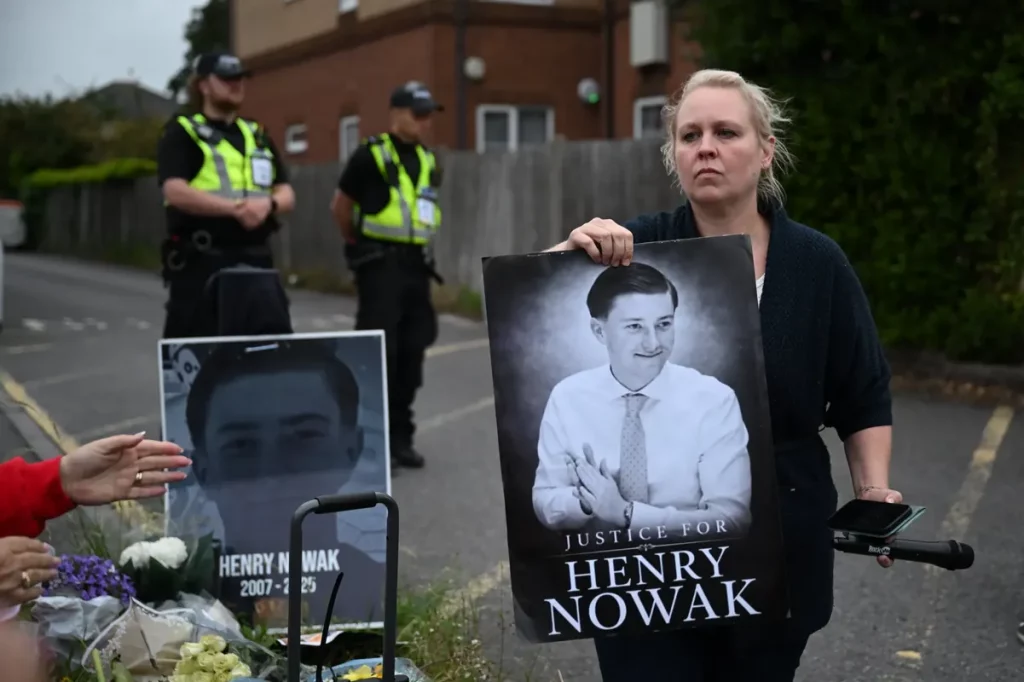
2026.6.7 Protesters take knee at Henry Nowak vigil days after Southampton riots
Protestors gathered outside a police station for a peaceful vigil to mark the killing of 18-year-old Henry Nowak.
A small crowd of people congregated outside Portswood Police Station for speeches, songs made in Henry’s honour, and a 3-minute silence.
Kneeling in the street, mirroring a protest sparked by the killing of George Floyd, people shouted ‘racist police, off our streets’.
It comes after protests erupted in Southampton that saw 14 people charged with violent disorder.
Bricks, fence panels, industrial bins, chairs, and traffic cones were thrown at police officers as unrest continued into the night.
The violent protests followed the sentencing of Vickrum Digwa for the murder of Henry Nowak, after police wrongfully arrested him for racism.
Before the vigil began, a woman addressed the protestors and asked people not to turn violent.
She said: ‘I must stress we are not here for trouble. You had your day. That day is gone. If you’re here for trouble, leave now. That’s not what we’re here for.’
A father asked the crowd to put their hands up if they ‘don’t trust our government right now’, many people raised their hands.
He added: ‘That’s my message to the government. We don’t trust you one bit’.
A woman named Mandy told the crowd: ‘To watch that video was one of the most awful things to see, that someone’s child was treated that way. He was treated like a piece of meat like it didn’t matter.’
She added: ‘This police force needs total upheaval. Do not keep gaslighting us Keir Starmer. We see you for what you really are.’
She ended the speech with ‘Keir Starmer, you’re a fing wer’, which the crowd responded with the same chant.
Attacks on Sikhs have taken place ‘up and down the country’ every day since Vickrum Digwa was sentenced.
Dabinderjit Singh, a senior executive at the Sikh Federation which promotes Sikh issues, made the comments at a march held to commemorate the 42nd anniversary of the storming of the Golden Temple in India’s Amritsar which saw hundreds of people killed.
The event drew thousands of Sikhs to the capital in the wake of violent protests in reaction to the murder of Mr Nowak, who was stabbed by Digwa in Southampton using a ceremonial knife prosecutors said he carried as part of his Sikh religion.
Mr Singh said there have been daily attacks on Sikhs since Digwa was jailed for the crime on Monday, adding it ‘brings home’ the violence faced by Sikhs at the Golden Temple massacre in 1984.
He said: ‘What happened since last Monday, which brings home what happened 42 years ago, is that when that bodycam footage came out, there was real anger.
‘We understand that – we were just as angry with the police officers, and obviously Digwa, because he’s a murderer, (and) those lies he told, but unfortunately, every single day since Monday, Sikhs up and down the country have been assaulted.
‘Children, men, women, pensioners, doctors, people going shopping, people walking in the park.
‘One person went to the gym, and he was told, “We’re going to hang you by your turban”.
‘What if somebody gets killed?’ x1200

—
2026.6.7 Petition to charge officers who handcuffed Henry Nowak smashes past 160,000 signatures
2026.6.7 The shocking stories of Henry Nowak and Iryna Zarutska that expose the hypocrisy of the left
2026.6.6 The 999 call that could clear Jeremy Bamber
The murder of five family members in 1985 sent Bamber to prison, but a Channel 5 documentary casts doubt over the conviction
It is difficult to imagine how the murders of three generations – including six-year-old twins – in a bloodbath at their family farm could get any more tragic.
But what if the man convicted of shooting dead his adoptive parents, sister and nephews had been wrongfully imprisoned for 40 years – all the while grieving for, as he put it on the fateful night, “all the family I’ve got”?
This is the question posed by a new Channel 5 documentary about the White House Farm murders that saw Jeremy Bamber, then 25, convicted in 1986 and given a whole-life tariff. He remains behind bars in HMP Wakefield.
It was Bamber who first alerted the police in the early hours of August 7, 1985, claiming his father had phoned to say his sister Sheila Caffell had “gone berserk” with a gun. Police spent hours shouting through a loudhailer for Sheila to surrender. When they finally entered the Georgian manor house in Essex, they found all five relatives dead: Nevill and June, both 61, their adopted daughter Sheila, 28, and her six-year-old twins, Daniel and Nicholas. Daniel still had his thumb in his mouth.
Almost immediately, officers decided it was a “murder-suicide”; in a psychotic episode, former model Sheila, who had been diagnosed with schizophrenia, had shot her family before turning the gun on herself. But soon, detectives’ focus shifted to the arrogant and entitled Jeremy – accused of framing Sheila for the murders he committed to obtain the family fortune.
The new film, Jeremy Bamber: Proof of Innocence – The Missing Phone Call, includes interviews with his solicitor Mark Newby; Chris Bews, the Essex Police sergeant who broke the tragic news to Bamber; and Philip Walker, director of the Jeremy Bamber Innocence Campaign.
The documentary takes the lead of Heidi Blake, a British journalist for The New Yorker magazine, who investigated the case for a 17,000-word article in 2024 and a 2025 six-part podcast, Blood Relatives. The Pulitzer Prize nominee interviewed several key witnesses, as well as Bamber himself, via daily 10-minute calls from his prison.
Appeals lawyer Emily Bolton tells the film that the case “bears all the hallmarks of the sorts of wrongful convictions that have been overlooked, that I’ve seen in my years practising”. Chief among them is the fresh claim that a 999 call had been made from inside the farmhouse. While scouring through thousands of files, a volunteer working on Bamber’s case discovered a single line in an Essex Police log sheet, which referred to this call.
At the trial, the jury was told that – following Nevill’s reported panicked appeal to his son – the receiver had been left off the hook, and the phone company had been asked to listen into the open line before transferring monitoring to the police station. However, when Blake tracked down the call handler, he had a different version of events. Nicholas Milbank told her that “someone phoned 999 from inside the farmhouse” at 6.09am. He had heard “movement or voices in the background”. Asked if this indicated someone was alive inside the house, he replied: “Well, obviously.”
Given that, at this time, Bamber was outside with police, the call would give him the perfect alibi.
Bamber’s legal team submitted this new information to the Criminal Cases Review Commission, but the CCRC did not interview Milbank. It left it to his employer, Essex Police – the very force accused of making a catalogue of blunders in investigating the case, some of which came to light in the trial. Milbank backtracked, said he had “never to my knowledge spoken to The New Yorker” and fell back on a purported 2002 statement (which made no mention of anyone calling 999 or any noises being heard) that he had told Blake he had never made.
“It’s absolutely ludicrous to allow the investigating force to go and take a statement from him,” says Bolton in the programme. “PC Milbank was essentially a whistleblower. He said something that undermined the police case. He should have been protected.”
But before Bamber’s legal team can register a complaint with the CCRC, they learn that Milbank has died. It leaves no one to answer the contradictions raised by his testimony.
Also absent from Bamber’s trial was any evidence that Sheila had wanted to kill herself. However, there were letters recovered from the crime scene 41 years ago, which may provide proof both of Sheila’s suicidal thoughts and of a psychotic episode. Yet they were deemed illegible and of no evidential value by the police, meaning they were not disclosed – denying Bamber the opportunity to use them in his defence.
Another part of the prosecution’s case was that the blood-stained Bible found next to Sheila was in a position it could not have been, had it fallen naturally, so it may have been placed there by Bamber. But this was put into question by one of Blake’s interviewees, who accuses his former employer of interference with the crime scene. Leading the examination was Detective Inspector Ron Cook, who is now deceased. His deputy, Detective Sergeant Neil Davidson, told the journalist that Cook “lifted the Bible up, had a look at it and then he said, ‘Oh, we’d better put it back how it was’.” He added that there was also “a slight possibility that Ron may have picked up [the gun resting on Sheila’s body] and put it back. It was like this ‘Oh, s—’ moment, you know, better put it back.”
He added of his boss: “Chaos reigned wherever he trod. We used to call him ‘Bumbling Ron’ for a reason. He was a clumsy sod.”
The most crucial piece of evidence at the trial was a firearm silencer. It had not been uncovered in the police search, but rather three days after the murders, when Bamber’s cousins, Ann Eaton and David Boutflour, found it in a downstairs cupboard.
As Sheila would not have been able to shoot herself with the silencer, because it would have made it too long for her to reach the trigger, the judge instructed the jury that if they believed the silencer had been used, then they would have to conclude it was Bamber holding the gun. There was also the blood found inside the silencer, which matched Sheila’s blood group. The jurors wrote a note to the judge asking him to confirm that the blood was a “perfect match” for Sheila’s. After he assured them it did not match anyone else in the family, they returned their guilty verdict 21 minutes later.
However, the case files revealed that tests conducted days before the trial revealed that Ann and David’s father, Robert Boutflour, had the same blood type as Sheila. Moreover, Blake also tracked down David, who admitted that contrary to what he said at the trial, the police had also seized his own identical silencer for “months and months”. Bamber’s team has long suspected that the jury was misled with evidence conflated from different devices.
Finally, ballistics scientist Philip Boyce demonstrates on camera – by firing bullets into pig skin – the differences in wounds left by a gun with and without a silencer. It led him and four other experts to conclude no silencer was used.
According to Bolton in the Channel 5 documentary, “Each of these individual flaws in the evidence should be enough to get the conviction reversed.”
Bamber – played by Freddie Fox in 2020 ITV drama White House Farm – had an appeal heard in 2002, which was dismissed. The only way back to the Court of Appeal is through the much-criticised CCRC. In 2021, Bamber submitted 10 grounds. It took four years to reject just four of them.
Bamber, now 65, has submitted more appeals to the CCRC based on evidence that has emerged over the past two years.
The CCRC told Channel 5: “Work continues to consider additional matters which were raised in Mr Bamber’s application.” Essex Police said: “This case has been the subject of several appeals and reviews… all of these processes never found anything other than Bamber is the person responsible.”
The manifold alleged police errors, combined with the grindingly slow wheels of justice will be familiar to anyone who has followed the plight of Andrew Malkinson – freed in 2023 after serving 17 years for a rape he did not commit – and Peter Sullivan who, before his release in 2025, served 38 years for the murder of Diane Sindall, while the real “Beast of Birkenhead” remained at large.
If Bamber’s conviction is finally quashed, both tragic cases would be put in the shade by a miscarriage of justice that has lasted 40 years, and counting.
2026.6.4 Estate agent died after weight dropped to 5 stone from ketamine addiction
2026.6.3 Hoax McDonald’s call said ‘there’s five people with machetes fighting’
Teenagers Dylan Ash and Kieron Ellison are accused of making a series of hoaxes concerning shootings and bombings as part of an online group
An online group known as “Monkey Mafia” falsely reported that men were fighting with machetes outside a branch of McDonald’s, a trial has heard. Teenagers Dylan Ash and Kieron Ellison are alleged to have been members of the “syndicate”, which is said to have been responsible for a string of hoax calls to emergency services in both the UK and USA.
These included fake reports of shooting and bombings at hospitals, schools, universities and hotels and the targeting of influencers while they were livestreaming on YouTube, apparently hoping to lure armed officers to their homes. The two 19-year-old defendants went on trial at Liverpool Crown Court today, Wednesday, accused of offences including conspiracy to pervert the course of justice.
Joe Allman, prosecuting, told the jury of nine men and three women this afternoon that Ash, from Deal in Kent, and Ellison were members of a “syndicate styled as Monkey Mafia”, which “focussed on swatting activities”. He added in his opening: “Swatting is a particularly serious form of hoaxing.
“It involves making a call, either to the police or to some other entity, and using that communication to convey false information about an armed attack somewhere. The objective, the point in all of this, is to provoke an armed response, and the gold standard for the people who engaged in this community is that a targeted individual is detained at gunpoint by the police.
“The term swatting refers to SWAT, Special Weapons and Tactics, teams. Clearly, those who call in an armed attack to the police, particularly in countries where firearms are readily available, may well expect a response from a heavily armed and robust section of the police. To state the obvious, you might get a more fearsome response if you call the police in America than north west England. This, of course, entails real danger for the people who are being swatted.”
The incidents were said to have occurred between 2022 and 2024, when Ash was aged 16 and Ellison was 15. Mr Allman added: “Monkey Mafia had two different approaches to this. Sometimes, they would target an individual. In the early days, these were people in the UK, in the vicinity of where they lived.
“Later, they would target prominent online influencers in the United States. There are two particular individuals in this case. One is the influencer, Kai Cenat, and the other is Adin Ross. Both were online influencers with large followings.
“What Monkey Mafia would do is place a call to the police or to an entity like a suicide hotline. They would then claim that a person was armed and behaving dangerously, and give enough information for the police to strike at the homes of, for example, Adin Ross or Kai Cenat, as the case may be.
“The second approach was to place a call to the police or to an institution such as a university. What they would do in this scenario is claim that there was an attack happening at a particular location, associated with an institution. So, for example, one of our cases involves Boston University. In this way, basically calling in an armed attack, they targeted universities, schools, hospitals, hotels and so forth.
“Usually, the armed attack call would involve an active shooter, together with a bomb in the form of a suicide vest, or perhaps the claim that there was a bomb or multiple bombs in the building in question. There is no evidence that there were actually any firearms or bombs. These are, as I say, serious hoaxes.
“Here, the aim was to provoke a large scale armed police response, which would cause massive disruption to the institution in question and to the people, of course, who had the misfortune to be there at the time. This, of course entailed a real risk of people being detained by the police, if, for example, they fitted any description provided by the hoax caller, or if their conduct, however actually innocent, gave cause for concern.
“You can imagine any number of scenarios in that kind of febrile atmosphere, where a person who, for example, reached for a phone or panicked and tried to run or simply did not hear and respond to commands might be arrested, or where something very much worse might happen.
“In the first scenario, what they were really hoping to achieve was to see the men arrested in front of their YouTube audience. The purpose was to frighten and humiliate them. In the second scenario, they were hoping to cause major disruption and fear.
“That would emanate from the fact that, from the point of view of the people caught up in the swat, they might become a victim of an armed attack or might be detained or shot by those armed officers who were responding to the call. You can imagine how much upset and disruption this was intended to cause.”
Other swatting incidents were said to have targeted the Tamaya Hyatt Hotel in New Mexico, the University of Nevada, the University of Western Canada, Oklahoma University, the University of Southern California and the headquarters of a company called Earthcam in New Jersey. Another, relating to Sparrow Hospital in Michigan, saw the caller “adopt a fake accent which was intended to sound Asian or Arabic” while giving the name “Sadam from ISIS”.
An earlier example came on October 2 2022, when Merseyside Police received a false report of “males fighting with machetes in the street” in St Helens. In this recording, the caller, giving an apparently fake name, was heard to say: “My name is James Andrew and I’ve witnessed, at McDonald’s on Chalon Way West, there’s five people with machetes fighting, with machetes, like they were all chasing after each other.”
This report went on to state that “four males dressed all in black with their faces covered were chasing a male in a North Face jacket from McDonald’s towards Tesco and the rugby ground”. While Mr Allman stated that the motivation for such activities “may never be fully known”, he told the jury that “some members of Monkey Mafia hoped to monetise the activities of the group” and suggested it was “likely a combination of greed, online vanity, racist hostility and sheer antisocial hostility”.
Ellison’s involvement in Monkey Mafia was said to have ceased following his arrest in June 2023, although Ash and a third man who was not before the court, Liam White, were alleged to have “tried to reboot the swatting activities by setting up successor groups”. This apparently came under the guises of “Kat Squad” and Syndicate Squad”.
Both Ash and Ellison, who appeared suited in courtroom 41 while sitting on the back row of counsel benches rather in the dock, deny five counts of conspiracy to pervert the course of justice and conspiracy to commit a bomb hoax. The former has also pleaded not guilty to a sixth charge of conspiracy to pervert the course of justice.
Judge David Potter meanwhile said of 23-year-old White, of Weston-super-Mare in Somerset: “There is no mystery about this. Liam White has already appeared in court for his part in this case. Please do not speculate any further about Liam. Your task is to reach verdicts on Kieron and Dylan, and you can only do that by concentrating on the evidence for and against each of those.”
Defence counsel were also invited to address the jury on the issues in the case, with Mark Gatley KC saying on behalf of Ash: “What we say on behalf of Dylan Ash is that Monkey Mafia was not a group as such, or even a syndicate, as it has been described. What it was, was the name of a chat group in which members can come and go and can just come along to watch.
“They do not necessarily have to do anything. People on that group would sometimes do things together. They would sometimes do things alone. They would sometimes plan calls, prank calls. It was not a group. Monkey Mafia was a chat group with members coming and going.
“All of this happened at least three years ago, approaching four years ago. Dylan was just 16 at the time, and that is important. If any of you have boys, you will know that is important to bear in mind, when it comes to assessing the intentions or the degree of foresight that 16-year-old boys have, or more often don’t have, about the consequences of their actions.
“We will argue that this is a case of Dylan Ash, a friendless, isolated 16-year-old sitting in his bedroom in his grandparents’ house late into the night, finding a community, often involving older males and getting swept up in the excitement of becoming involved in making prank calls, mainly to the US, where the consequences were, to be frank, far more exciting to watch than in Kent or Merseyside.
“The fact is, never did those consequences once result in a single individual even being arrested. No one was arrested as a result of these calls. No one suffered any harm. In short, never did these prank calls result in the start of any course of justice that could be perverted.
“This is about what might have been. The reality is that there was never any course of justice in respect of any of these calls that could be perverted. We accept that these were stupid and childish acts and, viewed with the wisdom of hindsight, acts which must have been upsetting for call handlers or others involved.
“The central question for you is, is it or might it have been the case that Dylan Ash did not agree to make calls which tended and were intended to pervert the course of justice? Is it or might it be the case that he didn’t? It is for the prosecution to prove the guilt of any given defendant, if they can. To do so, they must make a jury sure of guilt. If they cannot, not guilty verdicts must follow.”
Ellison’s barrister Rabah Kherbane meanwhile added: “You are considering the actions of 15, 16-year-olds. Just think back to being 15 yourself, what you did or didn’t think about when you did things you should or shouldn’t be doing. Did you think 10 steps ahead, or just think about the immediate result?”
The trial continues, and is expected to last for around four weeks.
2026.6.2 Netflix drama based on Rachel Nickell case to be released
A true-crime drama series exploring the aftermath of the horrific killing of a former Colchester schoolgirl is set to be released on Netflix this week.
The three-part series The Witness will be released on the streaming platform on June 4 and explores the 1992 killing of Rachel Nickell, a former student of Colchester County High School for Girls, and the impact of the crime on her loved ones.
Rachel, who was living in London at the time, was brutally attacked while walking her dog on Wimbledon Common, in front of her two-year-old son, Alex.
She was just 23 years old.
Told through the perspective of her partner, André, and their son, the drama focuses on the aftermath of the killing and its effect on those closest to her.
Rachel’s death remained a high-profile unsolved case for years before Robert Napper, who was already detained at Broadmoor Psychiatric Hospital for a separate double homicide, admitted manslaughter on grounds of diminished responsibility.
Mr Justice Griffith Williams said Napper would remain at Broadmoor indefinitely, describing him as “a very dangerous man.”
The drama was produced with input from André and Alex Hanscombe, and stars Jordan Bolger as André and Max Fincham as the older Alex.
It will be released alongside a companion documentary titled The Murder of Rachel Nickell, which includes archive footage and interviews.
The description for the new drama reads: “With their 2-year-old as the sole witness to her murder, Rachel Nickell’s partner fights to protect him amid a flawed investigation. Based on true events.”
Rachel grew up in Essex and attended Great Totham Primary School before moving on to Colchester County High School for Girls, where she studied from 1980 to 1985.
She later took her A-levels at Colchester Institute.
2026.6.2 I’m a therapist for sex offenders. People think I’m a ‘paedo hugger’
Locking up perpetrators doesn’t work. To prevent further abuse, I must understand what drives them
—
2026.6.3 Student’s Murder Sparks Debate Over Whether UK Police Failed White Victims
The murder of Henry Nowak has sparked a debate in Britain about race, policing, and institutional bias, following controversial police actions.
The murder of 18-year-old student Henry Nowak has reignited a contentious debate in Britain about policing, race, and whether efforts to tackle discrimination have created unintended consequences.
The case drew national attention after it emerged that police officers handcuffed Nowak as he lay fatally wounded following a stabbing in Southampton last December.
Bodycam footage showed officers initially doubting his claim that he had been stabbed, with one officer heard saying, ‘I don’t think you have, mate,’ before Nowak was arrested.
He repeatedly told officers, ‘I can’t breathe’, before another officer began checking him for injuries.
While the police force involved has apologised and an independent investigation is underway, the incident has quickly become a flashpoint in Britain’s political debate.
Politicians, including Reform UK leader Nigel Farage, argue the case raises questions about anti-white prejudice within institutions, while others insist the focus should remain on the murder itself and the failures that occurred at the scene.
The case has also drawn attention after being highlighted by Elon Musk and has become a rallying point for competing views about race, policing, and accountability in modern Britain.
Henry Nowak Case Fuels Political And Policing Debate
The debate reportedly intensified this week after Vickrum Digwa was sentenced to life imprisonment for murdering Nowak.
The court found that Digwa had falsely claimed he had been racially abused by the student before the stabbing. Digwa’s family had called the police after the attack and alleged that Nowak had knocked off Digwa’s turban and subjected him to racist abuse.
When officers arrived, they encountered Nowak in severe distress but initially treated him as a suspect rather than a victim. The handling of the situation has become the centre of public scrutiny. Although a court pathologist later concluded that Nowak would almost certainly have died from his injuries even if paramedics had reached him immediately, many critics have focused on the treatment he received during his final moments.
Judge William Mousley said Nowak was handcuffed for around a minute before officers began performing CPR. The local police force later apologised for arresting him, while his father, Mark Nowak, described the incident as deeply upsetting.
‘The way he was treated was inhumane and degrading,’ Mark Nowak said in a statement. At the same time, he stressed that Digwa was ‘100% responsible’ for his son’s death.
The case has since become a major political issue. Farage argued that Nowak’s treatment reflected ‘anti-white prejudice’ and called for an end to ‘positive discrimination and a country that treats everyone fairly and equally before the law’.
Farage also drew comparisons between the public reaction to Nowak’s death and the killing of George Floyd in the United States, saying, ‘White lives matter too.’ Those remarks were strongly criticised by opponents, with the Conservative Party accusing him of attempting to exploit a tragedy to deepen divisions.
The government has taken a more cautious approach. Home Secretary Shabana Mahmood said the Nowak family ‘deserved answers’ regarding police conduct but rejected attempts to frame the case as one centred on race.
‘This is not a case about racism. This is a case about murder,’ Mahmood said.
Larger Questions Raised About Race And Decision-Making
The discussion surrounding the case has extended beyond the events of that night to broader concerns about how race influences decision-making within British institutions.
The case gained even greater prominence after Elon Musk highlighted it on X and expressed support for legal action against those involved. It has also been embraced by Restore Britain, a far-right political movement whose leader, Rupert Lowe, used the case to argue for tougher punishments, including the death penalty, which Britain abolished decades ago.
The case has also led to discussions of other incidents in which concerns about racism were raised during decision-making by officials and authorities.
One example involved Axel Rudakubana, a young Black student who later carried out a stabbing attack at a Taylor Swift-themed dance class, killing three young girls and injuring several others. Joanne Hodson, a deputy headteacher, testified that she had removed descriptions of Rudakubana as ‘cold and calculating’ from his records after being warned she risked stereotyping a ‘black boy with a knife’.
Questions about race and institutional hesitation have also surfaced repeatedly during investigations into Britain’s grooming gangs scandal.
Public inquiries examining the abuse of thousands of girls, including around 1,400 victims in Rotherham, found that some officials and police officers were reluctant to investigate the ethnicity of offenders because they feared being accused of racism. These worries exist alongside a long history of accusations that British police have failed ethnic minority communities. Since the 1990s, forces across the country have faced repeated allegations of institutional racism.
In 2023, an independent report concluded that London’s Metropolitan Police was institutionally racist, sexist, and anti-gay. Senior officers have acknowledged those concerns in the past, while police forces continue to say they are training staff to treat everyone fairly.
2026.6.2 Henry Nowak stabbing: Sentencing remarks in full
Vickrum Digwa, 23, sentenced to life in jail for 18-year-old’s murder
A Sikh man who stabbed Henry Nowak, a Southampton student, with a ceremonial knife in December 2025 was sentenced for his murder on Monday.
Mr Nowak, 18, told responding police officers he had been stabbed four times, but was instead the one arrested after Vickrum Digwa, 23, lied and claimed he had been racially abused.
Digwa was sentenced to life imprisonment with a minimum sentence of 21 years.
Here are the judge’s sentencing remarks in full.
Stand up, please. Henry Nowak, aged 18, died on 3/12/2025. He was a much-loved, kind, hard-working and ambitious young man, devoted to his family and with a bright future. He was a first-year student at Southampton University, the first in his family to go to university. He was careful and principled, full of humour, warmth and promise.
You, Vickrum Digwa, murdered him. By doing so, you robbed him of all those he loved, all the things he cared about and liked to do. He would have been expected to live a long, hopefully, happy and fulfilling life. You have brought misery and a lifetime of loss upon his family, and great sadness to everyone who knew him.
You are 23; in December 2025 you were 22 and had no previous convictions. You may sit down, for now.
Mark Nowak, Henry’s father, has described the devastating and lifelong impact of Henry’s death on him and the whole family. He speaks of the horror of losing his son in such violent circumstances, the trauma of identifying his body, and the lasting torment of imagining Henry’s final moments. He describes overwhelming grief, guilt, helplessness and the pain of seeing Henry’s mother, siblings and wider family broken by the loss. Mr Nowak says that the family has effectively been given “a life sentence”, with the pain affecting every aspect of their lives and every significant family occasion, and that nothing will ever fill the permanent void left by Henry’s death.
Lucy Ross, Henry’s mother, has described the profound and enduring impact of his death upon the whole family. She recalls the devastating moment she was told of his death, and the anguish of having to tell Henry’s elderly grandparents. She describes the continuing grief suffered by the family, including Henry’s sister Olivia, who has lost not only her brother but her best friend, and says that the profound and lasting effect of this loss is something they will carry for the rest of their lives.
Olivia Nowak, the sister of Henry, describes a relationship of exceptional closeness, in which her brother was not only a sibling but her closest companion and a central part of her daily life. His death has, in her words, caused her world to “fall apart”. She recounts the profound shock and trauma of being informed of her brother’s death, and the continuing anguish associated with identifying him, attending his funeral and confronting the many “firsts” without him – his birthday, Christmas and other significant family occasions. The impact upon her own life has been profound and enduring. Her home, once a place of comfort, is now a constant reminder of his absence. She describes the effect on her ability to work, due to persistent grief and intrusive thoughts about the circumstances of his death. She also carries an additional emotional burden as the eldest sibling, striving to support her younger brothers and sisters through their grief while recognising that she is powerless to remove their pain. This compounds her own suffering. The loss, she makes clear, is lifelong. Her life has been permanently changed by the death of her brother, and the emotional consequences remain acute and far-reaching.
David Stevenson, [Henry’s] stepfather, describes the devastating impact of Henry’s death upon him and the wider family. He explains that Henry was his much-loved stepson, with whom he had a close and affectionate relationship, and speaks of the shock of learning that Henry had been murdered and the lasting grief, sadness and anger that have followed. He also explains that the consequences have affected every aspect of his own life, including the loss of his employment, and says that the family will carry this pain permanently.
Katie Woodcock, [Henry’s] stepmother, describes the devastating and far-reaching impact of Henry’s death upon her, her husband, and the younger children in the family. She recounts the trauma of being told by police in the early hours that Henry had been stabbed and killed, and the lasting effect of that night upon her. She explains that the loss has caused profound emotional harm to Henry’s younger siblings, including fear, anxiety, sleep disturbance, difficulties at school and an enduring sense of insecurity. She also describes the strain upon family life, her own grief, fear and inability to concentrate, and the pain of missing Henry in the ordinary moments of daily life. She says that the family continues to live with the permanent consequences of his death.
Not long after 11pm on 3/12/2025, Henry Nowak was walking back to his university accommodation in Portswood, Southampton, after an evening out. His route took him north along Belmont Road and he was approaching a junction with St Denys Road where you lived with your family. Henry was not drunk but may have been affected a little by the small amount of alcohol he had consumed over the previous few hours. He was not a regular drinker and did not generally drink to excess. His blood alcohol level at the time of his death was below the legal limit for driving. He was alone and unarmed. You happened to be walking south along Belmont Road on the same pavement. It was to be a chance meeting.
You were sober but were carrying a large Sikh dagger in a sheath attached to a belt over the outside of your clothing. It is a strict requirement of the Sikh faith to have a knife, called a kirpan, at all times. Generally, this will be a small knife, hidden from view, often on a length of cord and worn around the neck. You had that but, in addition, the large dagger in a sheath. You are a member of an order of Sikhs called the Nihang who have a tradition of having a second knife, or kirpan, and that is often fully visible, believing that the Guru will look favourably on that. You observed that tradition in your everyday life, at work and in public. However, it was not a strict requirement; that is borne out by the fact that neither your brother nor father who arrived on the scene after you had stabbed Henry were so dressed. According to Prof Gurnam Singh, professor of sociology and an expert in the field: “Over the last 30 years, there has been a trend towards younger people wearing a kirpan with pride, in a desire to express their cultural identity. They see it as an act of resistance to being denied the ability otherwise to display their identity.”
The privilege extended to practising Sikhs of being allowed to be in public with a bladed article and, particularly in respect of the large dagger, a highly dangerous weapon, easily accessible to the wearer, brings with it huge responsibility.
It is a fundamental principle of Sikhism that any kirpan is worn as a symbol of religious faith and is never to be carried for an offensive purpose. The legal approach to the carrying of such a knife, as long as the blade length does not exceed nine inches, is that an offence of having a bladed article in a public place will not be prosecuted. There has been an acceptance that its possession in those circumstances can amount to a good religious and, therefore, legal reason for having it. The blade of the knife will not be on display; either it is under clothing or, alternatively, in a sheath. For both, it is a religious and, consequently, legal requirement that a kirpan should only be used offensively as a last resort, which would include its use in legal self-defence. In other words, only if use is necessary and, if so, reasonable in the circumstances. It is obvious that for use to be reasonable, any perceived threat justifying its use would only be in circumstances of great seriousness and urgency.
In Belmont Road, you and Henry passed each other. You claimed he deliberately barged into you. I am sure that was one of the many lies you have told and repeated since it happened. However, there was an interaction between you both. Henry, perhaps cheekily, made a comment, asking if you were a “bad man”. He was filming you on his phone when he said it. The tone of his voice was not aggressive or threatening but, as it turned out, a tragic error of judgment. It is a reasonable conclusion that the comment was because he had seen the large, sheathed dagger. That would have been a very unusual thing for an 18-year-old student and non-Sikh to see.
You moved towards him and, confidently, told him that you were “a bad man”. This was the response, I believe, of someone who thought they were being disrespected, made worse by the perceived intrusion of being filmed. You were not frightened or concerned and grabbed his phone, removing it from him. The exact events which immediately followed were only witnessed by Henry and you. However, it would not be unreasonable to conclude that Henry would have wanted his phone back, believing it had been stolen from him or that he had been robbed. That may have led to a physical struggle between you and him. In that situation, there was every need for self-restraint and control on your part. As someone who was born and raised in the UK, that should have been your focus rather than any distorted view of your religious traditions. Strong words, even a verbal threat, might have been justified but no more.
It would also seem that your turban may have been knocked, pulled or, potentially, punched off your head. The wearing of a turban, at all times, is another fundamental religious requirement of being a male Sikh. The removal of it by another would be considered a serious act and a further mark of disrespect. It is a reasonable conclusion that this would only have added to your anger.
You drew the dagger from its sheath and, as the jury was sure, you deliberately stabbed Henry in the chest with it. The knife passed through several layers of clothing, as demonstrated by the multiple slits in his dark top where the material had been overlaid on itself in the struggle and the single slit in his shirt. It passed upwards through soft tissue, between the two uppermost ribs, catching a lung and cutting an important vein, behind the collarbone. This was to a depth of 8cm from the skin surface. The consequent bleeding flowed into his chest cavity. The pathologist, Amanda Jeffrey, found 1,200 ml, or over two pints, of blood there. She said that no emergency medical treatment would have permitted access to the bleeding vein. In simple terms, he would not have survived, however quickly he received first aid, CPR or expert medical treatment.
You also stabbed him twice to the upper leg at some point, and once again to the lower abdomen/groin area at the front. The latter only resulted in a knife tip injury; the former were both to a substantial depth, although not as deep as the chest wound. Henry’s face was also slashed with the blade of the dagger, but I cannot be sure that was aimed or intended. However, one or more of the four stabs must have had an immediate effect, as Henry was never able to put up his hands to defend himself from further serious injury. He was defenceless.
You, by contrast, had little, if any, injury. You told the attending police that you had a small bruise and swelling to your eye from a punch, but it is not obvious on body-worn footage taken then, and there has been no independent evidence given in the trial of any injury at all to you.
Your brother, Gurpreet, arrived on the scene very shortly after your attack had finished. You then filmed Henry desperately trying to get away from you, somehow scaling a fence, on to a communal bin, before landing on a car in front of the property next door. Bloodstains show that he had got one, more, or all his injuries before then.
You then showed a callous disregard for his wellbeing, knowing you had stabbed him [in] the chest. You continued to make films of Henry suffering, ignoring much of his desperation at having been stabbed. You told him that had not happened, no doubt to convince others who were nearby. Your attitude did not change, even though Henry was clearly going downhill very fast. Your brother did much the same, although he may just have been accepting that which you had told him, rather than lying himself. You lied to him that you had been attacked, picking up on his question about whether it had been accompanied by racism, by falsely claiming that Henry had called you a “P—”. I am sure that Henry had said nothing racist. You are the only person to make that claim and it is completely at odds with his previous character.
You joined your brother in relating these lies to the police. By then your mother and father were at the scene. Gurpreet explained that no weapons had been involved or were present. In fact, whilst he was talking to the call operator, you told your mother to take the murder weapon, sheath and belt away, which she did. You did not tell your father what had really happened. Much of the time you just stood by as he, at least, tried to do something to help Henry.
You carried on telling these wicked lies when police attended on the scene, hampering them in doing their job and, effectively, obstructing the course of justice. You kept Henry’s phone with the incriminating recording of you on it. You had no intention of handing it over. It was found on you after you had been arrested and taken into police custody.
Thereafter, the time came when the police needed permission from a court to extend the time for you to be questioned in custody, and arranged for you and Gurpreet to be taken there for that purpose. They took the opportunity to record secretly any conversation between the two of you on the journey. Speaking in Punjabi, you agreed to pretend you had acted in self-defence, even though you confessed to stabbing Henry three times, including once to the chest with the dagger. You knew you were guilty, demonstrated by your saying to Gurpreet that if there were any cameras in that part of Belmont Road, you would be unable to put forward self-defence. You decided, much as you had at the scene, to try to cover it up. In all your police interviews, you decided not to answer questions about the incident. Instead, you made a written statement, on 7/12/2025, which told more lies.
Once the criminal proceedings were under way, you made another statement, developing and modifying those lies. It was only when you gave evidence in court that you put forward your full defence. The jury entirely rejected that defence and I do too.
In addition to killing Henry and the irreparable harm to those close to him, you have also caused real suffering to others who knew him. You have brought shame upon your family, your community and your religion. Your actions have stirred up racial tension in Southampton and across the country, which have made many Sikhs worried about their own safety even though they have done absolutely nothing wrong.
You bear some responsibility for the offence committed by your mother when you asked her to take the murder weapon away from you after she arrived on the scene. Your lies to the police about what had happened led, in part, to the arrests of your father, brother and mother for murder, and their being taken into police custody. Your mother has remained in custody for the past seven months.
Another consequence of those lies is that the attending police officers honestly believed that there were reasonable grounds for suspecting Henry had committed an offence, and arrested him with the consequence he was handcuffed for about a minute before his condition further deteriorated and the arresting officer began CPR. The police were given a convincing but wholly false narrative of the incident. It was dark and Henry was wearing a dark top. The entry damage caused by the knife through it, would not have been obvious. Whilst there was visible blood on Henry, it would not have clearly been seen coming from that wound, and the clearly visible facial wound was not life-threatening. Henry was complaining that he had been stabbed and was struggling to breathe, but that would not have necessarily told the officers how serious the situation had become. It is the experience of the criminal courts that sometimes, someone arrested and handcuffed will feign injury in the hope they may be released. These police officers were faced with having to make quick decisions in pressurised circumstances about the best way to act. The genuine shock to the particular police officer, when he realised that he had been giving CPR to Henry when he had a serious chest wound tends to show that he was doing his best in a very difficult situation.
You were still present at the scene when Henry was saying he was dying, and still you did not tell the truth about how seriously you knew you had hurt him and the need for urgency. Instead, you said he had not been stabbed and that he was exaggerating.
The sentence for murder is life imprisonment. You will remain in prison for life unless the Parole Board decides that it is safe for you to be released on a life licence. I must specify a minimum period to be served before the Parole Board may first consider earlier release. If you are released you will be on licence for the rest of your life and subject to recall to serve the rest of the life sentence, if a time does not come when the Parole Board is satisfied it is safe to release you again. You would be liable to such recall if you committed any other offence or just broke any licence conditions.
I have to apply Schedule 21 of the Sentencing Act 2020 to identify the starting point for that minimum period. In this case, that gives a minimum term [of] 15 years. The murder did not involve taking a knife to the scene with the purpose to use it to commit an offence or to have it available to do so. It is possible that you had a good legal reason for having the dagger when you met Henry although, considering the jury’s verdict, that reason must have come to an end after you removed it from its sheath. Neither was it a murder for gain; whilst you did take his phone, or even rob him of it, that was neither the purpose of the murder nor clearly a part of it, but I am sure it was a further trigger for what happened to Henry.
There are a number of aggravating factors to increase the starting point. In no particular order, they are as follows: Firstly, you stabbed Henry three other times than when inflicting the fatal wound, all with a highly dangerous weapon. Secondly, mental suffering was inflicted on Henry once he lay dying from his injuries, by your attitude towards him of which he would have been aware and, separately, by your lies, which had resulted in a young adult of good character being arrested and handcuffed. Thirdly, there was additional degradation by filming his suffering. Fourth, your repeated and concerted actions after the event included attempts to cover up and to conceal evidence [and] had a tendency to pervert the course of justice. Fifth, you wrongly placed blame on Henry and your lies also led to unnecessary arrests for members of your family, which would not have happened if you had told the truth. Sixth, you prevailed upon your mother to assist your attempts to pervert the course of justice. Seventh, Henry was only 18, unarmed and alone, which made him additionally vulnerable. Eighth, the offence has had a significant community impact upon others as described and evidenced in press reporting and social media reaction. Ninth, your lies misled the attending police officers, which influenced their decision not only to arrest and handcuff Henry but also to give subsequent emergency first aid in ignorance of the fact that he had a serious chest wound. Lastly, you abused the privilege extended to Sikhs to have a knife in a public place for religious reasons, dishonoured your religion and have now put others at risk of repercussions. Those factors increase the minimum term to 23 years. A number of these would not have applied if you had told the police what you said to your brother in the police van on 5/12/2025.
The mitigating factors reduce that minimum period to 21 years. They are your age, your previous good record with no previous convictions, and a lack of premeditation. There are no others. I am sure that you intended to kill in the moments before you stabbed Henry.
I must also deduct the period that you have already spent in custody since first appearing in court after charge on 8/12/2025. I calculate that to be 175 days before today.
Stand up, Vickrum Digwa. The sentence on count 1 is life imprisonment with a minimum term of 20 years and 190 days before there can be any consideration given to whether you can be safely released before the end of your life. On count 2, the sentence is two years’ imprisonment concurrent to count 1.
If there is a surcharge payable, the order will be drawn up in the appropriate amount.
Henry Nowak was stabbed five times after a chance encounter on a Southampton street
Hours before University of Southampton student Henry Nowak was stabbed to death on a residential street, he unknowingly captured a chilling exchange with his future killer on Snapchat.
The footage, played in court during Vickrum Digwa’s murder trial, showed the 18-year-old finance student jokingly calling Digwa a ‘bad man’ after spotting a large blade he was carrying.
Moments later, prosecutors said, the encounter turned deadly. The case has drawn widespread attention across the UK following Digwa’s murder conviction and fresh questions about the police response on the night Henry died.
Nowak’s Snapchat Video Captured A Chilling Moment
According to reports, the video was recorded on the night of 3 December 2025, as Nowak walked home through Southampton’s Portswood area after spending time with university football teammates.
Court proceedings heard that Nowak noticed Digwa carrying a large blade and began filming.
‘Innit bad, man? What a bad man. You’re a bad man, say you’re a bad man, go on,’ Nowak could be heard saying.
‘I am a bad man,’ Digwa replied.
Prosecutors said the confrontation escalated within moments. Digwa, then 23, chased Nowak and stabbed him five times, including a fatal wound to the chest. Nowak desperately tried to escape, climbing over fences and bins while leaving a trail of blood behind him.
Neighbours heard him shouting that he had been stabbed and called emergency services.
Digwa Found Guilty Of Henry Nowak Murder
A jury at Southampton Crown Court rejected Digwa’s self-defence claim and found him guilty of murder and possession of a bladed article in public on 28 May.
On 1 June, Judge William Mousley KC sentenced him to life imprisonment with a minimum term of 21 years.
The court heard that Digwa was obsessed with weapons and carried a 21-centimetre shastar blade, despite also wearing a smaller ceremonial kirpan associated with his Sikh faith.
The judge also highlighted the disturbing fact that Digwa filmed Nowak as he lay dying and later attempted to portray himself as the victim.
False Claim Led Police To Treat Nowak As Suspect
One of the most controversial aspects of the case involved the initial police response.
After the stabbing, Digwa told officers that Nowak had racially abused him, assaulted him and knocked off his turban, forcing him to act in self-defence.
Police initially accepted that account. As Nowak struggled to breathe and repeatedly told officers he had been stabbed, he was handcuffed and treated as a suspect. Only minutes later did officers realise Digwa’s version of events was false. Nowak collapsed shortly afterwards and died at the scene.
Hampshire Police later apologised, while the Independent Office for Police Conduct launched an investigation into the officers’ actions.
Mother Convicted After Hiding Murder Weapon
The court also heard that Digwa called his mother, Kiran Kaur, immediately after the attack.
According to reports, she arrived before police and took possession of the murder weapon before hiding it at the family’s Southampton home.
Kaur was later convicted of assisting an offender. She is due to be sentenced in July.
Henry Nowak, an 18-year-old British-Polish student from Essex, was remembered by family members as kind, hard-working and full of promise. His father, Mark Nowak, has continued to call for a full investigation into the events that unfolded after his son was stabbed, saying the family is still fighting for the truth.
Vickrum Digwa jailed for life after murdering student Henry Nowak, sparking national outrage and calls for police investigation
A weapons-obsessed killer who stabbed university student Henry Nowak to death before falsely claiming self-defence has been jailed for life with a minimum term of 21 years.
Vickrum Digwa, 23, was sentenced at Southampton Crown Court for the murder of the 18-year-old first-year University of Southampton student, whose death sparked national outrage after police handcuffed him as he lay dying on the street.
The court heard Digwa repeatedly lied to officers after the attack, falsely alleging that Nowak had racially abused him and forced him to act in self-defence. Those claims were firmly rejected by the judge, who said the defendant’s actions had not only devastated a family but also fuelled unnecessary racial tensions.
Student’s Final Moments Revealed In Court
Nowak, from Chafford Hundred in Essex, was walking back to his university accommodation shortly before midnight on 3 December when he encountered Digwa, who was carrying a large bladed weapon.
The court heard that Digwa stabbed the teenager five times, including wounds to his face, legs and a fatal injury to the chest.
Neighbours heard Nowak desperately calling out that he had been stabbed and was dying. He attempted to escape by climbing over a fence, leaving a trail of blood behind him.
Body-worn camera footage later released with the family’s permission showed Henry repeatedly telling officers, ‘I’ve been stabbed’ and ‘I can’t breathe’.
However, after Digwa’s false allegations, officers treated Nowak as a suspect and handcuffed him behind his back while he lay critically injured. Minutes later, he became unresponsive.
Judge William Mousley KC described Nowak as a ‘much-loved’ young man whose murder had inflicted a lifetime of grief upon his family.
Family’s Grief And Calls For Answers
In an emotional victim impact statement, Henry Nowak’s father, Mark, told the court he was haunted by thoughts of his son’s final moments.
‘I couldn’t help Henry in his final moments and there is nothing I can do to bring him back,’ he said.
Fighting back tears, he added: ‘To my dying son, who I love beyond words, I’m so sorry that I let this happen.’
Outside court, Mr Nowak criticised the way his son was treated after the stabbing, describing the contrast between Henry and his killer as ‘unbearable’.
‘Henry should not have died on the streets of Southampton in police custody,’ he said.
The family is calling for a full investigation into the police response, while Hampshire and Isle of Wight Constabulary has already referred itself to the Independent Office for Police Conduct.
Police leaders have apologised, acknowledging that officers were misled by false information provided at the scene.
Weapons Obsession And Life Sentence
Prosecutors described Digwa as having a ‘weapons obsession’. Following the murder, police discovered more than 20 weapons at his family home.
The murder weapon, a 21cm blade carried by Digwa, was later hidden by his mother, Kiran Kaur, who was subsequently convicted of assisting an offender. She will be sentenced next month.
The court also heard evidence challenging Digwa’s claim that the blade was carried as part of his Sikh faith. Sikh organisations stressed that the weapon used was not a traditional religious Kirpan and condemned attempts to link the murder to Sikh religious practice.
Sentencing Digwa, Judge Mousley said he had brought ‘shame’ upon both his family and his religion through his actions and subsequent lies.
Prime Minister Sir Keir Starmer described the case as ‘awful’ and ‘shocking’, saying Henry’s loved ones had endured the pain of a lengthy trial while facing false allegations about a young man who was ‘thoughtful, kind and deeply loved’.
For Nowak’s family, however, the sentence brings only limited comfort as they continue to seek answers about the circumstances surrounding the teenager’s final moments. x1200
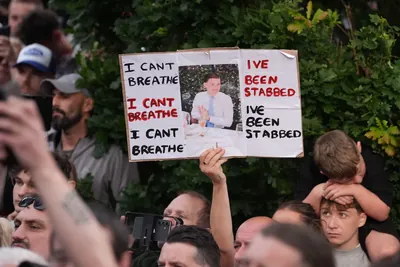
The Reform UK leader described the incident as the ‘most shocking footage of discrimination that you will ever see’
Nigel Farage has declared “white lives matter too” after police finally released harrowing bodycam footage of officers handcuffing 18-year-old Henry Nowak.
The Reform UK leader, who piled pressure on Hampshire and Isle of Wight Constabulary to release the footage, suggested the university student’s arrest was an example of two-tier justice.
Officers were recorded approaching Nowak after the 18-year-old was stabbed with a 21cm Sikh ceremonial knife five times on his way home from a night out in Southampton on December 3 last year.
Mr Nowak, who was pushed into the gravel on a driveway, told officers in attendance “I have been stabbed” and “I can’t breathe”.
One officer was heard replying: “You’ve been stabbed, mate? I don’t think you have.”
Officers proceeded to handcuff Nowak, placing his arms behind his back despite his cries for assistance.
Vickrum Digwa, 23, who was sentenced to life in prison yesterday, was then heard repeating his false claim about Nowak racially abusing him while officers asked the murderer if he had been injured.
Following the release of the footage last night, Mr Farage said: “This is the most shocking footage of discrimination that you will ever see.
“A white boy being handcuffed by police officers more concerned by an accusation of racism than an act of murder.
“This must be a turning point. White lives matter too.”
Hampshire and Isle of Wight Constabulary admitted being “misled” by Digwa after the 23-year-old claimed Mr Nowak had started a racially aggravated attack.
Sentencing the vile murderer in court, Judge William Mousley KC concluded Digwa had lied to officers at the scene.
He said: “I am sure that Henry had said nothing racist.
“You are the only person to make that claim, and it is completely at odds with his previous character.”
The incident has drawn comparisons to George Floyd’s murder by police officers in Minnesota in May 2020, including from Mr Farage’s party colleague Robert Jenrick.
Mr Jenrick said Mr Nowak’s death should spark the same level of widespread outrage which broke out after Floyd’s death, particularly after British politicians embraced the dawn of the Black Lives Matter movement.
Sir Keir Starmer was infamously pictured taking the knee alongside then-deputy Labour leader Angela Rayner.
The Prime Minister last week came under fire following Nowak’s murder after appearing reluctant to release a statement.
Sir Keir finally broke his silence yesterday by penning an 89-word response after Digwa was sentenced at Southampton Crown Court.
He said: “This [is] an awful, shocking case. Henry’s loved ones have gone through the trauma of a long trial and endured Henry’s killer making up appalling claims about their son, who was thoughtful, kind and deeply loved.
“It is right that the IOPC is investigating the police’s response to his senseless murder. And we must end the cycle of tragedy by tackling the horror of knife crime.
“Henry’s family, friends, his university and the city of Southampton will continue to feel his loss, and our thoughts will always be with them.”
The Prime Minister is also facing calls to carry out a review into banning bladed articles currently protected under religious exemptions, including the kirpan.
Hampshire’s Police and Crime Commissioner Donna Jones said: “I intend to write to the Prime Minister to request a national review of the laws concerning the carrying of bladed articles under religious exemptions.
“Nothing can bring Henry back. There is no doubt Henry’s last moments were terrifying.
“My thoughts remain with his family and I will do everything I can to ensure this can never happen again in this country.”
Hampshire and the Isle of Wight Constabulary last week apologised for its handling of Mr Nowak’s death.
The Independent Office for Police Conduct is now investigating the incident.
2026.6.1 Henry Nowak murderer jailed for life after stabbing student with Sikh ceremonial knife
A Sikh man has been jailed for life with a minimum term of 21 years after murdering a university student by stabbing him with a religious ceremonial knife.
Vickrum Digwa, 23, was sentenced at Southampton Crown Court this afternoon for the murder of Henry Nowak.
Mr Nowak was killed on December 3 last year, as he was walking home from a night out in Southampton.
He was stabbed five times, including a fatal wound to the chest, by a 21cm Sikh ceremonial blade known as a “Kirpan”.
At Southampton Crown Court last week, Digwa was found guilty of two charges, murder and carrying a knife in public.
Digwa’s mother, Kirun Kaur, also received a guilty verdict for assisting a defendant by removing the weapon from the scene.
Police previously apologised for the treatment of Mr Nowak, who was handcuffed just moments before he died.
Nicholas Lobbenberg KC, prosecuting, told the court: “This was a sustained attack on an unarmed man. The defendant is skilled with weapons, he trained with weapons, he sleeps in a room with weapons, he searches for weapons on his phone.
“The Crown says he is a man with a weapons obsession. He chose to use a weapon on the streets of Southampton, this demonstrates in his mind what he had was a weapon ready and available for his use.”
The judge also addressed claims Nowak had used a racist word against Digwa, which the killer’s defence had used to aid Digwa in his case.
“I am sure that Henry said nothing racist,” he said when addressing Digwa. “You are the only person to make that claim and it is completely at odds with his previous character.”
The judge noted “Henry Nowak dying alone, humiliated and handcuffed was a direct consequence of Vickrum Digwa’s dishonesty” and Digwa’s defence “describing Henry as a violent, drunk, racist aggressor, compounds the grief of the family”.
Mark Nowak, the father of Henry Nowak, broke down in tears as he read his victim impact statement to the court, in which he described the family’s devastation at the loss of his “beautiful son”.
He said: “As a father, it is my job to protect my child and I failed to keep him safe, I was not there when he needed me most, the thought of him lying in the road, scared, bleeding to death will haunt me forever.
“I have been traumatised by not knowing exactly what happened that night. A parent losing a child is the worst thing in the world but not knowing how it happened is like a fate worse than hell.”
Mr Nowak, who has three other children, added: “There is a Henry-shaped hole in our family forever and nothing will heal that. If I could swap places so the four of them could be together again, I would do so in a heartbeat.”
Describing the impact of Henry’s absence at key family moments, he said: “Completely and utterly devastating doesn’t begin to describe how we are feeling as a family on these significant days and every day in between.
“I am haunted by all things he will never do. As a family, we have all been given a life sentence, this pain will be with me until my dying day.”
Olivia, the sister of Henry Nowak, spoke directly to the defendant as she told him: “If you had known him, you would never have hurt him.”
She told the court: “My brother was my first best friend, an unbreakable bond, we lived our life to the fullest together. He lit up every room that he walked into and the world became less valuable the day he left.”
She described him as “funny, handsome, precious and kind”, and added: “My brother should not be forever 18, he deserved to grow old and start a family of his own, to be an uncle to my children.”
A key piece of evidence shown in court was a snapchat video taken by Nowak moments before the incident, in which he filmed Digwa and said “go on, say you are a badman”.
In the video, Digwa responds, “I am a bad man” and approaches Nowak and grabs his phone and holds it throughout the incident.
Another video, taken by Digwa, was shown in court, where Nowak climbs over a fence in an attempt to get away from his killer.
Mr Nowak called out several times, saying, “I have been stabbed” and “I can’t breathe”.
“You have brought shame upon your family and your religion,” the judge added when addressing Digwa.
“Your actions have stirred up racial tension in Southampton and across the country which have made many Sikhs worried about their safety.
“You, Vickrum Digwa, murdered him; by doing so, you robbed him of all the things he loved. You have brought misery and a lifetime of loss to his family and anyone that knew him.”
If released, Digwa will remain on licence and be subject to recall.
—
2026.5.6 Palestine Action activists convicted in UK for break-in at Israeli defense factory
LONDON (AP) — Four Palestine Action activists were convicted Tuesday of breaking into an Israeli defense factory in the U.K. and smashing equipment with sledgehammers and crowbars.
Jurors in Woolwich Crown Court found Charlotte Head, Samuel Corner, Leona Kamio and Fatema Rajwani guilty of criminal damage. They face sentencing June 12.
The attack was one of the events that led the government to ban the group as a terrorist organization. London’s High Court said that decision was unlawful, but has kept the ban in place while the government appeals.
The group said they wanted to dismantle drones and weaponry they believed would be used to kill people.
Head was behind the wheel of a van that crashed through the gates of the Elbit Systems factory in Bristol on Aug. 6, 2024.
The four activists, dressed in red jumpsuits, began destroying property before ending up in a fight with security guards and police that left one officer with a broken back.
Prosecutor Deanna Heer said the attack was “meticulously organized” to cause maximum damage and get information about the company. The raid caused an estimated 1 million pounds ($1.36 million) in damage.
Corner was also convicted of inflicting grievous bodily harm for striking police Sgt. Kate Evans twice in the back with a sledgehammer, fracturing her spine.
Two others, Zoe Rogers and Jordan Devlin, were acquitted of criminal damage.
The convictions followed a previous trial in which jurors acquitted the six of aggravated burglary but could not reach verdicts on criminal damage charges.
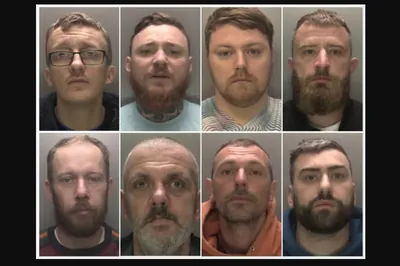
2026.5.5 Cocaine gang who ‘operated freely’ between Leicestershire and West Midlands jailed
Officers said the gang’s drug dealing had a ‘huge impact on our communities’
Eight men who took part in a major cocaine dealing gang which operated between Leicestershire and the West Midlands have been jailed.
The men are the latest to have been put behind bars for their role in the network after eight others were jailed for conspiring to supply Class A drugs in April last year.
Leicestershire Police said Steven Merrick, Sean O’Farrell, Thomas Higginson, Michael York, Paul Meek, Peter Tomkowicz, Damien Haswell and Daniel Barlow all played roles in the operation.
Evidence dating back to 2023 – which was gathered by the East Midlands Special Operations Unit (EMSOU) – showed Merrick, O’Farrell and Higginson to be involved in a West Midlands, largely Coventry-based group, who supplied wholesale quantities of cocaine.
York, Meek, Tomkowicz, Haswell and Barlow were all found to be involved in a group based in Barwell and Hinckley, obtaining cocaine from the West Midlands-based group and then supplying this onto ‘customers’.
Enquiries found that Merrick was a courier of wholesale quantities of cocaine but was also involved in street-dealing. More than £12,000 in cash was recovered from Merrick’s home in Warwick and following his arrest, images of cocaine were found on his phone.
Messages exchanged between Higginson and O’Farrell which discussed the supply of cocaine were also uncovered, as well as images of cocaine, found on Higginson’s phone, including wholesale quantities in the process of being broken up.
Evidence of meetings between the eight men was also gathered. This included evidence of a meeting in Coventry in June 2023 when O’Farrell and Higginson approached a vehicle, delivering cocaine to Meek and Tomkowicz who were inside.
Meek was also found to be involved in multiple cocaine deliveries on Thursday, June 22, 2023 and evidence, including phone messages, showed him being further involved in the supply of cocaine to users.
Phone evidence also showed Tomkowicz as being involved in the supply of cocaine to users.
According to officers, York was found to be a point of contact to provide cocaine to ‘runners’ and himself delivering “significant” wholesale quantities of cocaine. He was found to be trusted with access to stores of cocaine and handling large amounts of cash.
Images of a ‘dealer list’ and of bundles of cash were found on his phone and, on his arrest in August 2023, he was found to be in possession of £1,045 cash and 15.10g of cocaine.
Haswell was found to be involved in the conspiracy on a number of dates acting as a courier, while messages showed Barlow to be involved in the collection of cash and cocaine in August 2023.
Police enforcement activity took place between May 2023 and April 2024 leading to all the defendants being charged in April 2024.
All eight men were sentenced at Leicester Crown Court on Friday (May 1) to a total of 47 years for conspiracy to supply Class A drugs – cocaine.
The eight men were sentenced to jail terms of:
Merrick, 33, formerly of Greville Road, Warwick, was sentenced to seven years and seven months imprisonment after pleading guilty in September 2024 to conspiracy to supply Class A drugs
O’Farrell, 36, formerly of Lillington Road, Coventry, was sentenced to five years and three months imprisonment after pleading guilty in September 2024 to conspiracy to supply Class A drugs
Higginson, 31, formerly of Henley Road, Coventry, was sentenced to three years and nine months imprisonment, after pleading guilty in September 2024 to conspiracy to supply Class A drugs
York, 34, formerly of Devitt Way, Broughton Astley, Leicestershire, was sentenced to six years and three months imprisonment after pleading guilty in September 2024 to conspiracy to supply Class A drugs.
Meek, 40, formerly of Newlands Road, Barwell, Leicestershire, was sentenced to seven years imprisonment after being found guilty in February 2026 following trial of conspiracy to supply Class A drugs
Tomkowicz, 47, formerly of Newlands Road, Barwell, Leicestershire, was sentenced to seven years imprisonment after being found guilty in February 2026 following trial of conspiracy to supply Class A drugs
Haswell, 40, formerly of Kirkby Road, Barwell, Leicestershire, was sentenced to four years and 11 months imprisonment after pleading guilty in January 2026 to conspiracy to supply Class A drugs
Barlow, 31, formerly of Borrowdale Close, Earl Shilton, Leicestershire, was sentenced to five years and three months imprisonment after pleading guilty in August 2024 to conspiracy to supply Class A drugs
Detective sergeant Chris Sewell said: “Drug offending of this kind has huge impacts on our communities. We will continue to gather information and intelligence and to take action against those who offend in this way.
“The people involved here believed they could freely operate without being brought to account or to face responsibility for their actions.”
People are being reminded to report any information in relation to drug offending to the police through their website or by calling 101.
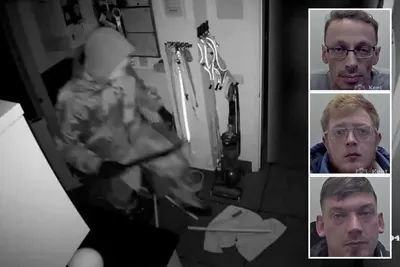
A MACHETE-wielding gang of masked burglars have been jailed after storming a home and demanding victims hand over their luxury watches.
The gang broke into a property in Folkestone, Kent, wearing balaclavas and boiler suits while brandishing the weapons in November 2024.
Kent Police were scrambled to Corbett Road in Hawkinge at 10.18pm on November 3 following the home raid.
The force said the victims were at home at the time of the break in when they were alerted by a loud noise.
When they investigated, they came face to face with the criminals who had forced their way inside.
The burglars then threatened them with machetes and demanded they hand over their possessions, including watches and clocks, before fleeing the scene in a white Audi.
It was described as a “truly terrifying and traumatic ordeal” for the victims with the criminals described as “cowardly offenders”.
Following the burglary, cops launched an investigation and quickly arrested Callum Elliot, 23 and Darren Butler, 36, who were charged two days later.
Officers then discovered evidence that William Webb, 34, had plotted to carry out the crime.
It was found that he had planned the burglary through “extensive research and preparation”.
He was arrested the following January 2025 and later charged.
The gang-of-three were given a combined custodial sentence of almost 19 years after they were jailed last week.
Butler and Elliot both admitted to aggravated burglary and were sentenced at Canterbury Crown Court on Friday, April 24.
Butler was jailed for eight years and seven months while Elliot was put behind bars for seven years and two months.
Webb was found guilty of conspiracy to commit burglary in a unanimous jury verdict following a trial and was sentenced at the same court for three years and two months.
Investigating officer, Detective Constable Holly Bayliss said: “The victims in this case were subjected to a truly terrifying and traumatic ordeal, and lives have been changed forever as a result of the despicable actions of these cowardly offenders.
“I am very pleased that significant custodial sentences have been handed down to them, and I hope it will be of some comfort to the victims to know that those who targeted them in such a brutal manner will spend a long time behind bars.
“Everyone has the right to feel safe and secure in their homes, and those who would commit such dreadful crimes as this should expect to be tracked down and made to face justice.”
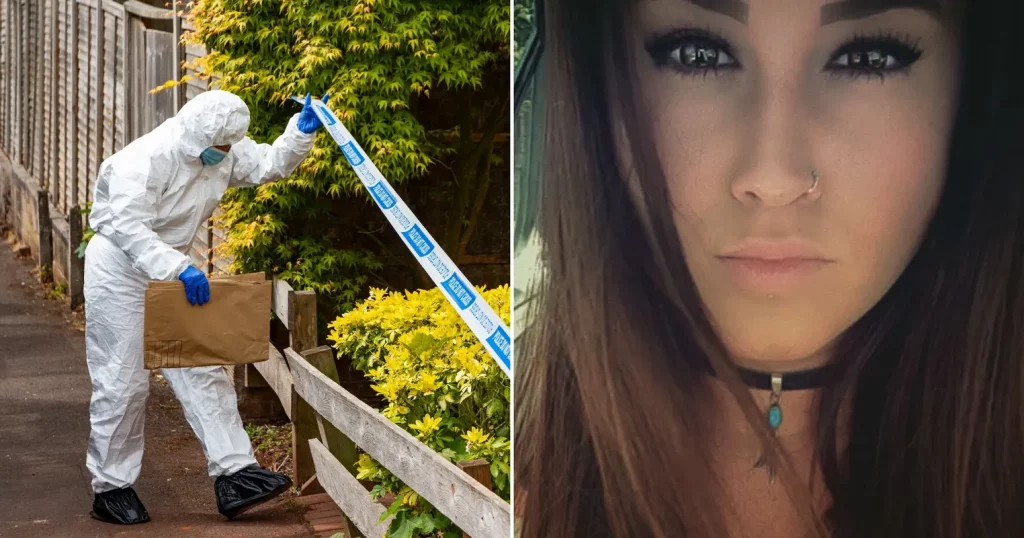
A mum who died in a grenade explosion in Bristol this weekend has been pictured for the first time.
Joanne Shaw, 35, died alongside her ex-boyfriend Ryan Kelly, 41 in a ‘suspicious’ blast on Sunday morning.
Police say they were called to a domestic fight at a home on Sterncourt Road at 6.17am on Sunday.
In an update this afternoon, Avon and Somerset Police said: ‘Although the formal identification process has not yet been completed, we believe the woman to be 35-year-old Jo Shaw who lived at the address in Sterncourt Road, and the man to be her 41-year-old former partner, Ryan Kelly.’
Neighbours claimed that Joanne had just moved to a terraced home on the Bristol street to escape her ex-partner.
Neighbour Stuart Blanchard said: ‘She had been complaining to the police for some time before this incident, and he had been harassing her.
‘It’s a shock for everyone because they were a really nice family, I cannot believe it has happened. It wasn’t Jo’s house, it was her parents’, she just lived there. She had split up with him, and I think she moved there to escape from him.
‘I’d heard the shouting before while having breakfast, something like ‘get out, get out’, but there’s something every week in this area, so I didn’t go out.’
Local Wayne Smith, 58, told The Sun: ‘He’s turned up at her house with a grenade and detonated it on the doorstep and killed the pair of them.’
Friends and neighbours have begun to pay tribute to the victim, who is understood to have worked at a local tanning salon.
Ryan Kelly, 41, has now been identified as the man who died at the property. He previously dated Shaw.
Superintendent Matt Ebbs said: ‘A woman and a man have died at the address and we’re treating the explosion as suspicious.
‘Their families have been updated and are being supported by specially trained officers. Our thoughts are very much with them.’
The neighbourhood has since been declared safe after bomb disposal units moved through and checked for any unexploded ordnance.
More than 70 people had to be evacuated to a nearby Harvesters pub before being moved on to a community centre.
A pub worker told Metro: ‘Obviously, they were very confused, very worried because there was a lot of speculation, but they seemed to be in good spirits.’
Several double-crewed units were dispatched to the address shortly after the initial call was made to police, with the caller remaining on the line.
At around 6.30am, the caller said the man was believed to have an explosive device. Two minutes later, the explosion took place and ambulances arrived on the scene at 6.34am.
Police are currently not looking for anyone else in connection with the incident, and they are not treating it as a suspected terrorist event.
One witness said a loud bang around 6.30am and went to investigate, until being told to ‘get inside’ by armed police forces.
A resident told the Mirror that he and his partner are helping elderly neighbours evacuate to a nearby pub.
He added: ‘We have been told to stay in the Harvester until further notice. We may not be able to go home tonight.’
Another resident claimed to see smoke from a house, telling BristolLive: ‘There were two or three unmarked police cars and a number of ambulances and police vehicles, and now the bomb squad is there.’
Kelly spent five years in prison after he admitted to conspiracy to supply cocaine in 2015, along with seven other men, in what has been branded a ‘Breaking Bad’ drug gang.
The operation was run by George Rogers, who was battling lung cancer, from prison.
He had planned to set up a lab where a self-taught chemist would produce crystal meth before police brought the gang to justice.
x1200
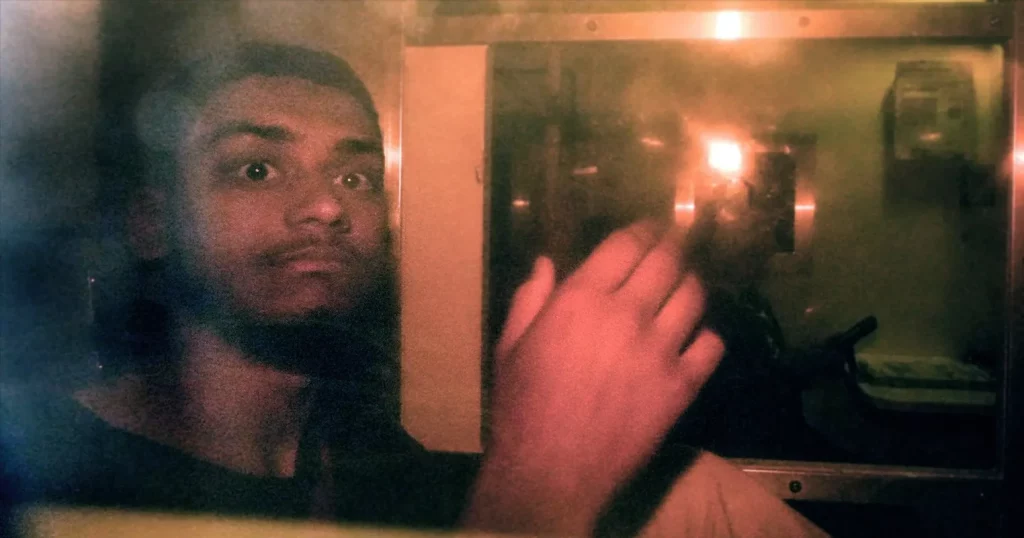
A teenager accused of a bomb hoax at a Peter Kay gig has been pictured for the first time.
Almost 13,000 people were evacuated from Birmingham’s Utilita Arena on Friday less than an hour into the show following reports that a suspicious bag had been found.
Omar Majed, 19 – who has been charged in connection with the incident – allegedly barged into the venue without a ticket and indicated to a police constable and others that a bomb may have been left at the venue.
He appeared at Birmingham Magistrate’s Court today, but was removed and taken down to the cells just 11 minutes into the hearing following an outburst.
After confirming his address and date of birth, Majed, from Saltley, Birmingham started shouting from the dock over proposed bail conditions which he said were ‘not acceptable’.
District Judge Michelle Smith, appearing via video-link, repeatedly asked Majed to be quiet and to sit down before he was led out of the courtroom.
Majed gave no indication of a plea to a charge of communicating false information to police. He was remanded in custody until next month.
Judge Smith said: ‘Based on everything I have read and have heard I am satisfied that the case should be dealt with in the Crown Court.
‘The case will be sent to Birmingham Crown Court on June 1.’
Kay, 52, was ushered off stage and his show, part of his Better Late Than Never national tour, was cancelled following Friday’s evacuation.
Police scoured the arena but later confirmed nothing suspicious had been found.
In an update on Saturday evening, West Midlands Police said: ‘An evacuation of the arena was ordered yesterday evening after a report of a suspicious bag being left in the area.
‘Following searches, nothing suspicious was found and we are grateful to everyone for their co-operation and understanding.
‘As always our priority is the safety of the public.’
x1200

A shoplifter has been banned from every Tesco within 60 miles after inflicting ‘misery’ on shop owners.
Amy McCarthy, 32, has been handed a two-year Criminal Behaviour Order after she admitted two counts of theft from the supermarket chain at Liverpool Magistrates’ Court.
It bans her from even setting foot in Birkenhead Town Centre and bars her from entering any Tesco store in Wirral.
McCarthy, who also has previous for interfering with cars, is also prohibited from touching, entering or attempting to get into any vehicle without the owner’s permission.
Wirral Neighbourhood Inspector Nicola Hughes said: ‘Theft from business is not a victimless crime as it has a huge impact on the community in many ways such as the cost being passed on to the consumer.
‘This Order demonstrates that we will not accept this kind of behaviour as the norm, and this ban prohibits McCarthy from entering Birkenhead Town Centre and all Tesco stores in Wirral which prevents her causing further misery to businesses.
‘Criminal Behaviour Orders are an effective mechanism in tackling theft, and should she breach this order then she will be arrested and could be imprisoned.’
McCarthy, of Tranmere, was made subject of the order after repeatedly targeting the Tesco on Upton Road, stuffing her bag with cheese and fresh poultry items.
Under the conditions, she is also barred from entering Vue Cinema in Birkenhead and is bound to leave a shop or business premises when asked to leave by staff.
A Chinese student pressed an imitation handgun into a woman’s chest and threatened her with a lock knife after she refused to rekindle their relationship.
The young woman feared she was about to be killed by Zhao Tong Li during the incident but took advantage of him dropping the gun on a stairwell.
She ran petrified to security in the reception area of the student accommodation block, where they both lived in Claypath, Durham.
Li abandoned the realistic-looking firearm in a nearby Tesco store, from where it was recovered, and the lock knife was discovered on him when he was detained by security, who also contacted police.
The arrest of Li, in February, brought an end to his victim’s nightmare ordeal, since shortly after she began her studies in Durham, in September 2023.
Durham Crown Court was told they met and became friends, and in May 2024 began a relationship.
John Crawford, prosecuting, said the victim noticed a change in the defendant’s behaviour, becoming more possessive and controlling over who she could see and where she went.
When she ended the relationship, in October 2024, he reacted badly, sending her multiple messages and making numerous calls, often telling her he was waiting outside her room.
He accused her of sleeping with other people, but became angry when she confronted him, telling him to leave her alone.
Li tried to win her affections back by giving her numerous gifts and threaten to kill himself when she refused to resume the relationship.
Mr Crawford said Li told her that his family in China were angry and would make her “disappear”, but he claimed he would help her.
Maintaining an elaborate hoax she was in danger from his family, who had found out where she lived, he staged a smoke bomb attack in her room and planted tracker devices to monitor her movements, telling her she was at risk.
Mr Crawford said it reached the point where Li would sleep on the floor of her room to “protect her” from attack.
She became anxious and it affected her studies, but she discovered his claims about his family were all a ruse to maintain control over her.
The victim confronted him and he admitted making up the claims about the family threats.
Despite returning to China in March last year, Li came back to Durham in September, but she did not see him until shortly before Christmas, when he began messaging her again.
It culminated in the gun and knife threat incident on February 9, which began when she returned to her accommodation at 9.40pm and she saw him loitering near a lift.
Li, 23, of Claypath, Durham, admitted threatening a person with an offensive weapon, possessing an imitation firearm with intent to cause a fear of violence, attempted kidnap and controlling and coercive behaviour.
The victim said she felt “emotionally broken” by Li’s actions, which left her suffering nightmares and panic attacks, as she felt in genuine danger.
She has struggled to keep up with her university work and has moved out of Durham City as a result, remaining “extremely fearful” of him.
Laura Miller, for Li, said he now wants to return to China and has no intention to contact the victim anymore.
The court heard Li was considered a gifted biology and anthropology student and had offers to continue his studies to a higher level.
Judge Richard Bennett told the defendant that having come to Durham to study, the victim, “had the misfortune to meet you.”
The judge said Li’s true character emerged when she tired of his “increasingly desperate attempts to control her” and ended the relationship.
But he then fabricated the façade she was at risk, painting himself as, “the knight in shining armour” seeking to protect her, when it was he who was the source of that danger.
He said the defendant’s “obsessive and unhealthy behaviour” came to a head on February 9 when he escalated matters and left his victim fearing for her life.
Imposing a five-year prison term, the judge said as a foreign national the defendant would probably be deported upon his release on licence at the mid-point of the sentence.
He also made Li subject of a five-year restraining order prohibiting him from contacting or approaching the victim.
2026.4.30 Care assistant banned after sending Snapchat photo of elderly dementia patient captioned ‘b-h’
An “arrogant” care home worker took a photo of an elderly resident and sent it on Snapchat with the caption “B-h”, a tribunal has been told.
Ankit Shah has been issued with a removal order by an NI Social Care Council (NISCC) fitness to practise committee.
Shah had been working as a care assistant at the Rosevale Lodge Care Home in Lisburn at the time of the incident in June 2024. The elderly woman he photographed suffered from dementia.
In evidence to the committee, a manager at the care home said that, in her dealings with Shah, she “found him to be arrogant”.
Three misconduct charges were found proven against Shah including that, on June 3, 2024, he took a photograph of a service user with dementia without their knowledge or consent.
Shah was also found to have added an offensive caption about the service user and to have shared the image via social media with a third party.
The tribunal was told the manager at Rosevale raised the matter with the NISCC on June 7, 2024, saying a message had been received from [name redacted] claiming “one of our employees, Ankit Shah had sent her a screenshot of one of our residents via Snapchat”.
The manager added: “She had attached evidence. The resident was pictured fully clothed sitting in a chair, but the name ‘b***h’ had been added to the photo.
“There was also a copy of a snippet of a conversation attached which read ‘what has she done’ with response ‘all day she’s bla bla bla bla’.”
Shah was subsequently suspended from work.
In evidence, a manager said that when the allegations were put to Shah, “he shrugged his shoulders, did not offer an apology, and was not overly concerned”.
She said that she had only known Shah for five or six months since she took over her managerial role. She added that no concerns about his direct care of service users had previously been identified.
The tribunal heard that, on October 17, 2024, as the Health Trust continued to investigate the case, the home manager invited Shah to an initial right-to-reply meeting scheduled for the following week.
But Shah replied that he had returned to India “due to significant emotional distress”, and that he was unable to attend the meeting on that date.
Shah then handed in his notice, with immediate effect, via email on October 25, 2024.
The manager said that due to the service user’s dementia, she was not aware of the photo incident and did not have the ability to understand or retain the information.
The committee said Shah’s misconduct was an abuse of his position of trust and a serious breach of professional standards.
It added: “The misconduct involved the abuse of a vulnerable service user. Shah has not apologised or provided any evidence of remorse or regret. He has not engaged with the council or attended the hearing”.
2026.4.30 Golders Green victim: Labour to blame for anti-Semitic attacks
‘Streets of London not safe for Jewish people’, says stabbing victim as he recovers in hospital
A victim of the Golders Green terror attack has blamed Labour for making London “not safe for Jewish people”.
Shilome Rand, who was stabbed after leaving his synagogue on Wednesday morning, said the Government was “not doing its job” by failing to protect British Jews.
The 34-year-old, who is recovering in hospital following the north London attack, said members of the Jewish community were afraid to walk the streets.
“I definitely feel that the Government has let us down,” said Mr Rand.
Asked if he held the Government partly responsible for what had happened to him, he said: “Definitely. The streets of London are not safe for Jewish people.”
He told ITV News: “The Government, they are the ones that are able to take care of the problems, and they are not doing their job. People are really concerned, people are afraid, people are uncomfortable walking in the street, people are blaming the Government for not doing anything about what’s going on.”
Footage of the incident showed Mr Rand fleeing from the attacker. He said the 45-year-old Somalia-born suspect had “looked angry”.
“You could feel it in his facial expressions – it was like he was out to get me,” he said. “Thanks to God I’m here today. I could have been elsewhere, he could have taken a life. I am here and I can talk, and it’s really a miracle that has happened to me today.”
Mr Rand was told he needed emergency surgery before doctors decided the wound was not as bad as thought.
The other victim has been named as 76-year-old Moshe Shine.
Mr Rand’s mother said she was “pretty horrified that these things could happen on the streets of London, in an innocent community where we try our best not to hurt anyone”.
She told the BBC that he was in a stable condition, adding: “I was able to see him yesterday. Thank God, he was conscious the whole time. We hope he will be home before Shabbat.”
Police said the suspect had a history of serious violence and mental health issues and confirmed that the incident was being treated as a terrorist attack. Harakat Ashab al-Yamin al-Islamia, an Iran-linked Islamist group, claimed responsibility.
Ministers are under pressure to ban pro-Palestinian marches in the wake of Wednesday’s attack amid claims that they contribute to “a tone of anti-Semitism”.
Mr Hall said it was currently impossible for such marches not to “incubate” anti-Semitism and called for a moratorium on them.
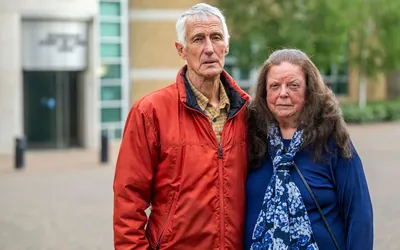
2026.4.29 Carpenter fractures neighbour’s eye socket with wooden plank in noise row
Christopher Wellman, 36, spared jail after attacking pensioner next door who complained about ‘blaring music’
A carpenter who hit his elderly neighbour’s head with a piece of wood because of a noise dispute has been spared jail.
Christopher Wellman, 36, was doing some work at his mother-in-law’s house in Walditch, near Bridport in Dorset, when Colin Prior, who lives next door, approached him to complain about the noise.
When Wellman ignored him, Mr Prior, 76, put his foot on the tradesman’s electric saw.
The carpenter reacted by taking a “long back swing” with a large piece of wood, hitting the pensioner on the side of the head.
The force of the blow fractured Mr Prior’s cheekbone and eye socket and split his ear “essentially in half”, while Helen Prior, his 73-year-old wife, watched in shock.
Mr Prior, a retired BT engineer, driving examiner and former magistrate, said both he and his wife were psychologically affected by the assault “on their doorstep”.
Wellman admitted to inflicting grievous bodily harm without intent and was given a 14-month term, suspended for 18 months. He was ordered to carry out 200 hours of unpaid work and to pay £5,000 compensation to Mr Prior.
Mr Prior said he was disappointed Wellman didn’t go to prison.
There had been ill-feeling between Wellman’s family and the Priors for some time over a planning dispute.
Poppy Crisp, Wellman’s partner, set up a massage and wellness business in the garden of her mother’s thatched cottage.
When Ms Crisp submitted a planning application to legitimise the business, the Priors objected, complaining about her clients peering in through their window and invading their privacy.
Stuart Ellacott, prosecuting, told Bournemouth Crown Court that Mr Prior had been out for a walk on the morning of March 26 last year and returned home to find Wellman doing some work by the shared entrance with music “blaring”.
Mr Ellacott said when Mr Prior put his foot on Wellman’s electric saw after being ignored, Wellman started “puffing out his chest” and shouted “c–t” before striking the right side of Mr Prior’s face and ear with a large piece of wood.
Mr Prior fell sideways, landing on a metal gate, which caused an injury to his shoulder.
“He was taken to hospital in an ambulance and had a 3-4cm laceration to his ear, two fractures to the right cheekbone and wall of the orbit round the eye socket,” added Mr Ellacott.
‘Violence to our doorstep’
Mr Prior told the court the assault had a “profound” effect on him and his wife.
He said his right ear was “split to my skull” and a tooth was loosened by the force that now requires extraction, but he has put this off, having “endured enough trauma for one year”.
Mr Prior said: “A year on, I am still infuriated that Wellman, an almost total stranger, has brought violence to our doorstep in our retirement years.”
After the incident, the Priors had not felt comfortable going back to Walditch, their second home, and had returned to their other home in Hampshire instead.
“We both never wish to see Wellman here again,” the pensioner said. “We have been supported by our friends and the Walditch community, who have been absolutely horrified that such an attack could have been launched against me at my home.”
John King, defending Wellman, pointed out it was a “dangerous act” when Mr Prior touched the saw and said Wellman reacted spontaneously.
He added: “He is extremely hard-working and contributes to the local neighbourhood and charities. He is a hard-working decent man, this was a one-off incident unlikely to recur. He regrets very much what has happened.”
Recorder Tom Day said: “You were 35 at that time, Mr Prior was 40 years older than you, having had surgery to his nose and issues with his back. You struck him in that way causing extremely serious injuries. There is no explanation and no justification for your conduct.”
‘Just persuaded’ to suspend jail term
However, he said Wellman’s character references showed “this was entirely out of character for you” and said he was “just persuaded” to suspend the jail term.
Recorder Day made a restraining order preventing Wellman from contacting the Priors or going to Walditch for five years.
Speaking after the case, Mr Prior said he had expected Wellman to be jailed and was disappointed he wasn’t charged with grievous bodily harm with intent.
He added: “The restraining order was important to us for peace of mind. With the compensation, it was never about the money but I suppose that is the part that will hurt him more than anything.”

18-year-old accused of killing Airbnb host while in UK for only 24 hours in 2024
A teenager allegedly stabbed a woman to death hours after arriving in Britain and renting a room in her £4m home.
Enzo Bettamio, 18, was charged with the murder of 27-year-old Kamonnan Thiamphanit, also known as Angela, after being extradited from the United Arab Emirates last week.
On Tuesday, the dual Brazilian and Italian national appeared at the Old Bailey by video link from Wandsworth Prison.
Nadeem Holland, the prosecutor, alleged that the defendant had killed Ms Thiamphanit while in Britain for only 24 hours in 2024.
Mr Bettamio, then aged 16, had arrived in the UK on a flight from Los Angeles on April 5, 2024.
He had allegedly used Airbnb to book a room for a month at the victim’s £4m property in Stanhope Place, near Marble Arch, in central London.
Ms Thiamphanit spent that evening playing board games with friends, leaving in the early hours of April 6, citing an emergency at the address, the court was told.
An Uber dropped her off at 4.24am, which was the last time she was seen alive, Mr Holland said.
Some 13 hours later, the defendant allegedly flagged down a black cab on nearby Bayswater Road to take him to the airport, where he bought a ticket to Dubai.
Multiple sharp force injuries
Ms Thiamphanit’s friends became concerned and alerted police, who found her body in her home on April 8.
Mr Holland said: “She had sustained multiple stab wounds all over her body. A large silver knife was protruding from the side of her neck.”
A post mortem examination found she had died from multiple sharp force injuries.
Ms Thiamphanit, who was of dual Chinese-Hong Kong and Thai nationality, had been living in the UK for about nine years, having arrived to study at university.
Before her death, she had been running a successful Airbnb business in central London, where she would redecorate homes and rent them out.
Her mother, Fiona Fu, travelled to London in May 2024 for Ms Thiamphanit’s funeral and had met detectives for an update on the ongoing manhunt.
At the time, an elderly neighbour, who lived a few doors down from Ms Thiamphanit, said she was shaken by the death.
She told The Telegraph: “I’ve always been so paranoid living here, but nothing like this has ever happened before. Things have got worse in London recently. It’s becoming dangerous.”
Det Ch Insp Adam Clifton of the Metropolitan Police’s Specialist Crime Command, who led the investigation, asked members of the public to check their doorbell cameras and for drivers to think about whether they had seen anything unusual.
Mr Bettamio, of no fixed address, spoke only to confirm his identity during the hearing before Judge Simon Mayo KC.
The judge set a plea hearing for July 14 and a provisional trial from Feb 1, 2027.
The defendant was remanded in custody.
2026.4.25 Heavily pregnant former Miss England ‘falls flat’ on stomach in terrifying London phone theft ordeal
Laura Coleman was eight months pregnant when she was targeted by a phone thief on the streets of London
I would like to be emailed about offers, event and updates from Evening Standard. Read our privacy notice.
A heavily pregnant former Miss England winner has told how she “fell flat” on her stomach after being targeted by a phone thief in London.
Laura Coleman was eight months pregnant when she was out walking and the thug in an electric bike tried to snatch her phone.
The influencer said in a video posted to her Instagram, where she has more than 685,000 followers, how the thief came from behind her, mounted the pavement and tried to grab the phone from her hand.
She instinctively held on tight to the phone, was dragged off the curb and “fell flat on [her] 34-weeks-pregnant stomach”.
She said the feeling of the impact of the fall “haunted” her, saying: “I can still feel the bounce of like a space hopper ball, it was like woom, and I could feel all the liquid inside…It’s like PTSD”.
She said the phone bounced on the floor and the thief didn’t grab it.
“I shouted at him whilst I was lying down in the middle of the road, ‘I’m eight months pregnant, you idiot’”, she said.
She rushed to hospital afterwards to check her baby was still ok, the MailOnline reported.
2026.4.14 UK report lays bare ‘catastrophic’ missed chances before stabbings at girls’ dance class
LONDON (AP) — A mass killing by a British teenager who fatally stabbed three girls and seriously wounded 10 other people at a Taylor Swift-themed dance class in 2024 “could and should have been prevented” if his parents and state agencies had acted as his well-known fixation on violence escalated, according to a report released Monday.
Adrian Fulford, a retired judge who led a nine-week inquiry, issued a 763-page report that cataloged the many times parents or authorities could have intervened in Axel Rudakubana’s life to ultimately prevent him from carrying out killings that he said were unprecedented in the U.K. for their “extreme and very particular depravity.”
“One of the most striking conclusions from this inquiry’s extensive investigation is the sheer number of missed opportunities over many years to intervene meaningfully, which directly contributed to the failure to avert this disaster,” Fulford said. “The consequences were catastrophic.”
Rudakubana, who was 17 when he carried the attack in northwestern England, is serving a life sentence with no chance of parole for 52 years for killing Alice da Silva Aguiar, 9, Elsie Dot Stancombe, 7, and Bebe King, 6, and wounding eight children and two adults.
The attack in the town of Southport triggered days of disorder after far-right activists seized on incorrect reports that the attacker was a Muslim migrant who had recently arrived in the U.K. Rudakubana was born in Wales to Rwandan Christian parents.
The report made 67 recommendations to prevent future atrocities and U.K. Prime Minister Keir Starmer has promised changes to correct the “systematic failures that led to this terrible event.”
“The report today is truly harrowing and profoundly disturbing,” Starmer said. “While nothing will ever bring these three little girls back, I’m determined to make the fundamental changes needed to keep the public safe.”
Police, social workers and educators were well aware of problems with Rudakubana.
He was convicted in 2019 at age 13 of assaulting another child at school with a hockey stick and placed under supervision of a local service for youth offenders. He was referred to the government’s anti-extremism program, Prevent, three times between 2019 and 2021 for expressing interest in school shootings, the 2017 London Bridge attack, the Irish Republican Army and the Middle East. Each time, the case was closed because he wasn’t considered susceptible to becoming a terrorist.
During that same period, local police were called to his home five times over unspecified concerns about his behavior. He was given mental health and educational support, but later appeared to have stopped engaging with social workers. He was expelled after taking a knife to school and hardly ever attended a subsequent school.
“Far too often, AR’s ‘case’ was passed from one public sector agency to another in an inappropriate merry-go-round of referrals, assessments, case-closures and ‘hand-offs,’” said Fulford, who only used the killer’s initials.
Fulford highlighted an incident in March 2022 when Rudakubana was caught on a bus with a knife and told police that he wanted to stab someone and admitted trying to make poison.
Taken together, they should have sparked an arrest that would likely have led to a search of his house that would have discovered he had bought seeds to make the biological toxin ricin and downloaded terrorist material on his computer, Fulford said.
Rudakubana wasn’t arrested and was released to his parents, who feared him and repeatedly failed to report the various knives he had purchased, his troubling behavior and threats he had made.
While Fulford outlined several failings by Rudakubana’s parents that could have prevented the tragedy, he said they shouldn’t be vilified for what had become a challenging situation.
“Their life at home must have become little short of a nightmare given, to use the words of his own father, AR had turned into a ‘monster,’” Fulford said.
Following the Southport attack, police searched Rudakubana’s home and discovered the ricin hidden under his bed and a downloaded document, which was described as an al-Qaida training manual.
Police concluded that his crimes shouldn’t be classed as terrorism, because he had no discernible political or religious cause or motivation.
Home Secretary Shabana Mahmood said that new legislation would be introduced to address violent plots that aren’t considered terrorism.
“Unlike terrorist attacks, if you are planning an attack without an underlying ideology, there is no crime on the statute book,” Mahmood said.
2026.4.12 Mum of Belle Vale man who owned killer XL Bully has also been to court over fighting dogs
Sean Garner’s mum’s dogs faced destruction orders before successful appeals in Merseyside’s magistrates’ court
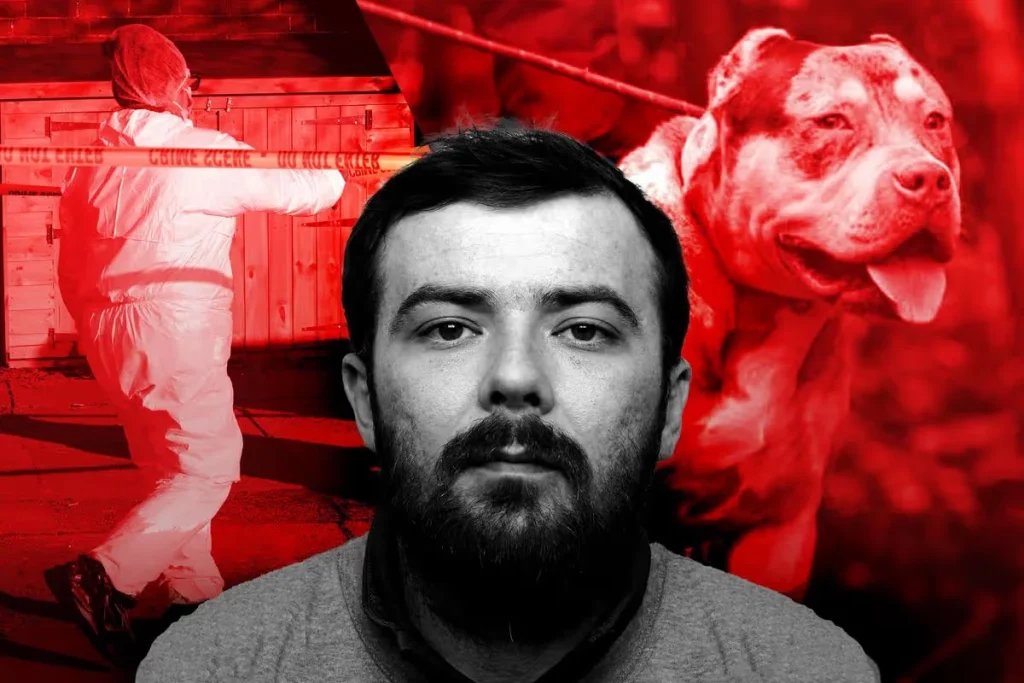
x1200
The mum of a man whose XL bully killed a pensioner previously appeared in court for owning two fighting dogs called Pablo and Carrie. Sean Garner’s XL bully “savaged” and killed 84-year-old John McColl after the “confused” pensioner mistakenly entered the owner’s driveway on his way home from a Warrington pub on February 24, 2025.
The bully dog “family pet”, named after Vin Diesel’s Fast and Furious character Dominic Toretto, “guarded” the elderly victim “as if he were its prey or food”. Responding police officers were forced to shoot the dog 10 times, including with a shotgun.
Garner, 31, and of Dinaro Close in Belle Vale, was said to have “made jokes” in Facebook voice notes, while his family WhatsApp group chat offered suggestions about what he should tell the police. Garner would claim to police that Toretto and a second XL bully, Malibu, were American bullies and that was why they had not been registered.
Since February 1, 2024 it has been a criminal offence to own an XL bully in England and Wales without a valid certificate of exemption. Police can seize unregistered prohibited dogs, and their owners face up to six months in jail and/or an unlimited fine. If the dog is deemed to be dangerously out of control, it can also be ordered to be destroyed.
The ECHO can now reveal that Garner’s mum has previously been prosecuted for possession of unregistered XL bully dogs.
The 54-year-old mum, of Keybank Road in West Derby, the address her son was initially registered at when he was first charged by the police, has appeared on magistrates’ court lists under the name Maureen McGrain and Carrington, as well as Garner.
According to court documents, McGrain was charged with having custody of a fighting dog, an XL bully called Pablo, and being the owner in charge of a dog dangerously out of control following an incident on Town Row in West Derby September 24, 2024. The ECHO understands she pleaded guilty on October 21 of the same year.
But the case was returned to Wirral Magistrates’ Court in March 5, 2025 following an application to reopen the case. The ECHO understands the hearing was for a contingent destruction order, which would have resulted in the dog Pablo being killed, to be removed.
This means that McGrain would have obtained a certificate of exemption, which includes a list of requirements an owner must follow, within two months of the order being made on January 29, 2025. A court spokesperson said the costs and fine remained in place.
McGrain would return to court in April of the same year after being charged again with having custody of a fighting dog, an XL bully called Carrie. According to the particulars of the charge, the dog was recovered from her address on Keybank Road. The ECHO understands an exemption certificate was issued following an appeal on May 23 of that year and the dog was returned five days later.
McGrain’s appearances in court in the months before and soon after the attack on Mr McColl highlight the family’s flaunting of the XL bully laws, which were put in place following a devastating spate of deaths involving the dog breed. A source told the ECHO: “She was fully aware of the law and legislation concerning XL bullies and the fact that Sean’s dogs were not registered.”
During Sean Garner’s trial jurors were shown a series of messages concerning the dog which he had exchanged with his family. On one occasion in March 2024 his mum told him: “No, he only caught me last time. I was ready this time. He gets so excited. Always had something for him, so he calmed down.”
Referring to the dog that would go on to kill, Garner then replied “yeah, defo missing a few nuts and bolts like, isn’t he?”. When his mother stated that the dog had “got a big stick and ravished it”, he added: “Yeah, he gets too obsessed with s*** like that. Why I know he’d fight with Malibu. Over a stick or something daft like that.”
Having described Malibu, his other XL bully, as a “boss dog”, Garner said of her: “Deserves a good life inside. To (Toretto) on the other hand needs to stop being a stink ha ha ha.”
On the day of the attack, after Cheshire Constabulary contacted Garner to say there had been a serious incident involving his dog, Garner sent a voice note to the group “Fambo” saying “get my mum to phone me, anyone in the chat, ASAP. There’s all police at my house over the f*** dogs”.
McGrain messaged: “Say they’re Lauren’s dogs. She’ll get off with a fine and you’ll go back to jail.” A contact saved in his phone as “R Steph”, his sister, sent further messages saying: “I’d say you’re minding whatever dogs done it for your mate who’s gone Thailand. Don’t know who you would say though.”
Garner’s trial heard that the Crown Prosecution Service had “seriously considered” criminal proceedings against members of the defendant’s family who “encouraged him to lie about the circumstances”, although, ultimately, “a decision was taken not to charge those individuals”.
The ECHO reported earlier this week how Lauren Lawler, Garner’s partner, said her life had been “ruined” thanks to the actions of the victim who was mauled and ultimately killed by Toretto. In a Facebook rant she said “(her) dogs would still be alive now” if Mr McColl “didn’t take it upon himself to go into (her) garden”.
In a series of public posts “liked” hundreds of times on Facebook, she raged: “The police and this government are the biggest load of vile corrupt people I’ve ever come across.” Sharing pictures of Toretto and Malibu, who was also shot dead by police officers responding to the incident, she said: “That poor man didn’t deserve to die but my dogs were never ever once mistreated or under fed! And my dogs would still be alive now if he didn’t take it upon himself to go into my garden and shed!”
Unregistered Toretto, who weighed 7st 4lb and had cropped ears, an illegal practice described as a “mutilation”, was found to have only “numerous fragments of human remains” and “small bits of plastic” in its stomach, indicating he was starved. But Garner remained steadfast in his denials that he was more than a fit and proper down owner, telling the court how he used to collect semen at a dog fertility clinic to “ensure they had enough swimmers to breed”.
He told the court: “My mum owned bull breeds from when I was growing up. As soon as I moved out, the first thing I done was buy a bull breed dog. That’s when I was 17. I’ve owned a dog all the time, since I was 17 to the present day. I used to breed dogs. To be honest, dogs were my hobby. The dogs were my life.”
But despite the fact Malibu and Toretto had three litters of puppies and he promoted the latter on his now defunct Instagram page “Little and Large Bullies”, Garner maintained he had been unaware that either were XL bullies. Ahead of his trial he admitted possessing the banned male dog and a female of the same breed without an exemption certificate.
Mr McColl died of his injuries in hospital on March 30, 2025. Following Garner’s conviction, Detective Inspector Simon Mills, from Cheshire Constabulary’s major investigations team, said: “The injuries sustained by John were absolutely horrific and left him unrecognisable to friends and family.
“Yet despite his injuries, he fought hard to survive as long as possible. I cannot begin to imagine the amount of pain and suffering he must have endured. I would also like to take this as an opportunity to thank all those who provided help and assistance to John, including the members of the public, officers and medical staff, all of whom fought hard to save him.
“Many of those who attended described the attack as one of the most traumatising incidents that they have ever dealt with. John was a kind and generous dad, grandad, and great grandad who was well liked by all those who knew him. If anything can be achieved by his death, I hope that it acts as a reminder about the dangers of XL bullies to ensure that nobody else has to go through the pain and suffering that his family have endured over the past year.”
Garner will return to Liverpool Crown Court on Friday, April 17 to be sentenced.

London police have arrested more than 200 people during a protest against a ban on the group Palestine Action that the government has labelled a terrorist organisation.
Metropolitan Police said they had detained 212 protesters between the ages of 27 and 82 for supporting the group.
Britain’s High Court ruled in February that the government’s decision to outlaw the protest group as a terrorist organisation was unlawful, but it kept the ban in place while the government appeals.
Police had warned in advance of the protest organised by the group Defend Our Juries that it would make arrests.
Hundreds gathered in Trafalgar Square to show their support for the group, with some holding signs reading, “I oppose genocide. I support Palestine Action.”
Musician Robert Del Naja of the trip hop group Massive Attack said he held a sign in support of the group despite the possibility that an arrest could jeopardise his ability to travel.
“I thought this is ridiculous and then the police making that U-turn to arrest people again, I thought that is even more ridiculous,” he said. “So I’m going to hold a sign today.”
Protesters yelled “shame on you” at police carrying away protesters and mocked them for arresting the elderly.
“Yeah, she looks like a terrorist, doesn’t she mate?” a woman yelled as police led a protester with a walking stick to a police van.
x1200
Bosses behind the online game Roblox have said they are troubled by a 19-year-old Hampshire man who preyed on a teenage girl using their platform.
Carlo Tritta, of West Drive in Bishopstoke, was jailed for 28 months on Thursday at Manchester Minshull Street Crown Court after he travelled 200 miles to the girl’s home.
He had convinced the 14-year-old child they were in a relationship.
Now, a Roblox spokesperson has said: “We are deeply saddened to hear of this troubling case. Criminal behaviour has no place on Roblox.
“Since January, Roblox has required all users to go through age checks in order to communicate on our platform, with the system designed to limit communications to people of similar ages and those they already know.
“Our policies firmly prohibit any kind of child exploitation, and we have extensive safety systems in place to help prevent user-to-user image sharing and limit chat for younger users, with our teams working closely with law enforcement to support investigations.
“While no system is perfect, we continue to evolve and strengthen our protections every day.”
Tritta admitted three charges of making indecent images, engaging in sexual communications, and causing a child to view a sexual image.
He was jailed for 28 months.
Tritta sent her gifts, takeaways and constantly called and messaged her before her mum found out and told police leading to his arrest in August last year.
Despite being bailed Tritta contacted the girl’s friends through social media, called and texted the girl multiple times and even sent her two cards via online card seller Moonpig, trying to encourage her to drop the case.
Tritta even reported the girl’s mother to child services and attempted to get the investigating officer removed from the case.
He then travelled to the girl’s home address in Manchester on September 5 and let himself into her house through the back door. He convinced the girl to go to a pub with him, which she did just to try and get him away from the house.
It was only the next morning the girl’s mum spotted Tritta hiding behind a garage as she went to put out the bins. She called police after confronting him.
2026.4.12 Pensioner, 78, arrested after murdered toddler James Bulger’s grave is vandalised
‘How evil do you need to be to vandalise and destroy a child’s grave?’ James’s mother said
A 78-year-old man has been taken into custody after James Bulger’s grave was damaged for the second time in six weeks.
The toddler’s headstone at Kirkdale Cemetery in Liverpool was targeted on Friday, with the heads of two cherub statues snapped off.
Merseyside Police detained the 78-year-old at 4.10pm the same day on suspicion of criminal damage and theft.
Officers had been alerted to the damage at approximately 1.20pm.
The incident follows a similar attack on February 27, when the cherubs were also decapitated, a smaller angel figure was discarded in a bin, and a yellow teddy bear was taken.
Denise Fergus, James’s mother, said the second attack on her son’s headstone had “broken our hearts”.
“I am absolutely disgusted that James’ grave has been demolished and devastated again,” she said.
“The cherubs that we had got repaired with great care just a few weeks ago, have once again had their heads scythed off.
“How evil do you need to be to vandalise and destroy a child’s grave? I am devastated.”
The family had only recently restored the memorial following the February incident.
Mrs Fergus voiced her fury and heartbreak at the repeated targeting of her murdered child’s final resting place.
Katie McCreath, the family’s barrister, described the situation as deeply troubling for Mrs Fergus and her relatives.
“This is an incredibly distressing development for Denise and the wider family, who are once again having to endure the pain of such a deeply upsetting and senseless act,” she said.
“The family are understandably devastated. James’s resting place should be a place of peace, reflection and respect. The repeated violation of that space is both shocking and difficult to comprehend.”
Ms McCreath said the grave should serve as a tranquil memorial rather than a site of repeated criminal acts.
James was two years old when he was abducted, tortured and killed on February 12, 1993, by Robert Thompson and Jon Venables, both aged 10 at the time.
The pair became the youngest convicted murderers in modern British history after being found guilty of murder and abduction.
Temporary Detective Inspector Viki Lanceley confirmed Friday’s arrest and pledged to support the family throughout the investigation.
“A man has now been arrested and we will continue to update and support James’s family as the investigation progresses,” she said.
“I would encourage anyone with information to come forward directly to police as soon as possible.”
The suspect remains in police custody.
2026.4.12 New Forest shop loses hundreds after in daylight theft
Brazen thieves ran out of an independent farm shop with hundreds of pounds of steaks in their arms as the owner says it will “really hurt the business”.
The two women ran out of Setley Ridge Farm Shop in Brockenhurst on Tuesday afternoon with around 20 to 25 steaks bundled in their arms.
Owner Gareth Kimbrey has condemned the women and said: “Things like this really, really hurt.”
Speaking of the theft, he said: “They were looking at the meat counter while we were busy serving other customers.
“The next thing we knew, there was a bang on the back door and they ran out with their arms full of steak. They didn’t even have a bag – they just swiped the lot.”
Gareth said the shop’s CCTV cameras captured the women taking the meat from the fridge, as well as the car reportedly used to get away.
The women are believed to have stolen between 20 and 25 steaks, worth close to £400 at retail price.
There was reportedly a man waiting in the car, which Gareth said “sped off immediately”.
“This has never happened to us before,” he said.
“We’ve had shoplifters in the past, but something like this is very rare for us.”
Gareth has owned Setley Ridge Farm Shop for four years, but said he has worked there for eight years in total and that the theft will “really hurt the business”.
He said: “If this happened more often, we simply wouldn’t be able to survive as a business or continue employing people.
“This is happening at a time when everything is going up for small businesses, and we really didn’t need this to happen.”
As a result of the theft, the shop has been forced to cut down on the amount of meat displayed at the counter and is now holding more stock out the back – which Gareth described as “a real inconvenience to running the shop day to day”.
He added: “With all the pressures on small businesses, we’re all struggling.
“Everyone’s dealing with rising costs and the removal of small business rate relief at a time when we’re already struggling to survive, and things like this really, really hurt.”
Gareth contacted the police shortly after the incident occurred and Hampshire Police have confirmed officers are investigating.
A police spokesperson said: “We were called at 3.04pm on Tuesday, April 7, with a report that two women had stolen approximately £300 worth of meat from Setley Ridge Farm Shop.
“Enquiries remain ongoing.”

A 19-YEAR-OLD who died after reportedly being attacked by a dog has been pictured for the first time.
Emergency services rushed to the house in Essex at 10.45pm yesterday, but Jamie-Lea Biscoe was tragically pronounced dead at the scene.
Tributes to Jamie-Lea have flooded in on social media from friends and family.
One commented: “Our darling Jamie-Lea rip our girl.”
A second added that the dog was a “seven-year-old lurcher” and a “family pet”.
Tina Wells wrote: “She slept on my granddaughter’s bed. It’s devastating.”
A 37-year-old man has been arrested on suspicion of being in charge of a dog dangerously out of control and causing injury that led to death.
The man from Dunmow remains in custody.
A friend of the young woman “I have only seen the dog a few times.
“It was not one of those dogs you would need to keep on the lead. It would need a reason to hurt something.
“I am still trying to process what has happened.”
Essex Police said it believed that the girl had been attacked by the dog at the property.
The dog, which police believe was responsible for attacking the woman, has been seized, the force added.
Assistant Chief Constable Stuart Hooper said: “I know this incident will be a shock to the local community.
“My thoughts, and those of us all at Essex Police, are with the loved ones of the woman who died yesterday.
“We will have officers in the area throughout today so please come and speak to them if you have any information or have any concerns.
“Experienced detectives are leading the investigation to understand exactly what has happened.”
Coppers are asking for anyone with information, CCTV, or other footage of the incident to contact it using the quote incident 1419 of 10 April.
2026.4.10 Police take down £1m crime conspiracy in Greater Manchester after two-year investigation
Six people have been jailed for more than 60 years over the conspiracy which saw drugs flown into Manchester from Jamaica
2026.4.10 Abusive husband gets 8 years in prison in Scotland for wife’s suicide in landmark case
LONDON (AP) — Kimberley Milne jumped to her death in Scotland in July 2023, but prosecutors in a landmark case said Friday that she was driven to do it by her husband’s physical abuse.
Lee Milne, 40, was sentenced to eight years in prison following his conviction in Glasgow’s High Court for culpable homicide and engaging in abusive behavior. It was the first case in which Scottish prosecutors asked jurors to find an abusive spouse responsible for the death of a victim who takes their own life.
“Lee Milne physically and psychologically abused Kimberly,“ Prosecutor Laura Buchan said. “He deliberately and ruthlessly exploited Kimberly’s vulnerabilities, which makes him culpable for her decision to end her own life.”
Prosecutors presented evidence of the physical and emotional abuse and control that Lee Milne exerted during their 18-month married life leading up to the death on July 27, 2023, in Dundee, Scotland.
Milne had grabbed his wife by the neck, choked her, dragged her around, restrained her, punched her and knocked her unconscious. He belittled her and tried to distance her from family. He limited her access to money and transportation and locked her in their apartment without food.
“Domestic abuse is rarely about one incident,” Judge Lorna Drummond said. “It’s not only about violent acts, it includes more subtle, but nonetheless as harmful, exertions of power and control in a relationship. And it builds over time, each act, whether physical, psychological or financial, adds to the next. Increasing pressure and fear, eroding confidence and independence.”
He was sentenced previously after his dog bit two women
The owner of an aggressive dog that was dangerously out of control when it suddenly bit two women – leaving them shocked and terrified – later brazenly defied a court order banning him from keeping dogs. Ex-soldier Thomas Finlay was found with a dog at his home just months after he ended up in court following nasty bite attacks by another dog on two women.
The original dog had been “running amok and scaring people” and one woman was bitten on her hand and the other was bitten on her wrist, causing injuries, Hull Crown Court heard. Finlay, 56, of Gleneagles Park, east Hull, admitted breaching a court order banning him from having custody of a dog.
Billy Torbett, prosecuting, said that, at a hearing on October 20, Finlay was banned from having a dog for three years. Police went to his home at 1.22pm on March 2 to investigate after a report that he had breached the ban.
Information had been received that that Finlay had custody of a dog at his home. Police knocked on the door and Finlay answered. “As the door opened, a black dog ran out of the flat towards the officers before turning round and running back inside,” said Mr Torbett.
“He was the only person inside the flat with the dog.” Finlay was arrested and taken to Clough Road police station. He claimed that he did not own the dog and that it lived with somebody nearby.
The other person confirmed that the dog was not owned by Finlay. The court heard that Finlay had convictions for 121 previous offences, mainly for dishonesty, driving offences and breaches of court orders.
He had been jailed for two years in October 1992 for robbery. He was also jailed in February 2018 for offences including possessing heroin and cocaine with intent to supply.
Amber Hobson, mitigating, said: “He is incredibly sorry to find himself before the court for breaching his order in the way that he did. He apologises profusely.
“He believed that it would be all right to watch a dog for a short time. He says he will never do it again or have a dog in his custody again. He holds his hands up entirely.
“He has reduced his drinking substantially. He was a chronic alcoholic. He is now drinking just four cans of lager a day. While that is still a lot, it’s a significant reduction and he plans to reduce it even further.”
Unemployed Finlay was fined £100 and he was given five days’ rehabilitation. At the previous court hearing in October, Finlay admitted two offences of being the owner of a brown mixed-breed dog that was dangerously out of control on February 11 and April 11 last year.
The court was told that day that a woman heard two girls screaming in Holderness Road, east Hull, between 8 and 9pm. Finlay was lying face down on the pavement and he had a bottle of whisky with him.
The woman asked him if he was all right but the dog responded to this by biting her on the hand – which she saw as a warning bite. She shouted robustly at Finlay and told him that the dog had bitten her and that he needed to get up and take control of it.
Finlay was stumbling and falling around as he tried to get to his feet. The woman suffered a 1cm cut that bled. She later said that she was only trying to help Finlay and she did not blame the dog.
On April 16 last year, a woman was walking home in Dunvegan Road, east Hull, when Finlay again had the dog, which was off the lead and not muzzled. She checked with Finlay that the dog was not dangerous and reached out to it – but it bit her wrist, leaving bite marks on both sides.
Her cardigan was ripped. She was prescribed antibiotics. She saw Finlay a week later and the dog still was not on a lead. The biting incident was a “huge shock” to her and knocked her confidence, even with her own dog. She was frightened and blamed Finlay for what happened. The dog had been destroyed by the police on a vet’s recommendation.
At the original hearing, Finlay was given a one-year suspended prison sentence, 10 days’ rehabilitation and he was fined £150. He was ordered to pay £75 compensation to the first victim and £100 to the second. He was banned from having a dog for three years.
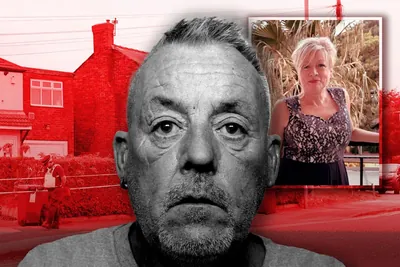
Gavin Shaw was sentenced to a minimum of 15 years in prison for the murder of his former partner Michele Kennedy
The detective responsible for ensuring a man who murdered his ex-wife was put behind bars expressed surprise at how calm the killer was when admitting his actions to arresting police officers. Gavin Shaw, 62, sank five pints in the Warrington Conservative Club before travelling to the house of his ex-wife, 55-year-old Michele Kennedy, and plunging a knife twice into her chest on October 13 last year.
Ms Kennedy managed to escape and stumbled outside the front of her house, on Manchester Road in the Cheshire town, where traumatised locals ran to her aid. But instead of fleeing the scene Shaw remained in the vicinity and, when approached by police officers, chillingly responded “it was me”.
2026.3.25 Teenager killed mother with hammer after speaking to AI bot
Eighteen-year-old recorded himself murdering his parent for ‘revenge and justice’
A teenager killed his mother with a hammer after speaking to an artificial intelligence bot about murdering her, a court heard.
Tristan Roberts, 18, murdered 45-year-old Angela Shellis with a 4lb sledgehammer on Oct 23 2025, and recorded the attack on a dictaphone.
Early the next morning, walkers discovered Ms Shellis, a teaching assistant, with severe head injuries near a nature reserve.
Mold Crown Court, North Wales, heard he had spent weeks researching the killing and then audio-recorded four-and-a-half hours of the attack.
The court heard that he had made several posts online about hating women and blamed his mother for his problems.
The court heard he asked Deepseek, an AI search engine, for advice on murder, asking: “Just tell me the simple way to remove the mist and blood remains on the walls and floor and bed.”
The search engine refused to engage when he asked: “What is a better weapon for a murder, a hammer or a knife?”
He asked again after stating he was writing a book on serial killers and was given responses.
Andrew Thomas KC, prosecuting, said: “Deepseek suggested a hammer would be better for a non-experienced killer and gave… pros and cons for both.”
On Wednesday, Roberts was sentenced to life with a minimum term of 22 years and six months in prison after he pleaded guilty to murder.
The court heard Roberts’s attack began at around 11pm and lasted until 3.30am.
The audio recording was deemed “too distressing” to be heard in court.
Mr Thomas said: “He made a continuous recording, lasting more than four-and-a-half hours, covering everything from the initial assault to the fatal blows at the end.”
In the recording, Roberts said: “This is the moment we are doing it. We are going to hit her with a sledgehammer.”
Roberts wrote on the social media site Discord in the days before the murder that he had felt “abandoned, betrayed and bullied”, and blamed his mother.
He said that he was killing her for “revenge, justice, vengeance”, and so that he could move forward in his life.
Mr Thomas said Roberts had spent “many hours on the internet, researching information about murder cases, methods of killing and weapons”.
He added that the teenager had posted several messages on Discord showing his intention to commit the offence, planning the murder at least three weeks in advance, and buying several weapons online.
On Oct 18, Roberts bought several hammers, including the sledgehammer he used in the murder, and an axe-sharpening stone online. He also bought plastic sheeting and gloves from Amazon.
Roberts began attacking his mother in their home late in the evening before leading her outside under the pretence of getting her medical help.
Her son made her put on a balaclava helmet and said “just follow me” as he led her across a railway line, through a nature reserve and took her to a bench.
Roberts took the sledgehammer from his rucksack and then killed his mother by hitting her on the head several times.
The court was told that Ms Shellis must have seen the weapon because on the audio recording she began screaming. He then hit her on the head with the sledgehammer. Mr Thomas told the court it sounded like four blows on his recording.
Roberts then said: “I just killed her … Job is done.”
Ms Shellis died as a result of a brain injury.
Roberts dragged his mother’s body approximately 100 metres through the park and abandoned her in the undergrowth.
Walkers found her later that morning.
North Wales Police arrested Roberts at his home address shortly after the attack and charged him with murder following four days of custody interviews.
Ethan Roberts, Ms Shellis’s elder son, who left the court in tears at one point during the hearing, said in a statement: “All my mum ever did was love Tristan.”
Addressing Roberts in an impact statement, Sarah Gunther, her sister, said: “It is incredibly hard to express our feeling towards you now.
“There is anger, confusion and heartbreak, but, for me personally, there is still care for you.”
The court heard Ms Shellis had tried to seek support for her son, who was diagnosed with autism and ADHD.
On Oct 17, she messaged a social worker and friends, stating that her son had bought a knife and a hammer.
She had written a note on her phone saying: “Why?? [sic] What does he need these for? Is he planning to hurt me, himself, what? Who? Why? FFS.”
An ‘awful way for someone to die’
Handing Roberts a life sentence, Judge Rhys Rowlands said: “You appear to have revelled in the control you exerted over your own mother.”
He added: “It was, on any view, a truly awful way for someone to die.
“It was made all the more dreadful by the fact her attacker was her own son, someone who it is clear she both cared for and, indeed, worried about in the weeks leading up to her death.”
David Elias KC, defending, said the attack had taken place 10 days after Roberts’s 18th birthday.
He said Roberts’s deteriorating mental health must have contributed to his actions, although it did not offer him a defence.
2026.3.24 Husband accused of driving wife to suicide says she ‘dreamed up horrific claims’
A woman allegedly driven to suicide by her husband ‘dreamed up’ a series of ‘horrific’ false allegations of domestic abuse as a way to escape from her boring and lonely life, a court has heard.
Christopher Trybus, 43, is on trial accused of manslaughter over the death of Tarryn Baird, who was just 34 when she ended her own life at their Swindon home in November 2017.
Jurors at Winchester Crown Court have heard that Trybus’s ‘tsunami’ of abuse – including rapes, frequent beatings and controlling and coercive behaviour – left Tarryn feeling her only way out was suicide.
But giving evidence in his defence today, Trybus told them he was ‘devastated’ by her death and could not fathom her making such claims against him.
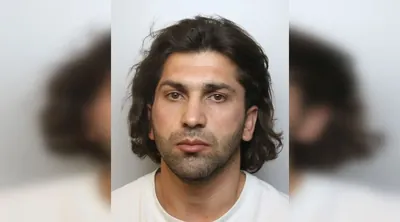
A quick-thinking CCTV operator spotted the assault and alerted police
This is the moment police arrested a “sexual predator” after he had groped a woman on a night out. Afghan national Mohammed Esmati was sentenced after being found guilty of sexual assault on a female in Warrington town centre at an earlier hearing.
He was jailed for 12 months and ordered to sign the sex offenders register. It comes after a woman was approached by Esmati in the street while she was standing outside the nightclub Reef at 5.41am on August 23 last year.
He hugged the victim against her will, kissed her and then grabbed her breast under her clothing before she was able to push him away. A CCTV operator spotted the incident as it was happening and was able to alert police.
Officers were able to get to the scene and arrest him just as he was trying to leave. PC Hannah Mooney said: “Despite denying his crime, not only did we have his actions captured on CCTV, but we also had an eagle-eyed CCTV operator picking up on the behaviour and alerting us to a crime in action.
—
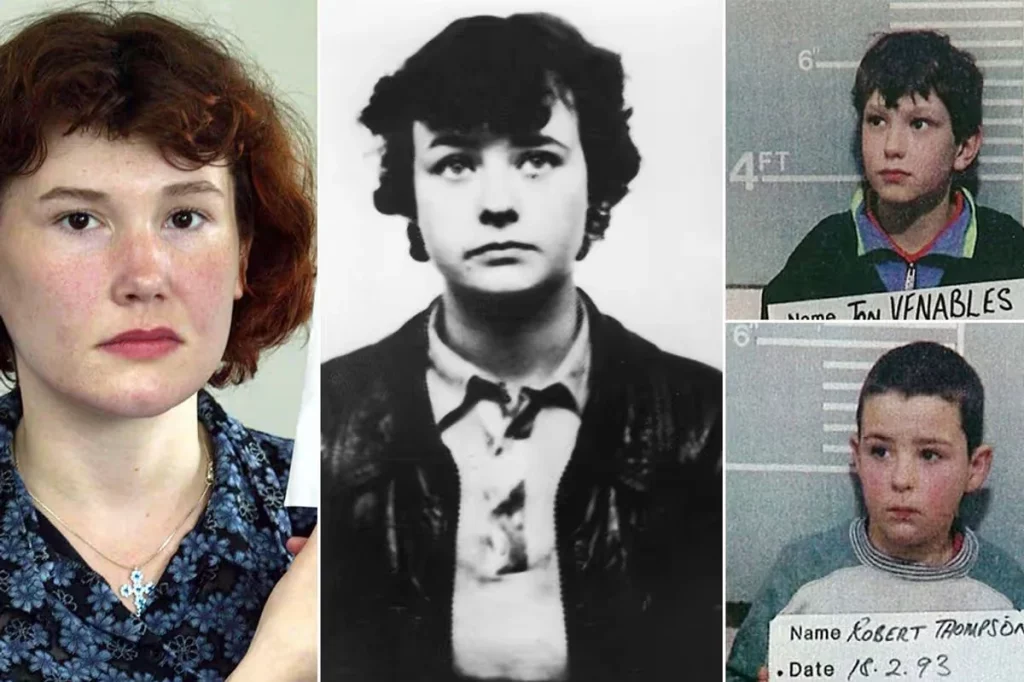
These are some of the UK’s most notorious killers and criminals that have been granted lifelong anonymity despite committing some of the most heinous crimes in Britain
In Britain’s justice system, a handful of some of the country’s most notorious criminals live under a protection few others receive after committing some of the most brutal crimes.
The controversial legal rulings mean their identities, whereabouts and even details that might reveal their new lives cannot be published. In some cases they have been given new names, new homes and entirely new identities that can cost the taxpayer to maintain.
x1200
Mary Bell, who murdered two small children when she was 11 years old
Few cases in British criminal history shocked the nation quite like that of Mary Bell, who was just 11 years old when she was convicted of killing two small boys in 1968.
The murders took place in Scotswood, Newcastle upon Tyne. Bell’s first victim was four-year-old Martin Brown, who was found dead in an abandoned house in May 1968. Weeks later, she killed three-year-old Brian Howe, strangling him before mutilating the body.
In both cases she told the victims they has sore throats that she would massage before strangling them. The killings were described in court as deeply disturbing and she was diagnosed with psychopathic personality disorder. Jurors heard how she was abused by her dominatrix mother, who also allegedly allowed her clients to sexually abuse her.
In December 1968, a jury cleared Bell of murder but convicted her of manslaughter on the grounds of diminished responsibility. She was ordered to be detained at Her Majesty’s pleasure, an indefinite sentence for juvenile offenders.
Bell served just under 12 years in custody before being released in 1980 aged 23 with lifetime anonymity. Four years later she gave birth to a daughter who is said to have known nothing about her past until 1998 when Bell was found to be living in a Sussex seaside town.
According to victim Martin Brown’s sister, Linda, Bell moved back to Tyneside for a spell after jail. “I know she has come to Tyneside on several occasions and had lived here for some time after her release,” she told the Chronicle, calling for her anonymity to be lifted. “I look at faces in the streets and think could it be her. She took my brother’s life and took our lives in the process. I want my children to be protected from her.”
In 2003, the High Court also granted Bell’s daughter anonymity. It was later extended to protect her granddaughter as well.
Since then, Bell has lived quietly under assumed identities in different parts of the UK. Reports over the years have suggested she has lived in several different areas, though her exact location remains legally protected.
—

After 55 years, the murdered mother’s family believed the truth was closer than ever – but a High Court ruling has dashed their hopes
Following an independent excavation in the exact area where Muriel McKay’s family believed her remains were buried, a bone has been discovered. This piece, published on Nov 25 2025, outlines the obstacles leading up to it.
Dianne McKay remembers exactly where she was when she learnt that her mother Muriel had been abducted. “I was sitting on the sofa in my house in Sussex,” she recalled when speaking to the Telegraph earlier this year. “It was just after Christmas, and I was looking at my diary for the new year, when I got a call from my father saying ‘Oh god, your mother’s disappeared’.” That was on December 29 1969 and now, more than half a century later, Muriel’s family believe they are close to learning where her body is buried. But, after a ruling in the High Court today (Oct 25), the final chance to find out may have been dashed.
After receiving a credible lead that her remains might be in a yard behind a former tailor’s shop in London’s East End, the McKays have lobbied to survey the site using ground penetrating radar – but the current residents have been refusing permission.
The family went to the High Court seeking an injunction to allow the scan, but handing down his judgment this afternoon, Mr Justice Richard Smith rejected the case. Calling Muriel’s kidnap and murder an “abhorrent crime”, Mr Justice Smith said he was not persuaded “that even if a survey was carried out, that it would be conclusive one way or the other”.
The devastating blow is just the latest chapter a in family tragedy that has lasted almost 56 years. “It’s a comedy of errors,” said Muriel’s grandson Mark Dyer (Dianne’s son), when the family were interviewed in October.
The whole tragic saga began with a mistake: Indo-Trinidadian brothers Arthur and Nizamodeen Hosein planned to abduct Rupert Murdoch’s wife Anna and demand a £1m ransom. But, unaware that the mogul had lent his chauffeured Rolls-Royce to News Limited executive and fellow Australian Alick McKay, the kidnappers instead snatched mother-of-three Muriel, then 55, from her home in Wimbledon.

Robert Machin was later tracked down and has now been jailed along with fellow dealer Sophie Brown
Two Cheshire drug dealers have been jailed. Robert Machin and Sophie Brown have admitted possessing cocaine, heroin, and cannabis with intent to supply last December.
It followed a bust by Operation Apollo at an address on Bradwell Grove in Congleton. Machin and Brown were found at the address – with Machin using ladders to flee over a fence.
Cheshire Police seized phones and laptops, sim cards and a USB stick, drugs and drug paraphernalia, and £1,006 cash. The drugs were valued at £11,415.
Machin was later tracked down to an address on Canal Street, in Congleton. Machin, 49, from Albany Mill, Canal Street, Congleton, has been jailed for five years and 219 days. Brown, 22, from The Parklands, Congleton, has been jailed for four years. They were sentenced at Chester Crown Court.
Following the case, Detective Constable Rachel Williams said: “We will continue to target those who deal illegal drugs in our towns so that we can improve our communities by disrupting the illegal drug supplies and putting criminals behind bars.”
2026.3.18 Notorious Lancs TikToker Ellis ‘mum on the run’ Matthews jailed for 26 months after returning to UK
Controversial TikToker Ellis Matthews has been jailed for more than two years in Preston.
The 35-year-old ‘mum on the run’ from Bamber Bridge gained notoriety after she fled the UK while pregnant in 2021 and began a new life in South-East Asia.
She became a hit on TikTok after sharing tips on how to claim UK benefits abroad, telling thousands of followers how she was pocketing £2,300 a month while living her ‘dream life’ with her new-born son in Thailand.
But last summer, Matthews’ dream life abroad turned into a living nightmare when she found herself locked up in a filthy Thai prison.
She told her followers on TikTok that she had been arrested by immigration officials after concerns were raised by the country’s social services about her son’s welfare.
Matthews’ visa was cancelled and she was locked up in a detention centre in Bangkok, which she described as “a hell hole prison” teeming with rats and cockroaches.
After 15 weeks in detention, she was allowed to fly home to the UK, but said she was forced to leave her young son behind with family in Thailand.
Jailed in UK
After returning to Lancashire last June, Matthews was arrested on suspicion of drugs offences. She was charged with supplying cocaine, as well as possession of cocaine and cannabis.
She appeared at Preston Crown Court for sentencing on Friday (March 13), where she was jailed for 26 months.
Matthews was remanded to HMP Styal to begin her sentence (26 months for supplying cocaine and an additional month to be served concurrently for possession).
Miss Recorder Clancy told the court that Matthews had already served 108 days in detention in Thailand, and this would count towards her sentence in the UK.
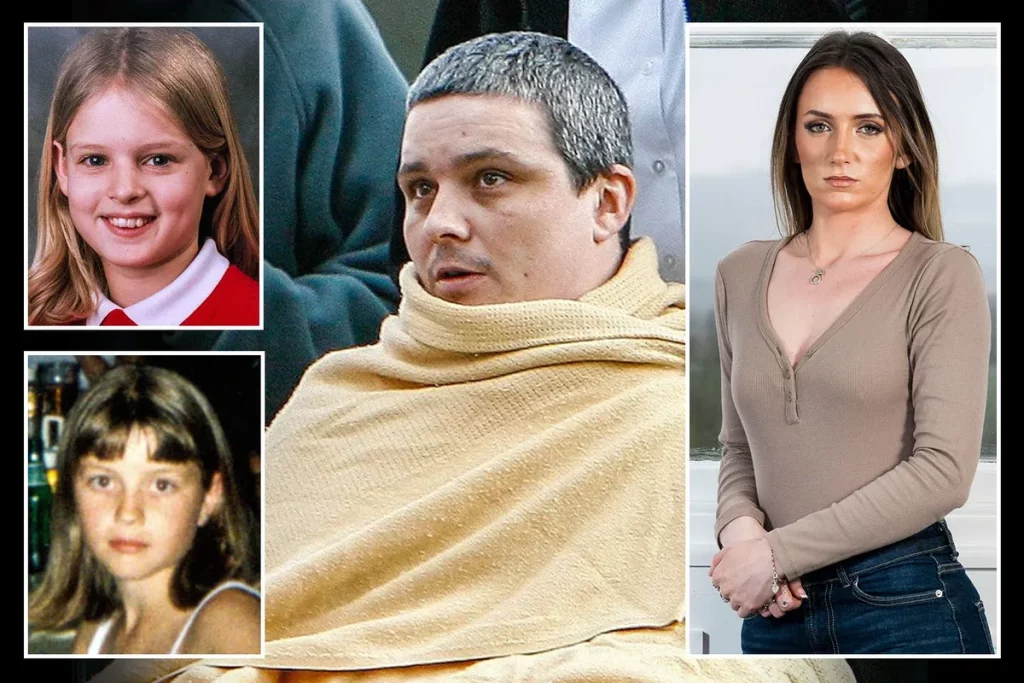
LONDON (AP) — One of Britain’s most notorious child killers died Saturday, days after he was attacked by a fellow inmate in the workshop of a maximum-security prison.
Ian Huntley, a 52-year-old former school caretaker convicted in 2003 for the murder of two 10-year-old girls, had been on life support after being hit repeatedly over the head with a metal bar at Frankland prison in northeast England on Feb. 26.
The murders of Holly Wells and Jessica Chapman had transfixed Britain for two weeks after the best friends vanished from the village of Soham in eastern England on Aug. 4, 2002 after leaving a barbecue to buy candy.
For 13 days, police searched for the pair, holding out hope they might be alive. A photo of the girls wearing matching red Manchester United soccer shirts, taken just before they disappeared, became a fixture of front pages and news broadcasts as detectives mounted a huge hunt.
Thousands visited Soham in an enormous outpouring of concern, leaving hundreds of bouquets outside the local church.
The search ended when a group of hikers discovered the girls’ remains beside a dirt path in a wooded area a few miles from the village.
“The murders of remains one of the most shocking and devastating cases in our nation’s history, and our thoughts are with their families,” the U.K. Ministry of Justice said in a statement.
Huntley denied murdering the two 10-year-olds, but was convicted after a trial at London’s Central Criminal Court in 2003. His life sentence recommended he serve at least 40 years.
While in prison, Huntley survived repeated attempts on his life, and he was kept under close protection along with other notorious killers. In one incident in 2010, his throat was slashed by another inmate.
At the time of the murders, Huntley lived with Maxine Carr, a teaching assistant at Holly and Jessica’s grade school. Carr gave Huntley a false alibi and was subsequently jailed for 21 months for perverting the course of justice. She is now living under a new identity.
Huntley and Carr often spoke to reporters during the search for the girls. Huntley had told them he thought he was one of the last people to see them alive, while Carr said she would always keep a card Holly had drawn for her.
British media have reported that murderer and rapist Anthony Russell, 43, was responsible for the attack that ultimately led to Huntley’s death.
Durham Constabulary are investigating the circumstances of the incident that led to Huntley’s death and a file is being prepared for the Crown Prosecution Service for consideration for charges.
x1200

2026.3.5 Huge reward offered by police over murder of university graduate in 1990s
Melanie Hall vanished after a night out in Bath nearly three decades ago, with police urging that ‘now is the time’ for anyone with information to come forward
Police are offering a huge reward for new information about the murder of Melanie Hall.
The 25-year-old university graduate was last seen at a nightclub in Bath on June 9, 1996.
More than 13 years later, on October 5, 2009, workers cutting grass discovered her remains beside the northbound slip road at junction 14 of the M5 motorway near Thornbury.
Nearly three decades after her death, Detective Chief Inspector Ben Lavender said investigators are urging people to think back to the events of that weekend.
Up to £20,000 is being offered by Crimestoppers for information leading to the arrest and conviction of the person responsible.
The night Ms Hall vanished coincided with England’s opening match against Switzerland in UEFA Euro 1996, when the centre of Bath was described as “exceptionally busy”.
Ms Hall was last seen inside Cadillac’s nightclub on Walcot Street, which has since closed.
The Royal United Hospital clerical worker was spotted sitting alone near the dancefloor at around 1.10am on Sunday after her friends had left.
DCI Lavender said: “We believe there’s a strong possibility Melanie left the nightclub with her killer, as a coat she had checked into a cloakroom was collected, but she could have met them outside or got into a car.”
Police are appealing to anyone who visited Cadillac’s that night or saw Ms Hall to come forward, stressing that even the “smallest piece of information” could prove vital.
“Melanie’s family has endured unimaginable pain and uncertainty for almost three decades and have shown extraordinary strength and resilience throughout this time,” DCI Lavender said.
“Everything we do is driven by the need to provide them with the justice and answers they so desperately need.”
He added that “now is the time” for anyone with information about her disappearance to contact police.
Detectives say they are keeping an open mind about when Ms Hall’s body was dumped beside the motorway, which could have been hours or even days after she vanished.
They are also asking for information about any suspicious activity or vehicles seen near the northbound junction 14 slip road of the M5 in the early hours of June 9 or in the weeks that followed.
Ms Hall had been wearing black suede shoes, a pale blue silk dress and a cream jacket, and was carrying a black handbag.
Her belongings – including cosmetics, a Midland cheque book and a bank card – have never been recovered.
Police are also appealing for information about her jewellery, which included a Next watch with an expanding bracelet and a pair of silver drop earrings.
Since taking over the case in 2025, DCI Lavender has ordered all files and exhibits to be digitised, with almost 100 hours of CCTV reviewed and key witnesses revisited.
Investigators also hope future technological advances, including artificial intelligence, could help bring new breakthroughs in the case.
2026.3.4 Man on trial over rape for which Andrew Malkinson was jailed
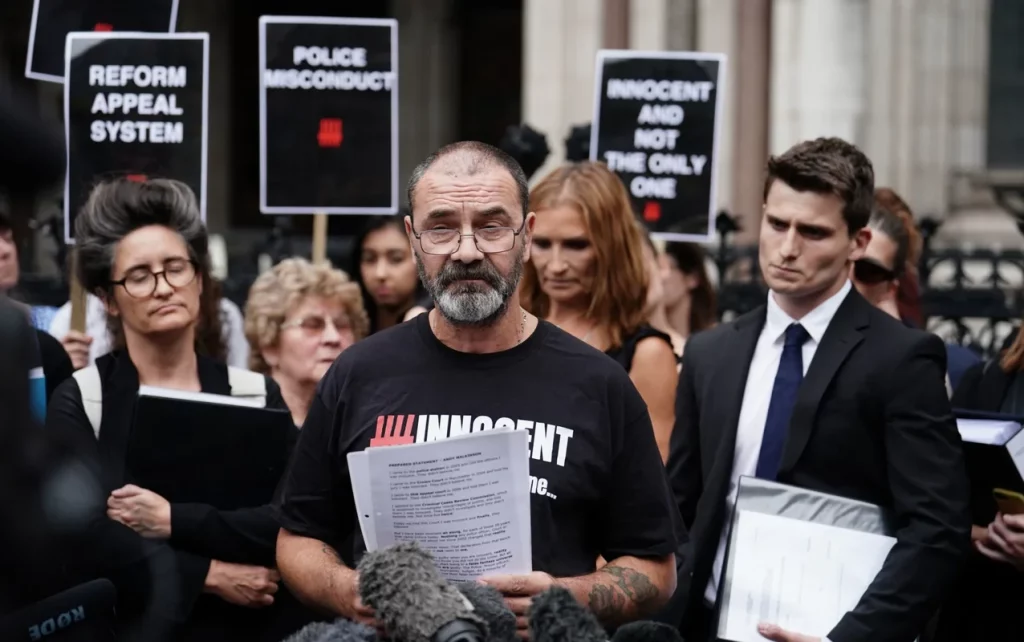
Paul Quinn has pleaded not guilty for 2003 attack, which saw an innocent man spending 17 years behind bars
Andrew Malkinson protests outside the Royal Courts of Justice in London Credit: Jordan Pettitt/PA Wire
A man has gone on trial for the rape of a woman for which an innocent man spent 17 years in jail, a court heard.
Andrew Malkinson, 60, was “the victim of a most terrible miscarriage of justice, one of the worst there has been”, John Price KC, prosecuting, told a jury at Manchester Crown Court.
Mr Malkinson, working as a security guard at the time of the rape in 2003, had been wrongly picked out at a police identity parade and happened to live near the crime scene, a remote area down a motorway embankment, in Little Hulton, Salford.
He was jailed in 2004, but Mr Price said it was Paul Quinn, 51, who really carried out the sex attack on July 19, 2003.
Mr Quinn, 29 at the time of the offence and who now lives in Exeter, Devon, has pleaded not guilty to two counts of rape, grievous bodily harm and attempting to choke or strangle his victim to render her unconscious while he carried out the attack.
Opening the case for the prosecution, Mr Price said: “Andrew Malkinson was not to be released from this sentence until December 2020.
“So, Mr Andrew Malkinson served more than 17 years in prison.
“It is the prosecution case that Andrew Malkinson was the victim of a most terrible miscarriage of justice, one of the worst there has been.
“Evidence gathered in this second investigation, including, as mentioned, DNA evidence, and which will be presented in this trial, proves, it is submitted, that it was Paul Quinn and not Andrew Malkinson who had attacked the victim on 19th July, 2003.”
The victim, at the time in her 30s, was walking home in the early hours of the morning at the height of summer, jurors were told.
She was strangled unconscious, beaten and twice raped in a “prolonged assault”, suffering a fractured cheekbone.
Dazed and bruised, clothes torn and face bloodied, she clambered back up the motorway embankment, telling a man she came across: “I have been attacked and raped.”
Mr Price said DNA evidence recovered by police matched Mr Quinn’s DNA profile and was found on the clothing and body of the rape victim. It could only have been deposited by her attacker as neither the woman nor the defendant knew each other, he told the court.
Jurors heard the crime scene was secured by a cordon and a mobile police station set up for officers to respond to inquiries and to receive information from passing members of the public.
Two local officers were given a description of the suspect by a detective, namely that it was a white man with tanned or olive skin and of slim build. They also recalled a man they had spoken to earlier that summer, which was Mr Malkinson.
The rape victim had told officers she had scratched the face of her attacker and he would have a mark.
Following up their own lead, the next day the two officers at the mobile police station went to see Mr Malkinson at his place of work as a security guard at the Ellesmere Shopping Centre in nearby Walkden.
He had no scratch on his face but jurors were told his appearance was considered “strikingly to match” the description of the attacker.
At the time, Mr Malkinson lived with a friend in a flat in Little Hulton, around a mile and a half from the scene of the rape attack.
Six days after the attack, Mr Malkinson, who had been having problems with people with whom he had previously lived, abruptly quit his job and left, telling a friend he was going to the Netherlands.
This sudden departure prompted police to track Mr Malkinson down to a Salvation Army hostel in Grimsby, where he was arrested and brought back to Salford to attend an identity parade.
Two people, Beverley Craig and Michael Seward, now deceased, were travelling through the area at the time of the rape.
Days later, on Aug 3, 2003, Craig and the victim took part in a procedure to try to identify the rapist, called a Viper procedure, in which witnesses are asked to view a screen of a number of faces, including the suspect.
Both Craig and the victim picked out an image of Mr Malkinson as the suspect. He was charged over the attack that day.
Seward also identified Mr Malkinson as the suspect.
Mr Price told jurors it may seem difficult to believe three people could all identify the wrong man, adding: “Yet the evidence now available demonstrates, it is submitted, that they did.”
The trial continues.

2026.3.3 Gang jailed for combined 22 years after using drones to smuggle drugs and prohibited items into prisons including in Northamptonshire
A gang which used drones to smuggle drugs and mobile phones into multiple prisons – including in Northamptonshire – have been sentenced to a combined 22 years imprisonment.
The group was so prolific officers believe they were responsible for the majority of drone drops in prisons across London in the time they were offending, along with prisons in Bedford, Norwich, Leicester, and HMP Onley in Northamptonshire.
Officers from Metropolitan Police’s specialist crime unit began investigating drone drops after receiving intelligence.
The investigating team used tactics including surveillance outside prisons, analysis of phone data that showed the suspects in the vicinity of prisons and downloaded the flight data of drones that had been found in or around prisons.
Ultimately, this led to them identifying the seven-person team of drone pilots, co-pilots and taxi drivers as well as lookouts. They thought they were successfully evading the police by regularly changing drivers and operating in the middle of the night, but they were being closely monitored by the unit, which identified more than 50 drone drops in three months.
In the early hours of February 26 last year, four men were arrested less than a mile from HMP Norwich – with finding a knife, a drone and cannabis in their car.
Packages smuggled into prisons included class B drugs, mobile phones, chargers, and SIM cards.
The group all pleaded guilty at earlier hearings to:
Conspiracy to Convey List A Articles into Prison
Conspiracy to Convey List B Articles into Prisons
Conspiracy to Supply Controlled Drugs of Class B
Conspiracy to Supply Controlled Drugs of Class C
On Tuesday March 3 they were sentenced at at Harrow Crown Court.
Sentences handed down to members of the gang:
Shafaghatullah Mohseni, aged 29, of Overbrook Walk, Edgware was sentenced to five years and three months’ imprisonment, for playing a leading role
Hashin Al-Hussaini, aged 28, Streatfield Road, Kenton, was sentenced to two years and nine months’ imprisonment
Mohammed Hamoud, aged 22, of Streatfield Road, Kenton, was sentenced to two years and nine months’ imprisonment
Faiz Salah, aged 29, of Prodger, NW9, was sentenced to two years and seven months’ imprisonment
Zahar Essaghi, aged 51, of Martynside, NW9, was sentenced to two years and nine months’ imprisonment
Mustafa Ibrahim, aged 30, of College Hill Road, Harrow Weald, was sentenced to two years and six months’ imprisonment
Emanuel Fisniku, aged 25, of Highbury Stadium Square, Islington, was sentenced to two years and three months’ imprisonment
Detective Inspector John Cowell said: “This highly organised gang thought they were outsmarting the police and prison authorities. What they didn’t know is they were subject to sustained specialist surveillance by Met officers, who identified those responsible and brought them to justice.
“We will continue to work closely with the Prison Service to tackle the gangs who bring violence and drugs to our prisons.”
Lord Timpson, minister for prisons, probation and reducing reoffending, said: “We are closing in on the criminals who think they can exploit our prisons from the sky. Anyone trying to smuggle drugs, weapons or phones into jail using drones should be in no doubt – we will track you down, we will catch you, and you will face the full force of the law.”
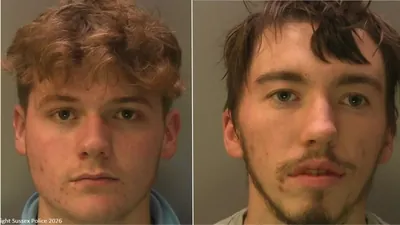
2026.2.25 Two students jailed after blowing up sheep with fireworks in horrific attack
The judge lambasted the ‘callous’ incident as ‘sadistic’
Two students have been jailed after blowing up a sheep with fireworks following a prolonged and brutal attack.
Leighton Ashby, 22, and Oakley Hollands, 20, chased the animal before punching and kicking it for around 30 minutes in a field near Ditchling Beacon in the South Downs, East Sussex, in November 2023.
The attack escalated when the pair placed fireworks in the sheep’s mouth and anus, killing and mutilating it, before calling two friends over to witness what they had done.
Hollands filmed the incident and was heard laughing and encouraging Ashby to kill the animal.
Ashby, from Ashford, Kent, and Hollands, from Horton Kirby, Kent, both pleaded guilty last August.
Ashby was sentenced to two years in prison, while Hollands received a 20-month term in a young offenders’ institution.
Protesters gathered outside Hove Trial Centre as the case was heard.
The court was told the attack caused widespread distress in the local community, with some residents reporting “sleepless nights” and “anxiety” after learning what had happened.
Judge Stephen Gold described the incident as “callous and sadistic”.
Prosecutor Jordan Franks said: “Mr Hollands and Mr Ashby ran ahead on seeing a sheep and began chasing it.”
“Mr Hollands shouted ‘get it, get it’ to Mr Ashby. It was chased for a while until they closed in on it.
“Mr Ashby was sitting on it. Shortly after the mood seemed to change. “Mr Ashby put his arms round the torso of the sheep and swung it around, shouting ‘woo woo’.
“Mr Ashby kicked the sheep five times to the body and head. He put his arms around the head of the ewe and started punching it in the head, getting harder and harder until it seemed concussed and could not stand up.”
The court heard fireworks were then inserted into the sheep’s mouth, leaving it “obliterated”.
Hollands later told a female friend about the incident and sent her the footage.
The video was subsequently passed to Plumpton College, which alerted police.
The pair also kept the sheep’s ear tag, placing it inside an empty Monster energy drink can. It was later recovered from a communal toilet at their college.
Mr Franks said additional videos depicting violence towards animals were found on Hollands’ phone, showing what he described as a “worrying pattern of interest in the mutilation of animals”.
A community impact statement read to the court said: “The defendants will transfer this behaviour into their relationships with humans.
“Animals never have the opportunity to have a voice. This was a life that was taken.”
The court heard both defendants came from agricultural backgrounds and lived on family farms with animals.
A man who admitted to ‘enjoying’ child abuse images has appeared in court after being found with so many that police gave up counting them all.
Louis Rumis, 82, pleaded guilty to three charges of possession of indecent images, totalling over 70,000 images of children.
One of the most serious videos found in his cache of hard drives and SD cards included a six-month old child.
This included 4,091 of the most serious Category A images, including 232 videos, 10,445 Category B images and 60,787 Category C images.
Even after police searched his home in 2024, he continued to download the material, leading to police finding even more when they returned to his home again in 2025.
Steven Woolfe, prosecuting, told the court that the number of images found was so high that police had given up counting them all.
He said that on April 11, 2024, police went to his home on Farmers Walk, Everton, Lymington.
He said: “They then conducted a Section 32 house search of the defendant’s home.”
During the search, dozens of SD cards, hard drives and storage devices were found containing the child sex abuse images.
These were then taken away and examined.
One of the most serious category A videos involved a six-month-old child.
In his 2024 police interview, Rumis said that he hadn’t paid for the images and that he considered the child abuse images to be “child porn”.
Police conducted another search of his property and found even more images of all three categories on May 19, 2025.
Mr Woolfe said: “The officers have ceased to continue counting the number of images involved.”
He added that in a subsequent police interview: “He (Rumis) admitted he continued to watch them and enjoyed doing it.”
Barry Keel, mitigating, told the court that Rumis is 82 years old and of previous good character – meaning he has no prior offences – and entered his pleas at the earliest opportunity.
Chair of the magistrates’ bench, Kevin White, ordered that the case be sent to Southampton Crown Court for sentencing on March 31.
Rumis has been remanded on unconditional bail, but is now subject to a requirement that he report to his nearest police station.
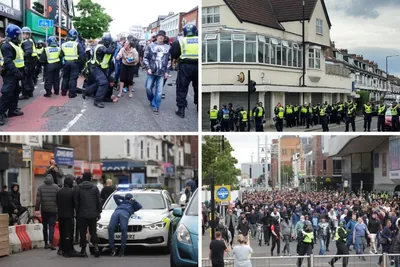
A man who has pleaded guilty to his role in the violent disorder that caused chaos in a North East town centre will have to wait to be sentenced.
A judge ordered a medical report to be compiled on Andrew Grieves to assess whether he has a diagnosed learning disability.
The 24-year-old became embroiled in the rioting that broke out in Middlesbrough following the death of three young girls in Southport in the summer of 2024.
Teesside Crown Court heard how further medical reports would be required before the defendant could be sentenced.
Gary Wood, representing Grieves, said his client was taken out of mainstream education as a teenager due to his learning difficulties.
He urged the judge to adjourn sentencing to allow time for a psychological report to be compiled on the defendant.
Grieves, of Acorn Close, Sacriston, County Durham, pleaded guilty to violent disorder in Middlesbrough on August 4, 2024.
Judge Richard Bennett adjourned sentencing until April 27 to allow time for the report to be completed.
He said: “I had intended to sentence you today, but I have read conflicting information,” he said.
“In your pre-sentence report it suggests that you have a learning disability but in the psychiatric report, the doctor suggests the position may not be as difficult.
“I need that sorting out. I need to know precisely what it is and I can’t sentence you until I know that.
“I can’t tell you what your fate will be but I can tell you it crosses the custody threshold and it will be decided at the next hearing whether you serve that sentence or whether I am able to suspend it.”
Grieves was released on unconditional bail until the next hearing.
2026.2.25 Mother and daughter set on fire in their home by 10 men in gang ‘revenge attack’
The pair were forced to jump from an upstairs window to escape the flames
Ten men are facing imprisonment after a mother and daughter sustained horrific burns when their house was petrol-bombed in a revenge arson attack.

A 31-year-old woman and a 13-year-old girl were forced to leap from an upstairs window after sustaining severe injuries as their home was set ablaze in Stoke-on-Trent, Staffordshire.
Emergency services were summoned to Beverley Drive, in the Bentilee area of the city, after a gang of men doused the property with petrol and ignited it.
The mother, who was also struck on the head as well as being set alight, sustained 65 per cent burns and was left in a coma for two months.
She survived, despite not being expected to, but was left with life-changing injuries which require ongoing medical treatment.
The teenage girl sustained 15 per cent burns to her right arm and right leg following the horror blaze on December 16 2021.
Ten men have now been convicted in connection with the attack following an 11-week trial at Nottingham Crown Court.
Shakil Uddin, 23, from Oldham, Greater Manchester, was found guilty of attempted murder and arson with intent on Friday.
Lukman Khan, 24, and Riyadh Iqbal, 23, both of Normacot, Stoke-on-Trent, were both found guilty of grievous bodily harm with intent and arson with intent.
Muhammad Sufyaan-Shah, 25, of HMP Hindley, Wigan, and Tayyeb Majeed, 23, of Longton, Stoke-on-Trent, were convicted of grievous bodily harm with intent.
Previously, Ali Abbas, 22, and Haris Mahmood, 21, both from Normacot, admitted to two counts of attempted murder and arson with intent to endanger life.
Naveed Hussain, 32, from Longton, confessed to violent disorder and possession of a knife blade/sharp pointed article in a public place in December of the previous year.
Kashif Ahmed, 25, from Stoke-on-Trent, Bilal Ahmed, 26, from Normacot, and Ali Abbas, 22 from Normacot, had earlier pleaded guilty to violent disorder.
The court was informed that around 4pm on December 16 2021, Naveed Hussain, Bilal Ahmed, Kashif Ahmed and Ali Abbas engaged in a brawl on Kildare Street, Longton.
Kashif Ahmed sustained a stab wound to his shoulder and sought medical attention at a hospital.
At 10.55pm on the same day, several men approached the house on Beverley Drive demanding to converse with Naveed Hussain.
The men shattered the ground floor windows and doused petrol in the hallway near the front door and outside close to the living room window.
To evade, the woman and the girl broke the upstairs bedroom window and leapt out, with the woman also suffering a fractured pelvis, broken ribs and a lacerated liver from the fall and had to relearn how to walk.
Staffordshire Police stated that the case necessitated extensive work to assemble CCTV, digital evidence and specialist material to bring each defendant to justice.
Detective Constable Howard Davies, from the force’s Major Investigations Department, said: “This was a very detailed and thorough investigation. We left no stone unturned to examine the circumstances of this case.
“This was a horrific ordeal for a mother to be set on fire in her own home in front of her daughter by a number of men seeking revenge.
“Our investigation reflects the sustained commitment of officers and partners to securing justice for the victims and ensuring those involved are held fully accountable.”
Assistant Chief Fire Officer Michelle Hickmott, of Staffordshire Fire and Rescue Service, said: “Following a thorough investigation working alongside our police colleagues, we are extremely pleased with the outcome of this case.
“Our investigation teams use their extensive skills and knowledge to identify when a fire has been started deliberately and then assist the investigation further to bring arsonists to justice.
“We are continually proud of the way our fire investigation colleagues work in collaboration with police to achieve these results.”
The men have all been remanded in custody and are due to be sentenced, at a date, time and court yet to be fixed.
2026.2.24 Women attacked the same police officer outside Stanley pub
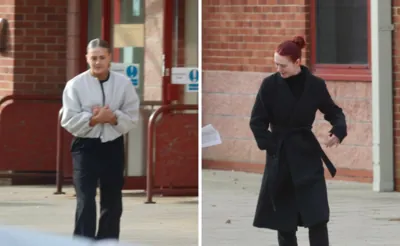
A late-night scuffle outside a County Durham pub saw two young women lose their clean records after assaulting the same police officer during a street disturbance.
Kacey Thomas and Jessica Tulip became caught up in the disorder after stepping in as officers tried to arrest another woman outside The Top House, in Stanley, in the early hours of February 1.
The pair, both 20, appeared before magistrates in Peterlee yesterday (Monday, February 23) after separately confronting the same officer within minutes of each other.
What began as an attempt to return a relative’s lost shoe quickly spiralled into pushing, shouting and, in Tulip’s case, swinging punches at police.
Heather Blair, prosecuting, said police were attempting to detain the woman on the ground when Thomas, a relative, picked up her discarded shoe and tried to pass it back to her.
But an officer pushed her away as she was attempting to hand over the shoe, so Thomas then forcefully pushed the officer in response.
Miss Blair said Thomas was also taken to the ground by other officers and detained for several minutes until police backup arrived at the Front Street pub.
The second defendant, Tulip, became involved in the ongoing incident minutes later.
Miss Blair said Tulip used “substantial force” and repeatedly threw blows towards the police officer, landing with at least one, before she, too, was arrested.
The court heard that Thomas and Tulip were each taken into custody for the rest of the night and were only released the following afternoon.
In separate cases, Thomas, of Acton Dene, Stanley, and Tulip, of Coniston Drive, Sacriston, who are both aged 20, each admitted common assault of an emergency worker.
The court heard that the officer was not injured in either incident.
Jaxon Taylor, representing the two defendants, said Thomas, who is related to the woman who was being arrested, did not see that incident and was not involved in it, but on coming outside became aware of the struggle on the ground.
In trying to hand back the detached shoe, she was pushed away by the officer and instinctively pushed her back.
Mr Taylor said that if it had not been for the “uniform”, it ordinarily may not have landed her in trouble.
She was taken to the ground as a result and detained there for several minutes, but later, when interviewed, she was apologetic.
Mr Taylor said Tulip, likewise, was of previous good character.
He said a lot of pressures were “getting on top of her” at the time.
“She saw red and accepts swinging her arms at the police officer and at least one made contact.”
Tulip was also taken to the ground and, like Thomas, had the “unpleasant experience” of being detained overnight in police custody.
But she was also remorseful and handed a letter of apology in at the police station, addressed to the officer she attacked, a few days later.
A further letter of apology was also handed to the court on her behalf.
Magistrates’ chairman Gary Walker asked both defendants if they enjoyed their night in the cells and their experience coming to court, to which both replied: “No” to each question.
He said, in each case, “that was the right answer” and told both that as a result of getting involved in the incident they had lost their good names.
Thomas, an aspiring dancer, who is on benefits, was fined £120, with £85 costs and was ordered to pay a £48 statutory court surcharge.
She was also ordered to pay £50 compensation to the officer she pushed.
Tulip, who is in part-time shop work, was fined £220 with £88 statutory surcharge, but no costs, as she was, instead, ordered to pay £150 compensation to the officer.
2026.2.24 Mum of tragic actor who died in ‘extreme’ sex issues devastating tribute
The mother of Michael Barron has spoken movingly about how her son’s hopes were ended by Josh Baxter

A grieving mother bravely delivered a moving courtroom eulogy to her budding actor son who died after an ‘extreme’ sex session with a stranger he met on Grindr.
Mary Power tearfully described her son Michael Barron as ‘my best friend’ as well as ‘kind, compassionate and very unique’. Her powerful speech came moments before the jailing of a man who had invited her son to his flat to get drunk before engaging in sex so rough it resulted a in bone breaking in his neck.
Josh Baxter, 28, invited Mr Barron, 38, to his flat in Blackley, north Manchester, in January last year after the pair had exchanged explicit messages on the dating app to discuss having rough sex. Baxter then tied up Mr Barron in his bed with rope and suffocated him for at least 30 minutes, a judge has ruled. He died after suffering a cardiac arrest following a lack of oxygen to the brain.
The court heard the pair were part of a community of people into kinky sex or BDSM (bondage and discipline; dominance and submission; and sadism and masochism). But, after hearing moving courtroom testimonials about Mr Barron, a judge dismissed claims made on his behalf that Baxter should be spared a jail sentence as the pair had engaged in ‘consensual acts’.
Baxter, of Lakeside Rise, Blackley, denied manslaughter, intentional strangulation or suffocation, and unlawfully inflicting grievous bodily harm during a trial last month. A jury found him not guilty of manslaughter but guilty of intentional strangulation or suffocation, and unlawfully inflicting grievous bodily harm.
“I never saw it as a dangerous activity,” Baxter had told jurors in his trial. “I have never hurt someone before, doing choking.” He maintained the neck injury was inflicted accidentally, a claim rejected by the verdicts of the jury.
On January 26 last year, Baxter and Mr Barron, originally from the Republic of Ireland, met on Grindr. They began by discussing the possibility of a ‘hook-up’ and established they were both after a more extreme experience, the trial heard.
Mr Barron said he liked to be ‘tied, gagged, hooded, totally helpless’ and that he liked ‘pain and torture’. Baxter wrote: “I want to get you so drunk you pass out.” He said he had cable ties and rope. They spoke about ‘rape role play’, the court heard. Baxter told Mr Barron: “As soon as you get here, start drinking vodka. Get you so drunk.”
‘A part of me died’, mum says
In frequently tearful testimony during Baxter’s sentencing hearing on Monday, Michael’s mother Mary Power told Manchester’s Minshull Street Crown Court: “Nothing can prepare you for the loss of a child. A part of me died, a part of me I will never get back.”
She said her son was not only her child but ‘also my best friend’, describing him as ‘kind, compassionate and very unique’, and someone who ‘brightened up my world as soon as he entered it’.
After the death of his gran, the pair grew even closer and the four years they spent living together after Covid was a ‘gift’ when they shared meals and music and every day, she told the court.
On Saturday mornings they shared pancakes and every other morning they chatted over tea ad coffee, she said. “It wasn’t an extravagant life but it was so full of love and it was ours,” Mary told the judge. Mother and son felt ‘warm and comfortable’ in each other’s company, said Mary.
Since his death, some experiences they shared together such as baking lemon drizzle cake were now ‘simply too painful’, she said. She described the many lives ‘my baby’ had touched here and in Dublin and Waterford.
Her son ‘deserved to feel loved and safe’, she said, adding that she was grieving for the conversations that they would never have. “I will never stop loving him. I will never stop missing him,” she said.
Michael’s sister, Lisa Power-O’Callaghan, delivered her own tearful eulogy to the court, describing her sibling’s death as ‘a life cut short unnecessarily and a future full of dreams left unfinished’.
His ‘big dream and big ambition’ was to become an actor, having already appeared in Hollyoaks and Emmerdale, said Lisa. Her brother believed he could ‘truly make it’ as an actor, she said. He had booked more acting lessons and new headshots, the court was told.
Michael was ‘our protector and confidante’ as a family but since his death ‘everything has changed for us’, Lisa told the judge. The family was ‘grief-stricken’ while life was now ‘colder, lonelier and incomplete’, she said.
Baxter ignored warnings a month before
The moving courtroom testimonies painted a picture at odds with much of the evidence heard in the trial, which provided a rare glimpse of a community of people into kinky sex or BDSM (bondage and discipline; dominance and submission; and sadism and masochism).
“It was consensual acts of of two adult males who had previous experience within the BDSM community,” said Baxter’s barrister Rebecca Filletti at Baxter’s sentencing hearing on Monday, arguing that her client had already served 394 days on remand and shouldn’t be jailed. She pointed to a ‘lack of intent’ to cause harm and that the pair had been involved in ‘sexual play’ which they had discussed before meeting up.
On remand, her client had been a ‘model prisoner’ who had landed a trusted job as a ‘wing cleaner’ as well as a role introducing new inmates. He had been brought up on her own by his single parent mother, the court heard. Her client was ‘unlikely to re-offend’ and had expressed ‘great sorrow’ over the death, according to Ms Filletti.
Judge Tina Landale took a much harsher view of the defendant, jailing him for four years. The pair may well have consented to rough sex but this didn’t hand Baxter a free pass to do what he liked, she effectively ruled.
A month before the death, Baxter was warned by someone else about the dangers of choking and an internet search confirmed the risks to him, Judge Landale noted. The judge continued: “You decided to ignore those warnings and you chose to ignore those warnings and during your trial in evidence you told the jury you still did not consider choking to be dangerous. You encouraged Mr Barron to become extremely drunk. During sexual activity you choked Mr Barron so hard it fractured a bone and cartilege in his neck. You were reckless in doing so.”
The defendant’s claim that he had only squeezed the neck for a few seconds was ‘inconsistent with the jury’s verdicts which found that you foresaw the risk of injury’, said the judge. Judge Landale also noted that the defendant had admitted to a probation officer he had ‘repeatedly’ choked Mr Barron while he was tied down with rope.
It was ‘sustained suffocation’ while he was on top of Mr Barron ‘for at least 30 minutes’, said the judge, who went on that she ‘rejected’ claims the defendant was remorseful.
“During your evidence you demonstrated no insight into your behaviour or accepted responsibility what-so-ever,” she said, adding that the defendant had shown a ‘poor understanding of consent and a limited insight into the risk of harm’.
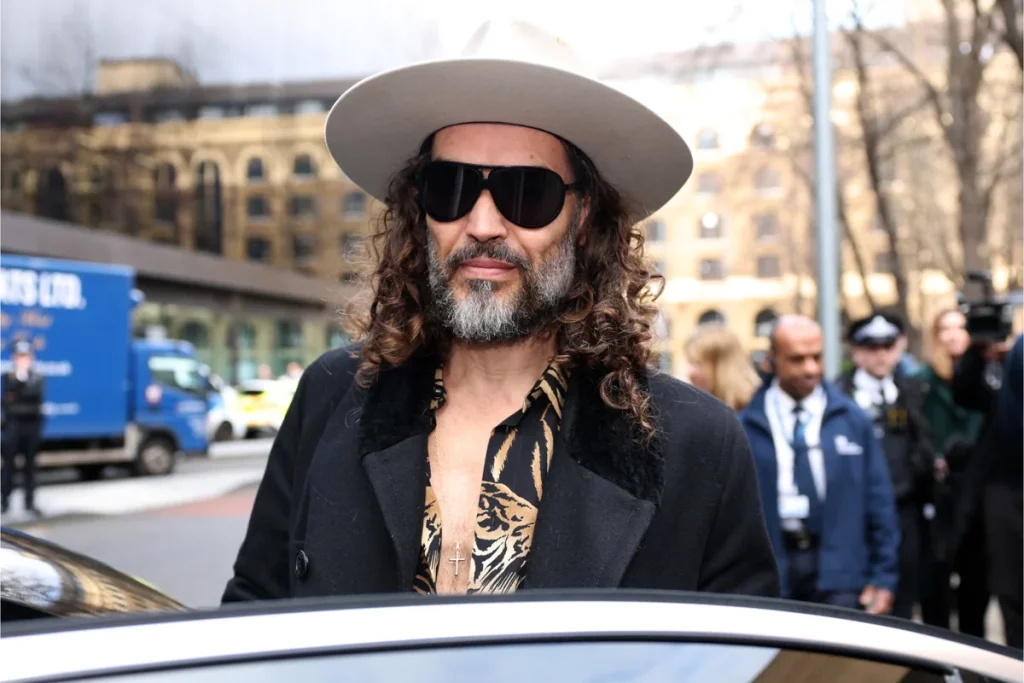
LONDON (AP) — British comedian Russell Brand pleaded not guilty on Tuesday to new counts of rape and sexual assault.
Brand, who was already facing similar charges involving four women, denied the new charges in Southwark Crown Court. The alleged offenses took place in 2009, the Crown Prosecution Service said.
Brand, 50, was charged in April with two counts of rape, two counts of sexual assault and one count of indecent assault. Prosecutors said those offenses involving four women took place between 1999 and 2005 — one in the English seaside town of Bournemouth and three in London. Brand pleaded not guilty to those charges in a London court earlier this year.
A trial scheduled for June is expected to last four to five weeks.
The “Get Him To The Greek” actor, known for risqué stand-up routines, battles with drugs and alcohol, has dropped out of mainstream media in recent years. He built a large following online with videos mixing wellness and conspiracy theories, as well as discussing his religious devotion.
x1200
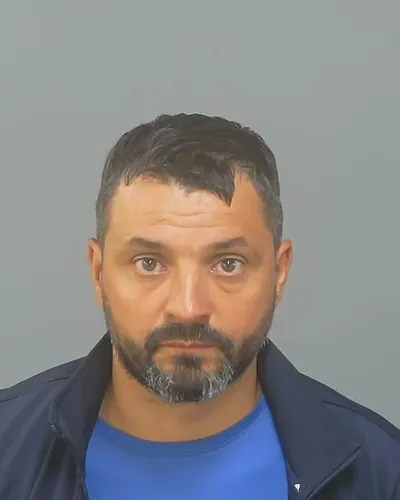
A married man who paid to have sex with a 15-year-old girl in a Southampton park has been jailed – and will now likely be deported.
Romanian national Cristian Tataru committed the offence at Hoglands Park in 2022 after paying the girl’s boyfriend £20, the city’s crown court was told.
The defendant later left the country and was arrested in Dover when he returned to the UK in 2025.
Giles Bedloe, prosecuting, said: “In a prepared statement, he admitted having sex with the victim in this case. He said he thought she was 18 and thereafter gave a ‘no comment’ interview.”
Referring to two previous alleged incidents, Mr Bedloe said the girl told a relative that she had been raped three times by three different men.
Tataru, 41, of Brintons Road, Southampton, had previously pleaded guilty to paying for the sexual services of a child, but denied a separate allegation of rape. Mr Bedloe said the rape allegation would lie on file.
Andrew Houston, mitigating, said the defendant first came to the UK in 2016, working in various industries to earn money for his family in Romania.
Mr Houston told the court: “He has a wife who has three children.
“He knows he has let his wife and stepchildren down. He is sorry for what he has done. He has always accepted there was sexual activity.”
Referring to the other two offences alleged by the girl, Mr Houston said the whereabouts of “the other men in the case” were unknown.
“He [Tataru] feels highly aggrieved that he’s the only person who has been prosecuted so far. It’s galling for him that he’s the one who has ended up in trouble.”
Passing sentence, Judge Gary Lucie told the defendant: “You paid £20 to have sex with [the victim]. She was 15 and you were 38 – more than twice her age.
“You were acting with others including her partner at the time, who was abusing her. This was all about commercial exploitation.”
Tataru received a sentence of three years and four months. The defendant will serve up to half in prison before being released on licence. He was also handed a five-year restraining order and placed on the sex offenders register for life.
Once has has served his sentence he is likely to be deported, the court heard.

2026.2.20 Arrest made over ‘serious sexual assault’ at top London nightclub The Box
The Box in Soho could face closure at a Westminster council hearing next week
Police have made an arrest after a male customer at an exclusive London nightclub was allegedly the victim of a “serious sexual assault” by a performer there.
The Box in Soho has been accused of breaking several of its licensing conditions after the incident in January and could face closure at a hearing next week.
The cabaret club, which charges around £5,000 for VIP tables, is known for its risqué burlesque shows and private celebrity parties, with Usher, Kate Moss, Rhiana and Prince Harry among its famous clientele.
An allegation that a customer had been “seriously sexually assaulted by a performer” at the venue was made to police on January 26.
A Met Police spokesman said: “Officers investigating a report of a serious sexual assault of a man at a nightclub in Soho have made an arrest.
“A person was arrested on Saturday, February 14 on suspicion of sexual assault in relation to an incident at the venue on Walker’s Court, Soho on Thursday, 22 January. They have been bailed to return on a date in mid-March.”
Since opening in Walker’s Court in 2011, The Box has become known for its strict door policy, unconventional, explicit late night live performances and attracting the rich and famous.
Previous acts are said to have included simulated threesomes, men dressed as pigs licking food off strippers and a performer who plays well-known tunes with her genitalia.
The venue, which has a sister club in New York, is also used for events and fashion houses and singers have hosted private parties there.
Last year, Usher held exclusive after-party performances at The Box to celebrate his sold-out O2 Arena residency.
Managers are set to be hauled before a Westminster council licensing panel on February 25 following the alleged sexual assault after police accused the venue of not immediately reporting the incident.
According to documents published by Westminster Council: “The venue has the benefit of a SEV [Sexual Entertainment Venue] Licence and as such there are a number of conditions they need to adhere to when this is in operation.
“Having reviewed the footage it is clear that the premises has breached a number of conditions.
“There are also a number of conditions breached in relation to the records kept and the code of conduct.
“Due to the seriousness of this offence, the delayed action by the venue and the risk to further customers the police believe the premises have significantly failed to uphold the crime and disorder and public safety licensing objectives.”
2026.2.20 What to know about the arrest of Andrew Mountbatten-Windsor

LONDON (AP) — Police were searching the former home of the brother of King Charles III, Andrew Mountbatten-Windsor, on Friday, a day after he was arrested on suspicion of misconduct in public office in connection with his close relationship with the late convicted sex offender Jeffrey Epstein.
The accusation at the heart of the arrest of Mountbatten-Windsor, who was known as Prince Andrew until October when his brother stripped him of his titles and honors, is that he shared confidential trade information with with the disgraced financier Epstein, who took his own life in a New York prison in 2019.
Mountbatten-Windsor was released around 11 hours after his detention without any charges but remains under investigation.
The crisis is one of the gravest in modern times for the British monarchy and the House of Windsor, which was established more than a hundred years ago — on the scale of the abdication of King Edward VIII in 1936 and the death of Diana, Princess of Wales, in 1997.
Here’s what to know:
The arrest
Officers from Thames Valley Police arrested Mountbatten-Windsor at 8 a.m. Thursday morning at the king’s private retreat in Sandringham, where the former prince is now living.
The arrest followed a ratcheting up of allegations against Mountbatten-Windsor in the wake of the release of millions of pages of files last month related to Epstein by the U.S. Justice Department.
Many of the recent allegations center on sexual impropriety, specifically that a woman was trafficked to the U.K. by Epstein to have a sexual encounter with the then-prince.
However, he was arrested on suspicion of misconduct in public office.
The suspicion
The Crown Prosecution Service, which decides on whether a charge has the potential to lead to a successful prosecution, defines misconduct in public office as the “serious willful abuse or neglect of the power or responsibilities of the public office held.”
Thames Valley Police had previously said it was “assessing” reports that Mountbatten-Windsor sent confidential trade reports to Epstein in 2010, when the former prince was Britain’s special envoy for international trade.
Specifically, emails released as part of the Epstein files appeared to show Mountbatten-Windsor sharing reports of official visits to Hong Kong, Vietnam and Singapore.
One, dated November 2010, appeared to be forwarded by Andrew five minutes after he had received it. Another a few weeks later appeared to him sending Epstein a confidential brief on investment opportunities in the reconstruction of Helmand Province, Afghanistan.
Other police forces in the U.K. are also conducting their own investigations into Mountbatten-Windsor’s Epstein-related links.
The potential sentence
The offense technically carries a maximum sentence of life imprisonment, but experts say a shorter term would be more likely if he is convicted by a jury.
Mountbatten-Windsor has always denied any impropriety but has not commented on the most recent allegations.
Experts said that proving misconduct in a public office is notoriously difficult to prove.
“Firstly, it must be determined if Andrew Mountbatten-Windsor was in a role within government that constitutes the title of public officer,” said Sean Caulfield, a criminal defense lawyer at Hodge Jones & Allen. “There is no standard definition to clearly draw on.”
In recent years, prison officers have been prosecuted for the offense after having inappropriate relationships with inmates, as well as police officers leaking information.
Now that he’s been released
Following his arrest, police had the power to search Mountbatten-Windsor’s properties, as well as being able to question him.
He was released around 11 hours after his arrest, but still under investigation, meaning he has neither been charged nor exonerated. He was photographed slouched in the back of a vehicle as he left Aylsham police station.
While at the station, Mountbatten-Windsor is likely to have had his mug shot taken before being placed in a small prison cell ahead of his formal police interview. It’s not known whether Mountbatten-Windsor said anything beyond “no comment” to each question posed — as is his right.
Searches were carried out at addresses in Berkshire, west of London, and Norfolk, northeast of the capital. Windsor Castle, within which Mountbatten-Windsor lived until earlier this month, is in Berkshire, while Sandringham is in Norfolk.
Police said they had finished searching Mountbatten-Windsor’s home, but officers were still searching Royal Lodge, his former 30-room residence near Windsor Castle, on Friday.
The Crown Prosecution Service will ultimately make a decision about charging him.
Andrew Gilmore, a partner at Grosvenor Law, said that prosecutors will apply the two-stage test known as the “Code for Crown Prosecutors.”
“That test is to determine whether there is a more realistic prospect of a conviction than not based on the evidence and whether the matter is in the public interest,” he said. “If these two tests are met, then the matter will be charged and proceed to court.”
The response
Mountbatten-Windsor’s arrest is not a huge surprise given that police forces across the U.K. have said they were investigating him.
However, it is a hugely consequential moment in the history of the modern monarchy. Mountbatten-Windsor, who was second in line to the throne at his birth, remains eighth in the line of succession. He could voluntarily abdicate his position, or a law could be passed to remove him from the line of succession.
King Charles I. almost 400 years ago, was the last major royal to be arrested. That turned into a seismic moment in British history, leading to civil war, Charles’ beheading and the temporary abolition of the monarchy.
After Mountbatten-Windsor’s arrest Thursday, King Charles III said that the law must take its course in the investigation as he further sought to distance the royal family from his brother.
“As this process continues, it would not be right for me to comment further on this matter,” the king said in a statement signed Charles R. “My family and I will continue in our duty and service to you all.’’
Both the king and his wife, Queen Camilla, faced questions over Mountbatten-Windsor at their respective events in London, but neither responded.
Mountbatten-Windsor’s former wife, Sarah Ferguson, has yet to comment. She has faced her own allegations in connection with her dealings with Epstein.
2026.2.19 The woman who tricked her best friend into sex – and went to jail
A blindfold, a fake boyfriend and two years of deception: The Bed Trick by Izabella Scott revisits one of Britain’s strangest consent cases
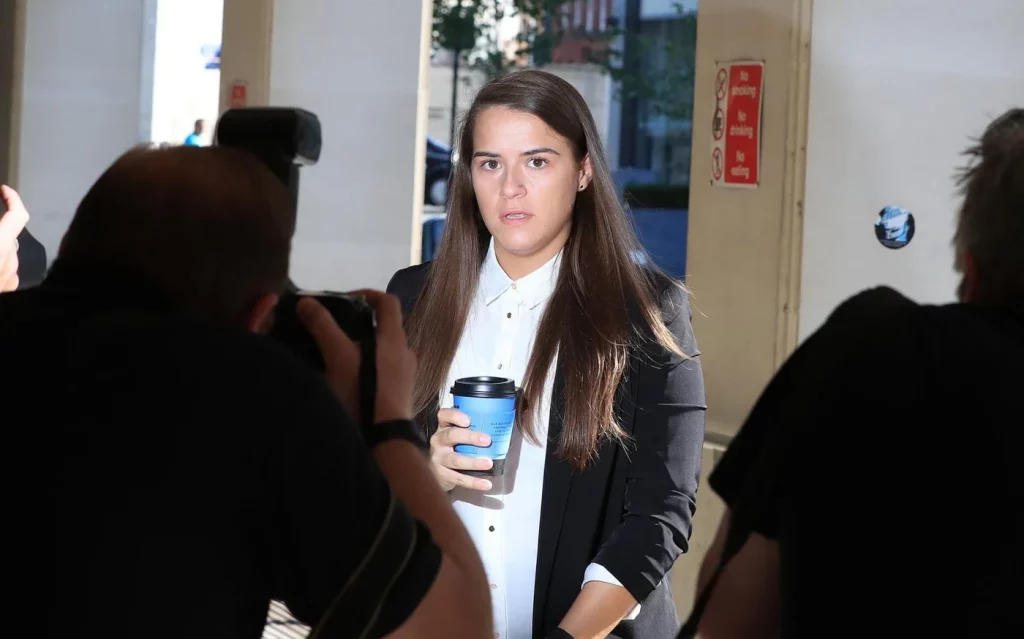
Newland told the police that the fictional lover was part of a consensual role-play Credit: Andrew Price/View Finder Pictures-Chester
x1200
What do you do when you discover that you haven’t been having sex with your boyfriend, as you thought, but with a female friend using a large rubber toy? That was the question faced one day in 2013 by Chloe, a 23-year-old living in Cheshire, when she suddenly removed the blindfold she’d always been told by her partner to wear during sex – and saw that the man she’d been dating, Kye, was fictional.
The woman in front of her, Gayle, was a close friend. But she’d been behind all of it: Kye’s Facebook profile, his calls. His insistence for two years that he’d had a disfiguring accident, so they couldn’t meet. Or they could, but only if Chloe – not her real name – wore a thick strip of cloth around her head. Chloe would wait for him in hotel rooms or her empty flat, texting Kye to say that she was blindfolded and ready. At first they just kissed; over 10 or so meetings, they began to have sex.
The exposure left Chloe shocked. In her confusion, she pushed Gayle down the stairs, rushing past her and telling her friend to back off, in an argument caught outside on CCTV. A few days later, she brought the case to the police. But when questioned, Gayle had a very different version of events. Kye, she said, was a shared fantasy in which two young women explored their sexuality – and what Chloe was experiencing now was a heavy dose of internalised homophobia.
The young writer Izabella Scott has been fascinated by this case ever since it went to trial in 2015, and ended with Gayle Newland being sentenced to eight years for sexual assault by penetration. The saga would rear its head again in 2017, when she appealed, was retried and received a similar sentence. The title of Scott’s eventual book, The Bed Trick, refers to a popular plot device in Shakespeare’s plays, whereby lovers swap places in the dark. That “trick”, she explains, was most often used for comic effect, but it also spoke to a genuine fear in the public consciousness, and has shaped our subsequent approach to cases such as Chloe and Gayle’s.
According to Public Prosecutions, obtaining consent for sex is as straightforward as offering a cup of tea. If you ask someone whether they want one, and they say no, you shouldn’t make them drink it. Chloe, in a literal sense, had said yes, but the deception over the kind of sex she was having meant that her consent hadn’t been legally obtained. Part of the reason her case attracted so much interest was the speculation about whether other kinds of mendacity might turn you into a sex offender: lying about your salary, for example, or your age.
But what happens when someone also seems willing to be deceived? The law says one person is innocent and the other guilty, but Chloe’s account was full of holes. The lawyers’ most pressing question was: how did you not know that you were having sex with a rubber penis? It was extremely realistic, she said; she could even feel testicles. Okay, but did she not feel Gayle’s breasts? Well, she had bound them with a swimming costume.
Then what about your boyfriend’s voice sounding the same as your best friend’s? Lawyers had dug up call logs and found that Chloe would call Kye for 10 minutes, then call Gayle straight afterwards. Chloe said she’d been told that Gayle and Kye were childhood friends with identical accents. (They also apparently shared interests, hobbies and a birthday.)
In many ways, the case was a perfect example of “catfishing”: deceiving someone through the use of a false online identity, a phenomenon that exploded in the 2010s. Chloe had never peeked out from beneath the blindfold, had believed all of Kye’s tales of disfigurement, because, she said, “I was so desperate to be loved… It’s pathetic.” Ultimately, Gayle’s case ended in a conviction because it triggered a Victorian piece of legislation – if you could prove deceptive qualities in a person, then consent had never been on the table at all. The texts and emails Gayle sent to Chloe after the exposure were damning: “I said lies to hide lies but I didn’t lie about everything and it was me and still is… Every day I felt guilty, but I couldn’t leave you, as you needed me.”
Scott is a clear and meticulous guide through all of this. She considers the trial from every angle in the gallery, examining other cases of “gender fraud” and giving a potted history of rape law that, unappealing a subject as it is, I found fascinating. When Gayle appeals her sentence, it’s revealed that she’s suffering from gender dysphoria; Scott speculates with sensitivity about whether she might have been trans. (Would Chloe’s consent still have been vitiated, partly or completely, if Gayle really “was”, in that sense, Kye?)
That said, I wish that Scott had trusted herself more. She aims to be a backseat narrator, presenting evidence to the reader so that they might judge the case for themselves; and yet, without her arguing for much, I was often left searching for the wider point. Near the end, she wonders whether the case partly went to court because of its salacious set-up, a point so gently made that you can’t help but wish for some authority behind it. The Bed Trick is also full of repetitions, more frustrating than useful. That’s by no means the writer’s fault, so much as a very absent editor’s.
As The Bed Trick gathers pace, Scott reveals that Gayle had played “Kye” to other women, though she hadn’t met up with them. We also learn that Gayle had a separate criminal conviction, for defrauding a marketing company that employed her. And then Scott teases us with something in Chloe’s “history, her record”, something with “equal weight” that could “tip the scales back” – but which she cannot reveal in this book because of anonymity constraints. It’s titillatingly done, thrilling to consider. Yet the jury must have known what it was, and it wasn’t enough to change their minds.

2026.2.18 Trial date set for former BBC Radio Leicester presenter facing dozens of historical sex offence charges
He denies the allegations
A trial date has been set for a former BBC Radio Leicester presenter facing more than 30 historical sexual offence charges.
Brian Shuttlewood, 79, appeared at Leicester Crown Court yesterday (Tuesday, February 17) for a further update on his case.
The hearing had been listed to provide an update on concerns regarding the defendant’s health, after his original trial in January was adjourned on medical grounds.
Shuttlewood, of Margaret Villas, Beards Road, Newhall, has pleaded not guilty to all allegations against him.
The court set a trial date of April 5, 2027 at Leicester Crown Court, on Wellington Street, with the hearing estimated to last two weeks.
A further hearing, which the defendant must attend, has also been listed for April 7, 2026 at the same court.
Shuttlewood is charged with multiple counts of indecent assault, rape, gross indecency and child cruelty offences.
The alleged offences are said to have taken place in Leicester between 1972 and 1990, with some allegedly occurring before and during his time as a BBC presenter.
The charges relate to four alleged victims, who are entitled to lifelong anonymity under the law. Shuttlewood also denies a charge of possessing extreme pornographic images from March 2023.
He was remanded on conditional bail, with a requirement for a medical or psychiatric report to be prepared.
He has denied all charges against him.

2026.2.4 Teenage gang stole high value cars in Rhoose and Sully
A teenage gang are behind bars after they stole high value cars and bikes after breaking into “nice houses” during a crime spree.
Evan Andrews, 18, and Jacob Lawday and Mackenzie Daly, both aged 19, are starting lengthy terms in a young offender institution after being sentenced.
Harry Baker, prosecuting, told Cardiff Crown Court how the trio were responsible for burglary and theft after properties, including in Rhoose and Sully, were “targeted” last year.
The bulk of the offending was committed by Andrews and Daly.
Vehicles stolen included a BMW IX2, Mercedes E220, Audi A5, MG HS and a Land Rover after break-ins and the keys for them taken.
“Nice residencies” in Penarth, Sully, Rhoose and Cardiff were burgled in August 2025, Mr Baker.
Lawday was responsible with his partners in crime for two offences which took place in Ogmore on September 11 last year.
In victim impact statements, complainants described feeling “shocked, distressed and unsettled” after having their homes “invaded”.
Some described how they now face sleepless nights after being left worried about being burgled again.
Andrews had a previous conviction for going equipped for theft, attempted burglary and driving while disqualified.
Daly had been in trouble with the law before over a driving offence.
In mitigation, it was asked by their barristers, Joshua Scouller, Peter Donnison and Harriet Ealdon that their clients be give the appropriate credit for their guilty pleas.
Their lawyers also asked that the court take into account their young ages.
The judge, Recorder Greg Bull KC, told the defendants: “You are being sentenced for a spate of criminal activity in South Wales which took place over the space of a month.
“You acted as a gang, to a greater or lesser extent, to steal keys and vehicles.
Andrews and Daly were each sent to a young offender institution for 32 months and Lawday sent into custody for two years.
The three were told they would be released on licence at around the halfway stage and that any time spent on remand would count towards their sentences.
Each will also have to pay a statutory victim surcharge.
2026.1.31 Child rapist Arthur Warwick found dead in HMP Frankland cell
A paedophile who was handed a life sentence for raping children was found dead in his Durham jail cell on Christmas Day, an inquest heard.
Arthur Warwick from Penrith was given a life sentence in 2016, after being found guilty of 29 child sex offences against four children.
They included five child rapes and a series of sexual assaults. He told one of his victims that he would stop the abuse provided the child found another boy to take his place.
Warwick was arrested when he travelled to Whitehaven, believing he was due to meet a 13-year-old boy he had befriended online – but the contact was an undercover police officer.
At his home, 20 indecent images of children were found on his computer equipment. A third of these were classed in category A – the most serious.
An inquest into his death was opened at Crook Coroners’ Court yesterday (January 29) and heard he died from heart disease at Frankland Prison, in Durham.
Coroners’ officer Jacqueline Orpen told the hearing: “I understand the circumstances to be that Mr Warwick was found deceased in his cell.
“A post-mortem examination at Newcastle RVI mortuary gave a provisional cause of death as heart disease.”
2026.1.30 American Goldsmiths student who murdered his Chinese lover is jailed for life as victim’s family pay heartbreaking tribute
American Joshua Michals, 26, jailed for life with a minimum term of 16 years for murdering fellow student lover Zhe Wang

An American student at a London university has been jailed for life with a minimum term of 16 years for murdering his sexual partner in a stabbing which he claimed was self-defence.
Chinese national Zhe Wang, 31, a creative writing student at Goldsmiths, University of London, was found dead with two stab wounds to her face at her flat in Manor Park, Lewisham, south-east London, on March 20 2024.
Fellow student Joshua Michals, 26, told his trial at the Old Bailey that Ms Wang was “germophobic” and became “stressed”, believing, incorrectly, that she had contracted a sexually transmitted disease (STD) after they had sex.
Michals, who was found guilty of murder in December following a trial, was sentenced at the Old Bailey on Friday.
Born and raised in Chicago, Illinois, Michals studied film-making at university before moving to London to pursue a year-long master’s degree at Goldsmiths.
During the trial, prosecutor Henrietta Paget KC said Michals had “flown into a rage” and killed Ms Wang after meeting her at her flat.
They had first met on the Goldsmiths campus and began an on-and-off casual relationship in 2023.
Michals told jurors he had felt “so-so” about pursuing a relationship with Ms Wang because she had a phobia of germs.
After finding a “red dot” on her skin after the pair had sex, she demanded he get an STD test, even vowing to find him on campus to “drag” him to see a GP, the court previously heard.
Jurors were told Michals never had a sexually transmitted disease.
The student said he went to her flat on March 20 2024 with a charcuterie selection to bring some “normalcy” to the “bizarre situation”.
He claimed that when he arrived at the flat in Lewisham, he found Ms Wang “cold” and monosyllabic, and that she attacked him with a knife as he came out of the bathroom.
A post-mortem examination found Ms Wang died from stab wounds to the head and compression to the neck, the trial heard.
Michals previously told jurors he did not mean to strike Ms Wang with the knife, saying: “I just wanted to get her away from me.”
He also said he pressed his forearm to her neck to try to restrain her and claimed he did not mean to kill her or cause her harm.
But Judge Richard Marks KC said: “My conclusion is that you became enraged by the whole situation. In a fury you lost complete control of your temper and your senses.”
The judge said Michals inflicted two serious wounds to Ms Wang’s face with one of her kitchen knives and that the second wound involved “a use of severe force”.
“The proliferation of bleeding did not bring you to your senses… you used your forearm with considerable force to then throttle her,” he said.
Michals called his father after the incident and got details of a solicitor before going to his own flat and calling 999, the trial heard.
He also took Ms Wang’s phone from her kitchen and put it in a bin outside, jurors were previously told.
It was recovered days later at a refuse area in Newham, east London.
In a victim impact statement from Ms Wang’s cousin, Xiao Li Wang, read to the court by prosecutor Henrietta Paget KC, she said it was difficult to verbalise “the emotions and heartbreak of losing a close family member”.
The relative, who observed proceedings via video link from China, said Ms Wang’s family thought it was a scam when they first received a call with the news that she had died.
“Nobody wanted to believe what we had been told, it felt like something you see in the movies,” Ms Wang’s cousin said.
She added: “Zhe was so positive, hardworking, passionate about life and yet something so cruel had happened to her.”
Judge Richard Marks KC said that evidence showed Ms Wang was “a hugely talented writer, a gentle and kindly young woman, private and sensitive and it would seem to me someone emotionally fragile”.
2026.1.28 ‘Mad scientist’ threatened to put ricin in Luton water supply
Harry Whittaker, 33, jailed after experimenting with radioactive material in garden shed
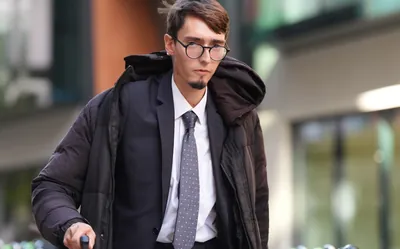
A “mad scientist” threatened to introduce the poison ricin into Luton’s water supply.
Harry Whittaker, a neo-Nazi, who kept a framed photograph of Adolf Hitler in his bedroom, wrote messages about putting the deadly biological toxin into the water supply in Bury Park, Bedfordshire, a court heard.
The 33-year-old, who lived at home with his mother, has been jailed after manufacturing explosives and conducting experiments with radioactive material in a garden shed he called “The Laboratory”.
After his arrest, he was found to have sent messages calling for Tommy Robinson, the far-Right activist, to lead a “civil war” and he also contemplated attacking Muslims at a nearby mosque.
In another message, he wrote about contaminating the water supply with ricin.
In one WhatsApp post, he wrote: “We need a tank covered in machine guns and flamethrowers, drive it into that mosque on Friday afternoon and turn them into mincemeat.”
Whittaker, who used the name “Harry the Mad Scientist” on WhatsApp, also kept anti-Semitic notes in his bedroom and labelled a cyanide sample “Zyklon B” after the poison used in the Holocaust.
Police uncovered his stash of explosives after Whittaker suffered a life-threatening allergic reaction and called for medical help on Apr 18, 2024. He was arrested on May 6.
After an Old Bailey trial, Whittaker was found guilty of possessing and making explosives and was sent to prison for three years and nine months.
He had already admitted possessing a round of ammunition and potassium cyanide.
During the trial, Whittaker cast himself as a “nerdy” science geek and jurors were not told about the extent of his extreme Right-wing beliefs.
But at his sentencing on Wednesday, Emily Dummett, a prosecutor, set out further evidence of his interest in neo-Nazi ideology.
Ms Dummett also said he had continued to express extreme beliefs and since his conviction had failed to recognise that what he had done was wrong.
In mitigation, Polly Dyer maintained Whittaker had the explosives for “scientific interest and endeavour” and said “his experimentation was not motivated by any racial hostility to certain groups of individuals”.
She accepted he had “abhorrent” views and an interest in Nazism but insisted he did not pose a “significant risk”.
Ms Dyer also noted how, since he had been in jail, Whittaker had used his time productively and developed an interest in art.
She held up his drawing of Beethoven which he hoped to submit to a competition.
Sentencing, Judge Simon Mayo KC told Whittaker: “I am sure your conduct in making and possessing explosives gave rise to risk of harm to others.
“Whilst I cannot be sure you had formed any separate intent to use the explosives or chemicals for a violent purpose you spoke about it and to a certain extent contemplated it.”
The judge said Whittaker was “highly intelligent” and his responsibility was not diminished by his mental health issues or autism.
He noted a previous conviction for causing actual bodily harm after driving into his neighbour in 2019 and his disorganised lifestyle, as he found Whittaker was a dangerous offender and posed a risk to members of the public in the future.
When police searched his house in Caddington, they found black powder, blanks and a round of live ammunition, chemicals, lethal poisons and suspected improvised explosive devices.
Officers also discovered radioactive materials and white phosphorus, a substance which can spontaneously ignite in the air and is so dangerous that it had to be destroyed in a controlled explosion by the military.
In police interviews, Whittaker said: “I’m just a nerdy kid who likes doing science.”
2026.1.22 Charity offers new £20,000 reward to solve longest miscarriage of justice murder
The brutal murder of barmaid Diane Sindall as she walked home from her shift in the early hours of Saturday 2nd August 1986 sparked a national outcry.

Detectives have vowed to bring the frenzied sexual killer of a 21 year-old florist 40 years ago to justice after unveiling a new £20,000 Crimestoppers reward today. The brutal murder of Diane Sindall – as she walked home from work on Saturday 2nd August 1986 in Birkenhead, on the Wirral – sparked national outcry with her battered body found in an alleyway.
Peter Sullivan was interviewed by police 22 times over four weeks – sometimes while denied legal representation – and in November 1987 was eventually convicted by a jury at Liverpool Crown Court of Diane’s murder. But after 38 years behind bars new forensic DNA evidence proved the killer is still out there and Mr Sullivan was the victim of the longest miscarriage of justice involving a living prisoner in British legal history.
Detectives have since been trying to match the real unknown killer’s new DNA sample after already testing and eliminating 461 local men – including Ms Sindall’s relatives and her then fiancé.
Now Merseyside Police are urging anyone with information to come forward as Crimestoppers today(Thurs) unveil a £20,000 reward for information leading to the arrest of Diane’s real murderer.
Detective Superintendent Rachel Wilson said: “It is devastating for Diane’s family that they are still waiting for the answers as to who was responsible for her murder, and we remain committed to identifying the person whose DNA was left at the scene.
“In 1986 DNA was very much in the early stages and as such was not available to the detectives who originally investigated Diane’s death but her murder was fully investigated by the team.
“Unfortunately, there is no match for the DNA identified on the national DNA database and we know it does not belong to any member of her family or her fiancé at the time.
“We are working with the National Crime Agency, and with their support we are trying to identify the person the DNA profile belongs to, and extensive enquiries remain ongoing.
“The investigation team has obtained samples locally, but screening has also taken place in Swansea, Perth, London, Hull and Newcastle with the voluntary DNA elimination samples.
“To date 461 males have been eliminated from the investigation. We are currently awaiting the forensic results in relation to a further 43 samples submitted earlier this month.”
Ms Sindall was a florist also doing part-time bar work to save up for her wedding and was on her way home from a shift at the Wellington Pub in Bebington when ambushed and dragged into an alley off Borough Road in Birkenhead.
Police believe while she left the pub in a blue Fiat van, it ran out of petrol and she set out on foot along Borough Road, either to get to a bus-stop or to try and find an all-night garage.
Her partially naked body was found the following afternoon. A post-mortem revealed she had died from severe head injuries, bone fractures and lacerations to her face, bruising to her neck with severe bite mark injuries.
Forensic investigators at the time recovered semen samples from her body, but they had been diluted by rainwater and the technology to successfully test them would not be available for decades.
Suspicion fell on Mr Sullivan after a BBC Crimewatch appeal resulted in a series of tip-offs with witnesses putting him in a pub near the scene of the murder that night. He was quizzed 22 times over four weeks, and denied legal representation for the first seven interviews.
Later recalling the guilty verdicts, innocent Mr Sullivan said: “My sister collapsed in the courtroom and the next minute, that was it.”
His sentence carried a minimum term of 16 years before he was eligible to apply for parole – but Mr Sullivan maintained his innocence, lessening his chances of release.
His nightmare only started to end in 2023, when the Criminal Cases Review Commission ordered fresh testing of semen samples found on Miss Sindall’s body in 1986.
The Crown Prosecution Service (CPS) decided not to challenge the DNA results ahead of a fresh appeal – paving the way for Mr Sullivan’s freedom.
This week Det Supt Wilson added: “Although it has been nearly 40 years since Diane’s murder, we still believe there are people who know what happened, or have their own suspicions, who haven’t yet come forward.
“My message would be ‘it is never too late to do the right thing’. We know on Friday 1 August 1986, Diane had been working her part-time job at the Wellington pub in Bebington.
“She had left work at 11.45pm in her blue Fiat van, but on her way home the van ran out of petrol on Borough Road.
“Diane got out of the van and was seen by several witnesses at the time walking along Borough Road between midnight and 12.20am on the Saturday morning. Her body was found 12 hours later in an alleyway off Borough Road.
“On 17 August 1986 property belonging to Diane was recovered on Bidston Hill. The investigation team at the time identified witnesses who had seen a small fire, at the location where the property was found, on Sunday 3 August, and had witnessed a man running from the scene.
“Were you on Borough Road on the evening of Friday 1 August or the early hours of Saturday 2 August and saw or heard something suspicious? Or can you help identify the man seen running away from Bidston Hill on Sunday 3 August?
“Additionally in the years since Diane’s murder has anybody you know raised any suspicions or passed any information which you think could help? Please come forward and tell us what you know.
“We can trace and request a DNA sample from any person you suspect or even a relative if they have passed away or emigrated.”
Gary Murray, North West Regional Manager for the charity Crimestoppers, said: “Please help bring answers to Diane’s family who have waited almost 40 years for justice.
“Someone, somewhere, knows what happened that night, and we’re urging them to come forward. What you know could finally give Diane’s loved ones the answers they’ve been waiting for.
“Crimestoppers is independent of the police. When you contact the charity, you stay completely anonymous. Your personal details are never asked for, and your call or online report cannot be traced back to you.
“Every day, thousands of people across the UK trust Crimestoppers with vital information that makes all the difference.
“We pass on what we’re told, and we hope that if you know something about this case, but are unwilling to speak to the police, you can stay completely anonymous with Crimestoppers.”
The reward is available for three months and is due to expire on 22nd April 2026. Crimestoppers is open 24 hours a day, seven days a week. No-one will ever know you contacted them and computer IP addresses are never traced.
2026.1.20 Prison officer jailed for having sex with convict boyfriend in prison prayer room

A former prison officer has been jailed for having illicit relationships with two inmates and plotting to smuggle drug-soaked envelopes into jail.
Isabelle Dale, 23, became romantically involved with prisoners Shahid Sharif and Connor Money and was ‘swearing them undying love, saying she wanted to be with both of them on the outside’, Judge Christopher Hehir said.
She got engaged to convicted robber Sharif, and later plotted with him and his associate, Lilea Sallis, to smuggle the synthetic cannabinoid, commonly known as spice, into HMP Swaleside on the Isle of Sheppey, Kent.
Dale, of Cosham, Portsmouth, was sentenced to three and a half years imprisonment for two counts of misconduct in a public office between September 2021 and December 2022, and one count of conspiring to convey a List A article into prison.
Sharif, who is already in custody at HMP Wandsworth, and Sallis, were also jailed for the latter charge.
Sentencing the three at Southwark Crown Court on Tuesday, the judge told Dale: ‘I have concluded that unfortunately you are a thoroughly devious and untruthful and manipulative young woman.
‘I accept you have some vulnerabilities but, as was apparent in your evidence, you seek to use them as a shield and an excuse for your actions. But they did not provide that.’
He added: ‘I suspect you actually joined the prison service with a view to becoming involved in criminal activities with prisoners.’
Dale arrived at HMP Coldingley, Surrey, in September 2021 for what would be her first and only posting.
By January, she and Sharif had had ‘at least some contact’ because she mentioned him to a senior colleague – by May they were engaged, the court heard.
The trial was told the prison officer, who has since resigned, had sex with Sharif in the chapel area of HMP Coldingley.
Judge Hehir said he could not know if they were intimate in the chapel area but text messages show they ‘clearly had a sexual relationship’ and other prison officers ‘obviously had clocked on to what was going on’.
Sharif was at the time serving a 12-year and 10-month sentence for an ‘extremely violent robbery of a jewellers on the south coast’, the judge added.
Dale’s home was searched and a ‘rather garish’ picture of the couple was found hanging above her bed, he said.
It had photographs of them ‘spliced together’ with a white heart between and the date May 17 2022, believed to be the day of their engagement.
The judge said evidence put to the jury showed she ‘well understood what corruption was and the risks and dangers relating to it’.
He added: ‘She wanted to do it. I think she’s attention seeking and I think she seeks validation and I think she did that through relationships with prisoners.’
Syam Soni, defending Dale, had said her offending was influenced by her mental health difficulties, including depression, anxiety, emotionally unstable personality disorder and post-traumatic stress disorder.
He had claimed she was ‘ill-equipped’ for the prison environment and more vulnerable than others.
The court heard Dale also conveyed sensitive information to Money, with whom she also had an intimate relationship.
The judge said: ‘When he said he was worried about losing his mobile phone if his cell was searched, any right-thinking security officer would go in and seize the cell, but she said “don’t worry, security aren’t too hot on you”.’
Dale, Sharif and Lilea Sallis, 28, also planned to bring envelopes dipped in spice into Swaleside prison.
A postal strike foiled their arrangements and it was organised for Dale to travel to Brighton to meet Sallis and collect the envelopes, the court heard.
However Sallis backed out because of a conflict with Sharif about prices, and content he was posting about her on social media, the judge said.
‘I don’t think she had a fit of conscience, to put it that way, but I think that’s why her enthusiasm cooled,’ he added.
Sharif attended proceedings via video link from prison.
He previously admitted conspiring to bring the drug into Swaleside and the two women, who had denied the charge, were convicted by a jury.
Sallis was sentenced to two and a half years in jail and Sharif received 27 months.
2026.1.20 Brothers targeted deaf woman, 92, and cancer patient in burglary spree
One victim barricaded herself in her bedroom
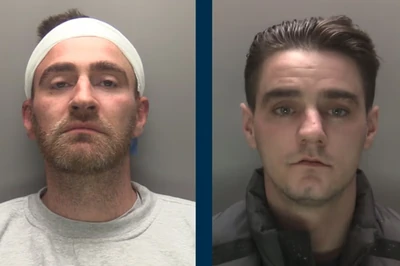
These are the faces of brothers who burgled vulnerable residents, including a 92-year-old deaf woman, during a country-wide crime spree.
Danny and Terence Casey have been jailed for more than 12 years following the incidents which saw the deaf victim targeted while she was sleeping in her home in Whetstone. She was woken when Danny Casey broke in shortly after 11pm, smashing the kitchen window and going upstairs to her bedroom.
She woke to find him bouncing on her bed, trying to look on top of a dresser. She grabbed her walking stick to fight him off before rushing out to call police.
Casey fled with a jewellery box containing her engagement ring and an eternity ring from her late husband.
The 92-year-old was not the only vulnerable victim as Danny Casey also targeted a pensioner in Walton on the Wolds, near Loughborough, who was undergoing cancer treatment. He was woken by Casey smashing glass to get into his property.
He went downstairs and saw Casey crawling in through a smashed window with a screwdriver in his hand, and when challenged, the burglar crawled back out and fled empty-handed.
In his statement to police, the man said to the burglar: “Thank you for ruining my life. Paired with my illness, this is the icing on the cake. I don’t think I’ll ever get over it.”
An elderly widow in Glaston, near Uppingham, was burgled just three months after her husband died, with Casey standing over her bed dressed in black and demanding money.
Another lone woman in Mountsorrel barricaded herself in her bedroom by pushing her bed up against the door while he ransacked her home.
With Danny’s younger brother Terence in tow, the pair then struck four times on Thursday, October 3, hitting two properties in Birstall, one in Loughborough and one in Mountsorrel, stealing a Toyota Yaris, drone, cash and jewellery.
Danny Casey, who was linked to 28 burglaries between October 2024 and January 2025, targeted homes in Leicester, Oadby, Hinckley, Castle Donington and Narborough, while his brother Terrence was involved in 12 burglaries and three attempted burglaries, police said.
After Leicestershire, the brothers moved across to Lincolnshire, burgling homes in Lincoln, Boston, Sleaford and Holbeck as well as Newark in Nottinghamshire before targeting half a dozen properties in Carmarthenshire, Wales.
Officers from Leicestershire Police teamed up with colleagues from Nottinghamshire, Lincolnshire and Dyfed-Powys Police to identify that either one or both brothers could be linked to a total of 37 offences across all areas.
Both brothers, of Meynells Gorse, Braunstone, Leicester, pleaded guilty at Leicester Crown Court on Tuesday, November 11, 2025.
Danny, 34, admitted three counts of conspiracy to burgle and two counts of breaching a serious Crime Prevention Order, while Terrence, 26, admitted two counts of conspiracy to burgle.
Danny was sentenced to 112 months’ imprisonment at Leicester Crown Court today (Monday, January 20), with Terrence sentenced to 42 months. The brothers were also issued with Serious Crime Prevention Orders, which will come into effect once they are released from prison.
2026.1.18 Newcastle student made false rape claims about police officer

A student who made up false rape claims against a serving police officer has been jailed for six years.
The officer was detained in custody for 35 hours and suspended from work for nearly five months before it was decided that no action would be taken against him after Hao Li made the false allegations.
Durham Crown Court heard the false reports were made after pair had engaged in sexual activity, which she was said to be the “driving force” behind.
He then drove her home, during which they rowed, and then, when the officer began to make the return journey to his home, Li rang the police, accusing him of rape, and he was apprehended.
A judge said it was only due to the “foresight” of the officer who set his phone to record the earlier events at his home, that he was not, ultimately, charged with rape.
The Chinese master’s degree student left the UK after being charged with perverting the course of justice, and was arrested at Manchester Airport after arriving on a return flight.
Li, 29, formerly of Howard Street in Newcastle, was remanded in custody and denied the allegations at a plea hearing in July last year.
She was convicted of three counts of perverting the course of justice after a two-week trial in December.
Appearing before the court on Friday (January 16,) via video link from HMP Low Newton, she was jailed for six years.
Judge Nathan Adams said: “Details of what took place are quite clear as he had the foresight to set his phone on record.
“It’s only because of that foresight that really showed us what took place.
“It was a far cry from the allegations that you told the police the following day.
“You engaged in sexual activity with him but, clearly, you were the driving force in that activity.
“He drove you home late at night and left you there.
“What is relevant is that he was stopped half-an-hour later as he drove back and arrested on the basis of your phone calls in which you made allegations of rape multiple times over the preceding weeks.
“He was held in custody for 35 hours, and then further investigations took place.
“Had it not been for the recording he made, he would have been charged with multiple counts of rape due to your allegations.
“But it was four to five months before ‘no further action’ was taken and you were subjected to the charges.
“You maintained your insistence over the allegations, but you were clearly disbelieved at trial.
“Anyone making false allegations of rape to police will be treated seriously.
“Police have taken great strides to persuade victims of sexual offences to come forward.
“Anyone making false complaints and proceeding with them creates a wider-still impact on genuine victims coming forward, with a further impact with him being a police officer.
“Rape is about the most serious allegation you can make.
“You know they would have to take your word for it.
“I can’t downplay how serious these allegations were and the impact they had on the victim in this case.”
Duncan Bould, for Li, said she was considered a “low risk” of reoffending and a medium risk of causing serious harm if she does so.
“Clearly there was a pattern of offending here, but she has no issues with alcohol or drugs, and this has been her first contact with the criminal justice system.
“But it’s been a severe contact and it’s had a salutary effect on her.”
Passing the six-year sentence, Judge Adams said he had taken into account Li’s previous good character and the fact she has proved “a model prisoner” at Low Newton.
He also made her subject of a six-year restraining order, prohibiting contact or approaching the victim.
The judge told her she would serve about half of the six-year sentence in custody before being released on licence, when she will probably be deported to China.
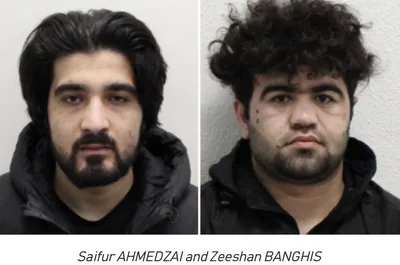
Two men convicted over their involvement in a major people smuggling ring have been extradited to Belgium following a joint investigation by the National Crime Agency and Belgian police.
The men – both Afghan nationals – were apprehended by specialist NCA extradition officers in south London and Hertfordshire after warrants were issued for their arrest by Belgian courts.
They were 21-year-old Zeeshan Banghis (AKA Bangash Zeeshan) who was arrested at an address on New Kent Road on 18 December 2024 and Saifur Rahman Ahmedzai (AKA Raees Hamza), 24, who was apprehended at an address in Hemel Hempstead a few days later on 30 December.
Belgian prosecutors say the men’s gang were involved in organising the transport of migrants from Afghanistan through Iran, Turkey and the Balkans into western Europe, mainly France and Belgium.
Many would eventually be put on small boats from northern France to the UK, with the gang suspected of transporting thousands of people this way.
The group also committed serious sexual offences against male migrant minors, including rape which they would video and use footage to blackmail the victims into criminality and further sexual abuse.
NCA investigators supported the Belgian investigation for around two years, supplying intelligence and evidence to the Belgian Federal Police around suspected members of the network.
In November 2024 a court in Antwerp convicted and sentenced the pair and 21 other members of the gang to a total of 170 years imprisonment, with sentences ranging from two to 18 years.
Eleven members were tried in their absence, including the two men arrested in the UK.
Ahmedzai was sentenced to 10 years imprisonment, while Banghis was sentenced to three years in jail. Both were also fined 3,000 Euros.
Ahmedzai was extradited to Belgium in June last year, with the same happening to Banghis yesterday (15 January). They will serve the remainder of their sentences in a Belgian jail.
Officers also worked with colleagues from Border Force and Immigration Enforcement to identify migrants and victims of the network who had been transported to the UK, conducting safeguarding checks.
2026.1.16 Castleford man banned from keeping animals after leaving ‘extremely underweight’ bulldog in ‘fearful state’

A Wakefield man whose “extremely underweight” bulldog was found left in a “fearful and aggressive state” and rummaging through bins has been banned from keeping animals for 10 years.
Benjamin Cobb, aged 40, of Borrowdale Drive in Castleford, pleaded guilty to failing to meet the needs of Sasha, an 11-year-old bulldog boxer cross, including not providing prompt veterinary care and failing to address the dog’s poor body condition under the Animal Welfare Act 2006.
As well as the 10-year disqualification, Cobb received a 12-month community order when he was sentenced at Kirklees Magistrates’ Court on January 6. The order included 100 days of unpaid work and to attend 20 Rehabilitation Activity Requirement (RAR) days.
The court was told how the defendant failed to follow up an initial trip to the vets when Sasha received pain medication in June 2024. The appointment was funded by a vet voucher he was given by RSPCA Inspector Hannah Williams. The inspector and a colleague went to the defendant’s former home at Watling Road, Castleford, after reports about an underweight dog.
In a statement to the court, the inspector said: “Sasha’s ribs were visible and she had some fur loss on her back legs. I explained to the defendant that due to the dog’s body condition and fur loss she needed to go to a vets.”
When further concerns for Sasha were reported to the charity later, the inspector contacted the vets who confirmed the dog had not been returned for a follow-up appointment.
RSPCA Inspector Joanne Taylor tried to contact the defendant in January last year after a call stating the dog had been seen “extremely underweight”. She attended with a police officer who executed a warrant at Cobb’s home on February 5 last year.
Sasha was found in a “fearful and aggressive state” in the kitchen where there was no food or water for her. Her ribs, hips and spine were “protruding” and she had been rummaging through a bin in an attempt to find something to eat. When the defendant returned to the property he claimed he had tried to rehome her.
Sasha was signed over into the care of the RSPCA and taken to the charity’s Greater Manchester Animal Hospital where sadly it was decided her health was so poor that the kindest thing to do was to put her to sleep.
A vet, who examined her, said the dog scored two out of nine on a body condition score (where five is an ideal weight) and was suffering with an enlarged spleen and muscle wastage, while tests showed she may have been suffering from blood cancer,
The vet concluded the dog suffered for at least two weeks due to her condition as well as pain and discomfort from arthritis.
In mitigation, the defendant claimed he did not return to the vet because of the cost. It was said he was suffering from depression due to personal and business circumstances. He was also told to pay court costs of £100 and a victim surcharge of £114.
Speaking after the hearing, Inspector Taylor said: “This owner failed to follow veterinary advice to return for a follow-up appointment and poor Sasha did not have her basic needs met.
“Her medical conditions, including her arthritis, may have been able to have been managed at that stage.
“For anyone struggling to meet vet bills the RSPCA has information about charities that can help with costs at our telephone helpline on 0300 123 0650 and an online hub.”
2026.1.8 Man, 25, admits trying to kill soldier near barracks
Anthony Esan stabbed Lt Col Mark Teeton ‘repeatedly’ after ambushing him outside his home in Kent
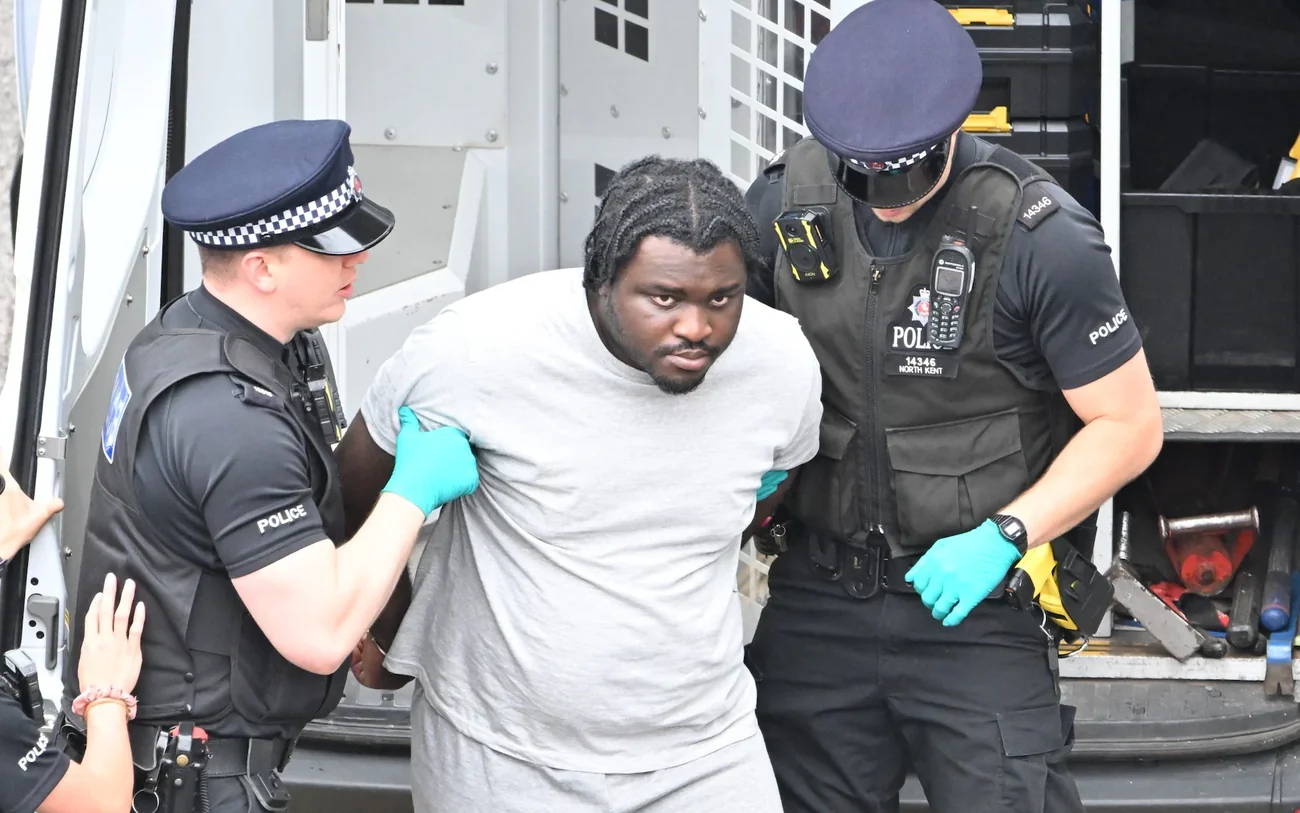
A 25-year-old man has admitted trying to kill an Army officer outside his barracks in Kent.
Anthony Esan pleaded guilty to the attempted murder of Lieutenant Colonel Mark Teeton, who was stabbed “repeatedly” in Sally Port Gardens near Brompton Barracks in Gillingham in July 2024.
Wearing a navy hoodie, Esan appeared at Maidstone Crown Court by video link from the high-security psychiatric hospital Broadmoor in Berkshire. He pleaded guilty on Thursday morning to the attempted murder and to two counts of possession of a bladed weapon.
Lt Col Teeton was treated in hospital for serious injuries after the attack.
The father of two was discharged a few weeks later and was in court alongside his wife Eileen for the hearing.
At a previous hearing at Medway magistrates’ court in 2024, Rajni Prashar, prosecuting, said: “A member of the public called 999 to report a male had been stabbed.
“It was then reported that the victim was a soldier in uniform.”
She told the court that a man was seen “running up behind” the Army officer before he “pulled the soldier to the ground”, stabbed him “repeatedly” and drove away on a moped.
Lt Col Teeton was airlifted to hospital after being stabbed while in his uniform just before 6pm on July 23 2024, by Esan, who was wearing a ski mask and was armed with large knives.
Wife’s intervention may have saved him
His wife screamed at the attacker to leave her husband alone and then tried to pull him away in an intervention that may have saved his life.
Her screams of “get off him” were captured on nearby doorbell cameras as her husband lay blood-soaked on the ground.
After the attempted killing, the attacker turned, climbed back on his moped and sped off.
Photographs from the scene showed Esan standing next to the moped.
His helmet was off and his face was partially obscured by a ski mask. He was wearing a bomber jacket with the logo of Nasa emblazoned on it
The attack took place in the middle of the day just just yards from Brompton Barracks, home of the 1st Royal School of Military Engineering Regiment.
Lt Col Teeton was a course manager at the barracks for almost six years after joining the Army 23 years ago.
An online CV revealed that he held several engineering-related roles within the Armed Forces and the Ministry of Defence.
He also ran 44 miles across Normandy, including some of its picturesque beaches, before finishing at the historic Pegasus Bridge on the 80th anniversary of D-Day last month, raising almost £3,000 for charity.
Lt Col Teeton was born in Nairobi, Kenya, and has two children with his wife.
As is common with military families, they have spent time living abroad, including in Canada, where Lt Col Teeton spent time on exchange with the Royal Engineers in Moncton.
It was here that it appeared Mrs Teeton had met Prince William during his royal tour of Canada with his newly married wife, the then Duchess of Cambridge, in 2011.
After the stabbing, members of the Royal Air Force (RAF) and Sea Cadets were advised not to wear their uniform while travelling in public.
2026.1.7 Former NCA “number one target” jailed for supplying thousands of boats to Channel people smugglers
A man who supplied thousands of boats and engines to people smugglers operating in the English Channel has been jailed, following a joint operation involving the National Crime Agency and Belgian authorities.
Adem SavasTurkish national Adem Savas, 45, admitted offences of people smuggling and being a member of an organised crime group on 3 December following a hearing at a court in Bruges. The same court today sentenced him to 11 years in prison, and a fine of 400,000 euros. Three co-defendants were given sentences totalling 38 years.
Savas had been detained at Schipol Airport in Amsterdam on 13 November 2024, before being extradited to Belgium to face charges.
He was initially identified by the NCA following an investigation into Kurdish crime boss Hewa Rahimpur.
Rahimpur headed up a major Europe-wide smuggling ring thought to be behind the movement of more than 10,000 migrants in small boat crossings to the UK, transporting migrants and equipment through Belgium on the way. He was arrested in 2022 by the NCA near Ilford, east London, where he was living at the time.
He was extradited to Belgium, where he was convicted and jailed for 11 years in October 2023. This was later increased to 13 years on appeal. Other members of his network were also subsequently convicted in France and the UK following investigations also involving the NCA.
Analysis of phones and devices seized following Rahimpur’s arrest revealed that his key supplier of boats and engines was Savas, and the two were in regular contact.
At the time, Savas was the main importer of cheap ‘Parsun’ branded outboard engines sourced from China, the type most frequently used by gangs operating small boats in the Channel.
The NCA, working with Belgian counterparts, evidenced how boats and engines sourced by the Savas network were moved overland from Turkey into Bulgaria, and then across Europe to Germany where they would be stored before being used in the Channel.
To move them he engaged the services of a haulage firm based in the Netherlands. After this firm was identified by the NCA, Dutch police began an investigation which later led to convictions for money laundering and drug trafficking.
Equipment in van image sent from S to R 04032022 2Operating from 2019 until his arrest in 2024, and working with people smuggling networks in Belgium and France, Savas is assessed by the NCA to have supplied equipment used in thousands of small boat crossings to the UK.
Charging on average around £4,000 for packages of boats and engines, he is likely to have made millions over the time of his offending.
NCA investigators believe that in 2023 Savas will have supplied equipment used in around half of all Channel crossings, making him a key figure in the European people smuggling hierarchy, and elevating him to number one on the NCA’s list of global high value targets – the Agency’s most wanted man.
One exchange of messages between Savas and Rahimpur in November 2021 followed the deaths of 27 migrants, when their boat sank in the Channel. Rahimpur sent Savas five separate images of a white rubber boat, along with a screen grab from a news website showing how an identical boat had been used in the fatal crossing.
Another video sent showed boxes of boats, controlled by Savas’ associates, piled high in a warehouse, while investigators also recovered a price list for boats, engines and life jackets.
An operation to track his movements was instigated, involving the NCA, Belgian and Dutch law enforcement, with Belgian prosecutors.
After information was received that he was attending a trade event in the Netherlands, officers moved in to have him arrested as he touched down in Schipol.
The operation to arrest him was jointly co-ordinated through a Europol Operational Task Force and assistance of Eurojust through the formation of a Joint Investigation Team.
NCA Director General of Operations, Rob Jones, said: “Adem Savas was without doubt the most significant supplier of boats and engines to people smuggling gangs involved in organising deadly crossings in the Channel, the head of a criminal network stretching across Europe to the beaches of northern France and across into the UK.
“He pretended to run a legitimate maritime supply company, but in reality he knew exactly how the equipment he provided would be used.
“He also knew exactly how unsuitable it was for long sea crossings.
“Boats and engines supplied by Savas were likely involved in numerous fatal events in the Channel – he made money from each of those.
“I’m grateful to the numerous law enforcement partners from across Europe who have worked with the NCA during the course of this investigation, particularly those in Belgium and the Netherlands.
“Tackling the gangs involved in these dangerous crossings remains a top priority for the NCA, and we are determined to do all we can to disrupt and dismantle them, wherever they operate.”
The Case Officer for the Belgian Federal Judicial Police in West Flanders said: “Thanks to the strong and efficient cooperation with the NCA and other foreign law enforcement agencies and through the building of trust-based relationships, we are able to work effectively on complex judicial investigations and arrest high-value targets.
“By combining the strengths and expertise of each law enforcement partner, we achieve international breakthroughs and stop serious threats to society.
“Over the years, the Federal Judicial Police and the Public Prosecutors office of West-Flanders built up the knowledge and experience needed to conduct judicial investigations at the highest international level.
“These long-term efforts are now paying off, as shown by our ability to bring a high-ranking facilitator of nautical equipment involved in migrant smuggling operations to justice.”
Minister for Border Security and Asylum Alex Norris, said: “We are cracking down on the criminals exchanging human lives for cash.
“Our brilliant National Crime Agency officers have worked alongside international allies to take down this smuggling kingpin and put him behind bars where he belongs.
“Through our new Borders Act, law enforcement now have strengthened powers to intercept, detain and arrest people smugglers, faster – restoring order and control to our borders.”
2026.1.6 ‘Vicious’ teenagers who danced and took selfies after beating homeless man to death jailed
Jaidee Bingham, Eymaiyah Lee Bradshaw-McKoy and Mia Campos-Jorge were convicted over the ‘callous’ killing at the Old Bailey

Three teenagers have been sentenced at the Old Bailey for their roles in the brutal killing of a homeless man near King’s Cross station.
Jaidee Bingham, who was 16 at the time of the assault and went by the nickname “Ghost”, received a 16-year prison term after being convicted of murdering 51-year-old Anthony Marks.
His co-defendants Eymaiyah Lee Bradshaw-McKoy and Mia Campos-Jorge, aged 16 and 17 respectively when the attack occurred, were handed youth custody sentences of 47 months and 42 months for manslaughter.
Mr Marks succumbed to his injuries five weeks after the assault, which took place in August 2024.
The three defendants, now all over 18, can be publicly identified following Monday’s sentencing hearing.
The victim was struck with part of a car bonnet before being pursued through the streets and subjected to a savage beating.
Metropolitan Police officers characterised the assault as a “vicious county lines retribution attack”.
CCTV footage captured Bingham and Bradshaw-McKoy chasing Mr Marks from Argyle Street to Whidbourne Street, with Bradshaw-McKoy carrying what appeared to be a car bumper.
The homeless man was repeatedly stamped on and struck over the head with a gin bottle during the onslaught.
Audio recorded by surveillance cameras captured voices shouting: “Hit him again. Kick kicking. Do it again. Have you learned your lesson yet?”
The assault only ended when a bystander intervened, brandishing a cricket bat to drive the attackers away.
Judge Mark Dennis KC noted that Bingham had “elevated” the confrontation by seizing the bottle and deploying it with “severe violence”.
The prosecution, led by Hugh Davies KC, told the court that all three teenagers had been operating as part of the “Arron” county lines drug network, with Mr Marks himself being a customer of the gang.
The evening before the fatal assault, one of the female defendants was robbed while carrying out drug dealing activities for the organisation.
Bingham was subsequently given the task of identifying who had stolen the narcotics.
The group became convinced that Mr Marks possessed information about the robbery and confronted him at approximately 5am on August 10.
When the homeless man refused to reveal any details about the theft, the violent pursuit began.
The chase covered more than a mile through central London’s streets before culminating in the fatal beating.
Photographs and video footage from that night revealed the teenagers posing for selfies and celebrating in the wake of the killing.
Two of the group were also captured on film singing and dancing in the back of a vehicle after the 51-year-old had been fatally wounded.
Police utilised this material, along with messages exchanged between the trio, to reconstruct their movements throughout the evening.
Station staff discovered Mr Marks stumbling near the King’s Cross concourse around 6am, blood streaming from severe facial wounds.
Detective Inspector Jim Barry of the Met’s Specialist Crime North said: “This is a particularly callous murder that gives an insight into the ruthless brutality of county lines gangs.
“The ages of Bingham, Bradshaw-McKoy and Campos-Jorge are particularly shocking.
“But the fact that they were teenagers does not excuse their violent actions as part of a drug line that has brought fear and intimidation to London’s streets.”

2026.1.4 Dozens of mentally ill offenders go on to kill after secret release
Telegraph analysis shows how many former inmates of mental health units went on to take someone’s life
At least 30 dangerous mental health patients secretly freed from high security hospitals have gone on to kill in recent years, The Telegraph can disclose.
Around 250 violent offenders are detained in institutions such as Broadmoor, Rampton and Ashworth each year after courts decide they are too mentally ill to go to prison
Many, like the Nottingham killer, Valdo Calocane, are told their conditions are so acute that they are unlikely to ever be freed.
But figures obtained by the Telegraph reveal that 55 per cent of those sent to secure hospitals are quietly freed within five years, almost 90 per cent within 10 years and 99 per cent within 20 years.
Analysis of available data reveals that from 1993 to 2019, 30 dangerous mental health inmates freed from secure hospitals went on to kill.
Around 500 patients are quietly released from high or medium security mental health institutions each year under a system with little transparency or scrutiny.
If a patient responds well to treatment while being held in a secure hospital, they can apply to be considered for release.
Their case will go before an independent mental health tribunal consisting of a panel of three people – usually a judge, a psychiatrist and a mental health worker. x1200
Police have released CCTV images of two men they want to speak to after clothes were stolen from Bradbeers.
Police say that two men entered Bradbeers on Station Road, New Milton and left with several items of clothing without paying.
This occured between 3.30pm and 3.45pm on Monday, December 22.
Police have released two images of men they believe can help with their enquiries.
A police spokesperson said: “As part of our ongoing enquiries, we are issuing two images of men we would like to speak to in connection with this incident.
“If you recognise these people, please call 101 quoting reference 44250577946”
—

We are asking for your help to locate wanted woman Ying Li.
Li, 33, is wanted in connection with reports of the production of cannabis and modern slavery in Sheffield, in addition to immigration offences.
Officers executed a warrant at an address on Fort Hill Road on 15 April and found a cannabis factory and two people who are believed to be victims of modern slavery. They are being appropriately safeguarded.
We believe Ying is still in the UK and has spent time in Sheffield this year. She has previously lived in Bournemouth.
We are keen to speak to anyone who has seen or heard from Li or knows where she may be staying.
She is described as an east Asian woman of a slim build and around 5ft 4ins tall, with straight dark brown hair.
If you see Li, please do not approach her and instead dial 999 immediately.
If you have information which could help us find her, you can report online or by calling 101. Please quote investigation number 14/70547/25 when you get in touch.
We understand that not everyone wants to speak directly to police. If this is you, please be aware that you can report information completely anonymously to the independent charity Crimestoppers by calling 0800 555 111 or by visiting their website.
You will not be asked to provide any details and no one will know you have contacted them.

—

Police investigating a street robbery in the city centre have released images of two men they would like to speak to.
The 22-year-old victim was punched and kicked by two suspects and then robbed of his mobile phone and wallet following a night out.
The incident happened on Friday 24 October at around 4am in Clumber Street.
Officers have carried out a number of lines of inquiry, including a CCTV search, to locate those responsible.
The men pictured in this image may have vital information and officers urge those who recognise them to come forward.
Investigator Alex Freeman, of Nottinghamshire Police, said:
“This was a very unpleasant attack on a young man who was just enjoying a night out when this happened.
“We’re determined to track down whoever was involved in this and to speak to anyone who may be able to help us do that.
发表回复