2026.6.13 Mbarara widow seeks nearly Shs100m to repatriate daughter’s body from China
A widow in Mbarara City is appealing to the government and well-wishers for assistance to repatriate the body of her daughter, who reportedly died under unclear circumstances in China.
Syson Karungi, 30, a resident of Taso Village in Mbarara City South Division, travelled to China in 2023 through a recruitment agency in search of employment opportunities.
According to her mother, Mable Bamutorana, Karungi initially struggled to find stable employment and later relocated to Beijing, where she worked as a casual labourer. Her employment reportedly ended in April, leaving her without work for two months.
Bamutorana said the family lost contact with Karungi on January 19, 2024, after her known phone numbers became unreachable.
Their concerns deepened on March 5, 2026, when a man who identified himself as an employee of the Ugandan embassy contacted the family seeking details of Karungi’s sister but provided no information regarding her whereabouts.
The family later learnt that Karungi had died in China after reportedly collapsing while having dinner at a restaurant.
Bamutorana said they have not received an official explanation regarding the cause of death and maintain that Karungi had never complained of any serious illness.
According to information relayed to the family by a Ugandan friend living in China, police transferred Karungi’s body to a mortuary in another province.
The family says the mortuary charges 600 yuan per day for storage, adding to the burden of repatriating the remains.
Bamutorana said efforts to seek assistance from Ugandan officials had yielded little progress, while a company reportedly willing to facilitate repatriation quoted approximately Shs96 million for the process.
“We want to bring our daughter home and give her a dignified burial, but we do not have the means,” she said.
Karungi’s sister, Shyrose Mutungi, said the family remains in contact with people willing to assist with the repatriation process but lacks the funds required.
The family has appealed to President Museveni, government authorities and well-wishers to support efforts to return Karungi’s body to Uganda as they continue to seek answers about the circumstances surrounding her death.

Police in Mbale city have launched investigations after another teenage girl was found dead in her room in what is suspected to be a case of suicide.
Vanisa Namakoye, 19, a senior five student at Mbale Progressive Secondary School and a resident of Bunamwani Lower Cell, was found dead at her home in Bumutoto Ward, Industrial Division.
The incident comes just days after 16-year-old Catherine Nelima was found dead two days earlier in a similar suspected suicide case in Bukisukye Lower Cell, also in Bumutoto Ward.
According to Elgon regional police spokesperson Rogers Taitika, the two girls were close friends. Police reports indicate that Namakoye is believed to have died between 10:30 pm and midnight on Thursday. Investigators say she was found hanging in her room.
According to preliminary findings, the events leading to the incident began earlier in the evening when Namakoye sent her younger sister with Shs 10,000 to buy food for supper. The younger girl reportedly lost the money and returned home empty-handed.
Police say Namakoye became angered by the loss and allegedly assaulted her sister, prompting their grandmother to intervene and protect the child. Later, when Namakoye’s mother, Juliet Natulal, returned home, she was informed about the incident.
Attempts to speak to her daughter were unsuccessful after the teenager reportedly locked herself in a room and refused to respond. At about 9:30pm, Natulal left for a nearby trading centre. When she returned shortly before midnight in the company of her husband, Moses Mutoto, they found their daughter unresponsive inside the room.
Police were notified and officers from the Homicide Department and Scene of Crime Office (SOCO) responded to the scene. The officers documented the scene and recovered exhibits before the body was taken to Mbale City Mortuary for a post-mortem examination.
The incident has renewed concern over the increasing number of suspected suicide cases involving young people in Mbale city. Police have urged parents, guardians, teachers and community leaders to pay close attention to the emotional wellbeing of children and adolescents and to provide support to those facing personal or psychological challenges.
2026.6.12 Police Make Breakthrough in Viral Nsambya Junction Robbery
Police in Kampala have announced a breakthrough in investigating a robbery caught on CCTV camera at Nsambya Junction along Ggaba road.
The robbery which occurred on May 6, 2026, at around 11:30am. Saw a group of boda boda riders attack the manager of Riverside Forex Bureau after exchanging cash.
During the attack in which the victim was kicked and beaten by the attackers, shs45 million was robbed in a video which has sparked public concern.
However, in a statement on Friday, Kampala Metropolitan deputy police said investigations have since led to the recovery of a motorcycle bearing registration number UMA 655GK but the number plate was found to have been forged to conceal the identity of the motorcycle used in the robbery.
“Today, June, 12, Police arrested Yudah Kamoga alias “Sparta” and Arnold Kayabula, a boda boda rider, in connection with the robbery. A motorcycle registration number UMA 602KK, believed to be linked to the case, was also recovered,” Owoyesigyire said.
“The suspects remain in police custody as investigations continue to establish their roles and apprehend other accomplices.”
Police said they are committed to ensuring all those involved are arrested and brought to justice.
2026.6.10 Besigye treason trial heats up
Last week, Uganda’s courts found themselves at the centre of some of the country’s most consequential legal and political battles.
In courtrooms stretching from Kampala to Mbale and Butambala, judges wrestled with questions that cut to the heart of justice, constitutional rights, political accountability and public trust.
One ruling dismantled a controversial legal provision that had allowed criminal cases to collapse before evidence was ever tested. Another exposed tensions in the long-running treason case against opposition leader Dr Kizza Besigye.
Elsewhere, prosecutors subjected bail sureties to unusually intense scrutiny, a court denied mandatory bail to a National Unity Platform official, and a citizenship dispute threatened the parliamentary seat of a sitting Member of Parliament. Meanwhile, investigators from the Inspectorate of Government launched a dramatic anti-corruption operation targeting senior officials in the Office of the Prime Minister.
Taken together, the developments offered a revealing snapshot of a justice system grappling simultaneously with constitutional questions, political controversies and allegations of corruption.
The most far-reaching decision came from the Constitutional Court, which struck down provisions of the Human Rights (Enforcement) Act that had allowed courts to automatically acquit accused persons once violations of their rights were established during criminal proceedings.
For years, those provisions had generated debate among lawyers and rights activists. Supporters argued that they acted as a necessary deterrent against torture, illegal detention and other abuses by state agencies. Critics countered that they created a legal shortcut that enabled accused persons to avoid prosecution before evidence had been fully examined.
COURT STRIKES DOWN AUTOMATIC ACQUITTALS
Last week, a panel of five Constitutional Court judges sided with the latter view. The court declared Section 11(2)(a), (b) and (c) unconstitutional, holding that automatic acquittals undermined the constitutional rights of crime victims and denied courts the opportunity to fully hear and determine criminal cases.
The case originated from a petition filed by lawyers Faruku Muhamed, John Musinguzi and Ibrahim Bunyasin against the Attorney General. It was later consolidated with another petition linked to corruption proceedings involving former Namutumba County MP Paul Akamba.
Akamba’s case had become emblematic of the debate after charges against him were withdrawn following allegations that he had been abducted, detained incommunicado and tortured after being granted bail.
Government lawyers argued that rights violations should be addressed through remedies such as compensation or exclusion of tainted evidence rather than through automatic acquittals.
Twenty-two intervenors led by lawyer Abubaker Sekanjako defended the law, insisting it served as a critical safeguard against abuse of power. They pointed to earlier cases, including litigation involving Dr Kizza Besigye in 2007, where proceedings had been halted because of serious rights violations.
Professor Christopher Mbazira, appearing as amicus curiae, urged the court to remember Uganda’s history of state abuses. The judges ultimately concluded that justice must serve both accused persons and victims.
In a significant interpretation of Article 28(1) of the Constitution, the court held that the right to a fair hearing belongs not only to accused persons but also to victims whose cases deserve full adjudication.
Rights violations, the judges ruled, must be addressed robustly, but they do not automatically erase criminal responsibility. Acquittals should come only after evidence has been tested through a complete hearing. If the Constitutional Court delivered the week’s most significant legal ruling, the High Court handling Dr Kizza Besigye’s treason case produced some of its most dramatic courtroom moments.
PROSECUTION REVEALS BESIGYE WITNESS LIST
The prosecution disclosed a list of witnesses it intends to rely on in the case against Besigye and his co-accused, Hajji Obeid Lutale. The disclosure included more than 800 pages of witness statements and roughly seven hours of audio recordings.
Among those expected to testify are senior military officers and intelligence figures, including Maj Gen Richard Otto, Maj Gen Abel Kandiho and Maj Gen James Birungi, who is currently incarcerated.
A British businessman also appears on the witness list. The defence immediately objected. Lawyers argued that reviewing such a vast volume of material within a week was unrealistic, particularly given the gravity of treason charges.
Justice Emmanuel Baguma nevertheless directed the defence to review the disclosure within seven days and fixed June 8 for further proceedings. Besigye reacted sharply. He instructed his lawyers to challenge the ruling, arguing that the compressed timeline violated his constitutional right to adequate time and facilities to prepare a defence.
He also described the prosecution as politically motivated, accusing it of delaying disclosure for months before suddenly placing the defence under intense pressure to prepare. While attention focused on Besigye’s case in Kampala, another politically sensitive matter unfolded in Butambala.
KIVUMBI CASE RETURNS TO COURT
Former MP Muhammad Muwanga Kivumbi and 22 co-accused persons, who face terrorism-related charges, returned to court seeking bail. What followed was an unusually rigorous examination of their proposed sureties.
State prosecutors led by Assistant Director of Public Prosecutions Thomas Jatiko and Chief State Attorney Richard Birivumbuka questioned at least 16 sureties about virtually every aspect of their lives. Their occupations, earnings, residences, business activities and understanding of surety obligations all came under scrutiny.
Some were asked whether they possessed formal qualifications in trades such as plumbing, electrical work and television repair. Others were required to identify local council leaders and verify signatures.
Several acknowledged that they had acquired their skills informally through apprenticeships rather than formal training. Prosecutors appeared determined to establish whether the proposed sureties possessed sufficient credibility and financial capacity to guarantee the accused should they abscond. Unlike standard practice, every surety was required to testify from the witness stand.
MUFUMBIRO DENIED BAIL AGAIN
Elsewhere in Kampala, the Chief Magistrate’s Court in Kawempe-Kanyanya delivered a ruling with significant implications for the interpretation of mandatory bail. National Unity Platform deputy spokesperson Alex Waiswa Mufumbiro sought release after spending more than 60 days on remand without trial on charges of incitement to violence.
His lawyers argued that both the Constitution and the Magistrates Courts Act entitled him to mandatory bail. Acting Chief Magistrate Doreen Ainembabazi agreed that Mufumbiro had satisfied the constitutional threshold.
However, she concluded that public interest considerations outweighed his entitlement to release and ordered that he remain in custody. The defence had emphasised Mufumbiro’s professional standing as a lawyer and political leader and presented three sureties, including his father, retired chief magistrate and advocate Moses Baligeya Mufumbiro.
Lawyers also highlighted his personal circumstances, telling the court he had recently lost his wife and was now the sole surviving parent responsible for raising eight children. In Mbale, meanwhile, a separate legal battle could determine the future of Namisindwa County MP Metrine Nanzala.
The High Court ordered the National Identification and Registration Authority (NIRA) to release certified records relating to two individuals at the centre of a citizenship dispute challenging her eligibility to sit in Parliament.
The petition was brought by Apollo Masika, who alleges that Nanzala is not a Ugandan citizen and therefore does not qualify to hold parliamentary office. The dispute centres on family lineage. Masika contends that Nanzala is not among the biological children of Agnes Nelima and the late Michael Walyama.
Nanzala disputes that claim and relies on an affidavit from Nelima stating that she is one of five children born to the couple.
Justice Dr Farouk Lubega dismissed objections raised against the request for records and ruled that courts are entitled to access NIRA-held information when necessary to resolve disputes before them.
He ordered the authority to provide certified copies of the records sought, with costs left to be determined by the outcome of the main petition. As those courtroom battles unfolded, investigators from the Inspectorate of Government launched what may become one of the most closely watched anti- corruption investigations of the year.
IGG ARRESTS COMMISSIONERS
The operation resulted in the arrest of Patrick Okello, the Commissioner for Refugee Management in the Office of the Prime Minister, alongside five other officials and a Pakistani national.
Authorities allege the suspects were involved in an extortion scheme linked to Uganda’s refugee registration process. Among those arrested were Assistant Commissioner for Refugee Management Douglas Asiimwe, Senior Settlement Commandant Mugabe Geoffrey, Head of Information Technology Ekwap Noel, Registration Officer Bweme Henry, Refugee Status Interviewing Officer Nadiope Arnold and Pakistani national Zafar Ahmad.
According to preliminary findings, Ahmad is believed to have acted as a key intermediary between refugees and officials allegedly involved in the scheme. Investigators say documents recovered during coordinated searches could prove crucial to the case.
All the suspects were taken in for questioning and recorded statements as investigations continue. For Uganda’s courts and accountability institutions, it was a week that touched nearly every corner of public life, constitutional law, political prosecutions, electoral disputes, bail rights and anti- corruption enforcement. The legal battles are far from over. Most of the cases will return to court in the weeks ahead.
—
2026.6.13 Why Ugandans watch as mob violence claims more lives
NEWS ANALYSIS | URN | The brutal killing of Uganda Cranes rugby player Sydney Gongodyo has once again forced the country to confront an uncomfortable question: Why does mob violence continue to thrive in Uganda, often in the presence of dozens of witnesses, without anyone stepping in to stop it?
As tributes continue to pour in for the 27-year-old athlete, lawyers, police officials, and civil society leaders are grappling with a deeper issue beyond the tragedy itself.
Why are ordinary citizens increasingly willing to watch, record, cheer, or even participate as suspected offenders are beaten to death?
Their answers point to a troubling mix of distrust in institutions, historical attitudes toward punishment, crowd psychology, and a growing erosion of empathy.
Assistant Inspector General of Police Donald Muhwezi, while appearing at Uganda Law Society’s weekly press briefing on Thursday, said that society must first stop describing such incidents as “mob justice.”
“What people call mob justice is not justice because it defeats the principles of justice,” Muhwezi said.
“We should drop the word justice and put their mob action or mob violence. I don’t think Sydney got justice. Groups of people acting out of hearsay, jealousy, fear, or suspicion take matters into their own hands, kill, assault, embarrass, and destroy property in a way they think is quicker and better. That is not justice.”
Muhwezi, the Metropolitan Police Community Liaison Officer, described mob violence as a situation where strangers suddenly become complainants, witnesses, judges, and executioners.
“You have uncoordinated people, people you have not invited, people just passing by. They claim to have witnessed something, they become witnesses, they become complainants, they sit in a jungle court, sentence the victim, and execute the punishment. Total madness in a very short period of time.”
Muhwezi warned that nobody is immune to becoming a victim of mob action.
“You may assume this is none of your business. You may say, ‘I am a businessman, I am a woman, I am not involved in crime.’ But you are a candidate for this. Last year alone, we registered 950 cases across the country, and those are only the cases that were reported or recorded.”
The victims, he noted, have ranged from lawyers and university workers to drivers and athletes.
Videos are recorded; no one intervenes
One of the most disturbing aspects of mob violence is that it rarely happens in secret. Crowds gather. People watch. Phones are raised. Videos are recorded. Yet few people intervene.
Lawyer Edwin Buluma says this collective silence is what should worry Ugandans most.
Quoting a famous song lyric during a public discussion organized by the Uganda Law Society’s Radical New Bar, Buluma asked: “How long shall they kill our prophets while we stand aside and look?”
The question resonates because Sydney Gongodyo was not merely a suspect in an allegation. “He was a son, father, friend, student, and national athlete,” said Buluma.
Buluma drew parallels between Gongodyo’s death and the 2019 killing of advocate Peter Kibirango, who was beaten to death after mistakenly picking up the wrong phone from a charging station.
“In both cases, fundamental constitutional protections disappeared,” Buluma said. “The right to life, the right to a fair hearing, and the presumption of innocence were completely ignored. These people took it upon themselves to impose their own form of justice. They killed these people. And that is not justice.”
For Buluma, the fact that victims come from different professions and social classes demonstrates that mob violence threatens everyone.
“If we have an advocate in 2019 passing away in those circumstances and we have a rugby player years later passing away in those circumstances, then each one of us in this room could be a victim. It could be anyone. The law is clear that these actions amount to murder, but somehow people continue to justify them.”
Sometimes, such criminality has been blamed on the public’s growing frustration with formal justice institutions.
According to the 2015 Afrobarometer survey in Uganda, one in six Ugandan adults said they took part in mob justice during the preceding year or would do so if they “had the chance.” This suggests that mob justice is not just a fringe problem in Uganda but commands attention and requires collective action. Why would a substantial number of Ugandans resort to taking the law into their own hands as an alternative form of “justice”?
Analysts have pointed to a number of factors that might contribute to a willingness to engage in mob justice. One is a lack of trust in the formal criminal justice system to administer fair and timely justice.
A 2005 study in Uganda showed that mob actions were often motivated by widespread suspicion or misunderstanding of the justice system, especially concerning the procedure of police bail, under which suspected culprits can be temporarily released before the court process.
Research has also shown that personal victimization by crime can have a lasting impact on attitudes toward the police, the courts, and the criminal justice system overall, as can negative personal experiences with the courts.
Lack of trust in police
Afrobarmeter said statistical analyses show that a lack of trust in the police is associated with a willingness to engage in mob justice, while perceived corruption undermines trust and thus indirectly contributes to a willingness to join others in mob actions. It said its analysis found ds that being a victim of crime (physical assault), encountering problems in the court system, finding it hard to obtain police assistance, and having to pay a bribe to police or court officials are factors that make people more likely to say they would take part in mob action against suspected criminals.
Muhwezi acknowledged that perceptions of delayed justice, corruption, and weak law enforcement continue to fuel public anger.
“The perceived justice delays, corruption, lack of transparency, slow response or no response at all lead to a lack of trust in the known justice systems,” he said. He pointed to severe staffing shortages across the criminal justice chain.
“You have one police officer investigating 54 cases versus the international standard of one officer handling four cases. Definitely, there will be a case backlog. If I have 54 files to handle, there will be delays in justice. In the long run, people lose trust in the system.”
According to Muhwezi, many Ugandans still struggle to understand the principle that suspects remain innocent until proven guilty.
“People find somebody in their plantation with a panga or inside their house, and then they are told this person is innocent until proven guilty. Many simply do not understand that concept and therefore prefer immediate punishment.”
For Anthony Asiimwe, Vice President of the Uganda Law Society, public mistrust is not always imagined.
Sometimes it is reinforced by the conduct of those entrusted with enforcing the law.
Asiimwe recalled witnessing a mob attack about a month ago while driving near the Northern Bypass.
“I encountered a mob justice incident where boda boda riders had rounded up someone and started beating him,” he said.
“I realized this needed intervention from security, from the police.”
Determined to help, Asiimwe drove to a nearby police patrol vehicle parked beneath a flyover and informed an officer about the ongoing attack.
“I stopped and told the gentleman in charge that there was an issue and that they needed to rush there because there was mob violence taking place,” Asiimwe recalled.
“He simply told me, ‘Okay,’ went back, sat down, and continued on his TikTok.” The experience left him deeply frustrated.
“I was so annoyed because I had taken my time as a citizen to stop and report to the nearest police officers I could find. As much as the public needs to continue being sensitized, it is also important that we engage our men and women in uniform to take their responsibilities seriously.”
Asiimwe warned that repeated experiences of institutional indifference can discourage citizens from reporting future incidents.
“If it happened again, I would hesitate to even report because I would not be sure whether any action would be taken. That is how trust and confidence are lost.”
His experience illustrates a vicious cycle. When authorities fail to respond, public confidence declines. As confidence declines, people become more willing to tolerate or participate in mob violence.
Muhwezi also traced mob violence to Uganda’s history. He said many communities traditionally relied on local leaders and elders to administer immediate punishment to wrongdoers.
While modern courts eventually replaced those systems, the culture of instant retribution never entirely disappeared.
“Some communities believed in practicing corrective punitive measures where leaders would punish wrongdoers on the spot to send a message to others,” he said.
“When the colonial government introduced modern courts, many communities did not fully understand or trust the process. Up to today, some people still struggle to understand what it means for a suspect to be innocent until proven guilty.”
Years of political instability and armed conflict further strengthened tendencies toward self-help justice and vigilante action in some parts of the country.
For both lawyers and law enforcement officers, the lesson from Sydney Gongodyo’s death is that mob violence is no longer a problem affecting only suspected criminals.
It has become a threat to every citizen. The victim could be a lawyer who picked up the wrong phone, a student caught in a misunderstanding, a driver involved in a minor accident, or a national athlete accused of an offence he never committed.
As Buluma observed, the tragedy is not simply that individuals are being killed. It is that society increasingly appears willing to stand aside and watch.
Breaking that cycle will require more than arrests after the fact. It will require faster justice, more responsive policing, stronger public trust in institutions, and a renewed commitment to the constitutional principle that every person deserves a fair hearing.
Until then, Uganda risks remaining a society where crowds act as judges and executioners while everyone else watches.
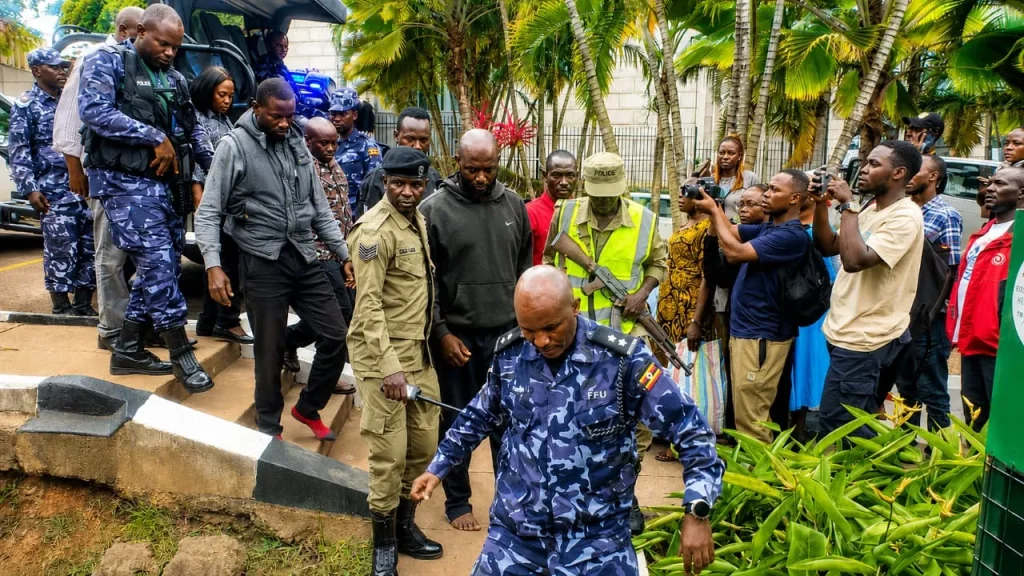
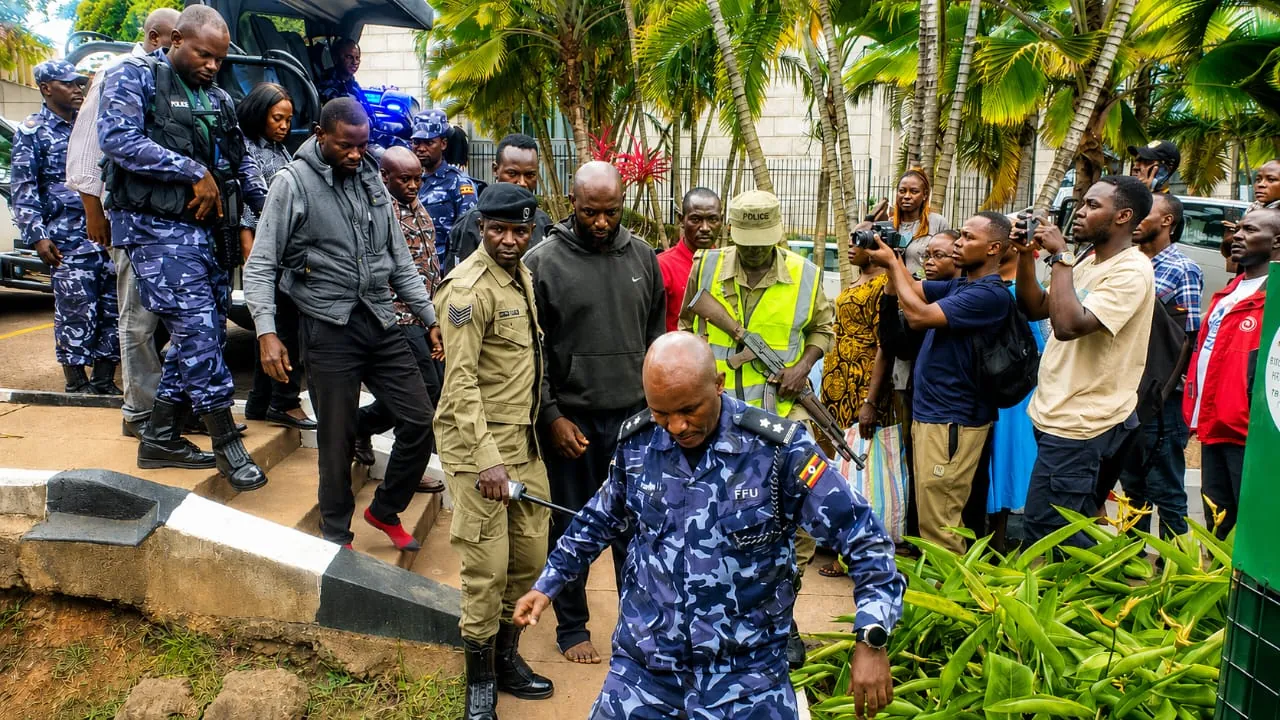
2026.6.12 Four Charged with Murder of Sydney Gongodyo as Police Hunt More Suspects
The suspects, including two boda boda riders, a security guard and a delivery agent, are accused of participating in the fatal attack on Sydney Gyabi Gongodyo in Naguru. Police say more arrests are expected as investigations continue.
Four men have been charged with murder in connection with the killing of Sydney Gyabi Gongodyo, as police intensify efforts to track down additional suspects believed to have participated in the fatal attack.
According to a charge sheet sanctioned at Kira Road Police Station under CRB 619/2026, the accused are Obed Mugwisa, 39, a boda boda rider from Nsimbiziwome Zone in Nakawa Division; Elly Mundoni, 33, a delivery agent attached to Medicinal Pharmacy and resident of Luzira Port Bell Road; Joseph Owino, 30, a private security guard from Bukoto; and Henry Kabugo, 21, a boda boda rider from Bukoto Old Kira Zone.
The quartet has been charged with murder contrary to Sections 171 and 172 of the Penal Code Act, Cap 128.
Prosecution alleges that on June 5, 2026, at Upper Naguru East Road in Kampala District, the accused, acting together with others still at large and with malice aforethought, unlawfully caused the death of Gongodyo.
The charges mark a significant development in a case that attracted widespread public attention and renewed concerns over mob violence and vigilante justice.
“The accused persons, together with others still at large, are alleged to have unlawfully caused the death of Sydney Gyabi Gongodyo on June 5, 2026, at Upper Naguru East Road,” a source familiar with the investigations said.
Police said inquiries into the circumstances surrounding the killing are ongoing and that investigators are pursuing other individuals suspected to have played a role in the incident.
“We remain committed to ensuring that all individuals connected to this crime are identified, arrested and brought before the courts of law,” the source added.
The killing triggered public debate about the growing incidence of mob violence and the dangers of citizens taking the law into their own hands.
Security agencies have repeatedly cautioned the public against assaulting suspected offenders, stressing that suspects should be handed over to law enforcement authorities for investigation and prosecution through the courts.
The accused are expected to appear before court as prosecutors prepare to present evidence supporting the murder charges.
Under Ugandan law, murder is a capital offence and carries severe penalties upon conviction.
Police say investigations remain active and further arrests are likely as detectives continue to piece together the events leading to Gongodyo’s death. x1200
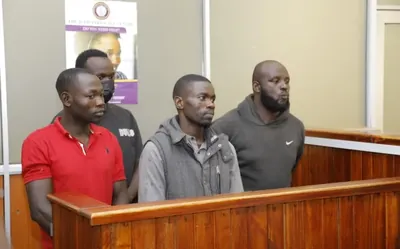
The Kampala City Hall Court has remanded four men to Luzira Prison in connection with the killing of Uganda Rugby Cranes player Sydney Gyabi Gongodyo.
The accused are Obed Mugwisa, 39, a boda boda rider and resident of Nsimbiziwome Zone in Nakawa division; Elly Mondoni, 33, a delivery agent with Medicinal Pharmacy and resident of Port Bell road in Luzira; Joseph Owino, 30, a private security guard and resident of Bukoto; and Henry Kabugo, 21, a boda boda rider and resident of Old Kira Zone in Bukoto.
The four appeared before senior grade one magistrate Edgar Karakire on Friday and were charged with murder. According to the charge sheet sanctioned under Kira Road Police Station CRB 619/2026, the accused and others still at large allegedly murdered Gongodyo on June 5, 2026, at Upper Naguru East Road in Kampala.
As murder is a capital offence, the accused were not allowed to enter pleas. Magistrate Karakire read the charges to them and explained that his court lacks jurisdiction to try capital offences, which are exclusively handled by the High court.
The prosecution, led by Grace Akite, informed the court that investigations are still ongoing. Akite said police are still pursuing other suspects believed to have been involved in the killing and requested an adjournment to allow investigators to complete their inquiries and effect further arrests.
During the proceedings, Mugwisa, described by police as the prime suspect, asked the court about the timeframe for the case. He was informed that the matter would return to the magistrate’s court for mention as investigations continue before being committed to the High court for trial.
Karakire subsequently remanded the four accused to Luzira Prison until June 23, when the case will come up for mention and an update on the progress of investigations.
Following Gongodyo’s death on June 5, detectives attached to Kira Road Police Station launched investigations to establish the circumstances under which he was killed.
The rugby player was pronounced dead at Mulago National Referral Hospital, where he had been rushed after sustaining injuries in an assault. Preliminary police findings indicate that Gongodyo was allegedly subjected to mob justice after being accused of snatching a woman’s handbag.
According to police, Mugwisa later led investigators to a local laundry where he had taken the yellow T-shirt he was allegedly wearing on the day of the incident.
The garment was recovered and has since been added to the evidence collected by investigators. Police said Mugwisa was arrested from a hideout in Nsimbiziwome, Ntinda.
Ten people were initially arrested in connection with the killing, but only four have so far been charged and presented before court. Under Ugandan law, murder carries a maximum sentence of death upon conviction.
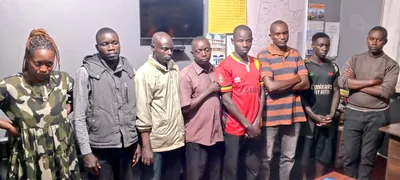
Police have unveiled the identities of eight suspects so far arrested in connection with the mob killing of Uganda Rugby Cranes player, Sydney Gongodyo last week,
Kampala Metropolitan Police spokesperson, Racheal Kawala identified the suspects as Noordin Ssebaggala, Roden Ayebazibwe, Juliet Namukose, Elly Mondoni, Herbert Twinomujuni, Perigrino Katsigazi, Darlious Tayebwa and Hannigton Tugume.
“Five additional suspects have been arrested in connection with the death of Sydney Gongodyo, a professional rugby player, following an incident that occurred on 5 June 2026,” Kawala said.
“This brings the total number of suspects in custody to eight as investigations into the alleged mob killing continue.”
She said the hunt for other suspects involved in the mob killing is still continuing.
Police spokesperson, Kituuma Rusoke on Monday condemned the barbaric attack, adding that its perpetrators will have to pay heavily.
“Under no circumstances should there be justification for a mob to take someone’s life. Whether Sydney was involved in the alleged offence or not, that does not justify killing him. Even when a suspect is found with exhibits linked to a crime, they should be handed over to the police for lawful processing,” he said.
Gongodyo, 27, who also played for the Stanbic Pirates Rugby Club, was killed on Friday after being attacked by a mob in Masulira Zone, Bukoto, a Kampala suburb. The Rugby Cranes player had been accused of snatching a bag, allegations that have yet to be proven in a court of law.
Disturbing videos circulating on social media show the helpless player being repeatedly assaulted by a group of people, including boda boda riders. In one of the videos, Gongodyo is struck on the head with a log as others take turns beating him.
The former Rugby Cranes player was rushed to Mulago National Referral Hospital but later succumbed to his injuries.

Obed Mugwisa, the prime suspect seen in widely circulated footage striking Ugandan rugby star Sydney Gongodyo with a wooden plank, has been arrested by vigilante groups, even as police are yet to officially confirm or issue a statement on his detention.
Obed Mugwisa, identified by investigators and online video footage as the prime suspect in the fatal attack on Ugandan rugby star Sydney Gongodyo, has been arrested by vigilante groups, sources confirm.
Mugwisa, who is alleged to be the man seen striking Gongodyo with a wooden plank during the violent incident, was reportedly picked up on Tuesday evening, around the same time Gongodyo’s body was being laid to rest in Mbale at about 6pm.
Mugwisa is a boda boda cyclist who operates from Frobel Road, near the Shree Kutch Satsang Swaminarayan Temple in Ntinda’s Nsimbiziwoome Zone.
He had not managed to run too far from his operational base as Rachael Kawala, the Kampala Metropolitan Police spokesperson, said he was arrested from Nsimbiziwoome Zone.
However, police have not yet issued an official statement confirming Mugwisa’s arrest or detailing the circumstances under which he was taken into custody.
Gongodyo, a 27-year-old forward for the Uganda Rugby Cranes and player for Stanbic Black Pirates, died after a brutal attack on Friday, June 5, 2026, in the Kampala suburb of Bukoto. He was rushed to Mulago National Referral Hospital but was pronounced dead on arrival.
The killing has triggered nationwide outrage, with renewed calls for tougher action against violent crime and mob justice incidents in the city.
Investigations so far indicate that Gongodyo was attacked by a crowd after being wrongly or prematurely accused of involvement in a handbag snatching incident.
Police had earlier confirmed that several suspects were arrested in connection with the case and are currently being held at Kira Road Police Station as inquiries continue.
The arrested suspects include Noordin Ssebagala, Roden Ayebazibwe, Juliet Namukose, Elly Mondoni, Herbert Twinomujuni, Perigrino Katsigazi, Darious Tayebwa, and Hannington Tugume.
According to Kawala, the arrests were part of ongoing efforts to reconstruct the events leading to Gongodyo’s death.
Meanwhile, CCTV footage circulating online has added another layer to the investigation, showing an unrelated street robbery incident in which a man snatches a woman’s handbag before escaping on a motorcycle.
In the same clip, a bystander is seen approaching the scene as the victim screams for help, raising further public discussion about street crime and citizen intervention in Kampala.
Authorities have not yet confirmed whether the CCTV footage is directly linked to the attack on Gongodyo or if it relates to separate incidents being conflated on social media.
The Uganda Rugby Union President Godwin Kayangwe described Gongodyo’s death as a “monumental loss to the sport,” noting that it has left the rugby community in shock and led to the postponement of the Uganda Rugby Premiership semi-final.
As public pressure mounts, attention is now turning to Mugwisa’s arrest and whether formal charges will follow, even as police remain tight-lipped on the latest development.
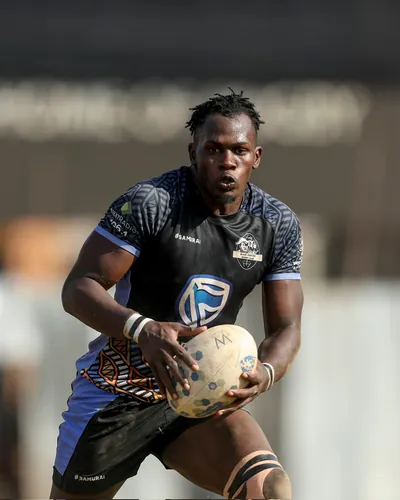
Police in Kampala have kicked off investigations into circumstances under which a Uganda Rugby Cranes players was killed by mob action on Friday.
Kampala Metropolitan Police spokesperson, Racheal Kawala said Sydney Gongodyo who was also a player for Stanbic Black Pirates Rugby Club was killed at around 2pm in Masulira Zone, Bukoto I Parish, Nakawa Division, Kampala District.
“It is alleged that while in Masulita Zone, the victim was subjected to mob action by members of the public under circumstances that are still under investigation,” Kawala said.
She added that police officers responded promptly and rushed the victim to Mulago National Referral Hospital for medical treatment.
“ Unfortunately, he succumbed to his injuries at the hospital on 5th June 2026 at approximately 7:00 PM.”
Police said investigations into the incident are ongoing to establish the circumstances surrounding the incident.
“Efforts are underway to identify and apprehend the suspects involved so that they can be brought to justice.”
The death has shocked a number of rugby fans and stakeholders since Gongodyo was a budding star and a famous figure around the game.
He was part of the Black Pirates team that won the Uganda Rugby Premiership and the Uganda Cup last season.
—
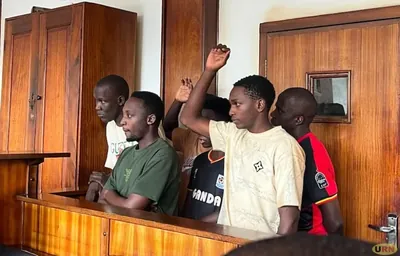
Buganda Road Chief Magistrate’s court has remanded seven youths to Luzira Prison on charges of aggravated robbery of Shs 620 million from a forex bureau operator in Kampala.
The suspects, aged between 18 and 30, were arraigned before senior principal magistrate grade one Winnie Nankya Jatiko, who read to them a single count of aggravated robbery.
The court did not allow the accused persons to take a plea, since the offence is capital in nature and can only be tried by the High court.
Those remanded include Ashiraf Mulindwa, a self-employed resident of Kyebando Kabulengwa in Wakiso district; Akid Khalid, a boda boda rider from Naluvule village; Muhammed Kayiira, a farmer from Kasekere village; Tamim Kawaganya; Ivan Ongom, a marketer and promoter from Kira Municipality; Ismail Maso Kasozi, a self-employed resident of Kabunza Cell in Matuga Ward; and Ivan Gizamba, a hawker from Nansana in Nabweru Municipality.
Prosecution alleges that on March 26, 2026, at Centenary bank’s Nkrumah Road branch in Kampala, the accused persons and others still at large robbed Gisma Zulaika Hussein of a black backpack containing Shs 620 million, property of Economic Exchange Forex Bureau.
According to the charge sheet, the suspects were armed with dangerous weapons, including pangas, during the robbery or immediately before or after committing the offence.
State attorney Grace Amy informed the court that investigations are still ongoing and requested an adjournment. The accused were consequently remanded to Luzira Prison until June 15, 2026, when they will return for mention as investigations continue.
The case adds to a growing list of financial crime proceedings before Buganda Road Chief Magistrates court, where cases of electronic fraud and large-scale bank theft have become increasingly common.
Barely a month ago, the same court remanded eight individuals on charges of electronic fraud and theft of Shs 6 billion from Finance Trust Bank.
Those remanded included Travies Nakabbunge, a broker; Ernest Mulindwa alias Abbas, a businessman; Robert Kaweesi, a farmer; Robert Kisitu alias “Digital,” a businessman; and Nicholas Ssekyanzi, a businessman of Rwandan nationality, all residents of Makindye-Ssabagabo in Wakiso district.
Others were Sister Kyoheirwe, a self-employed resident of Kyabukaju II Cell in Ntungamo district; Doreen Nantale alias Vanesa, a businesswoman from Buikwe district; and Amos Lyada, an infrastructure security analyst residing in Kira Municipality.
Prosecution stated that between April 3 and April 8, 2026, the group and others still at large allegedly accessed Finance Trust Bank’s core banking system and electronically diverted Shs 6 billion to 53 MTN Mobile Money numbers and 80 Airtel Mobile Money numbers in a coordinated fraud scheme.
In another related case in October 2025, four individuals, including a Rwandan national, were remanded over an attempted fraudulent withdrawal of Shs 725 million from a Stanbic bank account belonging to Enid Kukunda.
The suspects included Joel Mucunguzi, a driver from Entebbe; Elizabeth Mbabazi, a Rwandan businesswoman residing in Kyengera (who has since been convicted); Faridah Kobusingye from Kampala; and Flower Njawuzi, also known as Florence Mega Kanywani, a businesswoman from Wakiso district.
In the same month, boda boda rider George Byaruhanga was also remanded over allegations of defrauding Centenary bank of Shs 332 million through impersonation and electronic fraud.
The court heard that Byaruhanga allegedly used a falsified national ID to impersonate Ronald Kintu, enabling him to register on the bank’s biometric system, obtain a Visa card, and withdraw funds through both over-the-counter and mobile banking channels.
Prosecution further alleges that he transferred Shs 250 million to an Exim bank account and withdrew an additional Shs 32.2 million shillings via agent banking, using forged documents to access the funds.
In October 2024, six other individuals were charged at Buganda Road court over the theft of Shs 1 billion from Centenary bank’s Mapeera branch in Kampala. The suspects included Simei Rutinampola, a banking agent from Wakiso district; Newton Ayesiga, a businessman from Kira Municipality; Idris Kasozi, an agent banker from Kawempe; Shafiq Mugulo, a businessman from Makindye; Fred Byabasaija, an electrician; and Farouk Kiyemba from Luwero District.
Prosecution stated that Ayesiga received Shs 250 million, Kasozi received Shs 350 million, Mugulo received Shs 100 million, Byabasaija received Shs 200 million, and Kiyemba received Shs 100 million, all proceeds of the alleged theft routed through different accounts and forex bureaus.
2026.5.23 Ugandans rue link to Bundibugyo, the Ebola virus type named after a district of cocoa farmers
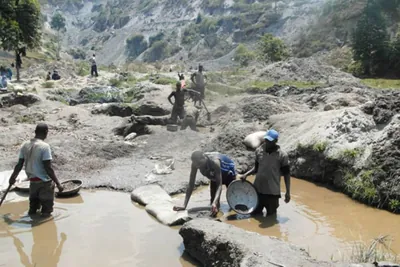
Police in Kisoro District detain 28 individuals, including 25 Rwandan nationals, following an intelligence-led operation targeting illegal mining at Kirwa Wolfram Mines, with authorities citing unlawful entry and mineral theft.
Police in Kisoro District have arrested 28 people in an intelligence-led operation against illegal mining at Kirwa Wolfram Mines, with 25 of the suspects identified as Rwandan nationals accused of entering Uganda through porous border points.
The raid was carried out on May 2, 2026, at the government-owned Wolfram and tin deposits located in Kabaya Village, Busengo Parish, Nyarubuye Sub-county.
Kigezi Police Spokesperson Elly Maate said the site falls under the Ministry of Energy and Mineral Development and is protected by the Mineral Police Protection Unit.
“The territorial police in Kisoro carried out an intelligence-led operation against illegal mining at Kirwa Wolfram mining site, where 28 suspects were arrested and 25 of whom are Rwandans who had illegally entered the country through porous entry points,” Maate noted.
Maate further revealed that local authorities had reported suspected illegal mining activities by foreign nationals at the site since the start of 2026.
“On May 2, 2026, the Kisoro territorial police carried out an intelligence-led operation on the illegal miners and 28 illegal miners were arrested and about 30 kilograms of suspected Wolfram was recovered from them,” he added.
He also confirmed that the suspects have been formally charged with illegal mining, as well as unlawful entry and stay in Uganda without valid permits.
“They were accordingly charged with illegal mining and entering and staying in the Republic of Uganda without valid permits. Inquiries are ongoing, upon completion of which, they will be produced before court to answer charges accordingly,” Maate said.
The operation highlights ongoing concerns over illegal cross-border activities and mineral exploitation in southwestern Uganda, particularly in border districts where enforcement agencies continue to contend with porous entry points and unregulated mining operations.
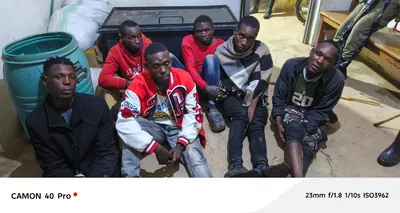
Police in Rubanda District have arrested six suspects during an intelligence-led night operation targeting ex-convicts and individuals on security watch lists.
The operation was conducted between midnight and 5:00am on Saturday, May 3, 2026, in identified black spots within Rubanda Town Council.
Kigezi police spokesperson Elly Maate confirmed the arrests, saying the operation was commanded by the District Police Commander, John Bosco Tumwebaze, together with officers from Rubanda Central Police Station.
“The territorial police in Rubanda carried out an intelligence-led disruptive operation where a number of suspects who have been on the security watch list and ex-convicts were arrested,” Maate noted.
Maate added that the arrested suspects were Joel Namanya, Anobed Mucunguzi, Bruno Ahimbisibwe, William Agaba, Erias Mugisha, and Brian Akankwasa.
“The operation follows reports of aggravated robberies by gangs armed with machetes, knives, and stones. The thugs have been waylaying late-night travelers and robbing them of valuables,” Maate said.
He further stated that the suspects are being detained at Rubanda Central Police Station pending further investigations and possible identification by victims.
“Among the cases under investigation is the alleged robbery of Eng. Denis Twesigomwe of Rubanda District Local Government. He was reportedly attacked on February 2, 2026, at around 3:00am while returning from Kampala and robbed of a bag containing a laptop and Shs4.9 million,” Maate stated.
“Inquiries are ongoing, and more similar operations are expected to be conducted across the entire Kigezi region to combat the vice of criminality,” Maate added.
2026.5.3 Woman stabs husband’s lover to death after catching them in bed
Adjumani, Uganda: Police in Adjumani District have arrested a 29-year-old woman on suspicion of murder following a fatal stabbing incident that left a 32-year-old woman dead.
According to Uganda Police Force, the incident occurred on Saturday, May 2, 2026, at around 1:00 PM in Ajujo Village, Alere Parish, Pachara Sub-county.
The suspect, identified as Alice, allegedly attacked the deceased, Andrubaku Grace, after finding her in a compromising situation with her husband inside the victim’s residence. Police say the suspect used a sharp knife to inflict multiple stab wounds.
Both the deceased and the suspect’s husband were reportedly intoxicated at the time of the incident.
The victim was rushed to Robidire Health Centre III but later succumbed to her injuries. The body was subsequently transferred to Adjumani General Hospital for postmortem examination.
North West Nile Regional Police Spokesperson SP Collins Asea confirmed the arrest, noting that a murder case has been registered under CRB 232/2026.
Police officers, including Scene of Crime personnel, visited and documented the scene. Relevant medical and investigative forms were completed, and witness statements recorded.
The suspect is currently detained at Adjumani Central Police Station as investigations continue to gather further evidence for prosecution.
Authorities have urged the public to resolve domestic conflicts through lawful and peaceful means and to seek help from community leaders or law enforcement when faced with disputes.
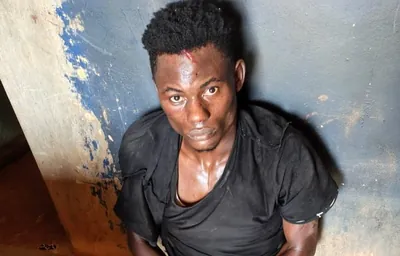
Wakiso, Uganda – Police in Wakiso are investigating a case of aggravated robbery following the vigilance of Nakuwadde residents that led to the arrest of one suspect in the early hours of Labour Day.
According to ASP Luke Owoyesigyire, Deputy Public Relations Officer for Kampala Metropolitan Police, the assiailant armed with a panga attacked a victim in Nakuwadde Village, Wakiso District, at around dawn on Thursday, May 1, 2026. The attacker stole a mobile phone and cash before fleeing.
Community members who responded to the incident apprehended a suspect, 21-year-old Kiyinji Marvin, and found him with the stolen phone. They handed him over to police.
“Police in Wakiso are investigating a case of aggravated robbery,” said Owoyesigyire “The suspect is currently in custody to assist with ongoing investigations.”
Owoyesigyire commended the vigilance of the community and urged the public to remain alert. “Report any suspicious individuals or activities to the nearest police station,” he said.
The case is being handled as aggravated robbery due to the use of a weapon. Investigations continue.

Panic spread in a Kyazanga village after residents accused a man of exhuming a corpse for ritual purposes, but no body was found, with leaders urging calm amid fears of mob justice fueled by unverified claims.
Tension gripped Bizo Village in Kyazanga Sub-county, Lwengo District, after residents stormed the home of a man accused of exhuming a corpse with alleged intentions of ritual practices.
The residents, led by Local Council One Chairperson Paul Wasswa, descended on the home of Paul Ssempijja, demanding that he open his house for inspection following claims that he had dug up the body of a deceased villager.
The allegations stem from the burial of Sereverio Kakyakya Byakatonda, who was laid to rest on April 8 in Busumbi Village. Residents claim that shortly after the burial, Ssempijja allegedly exhumed the body and took it to his home.
“We received information and decided to come and verify it ourselves. As leaders, we asked residents to remain calm and avoid taking the law into their own hands,” Wasswa said.
During the search, residents reported finding suspicious items inside the house, including bones, a hoe, a spear and knives, which they suspected could have been used in exhuming graves. However, no human remains were recovered.
“We saw items that raised serious suspicion. This has left the entire community in fear,” some residents said.
Claims of strange voices allegedly linked to the deceased further heightened panic, with some villagers interpreting them as supernatural signs. However, no independent verification of such claims was provided.
Relatives of Ssempijja dismissed the allegations, explaining that the bones found in the house were from animals slaughtered during Easter celebrations.
“Those are not human remains. They are from animals we roasted during Easter and kept for later use,” they said.
At the deceased’s home, his son Erineewo Mugenyi said the family had heard reports that unknown individuals had exhumed the body, but dismissed claims that the deceased was “demanding” cattle and money as false.
“We believe this is meant to confuse us. We buried our father and the rest is not up to us,” Mugenyi said.
Ssempijja denied the accusations, attributing them to political rivalry. He said the claims were being used to tarnish his name following a contested LC1 chairperson race.
“These are lies meant to destroy my reputation. This is not the first time I am being attacked. I was even assaulted before and reported the matter to Bijaaba Police,” he said.
Local leader Ismail Kafeero cautioned residents against spreading unverified information, warning that such claims could incite violence.
“People should verify information before spreading it. Some of these claims can easily lead to mob justice,” Kafeero said.
Authorities had not yet issued an official statement by press time, but the incident underscores growing concern over mob action and fear driven by unverified allegations in rural communities.
2026.5.1 Security guard arrested after beating lover to death in Gulu
Gulu City, Uganda: A 37-year-old security guard has been arrested in Gulu City after allegedly beating his girlfriend to death using the butt of his gun in a violent domestic dispute at a petrol station.
Police identified the suspect as Albert Okonye, attached to 7 Guidance Security Company, who is accused of killing Barbara Faith Akello on Tuesday night at Shine Petrol Station in Layibi Centre.
According to Aswa Regional Police Spokesperson David Ongom Mudong, the incident happened at around 11:00 pm when the victim visited the suspect at his workplace, where a confrontation reportedly broke out after Okonye suspected her of having an affair following a phone call she received.
“Preliminary investigations indicate that the suspect struck the victim repeatedly on the head using the butt of his firearm, causing fatal injuries,” Mudong said.
He added that a colleague who attempted to intervene was threatened, with the suspect allegedly attempting to shoot him before fleeing the scene.
Security operatives later tracked down Okonye and arrested him. Police also recovered an SMG rifle with a broken butt, believed to have been used in the attack. He is currently detained at Gulu Central Police Station as investigations continue.
Eyewitnesses described a chaotic and terrifying scene, with one witness saying they heard loud shouting before seeing the suspect assault the victim while armed.
Crime scene officers documented the scene and conveyed the body to Gulu Regional Referral Hospital mortuary for postmortem examination.
Police say the case file will be forwarded to the Resident State Attorney for legal guidance before the suspect is arraigned in court.
The incident adds to growing concerns over domestic violence and misuse of firearms by security personnel. According to the Uganda Police Annual Crime Report 2025, cases of domestic violence remain among the leading drivers of violent crime, with many escalating into fatal incidents.
Residents of Layibi Centre have expressed shock over the killing, describing it as a tragic act that has shaken the community.
—
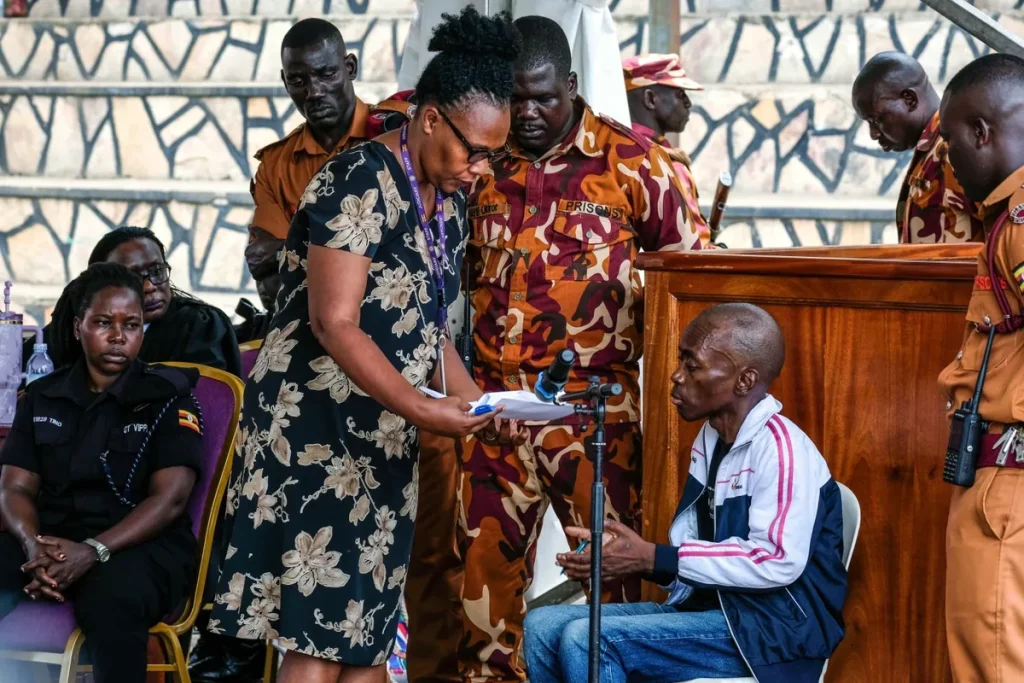
WAKISO, Uganda (AP) — A judge on Thursday sentenced a Ugandan man to death after rejecting his insanity plea in the killings of four children in a nursery school earlier this month.
A crowd watching proceedings in a tent erupted in cheers after the judge ruled that Christopher Okello should “suffer death” for the April 2 killings that devastated the East African nation.
The suspect “failed to adduce any evidence to support this claim that he was not mentally okay” when he committed the crimes, the judge said.
The 38-year-old man was accused of killing the children in a machete attack inside a nursery school in a suburb of the Ugandan capital of Kampala.
Witnesses said the attacker targeted the nursery school, known as Gaba Early Childhood Development Program, by disguising himself as a parent. He is said to have briefly talked to administrators there before locking the gate and attacking the children.
Ugandan President Yoweri Museveni ordered the courts to fast-track the criminal trial in a justice mechanism known as “mobile courts,” open-air rather than courtroom sessions that allowed hundreds of bereaved locals and others to witness the trial as it unfolded.
Still, there were concerns about the defendant’s mental health. He appeared nervous and, at times, laughed without provocation. The Uganda Law Society described the trial as “a judicial lynching rally.”
The judiciary defended the decision to conduct a quick and very public trial, saying it highlighted its “commitment to taking justice closer to the people through innovative approaches.”
The death penalty is rarely carried out in this East African country. Many people condemned to death have spent years behind bars. x1200
2026.4.27 Judge Sets April 30 for Ruling in Okello Murder Case
A tense and dramatic day in court saw closing submissions stretch into the evening as assessors recommended conviction, while the defence maintained the accused’s mental state remains central to determining criminal responsibility.
The High Court has set April 30, 2026, as the date for ruling in the murder trial of Christopher Onyum Okello, bringing to a close a marathon day of final submissions marked by intense legal arguments and emotional moments.
Presiding judge Alice Komuhangi Khaukha adjourned proceedings at 7:36pm on Monday after hearing closing arguments from both the prosecution and defence in a case that has gripped national attention.
The hearing, which ran late into the evening, capped weeks of proceedings characterised by dramatic courtroom exchanges and procedural twists.
Court assessors recommended that Okello be convicted, citing video evidence placing him in the neighbourhood of the crime scene a day before the April 2 killings. They said the footage suggested premeditation.
Under Uganda’s legal system, assessors provide advisory opinions to assist the judge, although their views are not binding.
Okello is facing multiple counts of murder in connection with the killing of four toddlers at Ggaba Nursery and Daycare Centre, an incident that shocked the country.
The prosecution has argued that the killings were deliberate and premeditated, presenting evidence it says links Okello directly to the crime.
However, the defence has maintained that the accused’s mental health is central to the case. Defence lawyer Richard Kumbuga told court that Okello has a documented history of mental illness dating back to 2016.
“My Lord, it is on record that the accused had a history of mental illness between 2016 and 2025,” Kumbuga submitted, citing medical records and family testimony.
He said Okello had previously attempted suicide and received treatment at Butabika National Referral Mental Hospital, arguing that such a history raises questions about his ability to form criminal intent.
Kumbuga also challenged prosecution evidence that the accused had been declared mentally stable at International Hospital Kampala, noting that mental illness can manifest in episodes.
“A person with mental illness can have episodes at any time,” he said, urging the court to consider whether Okello was in full control of his mental faculties at the time of the alleged offence.
The defence had earlier closed its case after failing to present additional witnesses, proceeding instead to final submissions.
The case has drawn widespread public attention due to the nature of the allegations and the age of the victims, making it one of the most closely followed criminal trials in recent years.
With submissions now concluded, all eyes turn to the court’s ruling on April 30, which is expected to determine Okello’s fate.

Kampala, Uganda | URN | Christopher Okello Onyum 39, the man accused in the Ggaba Early Childhood Development Day Care Center of slaughtering four toddlers in cold blood, will be tried in open court next week.
According to a statement by the State Minister of Youth and Children Affairs, Balaam Barugahare, posted on his X account on Friday night in response to public demand, the proceedings will be held in open court, starting on 13th April at Ggaba Community School Grounds.
Okello will be one of the first civilians to stand trial in an open civil court. While this is rare in the civilian justice system, it is a common practice in military justice, where court martial sessions are sometimes held in communities.
His trial follows a recent presidential recomendation to the judiciary to fast-track the case, with sessions conducted at the crime scene so the community can witness justice being served.
This will be done under the recently introduced mobile court framework which allows judicial officers to conduct proceedings outside conventional court premises.
According to the minister’s statement, seating within the court area will be limited to 1,000 people and open to the general public on a first-come, first-served basis.
“Once proceedings begin, no further entry will be permitted. To ensure wider public access, screens and speakers will be installed for live viewing, and the trial will also be broadcast on major television stations,” Balaam stated.
He further cautioned the general public not to carry bags or unnecessary items to the court hearings for security reasons.
“Parents and members of the public are encouraged to attend as we collectively uphold and support justice for all in Uganda, especially here in Kampala. We extend our sincere appreciation to the joint security forces including the CID, JAT, and Crime Intelligence for their swift, thorough, and comprehensive investigations into the tragic murder of our children in Ggaba,” Balaam said.
On Monday, during prayers to remember the four murdered toddlers Keisha Agenrwot, Ryan Odeke, Gideon Etuku, and Ignatius Sseruyange, religious leaders strongly urged authorities to fast-track investigations and deliver justice for the grieving community.
The suspect allegedly gained access to the daycare facility on April 2, 2026, by posing as a parent seeking to register his child. The facility is operated by Ggaba Community Church in Makindye Division, Kampala. Police also confirmed other investigations linking the suspect to several other murders.
—

Police in Nateete have recovered two suspected stolen cattle following a swift and coordinated early morning operation.
According to Kampala Metropolitan Police Spokesperson SP Racheal Kawala, officers received intelligence at approximately 04:00am on Wednesday about a motor vehicle reportedly transporting suspected stolen cattle. Acting promptly on the tip-off, police intercepted a silver Toyota X-Trail, registration number UAS 521W, in Busega opposite the main market.
“Officers immediately acted on the intelligence and intercepted the vehicle, leading to the recovery of two live cows believed to have been stolen,” SP Kawala said.
Upon interception, the occupants of the vehicle abandoned it and fled the scene. A subsequent search of the vehicle led to the recovery of the two animals.
The vehicle has since been impounded and is currently parked at Nateete Police Station as investigations continue.
Authorities have registered a case of being in possession of suspected stolen cattle to facilitate further inquiries.
Police say efforts are ongoing to identify and apprehend the suspects involved.
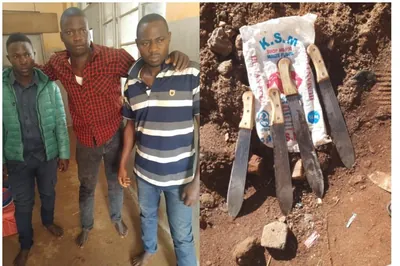
Security forces in Makindye Division acted on intelligence reports to stop an attempted armed robbery at a fuel station along Salaama Road, recovering weapons and arresting suspects.
Police in Kampala have foiled an attempted aggravated robbery at a petrol station in Makindye Division and arrested three suspects.
According to Kampala Metropolitan Police spokesperson Rachael Kawala, the incident occurred at Nesta Petrol Station along Salaama Road in Salaama Parish.
Kawala said the operation was based on intelligence indicating a planned robbery targeting the fuel station.
“Police at Katwe have successfully thwarted an aggravated robbery attempt at Nesta Petrol Station, located along Salaama Road in Salaama Parish, Makindye Division, Kampala District,” she said.
She explained that officers acted swiftly after receiving credible information about the planned attack.
“On 26th April 2026, police received intelligence about a planned robbery at the aforementioned location. Acting swiftly on this information, our task team responded immediately, resulting in the arrest of three suspects and the recovery of four pangas,” she said.
The suspects are currently in police custody as investigations continue into the attempted robbery and possible wider criminal links.
Police said identities of the suspects have not yet been released as inquiries are still ongoing.
Authorities have credited the operation to timely intelligence-sharing and rapid response, which they say prevented what could have escalated into a violent incident at the fuel station.
Investigations are expected to establish whether the suspects are part of a larger criminal network operating in the city.

Traffic Police have intercepted a driver who was transporting 35 students in a 14-seater vehicle, raising fresh concerns over road safety as the holiday travel season begins.
According to Traffic Police spokesperson Micheal Kananura, the driver of vehicle registration number UA 667DN was stopped on Friday while ferrying the students, aged between 15 and 21, from Ibanda to Kasese under dangerously overcrowded conditions.
“The driver of vehicle number UA 667DN has been intercepted while transporting 35 students aged btn 15 and 21 from Ibanda-Kasese loaded dangerously,” Kananura said.
He added that the driver is currently detained at Mbarara Central Police Station pending court action.
“The driver has been detained Mbarara CPS and is awaiting court action. Meanwhile, safer & appropriate transport arrangements are being made for the students,” he said.
Police said the situation was made worse by the presence of flammable materials in the vehicle.
“Disturbingly, the vehicle was also carrying jerrycans of petrol, with some students stepping on them while others were positioned on top of the vehicle. This created an extremely hazardous situation that could have resulted in a serious fire incident,” Kananura noted.
Authorities warned that such reckless conduct puts lives at risk and urged the public to take personal responsibility for safety on the roads.
“Safety must never be compromised. We should not wait for enforcement to act, everyone has a responsibility to make safe decisions and prevent such risks before they occur,” he said.
Police also commended members of the public who reported the incident in time, enabling officers to intercept the vehicle before it could evade enforcement.
“We commend the whistleblower who alerted Police in time, preventing the driver from using shortcut routes to evade enforcement,” Kananura added.
With schools closing and travel increasing, Traffic Police have issued a stern warning to motorists against violating road safety regulations.
“As the holiday season begins & more children travel, all motorists are strongly warned to desist from such traffic violations and others related. We remain vigilant on the roads and strict action will be taken against offenders,” he said.
Police noted that ensuring the safety of children on the roads requires collective effort from drivers, parents and the wider public.
“Ensuring the safety of our children is a shared responsibility. Let’s all play our part,” Kananura said.
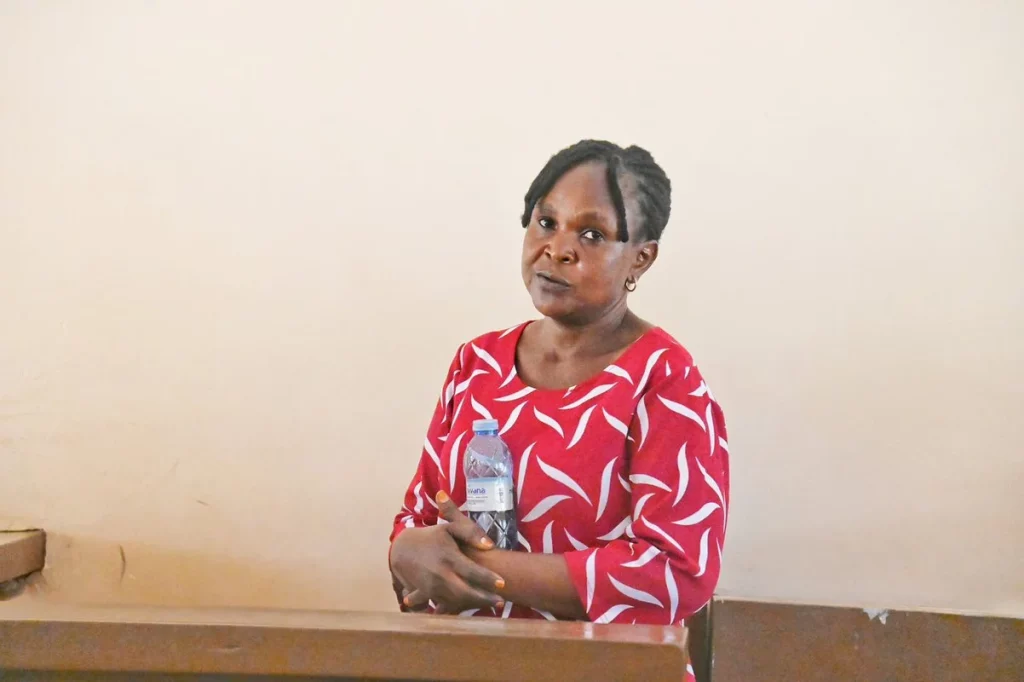
A Community Development Officer in Soroti City has been arraigned and remanded after being accused of extorting over 121 Parish Development Model beneficiaries through false claims of registration and administrative fees.
A coordinated operation involving the State House Anti-Corruption Unit (SH-ACU), the Criminal Investigations Directorate (CID), and the Office of the Director of Public Prosecutions (ODPP) has led to the arraignment of a Community Development Officer in Soroti City over allegations of extorting money from beneficiaries of the Parish Development Model (PDM).
The accused, Hellen Alajo, the Community Development Officer for Kengere Ward in the East Division of Soroti City, was brought before the Soroti Chief Magistrate’s Court on charges of obtaining money by false pretence.
Investigators allege that Alajo extorted funds from more than 121 PDM beneficiaries, claiming the money was required for group registration, renewal of group certificates, and stationery.
It is further alleged that after beneficiaries received Shs1 million under the government programme, she demanded additional payments ranging between Shs10,000 and Shs50,000 per person.
She is also accused of claiming that the money was meant to facilitate community-based trainers and to secure eligibility for more funding in the next financial year, claims investigators say were false.
The alleged offences are linked to the Parish Development Model (PDM), a flagship government initiative aimed at boosting household incomes at parish level.
The case was presented before the Soroti Chief Magistrate’s Court, where Alajo was remanded until May 27, 2026 pending further proceedings.
Authorities say the arrest is part of ongoing efforts to crack down on corruption within government programmes targeting vulnerable communities.
x1200
2026.4.3 First group of 12 deportees from the US arrives in Uganda, lawyers say
KAMPALA, Uganda (AP) — Twelve people deported from the U.S. arrived in Uganda on Thursday, the Uganda Law Society said, in the first known arrivals since Uganda and the U.S. signed a bilateral deal permitting the transfers.
The deportees were “effectively dumped in Uganda through an undignified, harrowing and dehumanizing process,” the law society said in a statement, adding that they arrived on a private charter flight.
The deportations are part of U.S. President Donald Trump’s crackdown on immigration as he seeks to deter migrants from entering the United States illegally and to deport those who already have done so, especially those with criminal records and including those who cannot easily be deported to their home country.
The U.S. State Department and the Department of Homeland Security have defended third-country deportations as a means to quickly remove people who are in the U.S. illegally. The deportations have been the subject of several legal cases, both in the U.S. and in some countries where migrants are sent.
The deportations are controversial in part because the unwanted migrants can be sent to countries they have no cultural ties with. In August, for example, U.S. authorities briefly considered sending Kilmar Abrego Garcia, the high-profile subject of an ongoing migration dispute, to Uganda.
The U.S. has struck deals with at least seven African nations to take some migrants. Those countries range from the western African nation of Ghana to the southern African nation of Eswatini, which the U.S. paid $5.1 million to take up to 160 deportees, according to details of the deal released by the U.S. State Department.
It was not clear if Ugandan authorities were similarly paid.
The law society charged that the deportees were at the mercy of “unnamed, private interests on either side of the Atlantic,” adding that it was seeking legal remedy to stop what it described as an “international illegality.”
There were no details on the identities of the deportees, nor on their countries of origin.
Okello Oryem, a Ugandan state minister in charge of foreign affairs, said he was traveling and unaware of the arrivals.
A spokeswoman for the U.S. Embassy in Kampala, the Ugandan capital, didn’t respond to questions about the welfare of the deportees.
Oryem told The Associated Press last month that Uganda was expecting “planeloads” of deportees from the U.S. He said the agreement with the U.S. was signed in the pan-African spirit and over humanitarian concern for Africans unwanted in a foreign land.
Ugandan authorities previously said their agreement with the U.S. relates to receiving deportees of African origin who do not have a criminal record.
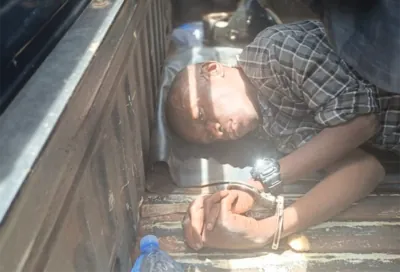
The assailant who stormed Gaba Early Childhood Development Programme Centre in Ggaba, Kampala, and hacked four children to death had reportedly visited the school two days earlier seeking admission for his child.
Kampala Metropolitan Police spokesperson Racheal Kawala identified the suspect as Christopher Okello Onyu, 34, a resident of Nwoya district, northern Uganda.
He allegedly gained access to the school on Thursday and attacked a group of 14 children, killing four (three boys and one girl). Police identified the deceased as Gideon Eteku, a male juvenile, aged 2 years, Kaise Alungat, female juvenile, aged 2, Ignatius Sserwange, male juvenile, 3, and Ryan Odeke, 2.
Their bodies were taken to Mulago City Mortuary for post-mortem examinations before being handed over to their families for burial. Preliminary police findings indicate that the suspect, who was armed with three knives, is currently detained at Kabalagala Police Division.
Investigators say he had visited the school two days earlier and requested admission for his child.
“The school asked him to return today [Thursday]. He came back with the admission fees [Shs 180,000], which he paid. After paying, he pretended to leave but instead changed direction, went to the seesaw where the children were playing, and began stabbing them,” Kawala said at the scene.
Police said the suspect was rescued from being lynched after officers, supported by the army, fired in the air to disperse an angry crowd that had gathered demanding mob justice.
Makindye deputy resident city commissioner Mark Bayingana questioned how the suspect managed to enter the premises undetected and access the children despite the presence of school security.
Some parents of surviving children expressed grief and shock. Karim Kazibwe said it was painful to see such young children killed, adding that more lives could have been lost had the suspect not been stopped.
Stanely Okecho, the school’s administrative lawyer, said management was cooperating with police to establish the motive behind the attack. He added that the school would remain temporarily closed as investigations continue. Inspector General of Police Abass Byakagaba, who visited the scene, called for calm as security agencies investigate the killings.
Onyu reportedly warned that even if he were killed, similar attacks would still be carried out against Ugandans.
2026.4.1 Congestion, funding gaps strain Uganda’s remand homes as juvenile cases rise
Uganda’s eight remand homes are grappling with overcrowding, delayed court processes and limited funding, as more than 1,100 children remain in custody amid rising juvenile crime and concerns over rehabilitation.
Uganda has eight remand homes that accommodate children in conflict with the law, but these facilities face several challenges, including inadequate funding to care for the children, delays in hearing cases, parents failing to show up in court, and transport difficulties.
The State Minister for Youth and Children Affairs, Balaam Barugahara, says that despite the limited resources, authorities are making efforts to rehabilitate the children so they can return to society with skills to earn a livelihood.
According to the Police Annual Crime Report for 2025, a total of 3,308 juveniles were involved in crime, of whom 2,908 were boys and 400 were girls.
Figures from the Ministry of Gender, Labour and Social Development indicate that more than 1,184 children are currently held in the country’s eight remand homes, including 1,136 boys and 48 girls.
A visit to Naguru Remand Home highlights the scale of the challenge. The facility, which sits on about one and a half acres, houses more than 300 children—far above its intended capacity.
At the time of the visit, children were engaged in prayer, one of the activities aimed at counselling and rehabilitation. They are also given opportunities to learn skills such as tailoring, hairdressing and farming.
Mary Kyomugisha, the officer in charge of Naguru Remand Home, says most children brought to the facility come from the Buganda region and parts of Busoga.
“We have 313 children now; this facility is meant to have around 100, so there is a bit of congestion,” she says.
Kyomugisha adds that earlier this year the number rose to about 400, partly due to election-related arrests, worsening congestion before slightly easing.
Children held in remand homes stay there while awaiting court decisions. While some cases are concluded quickly, others take longer, contributing to overcrowding.
Naguru Remand Home is among the few facilities with an on-site children’s court, a development Kyomugisha says has reduced anxiety among the children.
“At times the children would get panic attacks when told they are going to court, but now we just inform them the judge is coming and they can go through the process peacefully,” she says.
Minister Barugahara notes that logistical challenges continue to hinder operations. Some facilities lack vehicles to transport children to court, while long distances make it difficult for parents to attend proceedings.
“The Fort Portal home has no vehicle, while the one in Mbale lost the engine. This is a challenge and one of the reasons some children remain longer on remand,” he says.
He adds that funding remains insufficient despite some increases.
“When I became minister the budget was around Shs500 million, but now we have around Shs200 million for transporting the children and Shs600 million for feeding. I hope the budget can be raised to Shs1.2 billion,” he says.
Common offences committed by the children include theft, robbery, murder, defilement and rape. Both Barugahara and Kyomugisha attribute this to parental neglect and lack of guidance, with some parents failing to appear in court.
“Parents are turning to the police and this has left the children to do as they please,” Kyomugisha says.
“I ask religious leaders to help guide the children back to the Ten Commandments,” Barugahara adds.
Within the facilities, children are separated according to the offences committed, with three dormitories used for accommodation.
Those who are convicted are transferred to Kampiringisa National Rehabilitation Centre, where they serve their sentences before eventual reintegration into their communities.
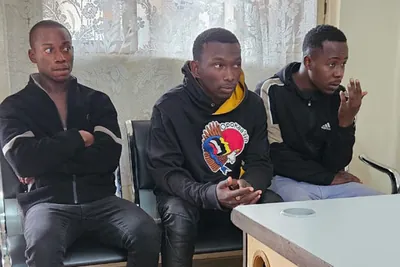
The arrests follow a series of complaints that some police officers were too eager to believe that promotion and perks could come via a few shillings exchanged online.
Police at Jinja Road have arrested three young men suspected of impersonating the Inspector General of Police, taking advantage of officers eager for fast-track promotions.
The suspects — Abubakar Uthmaan Ariho, Fayim Bukenya, and Dalton Kaweesi — were apprehended on Tuesday, 24 March 2026, after investigations revealed they had been running social media accounts posing as Abas Byakagaba, the Inspector General.
According to Kampala Metropolitan Police Spokesperson SP Rachael Kawala, the trio allegedly used the assumed identity to solicit money from officers and members of the public.
“The suspects are believed to have used false online identities linked to the office of the Inspector General to deceive and financially exploit their targets,” SP Kawala said.
The arrests follow a series of complaints that some police officers were too eager to believe that promotion and perks could come via a few shillings exchanged online.
In other words, the victims’ own gullibility — and appetite for advancement — made them easy targets.
Police have opened a formal case of personation, and searches of the suspects’ residences led to the recovery of electronic devices and documents believed to be linked to the scheme.
Investigations are ongoing as authorities seek to establish the full extent of the operation, and possibly remind some officers that shortcuts rarely pay.
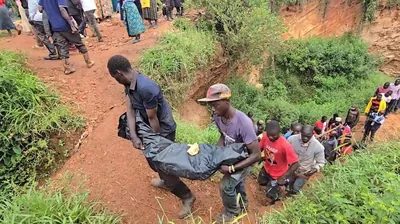
Grief and anger have gripped Minana Village after a quarry collapse killed two young children, prompting residents and local leaders to demand strict enforcement of safety regulations and a total ban on minors accessing hazardous quarry sites.
Residents of Minana Village in Mityana District are calling for strict regulations to stop children below the age of 18 from entering stone quarries after a tragic collapse claimed the lives of two young children.
The incident occurred at a stone quarry in Ttamu Division when part of the quarry wall suddenly gave way, burying three children who had entered the site. One child survived with injuries and was rushed by residents to Mityana Hospital for treatment.
However, two others were killed in the accident. The deceased were identified as Docus Muwanguzi, aged seven, and Florence Nakyejwe, aged six. The children had been living with their grandmother, Elizabeth Nabbosa, who works at the quarry.
Nabbosa said she received the devastating news while attending a parents’ meeting at the children’s school.
“I was attending a meeting at their school when I received information that the quarry had collapsed and my grandchildren were trapped inside,” she said.
Residents said the collapse occurred when a section of the quarry suddenly gave way, triggering a landslide that buried the children under stones and soil.
Following the incident, community members rushed to the scene and worked through the night digging through the rubble in an effort to rescue the victims.
According to residents, the rescue operation lasted several hours as people used basic tools to remove heavy stones and debris before finally retrieving the bodies of the two children.
By the time reporters left the scene, the bodies had been recovered and police were waiting for a medical officer to carry out a postmortem examination.
Residents said the quarry is widely used by people from surrounding areas including Minana Galabi, Kamuvuubo, Mpanga, and Busere A villages, with many families depending on quarrying as a source of income.
However, a community member, Lwanyaga Owen, said the site has previously claimed the lives of children, raising concerns about the lack of safety measures.
“This is not the first time children have died in this quarry,” he said. “We need strong regulations to stop minors from entering such dangerous places.”
Local leaders have strongly condemned the involvement of young children in quarry activities, describing the practice as extremely dangerous.
They announced plans to introduce strict regulations to ensure that no child below the age of 18 is allowed to work or access quarry sites.
Samuel Ssenkinga, the elected councillor for Ttamu Division, urged authorities in Mityana Municipality to strengthen safety measures and improve emergency response capacity.
“We must protect children from hazardous work such as quarrying,” Ssenkinga said. “Authorities should also ensure that rescue equipment is available to respond quickly when accidents occur.”
The tragedy has renewed calls for stricter enforcement of safety regulations at quarry sites to prevent similar incidents and protect vulnerable children in the community.
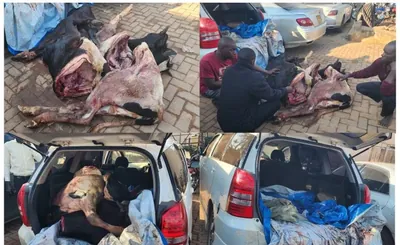
Kampala, Uganda – In a swift operation, the Police Flying Squad Unit has arrested three suspects for allegedly stealing and selling slaughtered cattle in Nakulabye.
The suspects, identified as Saka Kisiga Salongo Guloba Hamza, a butcher, and Bukenya John, a driver, were caught red-handed offloading stolen meat at around 2:00 am on March 11, 2026.
The operation began when police received a tip-off at around 2:00 am about a white Toyota Wish vehicle (UBG 345D) suspected of transporting stolen goods.
“Acting on the tip-off, officers trailed the vehicle up to Nakulabye, where it parked and the occupants began offloading slaughtered animals (cows),” said SP Kawala Racheal, the KMP police spokesperson.
Police found the suspects unloading two slaughtered cows from the vehicle.
Preliminary investigations reveal the animals were stolen from Zirobwe and Luweero areas and sold in Nakulabye at UGX 10,000 per kilogram.
The suspects are in police custody, and investigations are ongoing.
2026.2.26 Ugandan police arrest two women for allegedly kissing in public
KAMPALA, Uganda (AP) — Ugandan police detained two women who were reported by their neighbors to be engaging in same-sex activities, a police spokesperson said on Thursday, one of the first known instances of arrests under an anti-LGBTQ law enacted in 2023.
The women were arrested in the northwestern city of Arua on Feb. 18 after police were notified they were often seen kissing. When officers arrived, they caught the couple “red-handed on the cement floor,” said spokesperson Josephine Angucia.
The women were later freed on police bond and have yet to be charged as the investigations are continuing, she said.
The controversial Anti-Homosexuality Act was supported by many in Uganda but widely condemned by rights activists and others abroad. Its promoters said it was necessary to protect children.
While the legislation does not criminalize identifying as LGBTQ, it mandates the death penalty for “aggravated homosexuality,” which is defined as cases of sexual relations involving people infected with HIV, as well as with minors and other categories of vulnerable people.
The detention of the women in Arua “underscores the grim reality we are facing on the ground under the Anti-Homosexuality Act,” said Frank Mugisha, a prominent LGBTQ leader in Uganda. “We have seen a surge in a targeted crackdown that goes beyond just arrests; it has fueled a dangerous cycle of blackmail and extortion.”
Same-sex activity is separately criminalized in the East African country under a colonial-era law that punishes relations against “the order of nature.”
Homosexuality is criminalized in many of Africa’s 54 countries. The West African nation of Senegal is currently trying to impose tougher penalties for same-sex activity.
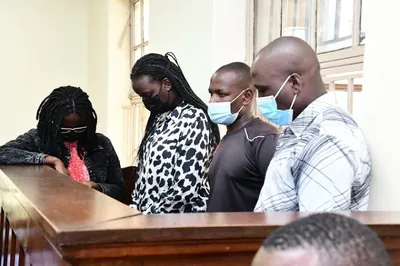
2026.2.26 Court puts Molly Katanga, four others on defence over husband’s murder
Kampala, Uganda | Molly Katanga and four others have to defend themselves over the death of her husband, businessman Henry Katanga, high court has ruled. In a ruling delivered on Thursday, Lady Justice Rosette Comfort Kania said the circumstantial evidence presented by the prosecution points to malice aforethought and requires each of the accused persons to explain their actions.
Court heard that 65-year-old Henry Katanga died from a gunshot wound at his home on Chwa II Road in Mbuya, Nakawa Division, on November 2, 2023. The death was initially reported as a suicide. However, in her ruling, Justice Kania said the prosecution relied on the doctrine of last seen, noting that only the deceased and his widow were in the bedroom at the time of the shooting, and that Molly Katanga was the last person to see him alive.
The judge cited forensic evidence placing Molly Katanga at the centre of the incident, including the presence of gunshot residue on her hands and her DNA on the pistol registered in the deceased’s name. “The accused is required to explain how she was attacked, yet there were no signs of disturbance in the bedroom,” the judge ruled.
The court further pointed to Molly Katanga’s conduct after the shooting, describing it as suspicious. Evidence showed she declined to record a police statement despite repeated requests from investigators and only did so on January 10, 2024. The judge said this conduct draws an inference of responsibility. The court also found that the crime scene had been interfered with.
Evidence indicated that the deceased’s body was removed from the marital bed, placed on a small mattress on the floor, tied with cotton gauze, and cleaned. The alleged murder weapon was also moved. According to the bloodstain pattern analysis presented in court, the scene had been tampered with, with stains introduced at different times due to mopping and cleaning. During reconstruction of the scene, one of the daughters, Patricia Kakwanzi, reportedly told investigators that she found her father lying on the bed and altered the position of the gun.
Martha Nkwanzi, another daughter of Molly Katanga, was also found to have a case to answer for allegedly tampering with evidence that would have been used in the trial. The prosecution further led evidence that the accused persons allegedly attempted to divert investigations by presenting the death as either a suicide or a traffic accident. At one point, it was reported that the widow had been involved in a road crash and was hospitalised. Family shamba boy George Amanyire and nursing officer Charles Otai were accused of cleaning the body and attempting to clean bloodstains in the room.
The judge specifically questioned why Amanyire allegedly carried the widow to the car and then returned to call the deceased for breakfast. Justice Kania ruled that although Henry Katanga died of a gunshot injury, the actions of the co-accused — including the two daughters, the shamba boy, and the nursing officer — amounted to acts of being accessories after the fact of murder by allegedly destroying or concealing crucial evidence to shield the principal suspect. “Each of the accused must give an explanation of their actions immediately after the death,” Kania held.
She informed the accused of their right to give sworn testimony, make unsworn statements, or remain silent in accordance with the Constitution. Following the ruling, defence lawyer Peter Kabatsi asked the court for time to consult with his clients and organise witnesses. The case was adjourned to March 26, 2026, for a defence hearing. The prosecution team includes Assistant Director of Public Prosecutions Samalie Wakooli and Chief State Attorneys Jonathan Muwaganya and Anna Kiiza.
Former Deputy Attorney General Mwesigwa Rukutana, alongside Brian Rubaihayo and Edgar Ayebazibwe, is representing the interests of the deceased’s family on a watching brief.

As part of ongoing enforcement operations by the @lgrb_uganda 12 illegal gaming machines have been seized and 15 gaming premises closed within KMP areas of Nakulabye, Kawala, Bwaise, Namungona and Kasubi, Natete, Nalukolongo, Katwe, Kabusu and Ndeeba.
We thank the public for their vigilance and continued support in reporting illegal gaming. Together, we are strengthening compliance and protecting our communities.
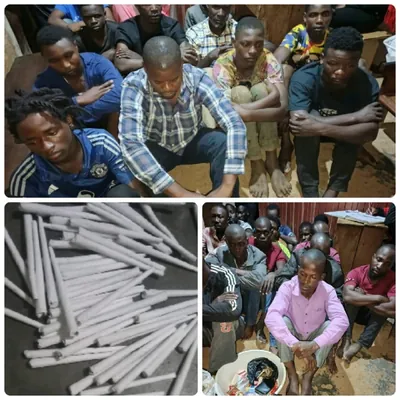
Kampala, Uganda – Kampala Metropolitan Police have intensified efforts to curb crime, arresting over 429 suspects in a series of coordinated operations across the city and surrounding districts.
The operations, conducted between February 24-25, 2026, targeted hotspots in Kira, Old Kampala, and Wakiso, resulting in the recovery of exhibits including opium rolls and suspected house-breaking tools.
In Kira Division, police swooped in on Mulawa Trading Centre and Najjera Kamwanyi, arresting 81 suspects on February 24, 2026, around 8pm.
Similarly, in Old Kampala Division, 152 suspects were picked up in Kisenyi Zone and Muza Zone between 5pm-9pm on the same day. The police operation was in full swing, with Kira Road Division also seeing 49 arrests in Kisaasi Sector, Kamwokya, and Kyebando on February 25, 2026.
Further operations in Jinja Road Division led to the arrest of 20 suspects in Center Zone, Kaggo Buyinja, and Kinawataka on February 24, 2026, around 11pm. The crackdown continued into the early hours of February 25, with 48 suspects arrested in Nansana around 12:30am.
Police also made significant arrests in Wakiso, picking up 23 suspects around 5pm on February 24, 2026.
The Bulenga Area saw 50 arrests between 4pm-8pm on February 24, 2026, while in Kajjansi, six suspects were arrested around 5pm on the same day.
The police operation was widespread, targeting crime hotspots and bringing the total number of arrests to over 429.
Speaking on the arrests, KMP Police Spokesperson SP Kawala Racheal stated, “All suspects are currently in police custody, facing charges related to possession of narcotics and public nuisance.” The suspects will be produced before court in due course.
2026.2.24 BESIGYE: Court orders full disclosure in treason trial
Kampala, Uganda | The High Court Criminal Division in Kampala has ordered the Office of the Director of Public Prosecutions (DPP) to fully disclose all evidence it intends to rely upon in the treason trial of opposition politician Dr. Kizza Besigye and his co-accused. Dr. Besigye appeared in court on Tuesday alongside Obeid Lutale and Captain Denis Oola before Criminal Division Judge Emmanuel Baguma in a courtroom packed with relatives, friends, and supporters.
The trio faces charges of allegedly plotting to overthrow the government of Yoweri Kaguta Museveni. Proceedings were dominated by sharp exchanges between prosecution and defence lawyers over the delayed disclosure of evidence. Assistant Director of Public Prosecutions Thomas Jatiko, alongside Chief State Attorney Richard Birivumbuka, told the court that partial disclosure had already been made.
He said materials shared include transcribed audio and video recordings, witness statements, and other documentary evidence. Jatiko explained that the State was still preparing additional material, including a forensic report, and converting evidence into accessible formats such as flash disks for the 18 defence lawyers. “If given until next week, we will have fully disclosed,” Jatiko submitted while seeking an adjournment. However, the defence strongly objected.
Kampala Lord Mayor Erias Lukwago, one of Besigye’s lawyers, argued that the prosecution had violated earlier court timelines. He cited proceedings of December 30, 2025, which he said required full disclosure by January 21, 2026. Lukwago told the court the defence had received only one file marked “Volume 1” and had not been informed how many additional volumes the State intends to rely on.
“Today, we are getting the shock of our lives that disclosure is not ready. The court should not entertain this,” Lukwago said. He added that continued delays were prejudicial, noting Besigye remains on remand after being denied bail. Prosecution disagreed. Jatiko maintained that the December 30 sitting did not impose a specific deadline for full disclosure and said the materials required time to organise.
Another defence lawyer, Eron Kiiza, argued that proper trial scheduling cannot proceed without full disclosure, accusing the prosecution of unnecessary delay. Ernest Kalibala also declined to participate in scheduling discussions until all evidence is shared. After hearing both sides, Justice Baguma ruled that, in the interest of justice and given the gravity of the case, the prosecution must complete full disclosure by March 3, 2026.
The matter was adjourned to March 3 for scheduling, with the case set to return to court again on March 12, 2026. Outside court, Besigye’s wife, Winnie Byanyima, criticised what she described as delayed disclosure. “This is not prosecution; it is persecution,” she told journalists. She alleged that the defence was being pushed to proceed without full knowledge of the evidence and also raised concerns about political interference in both judicial and religious matters.
Byanyima further claimed that on Monday, President Museveni contacted Paul Ssemogerere regarding a planned prayer Mass for Besigye at Lubaga Cathedral. She said she would continue praying for her husband despite the circumstances. Dr. Besigye, Lutale, and Oola are accused of holding meetings in Geneva, Athens, Nairobi, and Kampala to solicit funds, acquire weapons, and organise paramilitary activities.
Prosecutors allege that Besigye met a Kurdish intelligence operative identified as Andrew Wilson and received 5,000 US dollars to facilitate the transport of 36 Ugandan recruits to Kisumu for military training. The recruits were reportedly intercepted and deported before the training began. The State further alleges the accused sought weapons, including surface-to-air missiles, toxic substances, and drone technology to target President Museveni.
2026.2.22 Boy, 13, stabbed to death after being promised sugarcane job in Kamuli
Kamuli, Uganda: Police in Kamuli District are investigating the circumstances under which a 13-year-old boy was stabbed to death in Bulopa Sub-county.
The deceased has been identified as Bwoya Fred, a resident of Butaasa Village in Bugaya Sub-county, Buyende District.
Preliminary findings indicate that on Thursday, February 19, the boy was picked from his home by a family friend identified only as Mande, who reportedly promised him work cutting sugarcane in Bulopa. However, on Friday, February 20, he was allegedly stabbed to death by unknown persons.
According to the boy’s mother, Nakisuyi Sylvia, she was informed of the incident by the same individual who had taken her son.
“My son was taken on Thursday by Mande who promised him a job in Bulopa, but yesterday I received a call from Mande saying they had got an accident. Upon reaching the site, I found him dead,” she said.
Police have since arrested one suspect, a brother to Mande, who is currently detained at Kamuli Central Police Station to assist with investigations. Mande is reportedly on the run.
The body was taken to Kamuli General Hospital mortuary for postmortem examination as investigations continue.
Authorities say efforts are underway to trace other suspects connected to the incident.
2026.2.22 Horror in Bwaise as Mutilated Body Parts Found Dumped in Drainage Channel
Residents of Bwaise III in Kawempe Division were on edge after discovering mutilated human body parts dumped in a drainage channel in what police are treating as a suspected murder.
The remains were reportedly found by children commonly known as “Kawenja,” who had gone to collect plastic bottles from the channel. The children alerted nearby residents, who later notified Police.
Officers from Kawempe Division responded to the scene, retrieved the body parts and deployed sniffer dogs to search for additional remains in the surrounding area.
Some residents who witnessed the recovery said the legs appeared to belong to a woman.
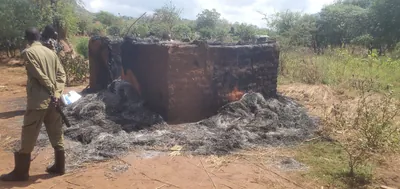
Police in Karamoja are searching for a man accused of killing his three children by locking them inside a grass-thatched house and setting it on fire.
The suspect, identified as Micheal Otyang, remains at large following the tragedy in Lokeru Village, Lorengechora Sub-county, Napak District, in southern Karamoja.
Eyewitnesses say Otyang allegedly became enraged after a quarrel with his wife, who accused him of failing to provide food for the family and spending excessive time drinking alcohol.
Reports indicate that he assaulted his wife, then forced the children into the house, locked it, and ignited the fire.
The victims have been identified as Janet Nadoli, 10; Emmanuel Lokong, 3; and Joan Nakodio, 1. All three died in the fire.
Karamoja Regional Police Spokesperson IP Mike Longole confirmed the incident, stating that security agencies are actively pursuing the suspect.
“We have leads and are actively pursuing the suspect. We urge anyone with information about his whereabouts to come forward and assist the police so that he can be arrested and brought to justice,” he said.
Police have condemned the act as brutal and inhumane, and investigations into the circumstances of the tragedy are ongoing.
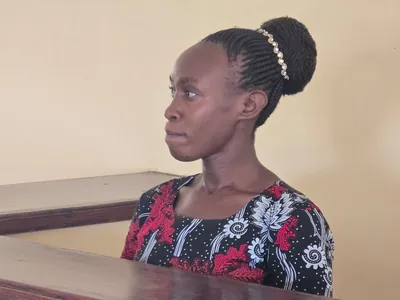
The Butaleja Magistrate’s Court was filled to capacity as proceedings opened in a case against Prossy Mukyala, a 31-year-old nurse attached to Kachonga Health Centre III, who is accused of causing the death of a pregnant woman through alleged negligence.
According to trial magistrate Joy Nambozo, the prosecution alleges that in July 2024, while on duty at the health centre, Mukyala failed to follow established referral procedures after the condition of Oliva Namuhoma, an expectant mother, deteriorated.
Court heard that the nurse neither called for an ambulance nor advised alternative safe transport.
Instead, the patient was reportedly carried on a boda boda to Mbale Regional Referral Hospital, where she allegedly died on the way.
“She unlawfully neglected to exercise reasonable care by omitting to provide the requisite referral care, thereby causing the death,” Magistrate Nambozo said.
Mukyala pleaded not guilty to the charges of manslaughter and negligence. Her defence team from Mutebuli and Company Advocates applied for bail, but the court rejected the application and adjourned the hearing to February 25.
Defence lawyer Saferi Were argued that the accusations against his client were misplaced.
“Our client has nothing to answer to. The alleged negligence cannot be attributed to her because the patient died at a different health facility and not under her direct care,” he told the court.
However, the deceased’s husband, Peter Lwanji, insisted that the nurse was responsible for his wife’s death. He said that when his wife arrived at the health centre bleeding heavily, she was allegedly denied timely care and instead asked for money.
“It was my relative who rushed my wife to the health centre. When they arrived, they were not given care by the nurse on duty. When my wife started bleeding more, they hurried to transfer her on a boda boda because they were being asked for money,” Lwanji said.
The State House Health Monitoring Unit confirmed that Mukyala’s arrest followed investigations by the unit. Its director, Dr Warren Naamara, warned health workers against unethical conduct.
“We will not keep quiet when such unethical practices occur. Any health worker who is not ready to work professionally should exit the system before we take action,” Dr Naamara said.
As the case continues, it has reignited national debate on accountability, professionalism, and patient safety within Uganda’s public health facilities.
The accused remains on remand as the court prepares to resume hearings later this month, while the bereaved family continues to seek justice.
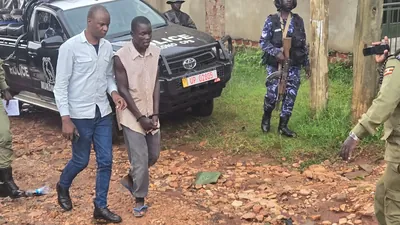
Detectives on Wednesday took the prime suspect in the murder of Uganda Christian Univeristy Dean of Students, Pamela Tumwebaze, to the residence as they reconstructed the events surrounding the crime.
The operation was led by personnel from the Joint Anti-Terrorism Taskforce (JAT), in collaboration with officers from the Uganda People’s Defence Force (UPDF) and the Uganda Police Force.
During the reconstruction, the suspect Hussain Dak Taekaiko reportedly demonstrated how he accessed Ms Tumwebaze’s house.
He indicated that he first knocked at the gate without receiving a response, before allegedly scaling the perimeter wall to gain entry.
Detectives then escorted him inside the house, where forensic teams examined key areas relevant to the investigation.
Access to the premises was restricted to preserve the integrity of the locus and ensure evidence was not compromised.
Residents identified Taekaiko as a former domestic servant at the deceased’s home, a detail authorities are treating as significant in establishing both motive and familiarity with the property.
Gwafu Village Chairman Alex Waswa said that during interrogation, the suspect allegedly admitted to a financial dispute involving Shs800,000.
Investigators are examining whether this claimed debt may have been a trigger for the alleged attack.
According to information from local leadership, Taekaiko reportedly hid inside the house while waiting for Tumwebaze to return.
Upon her arrival, he allegedly confronted her over the money, and when she raised an alarm, he is said to have overpowered and strangled her.
Taekaiko, arrested on Saturday in Budaka District, remains in custody as detectives continue to gather evidence, analyze forensic findings, and record witness statements to build a case.
Authorities have promised further updates as the investigation progresses.
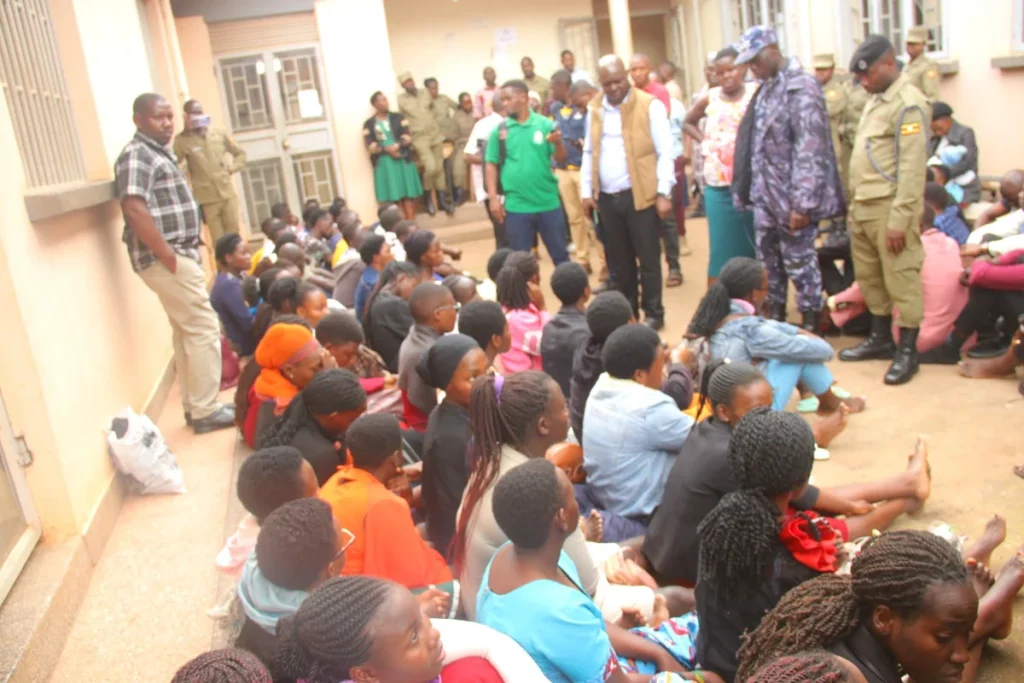
Kabale authorities have arrested 72 youths in connection with a fraudulent job recruitment operation run by Canaan Dream Visionaries Limited.
The scheme, based at J House in the Gleam Supermarket building along Kabale-Mbarara Road, lured young people with false promises of employment.
Deputy Resident District Commissioner Michael Muramira Kyakashari, who led the operation in collaboration with police, said prospective recruits were initially charged Shs150,000 for training in food nutrition and later asked to call their parents to pay additional fees ranging from Shs1.7 million to Shs2 million.
In one case, a victim was misled into believing she would be taken abroad for work.
Of those arrested, 61 are victims while 11 have been identified as organizers of the scheme.
Most of the victims hail from Eastern Uganda districts including Manafwa, Mbale, and Nkore, while others come from Rukungiri, Kanungu, and Rubanda.
Many had completed Senior Four, and their time under the scheme ranged from one to three months.
The victims, who preferred to remain anonymous, told authorities they were initially contacted by friends promising jobs.
They were invited for training with assurances that employment would follow, only to be asked for large registration and additional fees.
RDC Muramira described how the organizers subjected recruits to tight supervision, confiscated their phones, and provided false assurances of jobs and accommodation.
“The amounts demanded from these youths are substantial. If the 2 million and additional funds were properly invested, they could have been used to start their own businesses,” he said, urging parents to intervene and rescue their children.
Police confirmed that statements from the victims are being recorded and that the victims may face possible charges.
Investigations are ongoing to determine the full scope of the operation and bring all responsible parties to justice.
“The public must remain cautious of false employment schemes,” Muramira warned.
x1200
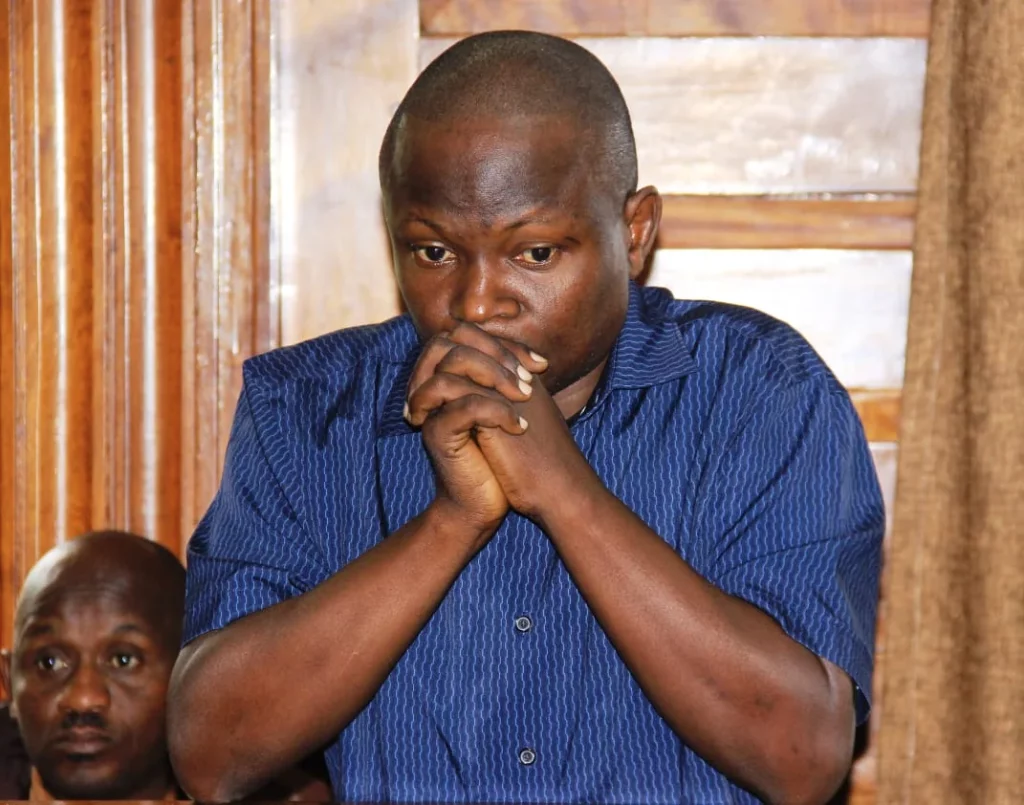
The High Court in Masaka has granted bail to Fr Deusdedit Ssekabira after more than three weeks of hearing submissions from both the defence and the prosecution.
Justice Victoria Nakintu Katamba delivered her ruling at about 2 pm following a lengthy hearing earlier in the day. During the proceedings, State Prosecutor Brian Kalinaki asked the court to return the case to the Chief Magistrate’s Court, arguing that Fr Ssekabira should first take a plea in the matter in which he is accused of laundering Shs500 million.
Kalinaki contended that the procedure used to bring Fr Ssekabira before the High Court was improper, noting that the Chief Magistrate’s Court had not committed the accused to the High Court for trial.
On January 27, the prosecution, led by Deborah Itwau, sought an adjournment to today’s date and assured the court that it would be ready to proceed with the hearing. At the time, Justice Katamba warned that if the prosecution appeared unprepared on the scheduled date, she would reconsider granting bail to Fr Ssekabira.
However, on Tuesday, the prosecution informed the court that the High Court lacks jurisdiction to hear the case and requested that it be referred back to the lower court.
Fr Ssekabira was allegedly abducted in Masaka District in December and held incommunicado for more than two weeks, triggering public outrage. The Catholic Church later issued a statement condemning what it described as injustice against the cleric.
At the time of his disappearance, both the Uganda People’s Defence Forces (UPDF) and the police denied knowledge of his whereabouts.
x1200
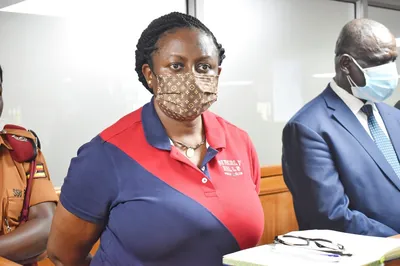
Kampala, Uganda: The Shs3.8 billion fraud case involving embattled former Ministry of Trade Permanent Secretary Geraldine Ssali suffered another delay on Thursday after the Anti-Corruption Court failed to proceed in the absence of the Assistant Registrar.
The matter, which had come up for mention, has now been adjourned to April 15, with bail for all accused persons extended.
Presiding Principal Grade One Magistrate Paul Mujuni informed the court that proceedings could not continue because the Assistant Registrar was away on official duties at the High Court to attend activities marking the opening of the New Law Year.
“The Assistant Registrar is on official duties at the High Court. We are going to adjourn the matter,” Magistrate Mujuni said.
Defence lawyer Musimeta, appearing for Michael Mawanda and holding brief for counsel representing the other accused persons, confirmed that the matter had been fixed for mention and noted that the prosecution was not present in court.
“I appear for Accused One and also hold brief for Accused Two, Three, Four, Five and Six. This matter is coming up for mention. For the record, the state is not present,” Musimeta told court.
She applied for an adjournment on grounds that the court was indisposed and requested that bail be extended for all the accused persons. “In view of the court being indisposed, we pray that the matter be adjourned and bail extended,” she said.
Magistrate Mujuni granted the application, adjourned the matter to April 15, and extended bail for all accused persons.
The criminal proceedings remain temporarily stayed, pending the hearing and determination of a constitutional application alleging violation of human rights against the Attorney General, which must first be resolved by the Constitutional Court before the trial can resume.
Background
Ssali is jointly charged with Members of Parliament Ignatius Mudimi Wamakuyu and Paul Akamba, alongside lawyer Julius Taitankoko Kirya and principal cooperative officer Leonard Kavundira.
They face charges of abuse of office, conspiracy to defraud, money laundering and causing financial loss in relation to the payment of Shs3.8 billion to Buyaka Growers Co-operative Society.
The prosecution alleges that during the 2021/2022 and 2022/2023 financial years, Ssali irregularly added the cooperative to the list of entities eligible for war-loss compensation, despite it not appearing in the approved supplementary budget.
It is further alleged that she authorised payments totaling Shs3.8 billion to Kirya and Company Advocates, a law firm owned by co-accused Taitankoko, in contravention of the 2017 Treasury Instructions, thereby causing financial loss to the government.
In October, the Anti-Corruption Court halted trial proceedings after ruling that it must first determine a constitutional application filed by MP Akamba, who claims his rights were violated during arrest and prosecution.
The case now awaits direction from the Constitutional Court before substantive hearings can resume.
2026.1.27 Days after a disputed election, Uganda’s army is on the hunt for opposition leader Bobi Wine
KAMPALA, Uganda (AP) — Where is Bobi Wine?
In a recent video shared from hiding, the Ugandan opposition leader walks in a family graveyard in central Uganda, taunting the army chief who has failed to find him and lamenting what he calls the injustice that has befallen him.
The 43-year-old musician-turned-politician has been evading a military hunt for over a week, infuriating Gen. Muhoozi Kainerugaba — the army chief and president’s son — in what has become a very public rivalry.
Wine went into hiding shortly after Uganda’s disputed presidential election on Jan. 15. The vote was marred by an internet shutdown and the failure of biometric voter identification kits meant to prevent ballot stuffing.
Wine, whose real name is Kyagulanyi Ssentamu, has rejected the official results, according to which President Yoweri Museveni won a seventh term with 71.6% of the vote.
发表回复