
2026.8.22 14-year-old arrested over alleged killing of 15-year-old in Bansang
The Gambia Police Force has arrested a 14-year-old boy in connection with the death of a 15-year-old boy following an alleged stabbing incident in Bansang, Central River Region.
The incident reportedly occurred at Bansang Angal Futa on Wednesday, 19 August 2026, following an altercation between the two minors.
According to police, preliminary investigations indicate that the 15-year-old was allegedly stabbed with a pair of scissors during the confrontation. He was taken to Bansang Hospital, where he was pronounced dead.
Police teams from the Crime Scene Investigation Unit, Criminal Investigation Department and Child Protection Unit visited and secured the scene. A pair of scissors suspected to have been used in the incident was also recovered.
The suspect, whose age was initially reported as 12, has since been confirmed to be 14 and remains in police custody as investigations continue.
As both the suspect and deceased are minors, police have withheld their identities and urged the public not to circulate information that could identify them or prejudice the ongoing investigation.
2026.8.20 Magistrate Remands Three Boys at Jeshwang Juvenile Centre Over Robbery Charge
The Brusubi Magistrates’ Court has remanded three boys at the Jeshwang Juvenile Centre after they pleaded guilty to a charge of robbery with violence.
The names of the accused have been withheld because they are minors.
The three boys appeared before Magistrate Isatou Jallow, with the prosecution led by ASP Badjie on behalf of the Inspector General of Police.
They are accused of robbing a Nigerian national who reportedly sustained injuries to his body and face during the alleged incident.
When the case came before the court, the charge was read and explained to the accused in Wolof.
The magistrate asked each of the boys whether they understood the charge and how they pleaded.
They each entered a plea of guilty.
Following the guilty pleas, the prosecution requested an adjournment to allow the State to present the facts of the case before the court.
The court granted the request and ordered that the three minors be remanded at the Jeshwang Juvenile Centre pending their next appearance.
The case has been adjourned to 20 August 2026, when the prosecution is expected to narrate the facts of the case.
The court is expected to consider the facts presented by the prosecution before determining the appropriate next step, including sentencing.
Juvenile proceedings
The accused are being dealt with under the juvenile justice framework because they are minors.
Their remand at the Jeshwang Juvenile Centre means they will remain at a juvenile facility rather than an adult correctional institution while the case proceeds.
At the next hearing, the prosecution is expected to present details of the alleged robbery, including the circumstances surrounding the incident and the injuries reportedly suffered by the victim.
The court will then consider the prosecution’s account of the facts before deciding the matter in accordance with the law.
The three boys remain at the Jeshwang Juvenile Centre pending their appearance on 20 August, today.
2026.8.20 Ismaila Kone pleads not guilty to murder of Isatou Elizabeth Mendy
An accused man charged in connection with the death of Isatou Elizabeth Mendy has pleaded not guilty to murder, as the Banjul Magistrates’ Court transferred the case to the High Court, saying it lacked jurisdiction to hear the matter.
Ismaila Kone, also known as Ous, appeared before Principal Magistrate M. Krubally after being charged by the Inspector General of Police with one count of murder under Section 155 of the Criminal Offences Act 2025.
Prosecutors allege that on Aug. 17, 2026, at Lovell Square Street in Banjul, Kone unlawfully caused the death of Ms. Mendy with malice aforethought.
The charge was read to Kone in English and interpreted for him in Wolof. When asked to enter a plea, he denied the allegation and pleaded not guilty.
Magistrate Krubally formally entered the plea, noting that Kone is presumed innocent unless and until the prosecution proves the charge against him beyond a reasonable doubt.
Because murder falls outside the jurisdiction of the Magistrates’ Court, Magistrate Krubally ordered the case transferred to the Special Criminal Division of the High Court under Section 72(1) of the Criminal Procedure Act 2025.
The magistrate also ordered Kone remanded at Mile Two Central Prison pending proceedings before the High Court, in accordance with Section 72(2)(a) of the act.
The registrar of the Banjul Magistrates’ Court was directed to forward the full case record and charge sheet to the High Court for further proceedings.
2026.8.20 Justice Janneh Gives State 30 Days to Prosecute Murder Suspect After More Than Two Years in Detention
Justice Isatou Janneh of the Bundung High Court has given the State 30 days to file an indictment against a murder suspect who has been in custody for more than two years without trial.
Justice Janneh ruled that the continued detention of Muhammed Jallow for more than two years without the commencement of trial was unconstitutional and violated his fundamental rights to personal liberty and to a fair hearing within a reasonable time.
The court, however, stopped short of ordering Jallow’s immediate and unconditional release because of the seriousness of the murder allegation and concerns over his ability to return to court if released.
Jallow has been in custody since May 2024 after he was arraigned before the Brusubi Magistrates’ Court on a murder charge. He pleaded not guilty and has remained in detention without the case progressing to trial.
He filed an Originating Summons dated and filed on 11 June 2026, asking the High Court to declare his continued detention unlawful and order his unconditional release.
Jallow argued that his constitutional right to have his case heard within a reasonable time had been breached.
According to his affidavit, repeated attempts by the prison’s paralegal office to trace his case file showed that the file could not initially be located at the High Court Registry. The court was later informed that the file had been transferred back to the Magistrates’ Court.
State asks for more time
The State opposed Jallow’s application but acknowledged that no indictment had been filed against him.
State Counsel told the court that the Attorney General’s Chambers had been unable to file the indictment because the case file could not be located.
Counsel said efforts were ongoing to retrieve the file and commence proceedings before the High Court.
The State argued that although Jallow’s constitutional rights were recognised, those rights were not absolute, particularly because he was facing the capital offence of murder.
Counsel further argued that releasing Jallow unconditionally would not be in the interests of justice, given the seriousness of the alleged offence, the interests of the alleged victim and the wider public.
The State therefore asked the court to give it reasonable time to file the indictment.
Court finds detention unconstitutional
In her ruling, Justice Janneh identified the central question as whether Jallow’s continued detention for more than two years without trial violated his constitutional rights and, if so, what remedy should be granted.
The court stressed that the right to personal liberty is a fundamental right protected by the Constitution.
It also noted that every person charged with a criminal offence is entitled to a fair hearing within a reasonable time.
While recognising that the law allows restrictions on those rights in certain circumstances, the court said detention could not continue indefinitely without meaningful action by the prosecution.
The court found that Jallow had remained in custody since May 2024, while no indictment had been filed before the High Court and no trial had commenced.
Justice Janneh also took note of the State’s explanation that the missing case file had prevented the filing of an indictment.
But the court rejected the suggestion that administrative difficulties could indefinitely justify the deprivation of a person’s liberty.
“The constitutional obligation to prosecute criminal offences diligently rests with the State,” the court held.
Seriousness of murder charge considered
Although the court found Jallow’s continued detention unconstitutional, it said it could not ignore the seriousness of the allegation against him.
Murder, the court noted, is one of the gravest offences under Gambian criminal law, creating a strong public interest in ensuring that the allegation is properly investigated and determined by a court.
The court therefore declined to order Jallow’s immediate and unconditional release.
Justice Janneh said such an order would not sufficiently balance Jallow’s constitutional rights with the interests of justice.
The court also considered Jallow’s statement that he is a Guinean national and has no family ties or sureties in The Gambia.
It held that releasing him on bail or on his own recognisance could create a significant risk that he might fail to appear in court if an indictment were subsequently filed.
State given 30 days
Instead of ordering Jallow’s immediate release, the court gave the State what it described as a final and limited opportunity to regularise the proceedings.
Justice Janneh declared that Jallow’s detention for more than two years and one month without trial was unconstitutional and violated his rights to personal liberty and a fair hearing within a reasonable time under Sections 19 and 24 of the Constitution of The Gambia.
The State was ordered to file the appropriate indictment within 30 days from the date of the ruling and take all necessary steps to ensure that the case proceeds in accordance with the law.
Jallow will remain in custody during the 30-day period.
However, the court ordered that if the State fails to file the indictment within the stipulated period, Jallow must be released forthwith, unless his continued detention has, before then, been authorised by a valid order of a court of competent jurisdiction.
The ruling effectively gives the prosecution a final deadline to move the murder case forward after more than two years of detention without trial.

Ansumana Gassama, a football coach convicted of sexually assaulting a 10-year-old boy he trained, has been sentenced to seven years in prison, two years above the statutory minimum after Principal Magistrate I. Sallah M’bai ruled that the aggravating factors in the case far outweighed any mitigation.
Principal Magistrate Sallah M’bai also ordered Ansumana Gassama to pay 500,000 dalasi in compensation to the victim, with an additional year in prison to be served consecutively if he defaults on payment.
Ansumana Gassama first appeared before the court on 5 August 2026, arraigned on one count of unnatural offences under section 122(1)(a) of the Criminal Offences Act 2025, which carries a minimum sentence of five years.
When the charge was read and explained to him in Mandinka, he pleaded guilty, though he maintained that he hadn’t acted intentionally. After the prosecution’s facts were narrated to him, he acknowledged that they were correct. Satisfied that the plea was informed and voluntary, Magistrate Sallah M’bai convicted him on the spot and adjourned the matter to 18 August 2026 for sentencing.
Returning to court today, the charge was read to him once more in Mandinka, and he confirmed his guilty plea after the facts and exhibits were again put to him.
In his mitigation plea, Ansumana Gassama asked the court for mercy, described the offence as a mistake he would never repeat, and said what he had experienced at Mile 2 Prison in the few days had already been punishment enough.
The prosecution, represented by Inspector Jallow for the Inspector General of Police, acknowledged he had no prior convictions but applied under section 191 of the Criminal Procedure Act 2025 for the minor to receive compensation.
In her ruling, Magistrate Sallah M’bai said the case could not be treated as an ordinary application of the statutory minimum given how serious the circumstances were. She pointed to several aggravating factors:
The victim was only ten years old, a fact established by his birth certificate. Ansumana Gassama, as the boy’s football coach, held a position of trust that he exploited to gain access to him, inviting him to his home after a coaching session.
Also, the offence involved penetrative sexual conduct. Medical evidence showed the child suffered physical injury, including bruising and bleeding and the child’s age made him especially vulnerable, and the assault represented a serious violation of his dignity and bodily integrity.
Principal Magistrate stated that although there was no psychological assessment before the court, an experience of such could still affect a child’s long-term sense of safety and trust.
Magistrate Sallah M’bai affirmed that Ansumana Gassama wasn’t being sentenced for being a coach, but that the coaching relationship mattered because it explained how he was able to access and abuse the child, something she said adults entrusted with children’s care must never do.
Weighed against that, Magistrate Sallah M’bai credited Ansumana Gassama with mitigating factors: his youth, his lack of prior convictions, his guilty plea, and his cooperation throughout the proceedings, which spared the child and his family the burden of a contested trial.
But the magistrate Sallah M’bai concluded that none of that was enough to offset the gravity of the offence, and that the five-year statutory floor wouldn’t adequately reflect what had happened.
She sentenced Ansumana Gassama to seven years’ imprisonment, plus the compensation order, with a consecutive year if fail to pay the compensation.

2026.7.28 Sanna Manjang Denies Selecting Kanilai Patrol Team as Defense Continues in Assault Trial
(BANJUL, The Gambia) – Sanna Manjang on Tuesday continued his defense testimony before Justice Ebrima Jaiteh at the High Court in Banjul, detailing his military career and role as patrol commander in Kanilai while denying that he was responsible for selecting soldiers deployed to the area.
The State is represented by Deputy Director of Public Prosecutions E.R. Dougan and State Counsel A. Badjie, while Manjang is represented by Counsel S.K. Jobe.
Taking the witness stand, Manjang told the court that he lives in Brikama with his children and served as a military officer in the Gambia Armed Forces.
He testified that he enlisted in the Gambia Army Training School in 1994, where he completed six months of military training before being posted to Fajara Barracks as an infantry soldier.
According to Manjang, he served in that capacity for about two years before being promoted and assigned responsibility for maintaining discipline among soldiers at Fajara Barracks.
He further told the court that he was later selected for a three-month commando training course at Yundum Training School, which he described as extremely difficult and dangerous.
Manjang said the course was conducted by Libyan instructors and that he graduated as the best trainee in his batch, earning him an appointment as lead trainer at Fajara Barracks.
Patrol Commander at Kanilai
The accused testified that he was subsequently transferred to Kanilai, where he reported to a commander identified as Kalifa Bajinka.
According to Manjang, Bajinka informed him that he would serve as patrol commander, making him the first officer assigned to lead the patrol unit in Kanilai.
He acknowledged that he had little prior knowledge of patrol operations when he assumed the role.
Manjang told the court that the border region was experiencing heightened insecurity because of clashes between Senegalese forces and rebel groups in Casamance. He said his primary responsibility was to protect Gambian communities living in the area.
He testified that approximately 100 soldiers were deployed from Banjul to Kanilai for one-month patrol rotations following a directive issued by the then State House commander and former State Security Service (SDS) Director Ousman Badjie.
However, Manjang denied having any role in selecting members of the patrol team, insisting that he only commanded those assigned to him.
He further claimed that his knowledge of the Gambia-Casamance border exceeded that of any other officer and said he remained head of the patrol unit until February 2, 2017.
Manjang also attributed his rapid promotions, including his advancement to the ranks of Major and later Lieutenant, to his operational experience and the demanding assignments he undertook during his military career.
Testimony on Border Rescue Mission
The accused also recounted what he described as a successful military operation to rescue Gambian nationals allegedly captured by Casamance rebels.
He testified that a superior officer identified as Bora instructed him to confront the rebels and secure the captives’ release.
According to Manjang, he pursued one of the rebels, who initially did not fire at him but eventually opened fire after sustained exchanges. He said he shot the rebel, causing him to lose his balance.
Manjang told the court that after approximately 45 minutes, the operation ended with the safe rescue of the captives.
He said no one suffered serious injuries during the operation, except for one individual who sustained a minor injury to the mouth.
The accused added that his area of operational responsibility extended from Kampasa to Almadia.
Charges Before the Court
Manjang is facing two counts of assault causing actual bodily harm under Section 228 of the Criminal Code.
The first count alleges that in March 2006, at the premises of the National Intelligence Agency (NIA), while serving in the Gambia Armed Forces and allegedly as a member of a group identified in the charge sheet as the “Black Black” or “Junglers,” he assaulted Tamsir Jasseh by beating and kicking him, causing severe bodily injuries.
The second count alleges that during the same month in Banjul, Manjang assaulted military officer Yaya M.S. Darboe by beating him with sticks, pouring molten plastic on his body, tying him inside a sack, and winching him up, causing serious injuries and bleeding to his face, body, and leg.
The allegations remain before the High Court. Manjang has denied the charges and is presumed innocent unless and until proven guilty.
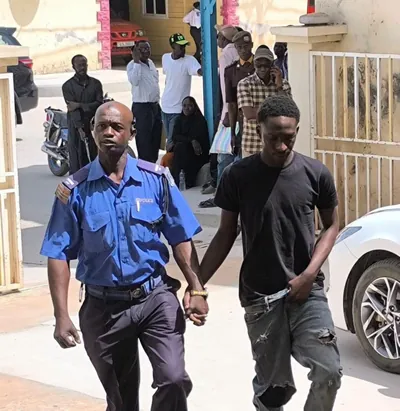
The prosecution has amended its charges against Abdul Wahab Jobarteh. Instead of three charges, he now faces seven charges.
When the case was called before Magistrate A. Manneh of the Kanifing Magistrates’ Court, the Inspector General of Police was represented by Assistant Commissioner A. Manga, along with DSP Y. S. Colley and C. B. Jallow, while Counsel K. Bojang appeared for the accused.
After the announcement of representation, lead prosecutor ACP A. Manga sought to substitute the original charges with a fresh seven-count indictment pursuant to Section 218 of the Criminal Procedure Act 2025. The defence counsel didn’t object to the application, and Magistrate Manneh ordered that the new charges be read over to the accused.
The amended indictment now comprises seven counts, broadening the allegations. Count One is the most serious, causing danger or blocking the public highway (Section 194 of the Criminal Offences Act 2025). The prosecution accused him of driving with a police sergeant on the bonnet of the vehicle.
Count Two is driving without a valid licence. Count Five is careless driving (Section 51 of the Motor Traffic Act).
Count Six is using tinted glass without permission (Section 25C of the Motor Traffic Act Amendment Act, 2013).
Count Seven is driving a vehicle without paying road tax (Section 22A of the Motor Traffic Act Amendment Act, 2013).
All the charges relate to the incident that occurred on June 5, 2026. The vehicle involved is a Mercedes-Benz C-Class with registration number BJL 6726 J. Abdul Wahab Jobarteh pleaded not guilty to all seven counts.
The prosecution opened its case by calling its first witness, Assistant Superintendent Mam Berry Touray, an Information Technology expert attached to the Information Technology Unit of the Gambia Police Force Headquarters in Banjul.
ASP Touray testified to his qualifications, stating that he holds a Bachelor of Science degree in Computer Science from the University of Science and Technology in Casablanca, Kingdom of Morocco, and a Master’s degree from the same institution. His expertise in digital forensics and video retrieval appears central to the prosecution’s evidentiary strategy.
ASP Touray testified that in June 2026, he was directed by his superior to download a video footage from the social media platform Facebook.
The case adjourned to 10th and 11th August 2026, at 1:00 pm to 3:00 pm for continuation of testimony.
2026.7.9 GAMBIA: Court Acquits Three GALA National Audit Office Protesters; Magistrate Finds Prosecution Failed to Prove Prima Facie Case
Kanifing Magistrates’ Court rules in favour of a no-case submission on both unlawful assembly and common nuisance charges; orders acquittal and discharge of all accused. Principal Magistrate Sallah Mbai has acquitted and discharged three GALA members by ruling that the prosecution failed to establish a prima facie case against the accused persons, highlighting that criminal liability cannot be built on “suspicion, conjecture, or public perception”.
The case arose from an incident on September 15, 2025, at the National Audit Office. The three accused persons, Kemo Fatty, Alieu Bah, and Omar Saibou Camara, had been charged with unlawful assembly contrary to section 63 of the Criminal Offences Act 2025 and common nuisance contrary to section 137(1) of the same Act.
The case presided over by Her Worship Sallah Mbai, Principal, arose from an incident involving journalists and civil society members who gathered outside the National Audit Office to protest or express public dissatisfaction over the controversial removal of the Auditor General.
Following their arrest, the Inspector General of Police (IGP) arraigned them before the Kanifing Magistrate Court on two criminal counts under the Criminal Offences Act, 2025.
Count One: Unlawful Assembly
The prosecution alleged that on 15 September 2025, at the National Audit, the accused persons conducted themselves in a manner likely to cause a breach of the peace by holding an unlawful protest against the removal of the Auditor General without a permit from the Inspector General of Police.
Count Two: Common Nuisance
The second count alleged that by the same conduct, the accused persons caused annoyance, obstruction, or inconvenience to the public. The accused pleaded not guilty to both counts.
The prosecution called four witnesses to support its case. The first officer (PW1), Superintendent Dawda Jallow, testified that he received information about a gathering at the National Audit Office and proceeded to the scene with approximately fifty police officers. Upon arrival, he found journalists conducting a press conference and instructed them to disperse, which they did. However, PW1 stated that another group later arrived intending to hold a press conference.
When asked whether they possessed a permit, they replied that they did not. PW1 further testified that the accused person, Alieu Bah, returned and insisted on his right to gather and express dissatisfaction.
Under cross-examination, PW1 admitted several critical facts: the accused persons were not present when he initially arrived; none of the accused persons prevented police officers from entering the premises; and the reason for arrest was the accused persons’ insistence on holding a press conference without a permit.
The second officer (PW2), Superintendent Modou Lamin Korta, testified that he proceeded to the National Audit Office and observed a gathering of approximately twenty to thirty persons, including the accused person, Omar Saibou Camara.
He stated that Alieu Bah later returned and remained near the gate, insisting he had a right to be there.
Under cross-examination, PW2 admitted that police officers maintained unrestricted access to the National Audit Office throughout the incident, were stationed both inside and outside the premises, and that Alieu Bah was standing in a public place when arrested.
PW3, ASP Landing Bojang, testified that he was deployed with PIU officers to the National Audit Office and joined efforts to persuade the gathering to disperse. According to his account, the gathering refused to leave, and he eventually ordered the deployment of tear gas.
Under cross-examination, PW3 admitted that he did not personally arrest any of the accused persons, did not know where each accused was arrested, and did not know the specific reason for each arrest.
PW4, Sub-Inspector Ousman Colley, testified as part of an investigation panel headed by ASP Demba Jobe. He stated that the accused persons were asked to disperse but refused and were arrested because they did not possess a permit from the Inspector General of Police.
Under cross-examination, PW4 admitted that his knowledge of the event was derived entirely from information supplied by others during the investigation; he was not present at the National Audit Office on the day of the incident.
At the closure of the prosecution case. Defence counsel L.S. Camara submitted that the prosecution had failed to establish a prima facie case on either count. Counsel Camara argued that none of the prosecution witnesses led evidence establishing the essential ingredients of unlawful assembly as defined under section 62 of the Criminal Offences Act.
He further argued that there was no evidence demonstrating that the accused persons caused annoyance, obstruction, or inconvenience to the public to constitute a common nuisance.
Counsel Camara cited the landmark case R v Galbraith (1962) and other authorities dealing with submissions of no case to answer, submitting that the prosecution had failed to satisfy the legal threshold required to compel the accused to enter their defence.
The prosecution led by Commissioner Sanneh countered that a prima facie case had been established. The prosecution argued that the accused persons assembled in a group, intended to pursue a common purpose, and refused lawful instructions to disperse despite not possessing a permit.
Commissioner Sanneh relied on sections 62 and 63 of the Criminal Offences Act, section 5 of the Public Order Act, and section 25 of the Constitution in support of its case.
Commissioner Sanneh urged the Court to call upon the accused persons to enter their defence.
Legal analysis and her reasoning. Principal Magistrate Sallah Mbai applied the historic common law threshold established in R v Galbraith [1981] and Section 215 of the Criminal Procedure Act. She emphasised that the burden of proof rests entirely on the prosecution and never shifts.
On the unlawful assembly (Count One). Magistrate Sallah Mbye said that to establish unlawful assembly under Section 62, the prosecution had to prove a gathering of three or more persons, a shared common purpose, and conduct creating an objectively reasonable apprehension of violence or disorder.
Magistrate Sallah analysed that while the first two elements were met (an assembly with a shared purpose to address the media), the third element, the crux of the offence, was completely vacant.
Magistrate Sallah Mbye noted that PW1’s claims of a “chaotic” environment lacked any particulars of actual violence, threats, or property damage. Furthermore, Magistrate Sallah Mbye rejected the prosecution’s attempt to use the Public Order Act (regarding missing permits) to satisfy the elements of the Criminal Offences Act.
“An assembly does not become unlawful… simply because it is unlicensed,” Magistrate Sallah Mbai stated. “The absence of a permit under the Public Order Act is not an ingredient of unlawful assembly under sections 62 and 63 of the Criminal Offences Act.”
On Common Nuisance (Count Two). Magistrate Sallah Mbye said that for the charge of Common Nuisance to stand under Section 137(1), the prosecution was required to prove that the accused committed an act not warranted by law that endangered public safety or obstructed public rights.
Magistrate Sallah Mbye’s analysis found that the prosecution fell completely short of that benchmark. Magistrate Mbai highlighted that the prosecution failed to call a single independent witness from the public. No pedestrian testified to being obstructed, no motorist complained of blocked roads, and no employee stated that entry to the National Audit Office was denied. Because police witnesses admitted they maintained unrestricted access to the building, there was no evidential basis to infer public obstruction.
Magistrate Sallah Mbai also threw out PW4’s testimony entirely, ruling that a court cannot rely on inadmissible hearsay to establish a prima facie case.
Before rendering the final orders, Magistrate Sallah Mbai clarified its structural position. Magistrate Sallah Mbai noted that the ruling was not a judicial endorsement of the activists’ behaviour nor a finding that the police acted unlawfully. Instead, it was a strict application of criminal justice principles. She reiterated that calling upon the defence to answer such an empty case would unconstitutionally force the accused persons to “fill a gap in the prosecution’s case”.
Concluding that the prosecution evidence on both counts fell squarely within the first limb of Galbraith, where essential ingredients of an offence are completely unsupported by evidence, the court decisively halted the trial.
“The no-case submission filed by defence counsel, L.S. Camara, on behalf of all accused persons is hereby upheld on both Count One and Count Two. Accordingly, all three accused persons are acquitted and discharged.”
Following the ruling, police prosecutor inspector Baba Jallow took the floor. He informed the court of the prosecution’s intention to appeal the ruling. Inspector Jallow applied to the court to place the acquitted person on bail, requesting that the court seize the sureties’ ID cards for one month. He argued that if the police failed to file their appeal within that timeframe, the accused could then be fully released.
Counsel A. Njie strongly countered the application, pointing out that no charges were pending against three GALA members. Counsel Njie urged the court to throw out the application, emphasising that the accused have a fundamental right to freedom.
Counsel J. Jobarteh added his voice to the resistance, standing firm on the principle that bail is legally impossible when there is no operative charge before a court. Counsel Jobarteh submitted that the prosecution’s strange request is “unknown in law.”
After carefully listening to both parties’ arguments, Principal Magistrate Sallah Mbai overruled the police prosecution’s application to hold the acquitted GALA members on bail pending appeal.
“The prosecution hasn’t quoted any law in its submission and therefore overruled the submission; they’re free, and this is my ruling, and I have no further orders,” Magistrate Sallah Mbai concluded
With those final words, Kemo Fatty, Alieu Bah, and Omar Saibou Camara walked out of the Kanifing Magistrates’ Court as free activists chatting.
2026.7.9 Court Clears GALA Members Standing Trial Over NAO Protest, Rules Police Failed to Prove Unlawful Assembly
(BANJUL, The Gambia) – Members of the civil society group Gambians Against Looted Assets (GALA) who were standing trial over an alleged unlawful assembly at the National Audit Office (NAO) have been cleared to walk free after a Banjul court ruled that the prosecution failed to establish that an unlawful assembly took place.
Principal Magistrate Sallah Mbye, delivering her ruling on a no case to answer submission filed on behalf of the accused, found that the police had not proven that GALA members gathered at the NAO in a manner that met the legal threshold for an unlawful assembly. The magistrate consequently held that the accused had no case to answer and could not be called upon to defend themselves against the charge.
The ruling followed a submission filed by defense counsel L.S. Camara, who had argued that the prosecution’s evidence was insufficient to sustain the charge against his clients.
Background to the Case
The matter traces back to September 2025, when Gambian police arrested five members and senior figures of GALA outside the NAO in Banjul. The arrests occurred during what had been billed as a press conference, which was followed by protests outside the institution’s premises.
The demonstrations were sparked by the forceful removal of Auditor General Modou Ceesay from his office by law enforcement officers. Mr. Ceesay’s removal followed a controversial cabinet reshuffle by President Adama Barrow, in which the president sought to reassign him to the Ministry of Trade.
GALA activists strongly opposed the reassignment at the time, describing it as a move that threatened to undermine the independence of the NAO and shield state institutions from scrutiny over allegations of corruption.
Their attempt to publicly voice this opposition outside the NAO led to their arrest and subsequent arraignment on charges of unlawful assembly.
With the court’s latest ruling, the case against the GALA members effectively collapses on the unlawful assembly charge, marking a significant legal victory for the group and reigniting public debate over the independence of the Auditor General’s office and the treatment of civic activism in The Gambia.
2026.7.7 Prosecution Challenges Arona Tine’s Account, Says No Other Attackers Were Present
State Counsel A. Gibba on Tuesday challenged Arona Tine’s version of events in the ongoing murder trial of Fatoumatta Kargbo, suggesting that there were no other attackers inside the Westfield bureau where the deceased was killed.
During cross-examination before Justice Jaiteh at the High Court, Tine maintained that he did not kill Kargbo and insisted that other men entered the bureau and assaulted him before the incident.
The prosecution questioned why Tine failed to identify the alleged attackers to the police despite claiming he knew them. Tine responded that he was not given the opportunity to include that information in his police statement, adding that he recognised the men by their faces but did not know who they were.
The court also viewed CCTV footage from the bureau. Tine argued that the footage played in court was incomplete and maintained that a full recording would support his account of events.
Tine admitted placing a knife against his throat after the incident but denied that he intended to take his own life. He testified that he acted out of fear after a crowd gathered outside the bureau and allegedly attempted to attack him.
The prosecution further questioned why Tine did not call for help if he had regained consciousness. Tine replied that he had been struck on the head and feared the crowd, claiming he believed he would be killed.
Counsel Gibba also put it to Tine that the D110,000 he claimed to have brought to the bureau was never taken by the alleged attackers, suggesting that his account was inconsistent. Tine said he did not know what happened to the money but later saw money produced as an exhibit during the trial.
In closing the cross-examination, the prosecution accused Tine of fabricating his defence, arguing that there were no other attackers inside the bureau and that he killed Fatoumatta Kargbo before placing the knife on his own throat to mislead investigators and the court.
Tine rejected the allegations, insisting that he was innocent and that a complete CCTV recording would reveal what truly happened inside the bureau.
The case was adjourned to 22 July 2026 at 11:00 a.m. for continuation of the defence.
2026.7.7 Murder Case Against Buba Jallow Transferred to High Court as Suspect Allegedly Mocks Victim’s Family
(BANJUL, The Gambia) – The Kanifing Magistrates’ Court on Tuesday transferred the murder case against Buba Jallow, who is accused of killing Ebrima Njie, to the Special Criminal Division of the High Court after ruling that it lacks jurisdiction to hear capital offenses.
Jallow appeared before Magistrate F. J. Camara of the Kanifing Magistrates’ Court, where Chief Inspector Bojang and ASP S. Bah represented the Inspector General of Police. The accused was not represented by counsel.
Court Declines Jurisdiction
When the matter was called, Chief Inspector Bojang applied under Section 72 of the Criminal Procedure Act, arguing that the offense of murder is a capital offense carrying a possible sentence of life imprisonment or the death penalty upon conviction. He submitted that the Magistrates’ Court lacked jurisdiction to try the case.
The prosecution therefore asked the court to transfer the matter to the High Court for hearing and determination and requested that the accused be remanded at Mile 2 Central Prison pending trial under Section 228 of the Criminal Offences Act.
In her ruling, Magistrate Camara agreed with the prosecution that the charge of murder placed the matter beyond the jurisdiction of the Magistrates’ Court.
She ordered that the case be transferred to the High Court under Section 228 of the Criminal Offences Act and remanded Jallow to Mile 2 Central Prison pursuant to Section 72 pending the hearing and determination of the case.
According to the charge sheet, Jallow allegedly stabbed Ebrima Njie in the mid-upper back with a knife on June 29, 2026, at Latrikunda German in the Kanifing Municipality, causing his death.
He has been charged with murder contrary to Section 155 and punishable under Section 156 of the Criminal Offenses Act 2025.
Bravado, Provocation, and Middle Finger
Following the court’s ruling, Jallow behaved provocatively as he was escorted from the courtroom to the police vehicle.
Eyewitnesses corroborated by video captures said the accused smiled, insulted journalists, raised both middle fingers towards the crowd, including members of the deceased’s family, and blew kisses. He also allegedly suggested that videos of his actions be shared on TikTok to generate attention.
The case will now proceed before the Special Criminal Division of the High Court, where Jallow is expected to take his plea. Until then, he will remain in custody at Mile 2 Central Prison.
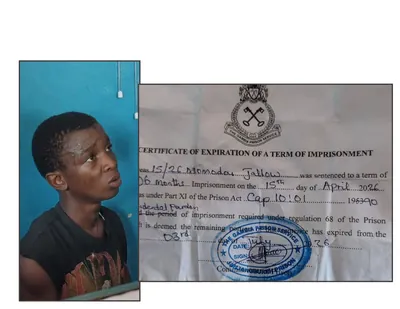
While on a GTSC bus to Jarra Soma after his release, he was allegedly caught trying to steal another passenger’s mobile phone.
Momodou was sentenced to six months in prison in April this year. So our question is: why was he included on the president’s pardon list?
We couldn’t find any public records about Momodou’s case. However, a source told us he is from Jarra Soma and was jailed for stealing nearly D2 million
2026.6.22 CUTLASS ATTACK, YEARS OF THREATS, AND A HOME TURNED INTO A CRIME SCENE: COURT FINDS MAN GUILTY ON ALL COUNTS
The High Court in Banjul has convicted Yugo Sowe on all five counts, including attempted murder and domestic violence, over a brutal cutlass attack that left his estranged wife with life-altering injuries and permanent disability.
Justice Ebrima Jaiteh described the attack as “sustained, violent and deliberate,” saying the evidence pointed to a clear intention to kill or cause catastrophic harm. The court heard that the incident, which took place on 16 November 2023, unfolded inside the complainant’s home, a place the judge noted should ordinarily represent safety and protection, not violence and fear.
Prosecution witnesses told the court that the victim, Amie Sowe, was attacked with a cutlass while she was asleep. Her son testified that he witnessed the assault and identified his father as the attacker. Another witness also told the court she recognised the accused during the attack, saying she saw him repeatedly strike her with the weapon.
The court also relied heavily on medical findings presented by Dr. Pa Samba Secka, which confirmed that the victim suffered multiple severe injuries, including fractures to both legs, tendon damage, nerve injuries, and deep lacerations.The doctor classified the injuries as “dangerous,” noting they were life-threatening and required prolonged hospitalisation, surgery, and rehabilitation. The defence rejected Sowe denied the allegations, claiming he was physically unwell at the time and suggesting he was elsewhere during the attack. But the court dismissed his account as “improbable and unconvincing,” pointing to consistent eyewitness testimony, recovery of a cutlass and bloodstained clothing linked to him, and immediate identification by the victim after the incident.
Justice Jaiteh said the defence version failed to withstand scrutiny when weighed against the totality of evidence.
“Not just violence, but domestic violence”
The court also framed the case as a severe example of domestic violence, noting that the complainant and the convict shared a long marital history and had seven children together. The court found that the attack did not occur in isolation but followed what it described as a pattern of threats, intimidation and prior disputes over property and land. Witness testimony also revealed that the accused had allegedly threatened to kill the complainant in earlier disagreements. A case built on recognition and medical proof, a key pillar of the prosecution’s case was identification evidence.
The court accepted that the victim and an eyewitness both recognised the accused during the attack. That evidence was further supported by a third witness who said the victim named “Gorgie” shortly after being rescued.
Medical records and physical exhibits, including the alleged weapon and bloodstained items, were also accepted as corroborative evidence.
Justice Jaiteh said the combined weight of eyewitness accounts, medical evidence, and recovered exhibits left “no realistic possibility of mistaken identity.”
He ruled that the prosecution had proven its case beyond reasonable doubt on all counts. Sowe was convicted of attempted murder, grievous harm, acts intended to cause grievous harm, wounding, and domestic violence.
Sentencing: maximum penalties and life imprisonment
In sentencing, the court described the attack as one of the most serious domestic violence cases it had handled. The judge cited aggravating factors including the use of a cutlass, the victim being attacked while asleep, the severity of injuries, and the presence of children during the assault.
Sowe was sentenced to:
7 years for attempted murder
7 years for grievous harm
Life imprisonment for acts intended to cause grievous harm
3 years for wounding
2 years for domestic violence
All sentences, except the life term, will run concurrently. The court also noted that Sowe showed no remorse throughout the trial.
Justice Jaiteh used the judgment to issue a wider warning about domestic violence, describing it as a “scourge that destroys families and lives.”
He stressed that repeated threats, coercion, and intimidation are often early warning signs of escalating violence, urging communities not to ignore them. The judge also made a firm statement on gender relations, saying a spouse “is not property, not a servant, and not an object to be controlled.”
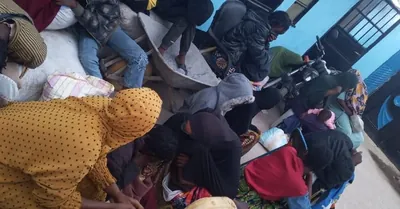
Acting on credible intelligence regarding suspicious gatherings, officers led by RSM Corr apprehended the group, which included foreign nationals from Guinea Conakry, Senegal, Mali, and Ivory Coast, and escorted them to the Barra sub-base for investigation.
While Police look into the attempted migration, the public is urged to remain vigilant and report any suspicious activities to the nearest station.
2026.5.22 Man sentenced to life in prison for raping 4-year-old girl
Hon. Justice Sidi K. Jobarteh of the Special Criminal Court of the High Court on Thursday sentenced one Lamin Jobe to life imprisonment for raping a four-year-old girl in June 2025.
Jobe, was charged with one count of rape contrary to 3 (1) (a) and punishable under section 4 (1) (a) (iii) (bb) of the Sexual Offences Act 2013.
The prosecution alleged that the accused sometime in June 2025 in the West Coast Region of the Republic of The Gambia and within the jurisdiction of the High Court intentionally under coercive circumstances, engaged in a sexual act with a four-year-old (name withheld) thereby committing an offence.
After Jobe pleaded not guilty, the prosecution called eleven witnesses and tendered eighteen exhibits to prove its case beyond a reasonable doubt.
At the close of the prosecution’s case, the accused person testified and called no witnesses or tendered any exhibits.
After the close of the defence case, both parties were ordered to file their brief of argument. The Prosecution filed its brief of argument on 12 March 2026. The Prosecution referred the Court to a plethora of cases and statutory provisions and urged the Court to convict the accused. It was their argument that the ingredients of the offence of rape had been established beyond a reasonable doubt.
The Defence filed its brief of argument on 17 April 2026. The Defence also cited statutory provisions and judicial authorities. It was their position that the Prosecution had failed woefully to prove its case beyond a reasonable doubt.
However, in delivering her judgment, Hon. Justice Jobarteh found that the prosecution proved its case beyond a reasonable doubt.
Hon. Justice Jobarteh said the evidence established that shortly after leaving the vicinity where the accused was present, the victim returned home bleeding profusely.
She said that PW1, PW2, and PW3, all testified that there were blood stains on the victim. She said the consistency across the prosecution witnesses is significant.
“None of these witnesses materially contradicted each other regarding the condition of the victim immediately after the incident,” she said.
Hon. Justice Jobarteh also said the medical evidence substantially corroborates the account given by the victim. She said medical evidence plays a critical role in sexual offences particularly where penetration is alleged.
Hon. Justice Jobarteh also stated that the DNA evidence from Habib Jagne, a Forensic Science Specialist with the Gambia Police Force is a cornerstone of the prosecution’s case.
“The match between the victim’s saliva and the blood on the accused person’s shorts establishes a direct biological link,” she said.
Hon. Justice Jobarteh said the accused person’s explanation that the blood was from a leg injury is rendered implausible by the presence of the victim’s saliva, indicating contact during assault itself, not merely wiping an unrelated wound.
She said the leg injury explanation is directly contradicted by the forensic finding that the victim’s saliva matched the blood found on the accused’s shorts.
Hon. Justice Jobarteh said the accused person provided no corroborating evidence for his presence at work, no witnesses, and no documentation.
“In considering whether the ingredients under section 3(1) (a) of the Criminal Offences Act are established, when the medical evidence is considered alongside the testimonies of the prosecution witnesses, this Court is satisfied that the evidence, taken as a whole, establishes beyond a reasonable doubt that there was penetration of the victim,” she said.
Hon. Justice Jaiteh said she is further satisfied that, given the victim being only four years old at the material time, the accused engaged in unlawful carnal knowledge of the victim under coercive circumstances.
“Having carefully considered all the evidence before me, I am satisfied that the circumstantial evidence forms one complete and unbroken chain. The chain excludes reasonable innocence. The prosecution has proved beyond a reasonable doubt that it was the accused person (Alieu Jobe) and no other who committed the offence charged,” she said.
Hon. Justice Jobarteh said the prosecution has successfully discharged its burden of proving the guilt of the accused, Lamin Jobe, beyond a reasonable doubt.
“I accordingly find the accused person, Lamin Jobe guilty as charged and convict him accordingly,” she said.
After his conviction, Counsel Khadijah A. Mohamed Bisola, the lawyer representing Lamin Jobe, urged the court to temper justice with mercy. She said Lamin Jobe is a first-time offender.
However, despite her plea, Hon. Justice Jobarteh handed Lamin Jobe a life imprisonment. She said sentencing is not an exercise guided by sympathy alone.
Hon. Justice Jobarteh said it is a solemn judicial duty that demands a careful balancing of competing considerations, the personal circumstances of the offender on one hand, and on the other hand, the gravity of the offence, the manner in which it was committed, the harm occasioned to the victim, and the broader interest of society in the administration of justice.
“The victim in this matter is a child of tender years-innocent, vulnerable, defenceless, and entirely dependent upon adults for care, protection, and safety. Instead of receiving protection, she was subjected to an act of cruelty that no child should ever endure,” she said.
Hon. Justice Jobarteh said the evidence before the court established not merely sexual violence, but violence of such severity that the child sustained grave injuries.
Hon. Justice Jobarteh said the victim suffered a ruptured hymen, and a second-degree perineal tear. She said the injuries of the victim were so extensive that she had to be taken to the theatre, placed under anaesthesia, and surgically repaired.
She said those are not injuries that can be viewed lightly, saying they speak to the profound violence inflicted upon a helpless child.
“This court cannot ignore the increasing concern surrounding offences of this nature. Courts must speak firmly where society demands protection for its most vulnerable members. Those who prey upon children must understand that the law will respond decisively and without hesitation. The objectives of punishment in this case-deterrence, denunciation, retribution, and protection of the public-must assume paramount importance,” she said.
Hon. Justice Jaiteh said her sentencing must also stand as a message beyond the courtroom. She said a society is judged not merely by how it treats the powerful, but by how it protects the vulnerable.
Hon. Justice Jobarteh said Children are not objects to be exploited. She said Children are not without dignity because they are small. She said Children are entitled to safety, to care, and to protection under the law.
Hon. Justice Jobarteh further stated that those who choose to violate that protection must face the consequences prescribed by law.
“While I have carefully considered the mitigating circumstances placed before this Court, they are overwhelmingly outweighed by the gravity, cruelty, and devastating consequences of the offence committed. To impose a sentence that does not adequately reflect the seriousness of this crime would diminish the value society places upon the protection of its children and would amount to a failure in the Court’s duty to uphold justice,” she concluded.
In faithful compliance with the law, Hon. Justice Jobarteh sentenced the Convict, Lamin Jobe, to life imprisonment.
2026.5.21 GAMBIA: Man Sentenced to Death for Murder of 62-Year-Old Woman in Fajara Home Break-In
Ousainou Jallow suffocated Binta Gassama, 62, in her own bathroom during a robbery in September 2022. Nearly four years later, Justice I. Janneh found his confession reliable, his alibi worthless and the law left her no choice but to sentence him to death. His teenage accomplice has been referred to the Children’s Court.
The High Bundung Court has sentenced Ousainou Jallow to death after finding him guilty of murdering a 62-year-old woman inside her own home during a robbery in September 2022. Ousainou Jallow was convicted yesterday Tuesday, 19 May 2026, by Hon. Justice I. Janneh on two counts murder and robbery in what the court described as an offence of “exceptional gravity.”
His teenage accomplice, Lamin Jammeh, was also found guilty of both offences. Because he was a minor at the time of the crime, he was remitted to the Kanifing Children’s Court for sentencing under the Children’s Act, 2005. He will be held in the juvenile wing of the State Central Prison pending that hearing.
The prosecution established that in the early hours of Sunday, 4 September 2022, Ousainou Jallow and Lamin Jammeh broke into the home of Binta Gassama, who lived alone in the Fajara South Atlantic area of the Kanifing Municipality.
According to the prosecution, the investigation reveals that the two had been out at a nightclub in Senegambia and were returning home when Lamin Jammeh indicated he had a target and led Ousainou Jallow to the deceased’s compound.
They scaled the fence at around 4:00 a.m. and waited inside for several hours. To draw the elderly woman out, they threw stones and charcoal at the gate. When Binta Gassama came out to investigate, they rushed her. When she threatened to call for help, both attacked her, grabbing her neck and the other covering her mouth until she stopped moving after which they dragged her into the bathroom open the shower on her and ransacked her house.
Before leaving, they stole an iPhone, a Samsung phone, a Huawei tablet, a router, a power bank, large headphones, jewellery, a car key, and D600 in cash. The stolen items were sold the same day at the Serrekunda black market for small amounts of money.
The victim was discovered by her daughter, Sally Fiah, on the morning of 4 September 2022. Sally Fiah testified that she became worried when her mother repeatedly failed to answer her calls that Sunday morning. She went to check on her, carrying a plate of her mother’s favourite meal.
When she arrived at the compound in Fajara South Atlantic, both the main gate and the front door were unlocked. Hearing running water, she initially assumed her mother was showering. Instead, she followed water flowing freely across the veranda into the bathroom, where she discovered her mother lying unclothed and unresponsive on the floor, face upward, with a direct stream from the shower pouring onto her face.
A cloth had been placed across the victim’s mouth and nose.
The house was in complete disorder. Neighbours helped move the body to the living room. Binta Gassama was taken to hospital, where she was pronounced dead.
Professor Gabriel Olebiyi Ogun, a consultant pathologist with approximately 30 years of experience, conducted the post-mortem examination. He told the court that Binta Gassama died from asphyxiation meaning she was unable to breathe. The cause was smothering and compression of the neck, combined with blunt force injury to the skull.
The professor explained that when a person is prevented from breathing for three to five minutes, death can result. The injuries found bruising, defensive wounds on the forearm, ligature marks on the neck, and skull fracture were entirely consistent with a violent and sustained attack.
The two men were arrested within days of the murder. Police received a tip that a mobile phone belonging to the deceased had been seen in the possession of one of the suspects. The teenage accomplice was first picked up at a police post at London Corner and questioned. He then led officers to Ousainou Jallow, who was later apprehended at his residence in Fajara.
The deceased’s Samsung phone was traced to a black market trader, Samba Njie PW3 confirmed the teenage Lamin Jammeh had sold it to him for D1,500 shortly after the incident at Serrekunda black market, claiming it was his own. That phone was later traced by police and identified by the deceased’s family from the second buyer, Fatou Touray, who purchased the same phone before it was eventually recovered by investigators.
Following Ousainou Jallow arrest, a silver chain was recovered from Jallow at the police station. He then led investigators to a busy area in Bakau, where the victim’s iPhone X was found hidden in thick bushes near a fence. He further directed the team to his own residence in Fajara South, where the victim’s car key was pulled from the roof of an outdoor toilet. The deceased’s daughter later tested the key, which successfully unlocked her late mother’s vehicle.
Ousainou Jallow was charged alongside Lamin Jammeh, who was classified as an Alleged Child Offender (ACO) after an age-determination report confirmed he was a minor at the time of the incident despite having initially told police he was 18 years old. Both were arraigned before the court on 20 March 2023 and both pleaded not guilty.
The prosecution built its case around nine witnesses, forensic evidence, and cautionary statements from both accused. At the heart of the case were two confessional statements Exhibit A2 for Jallow and Exhibit B2 for Jammeh each of which the court found detailed their joint participation in the attack with striking mutual consistency.
In his confessional statement provided by the prosecution, Ousainou Jallow described how, in the early hours of 4 September 2022, he and his co-accused returned from a nightclub at Senegambia, after which Jammeh indicated he had a target and led them to the deceased’s compound. The two men scaled the fence.
After drawing the elderly woman out of her house by throwing stones and charcoal at the gate, they rushed her when she threatened to call her husband. Jallow’s statement described pressing on her neck while Jammeh covered her mouth until she became motionless, after which they dragged her into the bathroom. They then ransacked the house, stealing an iPhone, a Samsung phone, a Huawei tablet, a router, a power bank, headphones, jewellery, a car key, and approximately D600 in cash.
“The statements contain detailed facts and circumstances which could not reasonably have been invented by investigators without knowledge peculiar to the perpetrators.” Justice I. Janneh pointed.
In his defence Ousainou Jallow told the court he was at his tailoring workshop the entire day and had nothing to do with the deceased. He said he went to the police station voluntarily to clear his name but was immediately detained for 21 days. He denied that his statement to police was voluntary and claimed he was tricked into thumb-printing a document under the false promise of bail.
Lamin Jammeh gave a similar account. He said he was arrested while walking home from work, was held without being told the charges, and had no parent or guardian present when police recorded his statement. He said he first learned of the charges against him when he appeared in court.
Ousainou Jallow called one alibi witness DW3 Mola Jammeh, a fellow tailor who testified that he worked alongside Ousainou Jallow on the day of the murder and was with him until they parted ways in the evening. However, under cross-examination, Mola Jammeh admitted that he had no knowledge of Ousainou Jallow’s whereabouts during the hours before work began precisely the time when the attack on Binta Gassama occurred.
The defence had challenged the admissibility of the statements at an earlier stage, alleging torture and, in Lamin Jammeh’s case, that the statement was obtained in violation of section 210 of the Children’s Act because no parent or social worker was present.
Following a voire dire a trial within a trial to assess voluntariness Justice I. Janneh overruled the objection and admitted all statements into evidence. On the Children’s Act point, Justice Janneh noted that at the time of the statement on 6 September 2022, Lamin Jammeh had himself declared his age to be 18; the age determination report placing him as a minor was only produced eight months later in May 2023. She held the issue went to weight, not admissibility.
Justice I. Janneh stated that the statements were remarkably consistent with each other and with the physical evidence at the scene and both described from slightly different vantage points entering the compound, waiting, attacking the woman, dragging her into the bathroom, searching the house, and selling the stolen items at the market. The amounts they each received and the items each held matched in material detail.
Justice I. Janneh also applied the doctrine of recent possession the legal principle that a person found with stolen property who cannot provide a satisfactory explanation for that possession may be presumed to have stolen it. This principle weighed heavily against both accused.
Citing the Supreme Court’s recent guidance in Yankuba Touray v The State (SC Crim. App. No. 001/2022), Justice Janneh held that a plea of alibi must be raised at the earliest opportunity that is, during police investigations to allow the prosecution to verify or disprove it. Because neither accused raised the defence when giving their statements to police, Justice I. Janneh found they had deliberately denied the prosecution of that opportunity. The alibi was rejected as a bare and belated denial, unsupported by independent verification, and incapable of displacing the overwhelming prosecution evidence.
In her sentencing ruling, Justice Janneh acknowledged the mitigation advanced by defence counsel that Jallow is a first-time offender with a wife and a three-year-old child. The prosecution had urged the court to consider a sentence of life imprisonment in view of an existing moratorium on the execution of death sentences. Justice Janneh rejected that submission.
On the murder conviction, Ousainou Jallow was sentenced to death. Justice I. Janneh ruled that Section 188 of the Criminal Code, which was in force at the time of the offence, is mandatory a murder conviction carries no discretion as to the sentence. The existence of a moratorium on executions, she held, does not override the law enacted by the legislature.
On the robbery conviction, Ousainou Jallow was sentenced to life imprisonment. Both sentences are to run concurrently, making the death sentence the operative one.
Justice Janneh identified several aggravating factors the victim was elderly, alone, and in the sanctity of her own home; the assault was prolonged and calculated; the violence used was extreme and ultimately fatal; the stolen goods were swiftly and systematically disposed of; and neither accused displayed any remorse.
“This was not a momentary loss of control. It was a prolonged, deliberate and brutal assault upon a vulnerable and defenceless woman in her own residence.” Justice I. Janneh stated
Justice I. Janneh also noted that the murder was committed in the course of a separate serious felony, which further compounded the gravity of the offence. After the conviction and sentenced, Justice I. Janneh informed Ousainou Jallow of his right to appeal against the decision within ten days from the date of judgment against both conviction and sentence he so wished.
However, Lamin Jammeh’s case was handled separately on account of his age. Justice Janneh remitted him to the Kanifing Children’s Court, which sits at the Bundung Court Complex, where his fate will be determined under juvenile justice provisions. He will remain in the juvenile wing of the State Central Prison pending his appearance before that court
2026.5.20 Man Intercepted With Suspected Counterfeit Foreign Currency Notes
State intelligence operatives at the Police Checkpoint in Yorobawol in URR, have intercepted a Senegalese national with suspected counterfeit foreign currency amounting to $46,700.00, police confirmed on Monday 18th May, 2026. The incident which occurred on Saturday, 16th, was characterised when officers stopped a man traveling from Basse towards the Senegal border on a motorcycle loaded with a bale of second-hand clothing. Acting on suspicion, security personnel searched the consignment of the bale of second hand clothing and discovered the forged banknotes concealed inside.
According to an anonymous source who spoke to Foroyaa, the package contained 400 pieces of US $100 notes found wrapped within the bale of clothing that was carried by the suspect.
When questioned, the man identified himself as a Senegalese national from Malem village. He told officers that his younger brother residing in Italy, had sent the bale to a recipient in Tambasansang village in The Gambia, and said he had only gone to collect it. He denied any knowledge of the counterfeit currency hidden inside.
After his initial interception, both the suspect and the seized notes were handed over to the Basse Police Station for further investigation.
Then on Monday, 18th May, the Police decided to provide the general public with an update on the matter.
It was at this juncture that the Criminal Investigations Department in Basse identified the suspect as one Sadia Ndome who is a 30 year old Senegalese national. Investigation also revealed that Ndome claimed he had been instructed by a cousin in Italy to collect and transport items including the bale of clothing and a television set from Basse to Senegal.
“A search of the luggage led to the recovery of suspected forged banknotes estimated at US$46,700 that was concealed within the bale of clothing,” the Police stated; that the suspect maintained he had no prior knowledge of the suspected currency.
Meanwhile, Sadia Ndome remains in police custody as efforts continue to trace and engage other individuals linked to the case.
This interception underscores ongoing operations by state intelligence agents and the police in the Region, to curb the trafficking of counterfeit currency across The Gambia’s border and emphasised that investigations into the case continue.
2026.5.18 DLEAG nets more suspects over ecstasy, cocaine, hashish
The Drug Law Enforcement Agency The Gambia (DLEAG) has arrested more than 20 suspects across the country, with officers seizing suspected hashish, cocaine, ecstasy, kush, skunk, crystal meth and cannabis sativa in a series of coordinated operations between April and May.
Among those arrested were 26-year-old Senegalese national Chiekh Diong, also known as John, who was intercepted at the Kerr Jatta checkpoint on 12 May with two blocks of suspected cannabis resin, commonly known as hashish. The suspected drugs were allegedly concealed inside a yellow plastic bag hidden beneath clothing in his luggage.
In another major arrest, 20-year-old Yaya Manga of Sanyang was reportedly found with a large cache of suspected drugs including cannabis sativa, skunk, kush and ecstasy pills. DLEAG said the substances were wrapped in foil paper, brown and white papers and hidden inside a transparent plastic bag.
Officers also arrested 30-year-old Ousman Ceesay and 34-year-old Maimuna Njie during a late-night operation in Jambanjelly on 14 May. They were allegedly found with suspected crack cocaine concealed in a yellow plastic bag.
The operations stretched across several communities including Bijilo, Tanji, Banjul, Gunjur, Brikama, Farafenni, Bullock, Barra Ferry Terminal and Basse. Arrests involved suspects from different age groups and nationalities, including 76-year-old Dutch national Jan De Jader, who was reportedly found with Diazepam, Tramadol and Oxazepam tablets concealed in manufacturers’ packages at Kololi.
Other seizures included suspected crystal meth at the Barra Ferry Terminal, ecstasy pills in Latrikunda, and large quantities of cannabis sativa hidden in bags, rice sacks and travelling luggage.
DLEAG also reported the arrest of 22-year-old Alasana Jarju of Sinchu Wurry, who was allegedly transporting 64 bundles of suspected cannabis sativa in five separate bags on a black motorcycle without a registration number.
Several suspects were arrested with suspected cannabis ruderalis, commonly known as skunk, while others were allegedly found with molly, hashish and ecstasy tablets concealed in nylon bags, medical plastic bags and foil paper.
According to DLEAG, all suspects are currently in custody as investigations continue into their respective cases.

(BANJUL, The Gambia) – The murder trial of former “Jungler” Sanna Manjang continued Monday before the Banjul High Court, with retired soldier Yaya M.S. Darboe testifying as the fourth prosecution witness.
Darboe, who told the court he served for 31 years in the Gambia Armed Forces, said he had known Manjang since 2002 when they attended the same military course. His testimony focused largely on his arrest and alleged torture following the failed March 2006 coup attempt led by Ndure Cham.
According to Darboe, armed men dressed in black, including Manjang, arrested him at his home in Brusubi and transported him to Mile 2 Prison. He identified several members of the group as Bora Colley, Tumbul Tamba, Malick Jatta, Michael Correa, and Nuha Badjie, among others.
“They told me, ‘Small boy like you, you came to the army just yesterday, and you want to become President. We will kill you and fuck your wives,” Darboe testified.
He alleged that members of the group, including Manjang, assaulted him before Bora Colley intervened.
The witness further testified that he was later transferred to the National Intelligence Agency (NIA) headquarters, where he was handcuffed, beaten with sticks and palm leaves, and interrogated about the alleged sponsors of the coup plot.
Darboe told the court that Musa Jammeh instructed those involved not to leave visible injuries on him because he was expected to appear on national television the following day.
He alleged that the torture caused him to lose sight in one eye. Recounting another incident, Darboe testified that Manjang allegedly told him: “Today we will kill you and bury you here and nothing will come out of it.”
He said he was severely beaten, had a cement block placed on his head, and had a plastic bag tied over his head while the men allegedly laughed and photographed him. He added that he was never provided medical treatment.
During cross-examination, defense counsel S.K. Jobe questioned Darboe about his conviction following the coup attempt. Darboe confirmed that he had been convicted of treason and sentenced to life imprisonment before later receiving a presidential pardon and being reinstated into the Armed Forces.
Jobe further suggested to the witness that Manjang had been stationed in Kanilai on border patrol duties in 2006 and was not involved in investigations related to the coup attempt. In response, Darboe said he could not confirm Manjang’s posting at the time but maintained that “Sanna Manjang was always part of people who tortured him.”
Darboe also confirmed that he did not testify before the Truth, Reconciliation, and Reparations Commission, though he said he had been approached by three human rights commissions in Senegal. He agreed to search for his court judgment and related documents ahead of the next hearing.
Presiding judge S.K. Jobarteh adjourned the matter to Tuesday, 19 May 2026, for the continuation of Darboe’s cross-examination.
2026.5.11 Detained GALA activists to appear in court today
Youth activists arrested Friday at Westfield Youth Monument are expected before the Kanifing Magistrate Court at 8:00 a.m. today, Monday, 11 May 2026, after spending the weekend in police custody.
The group, members of Gambians Against Looted Assets (GALA), were detained on 8 May while marking the organisation’s first anniversary. GALA says the gathering was peaceful and authorised by the Kanifing Municipal Council, which manages the monument.
“At no point did they violate any law,” GALA said in a statement Sunday. “Their gathering was lawful and duly authorized by KMC, the authority responsible for managing the Youth Monument.”
The group described the arrests as “unjust” and a “serious violation of fundamental rights and freedoms guaranteed under the Constitution.” It warned that detaining citizens beyond 72 hours without due process is unlawful.
“No democratic society should criminalize peaceful assembly or intimidate citizens for exercising their lawful rights,” the statement read.
Police have not yet publicly commented on the charges. The number of activists detained was not disclosed in the statement.
GALA is calling on Gambians, particularly youth, to attend court today “in a peaceful show of solidarity.”
“Your presence will demonstrate that Gambians stand united against injustice, unlawful detention, and the abuse of state power,” the group said. “Now, more than ever, we must defend our constitutional freedoms and uphold the principles of justice, democracy, and accountability.”
The Westfield Youth Monument, under KMC management, has become a frequent site for civic gatherings. Section 25 of the 1997 Constitution guarantees freedom of assembly, subject to laws on public order. Organisers of public assemblies typically notify authorities, but GALA insists its event had KMC’s approval.
The arrests come amid heightened sensitivity over public demonstrations. Civil society groups have repeatedly raised concerns about police handling of protests since 2017.
Today’s court appearance will indicate whether the state intends to pursue charges or release the activists. Under Gambian law, detainees must be brought before a court within 72 hours or released on bail.
GALA ended its statement: “The struggle for a better Gambia continues.”
2026.5.8 No Case to Answer: Infant FGM death trial ends in acquittal of three accused women
Hon. Justice Isatou Janneh of the Bundung High Court of The Gambia on Thursday acquitted and discharged three women accused of causing the death of an infant by subjecting her to Female Genital Mutilation (FGM) causing her death.
The three women acquitted and discharged are Fatou Camara, Hawa Conteh and Oumie Sawaneh, who were arraigned before the court on 26 November 2025 on four criminal charges of Conspiracy to commit felony contrary to Section 341 of the Criminal Offences Act of 2025; Prohibition of Female Circumcision contrary to Section 32A (2b) of the Women’s (Amendment) Act 2015; Accomplice to Female Circumcision contrary to Section 32B (1) of the Women’s (Amendment) Act 2015, and Accomplice to Female Circumcision contrary to Section 32B (2) of the Women’s (Amendment) Act 2015.
Upon arraignment, the accused respectively pleaded not guilty to the charges preferred against them, thereby placing upon the Prosecution the burden of proving its case beyond a reasonable doubt. In discharge of this burden, the Prosecution called ten witnesses and tendered exhibits in support of its case.
Their acquittal and discharge followed their lawyers’ filing a “No Case to Answer” application after the prosecution closed its case.
“At this stage of the proceedings, it is my humble view that the sole issue to be resolved is whether the prosecution has made out a prima facie case against the accused persons sufficient for the court to call on them to enter a defence to the charges respectively preferred against them?,” she said.
Hon. Justice Janneh said a prima facie case is not the same as proof beyond a reasonable doubt, which comes later when the court is to make a finding of guilt of the accused. She said it is evidence which, if believed and uncontradicted, will be sufficient to prove the guilt of the accused.
Bearing in mind the guiding principles, she said the basic responsibility or focus of court is to examine the evidence led by the prosecution witnesses in the light of the elements required to sustain the offences for which the accused are charged with and, in doing so, determine whether the evidence has failed to link the accused persons with the commission of the offences alleged against them so as not to require them to put in a defence.
On count 1, the three accused are jointly charged with the offence of conspiracy under Section 341 of the Criminal Offences Act, 2025.
Hon. Justice Janneh said the testimonies of the prosecution witnesses on this count are all hearsay evidence and were only admitted for the fact that the statements were made and not to establish their truth. She said the testimonies of PW4 and PW9 relate to alleged confessions made by the 2nd and 3rd accused which were rejected by the court for non-compliance with Section 31(2) of the Evidence Act.
Hon. Justice Janneh said the proof of conspiracy need not be direct, however, she found no admissible evidence of any meeting of minds, or admissible evidence of coordination or prior agreement.
“At best, the evidence raises suspicion, but suspicion is not proof of conspiracy. For these reasons, I find that the Prosecution has failed to adduce legally admissible evidence of any agreement between the accused persons to commit a felony to wit: performing female circumcision prohibited under section 32A of the Women’s (Amendment) Act, 2015,” she ruled.
On count 2, the 1st accused is charged with the offence of prohibition of female circumcision contrary to Section 32A (2b) of the Women’s (Amendment) Act 2015.
Hon. Justice Janneh ruled that the observations made by PW1 and PW2 and the evidence from the medical personnel and the pathologist indicate that female circumcision was performed and it resulted in death.
However, she further ruled that aside from the hearsay evidence presented, there is no direct eyewitness testimony or conclusive forensic evidence or even admissible circumstantial evidence tying the 1st accused to the physical act of circumcision.
She said the evidence, at best, only places the offence as having occurred, not the identity of the perpetrator.
“Based on the foregoing. I find that there is proof of death caused by genital injury, but no legally admissible evidence linking the 1st accused to the act,” she said.
The 2nd accused is charged under count 3, for being an accomplice to female circumcision contrary to Section 32B (1) of the Women’s (Amendment) Act, 2015.
Hon. Justice Janneh ruled that aside from the testimonies of PW4 and PW9 whose evidence is inadmissible because they were based on rejected confessions, the remaining evidence is that of PW1 and PW2 who testified that the 3rd accused informed them that the child was taken by the 2nd accused for circumcision.
“These are evidence of hearsay and they cannot, on their own, be sufficient to prove the offence charged. The evidence is largely inferential and weak,” she said.
On count 4, the 3rd accused is also charged for being an accomplice to female circumcision contrary to Section 32B sub-section (2).
Like the three counts, Hon. Justice Janneh said the evidence in support of this count is the hearsay evidence of PW1 and PW2 and the inadmissible evidence of PW4.
“Aside from this evidence, there is no legally admissible evidence on which the Court can rely to rule that the elements highlighted above have been satisfied,” she ruled.
Hon. Justice Janneh said on the totality of evidence before the court, there is clear evidence that female circumcision indeed occurred on the deceased, Baby Sarjo Conteh, leading to her death. However, she said it is apparent that there are significant gaps in establishing all the necessary elements for all counts particularly in the sense of linking the accused to the offences charged.
“It is on the basis of the foregoing that this Court ruled that the Prosecution failed in establishing a prima facie case on all the charges against the accused persons. The evidence presented by the Prosecution is largely based on hearsay which this Court cannot rely on to rule that the Accused persons committed the acts they are alleged to have committed,” she said.
Hon. Justice Janneh said calling the accused to enter a defence would be unsafe and contrary to established principles of criminal justice and also a violation of their constitutional right of presumption of innocence until proven guilty guaranteed under S. 24 (3) (a) of the 1997 Constitution.
“Accordingly, the no case to answer submission filed on behalf of the 1st Accused person and also on behalf of the 2nd and 3rd Accused persons, both filed on the 18 of April 2026 succeeds and the same is upheld. The accused persons are hereby accordingly acquitted and discharged on all counts,” she ruled.
2026.5.5 Thiès Adultery Trial Grips Court as Accused Cite “Mystical Influence” in Defence
(THIES, Senegal) – A district court in Thiès on Monday heard a contentious adultery case involving a married woman and a close friend of her husband, in proceedings marked by conflicting accounts, allegations of betrayal, and claims of mystical manipulation.
The accused, identified as F.K.N, is being prosecuted for alleged adultery, while P.M.T, described as a longtime friend of her husband, is facing charges of complicity.
According to the prosecution, the incident dates back to a night when the husband left the family home to attend to his farm located over 20 kilometers from Keur Moussa. It is alleged that during his absence, P.M.T. seized the opportunity to visit the residence discreetly.
Testimony before the court indicated that around 1 a.m., P.M.T. entered the couple’s bedroom. The husband’s younger brother, who was present in the house, said he witnessed the entry and, suspicious of the situation, promptly alerted his elder brother by phone.
The husband told the court that he rushed back home and found the bedroom locked. Sensing wrongdoing, he summoned his father and brother to serve as witnesses before forcing entry into the room.
He claimed that upon entering, he found his wife and his friend naked, with the woman on top of the man, in the marital bed.
The confrontation quickly escalated, drawing the attention of neighbors and turning the incident into a public spectacle. The husband subsequently filed a complaint with the gendarmerie, accusing his wife of adultery and insults and his friend of complicity.
In her defense, F.K.N. denied engaging in any sexual relationship with P.M.T. She acknowledged that he had made advances toward her but insisted she resisted.
She further claimed that the man had introduced her to so-called mystical practices purported to help her conceive, alleging that substances he provided altered her behavior and left her in a state she could not control.
Despite admitting to being found in a compromising position, she rejected the accusation of adultery.
P.M.T., for his part, admitted being present in the room and confirmed that both individuals were undressed at the time they were caught. However, he denied that any sexual act occurred, dismissing claims of mystical practices and attributing the situation to what he described as “the work of the devil.”
Maintaining his complaint, the husband reiterated his sense of betrayal, telling the court he was deeply hurt by both his wife and his friend. He emphasized his longstanding relationship with P.M.T., noting that the latter had been close to the family since childhood and had even played a role in formalizing his marriage.
The younger brother, considered a key witness, supported the husband’s account, stating that he saw P.M.T enter the bedroom and later found both individuals in a compromising state.
After hearing all parties, the public prosecutor called for the law to take its course without specifying a sentencing recommendation.
The court has reserved its judgment, with a verdict expected on May 11, 2026.
2026.4.30 Whiteman faces rape charge
Jan De Jager, a foreigner, was recently arraigned before Magistrate Manneh of the Kanifing Magistrates’ Court and charged with rape, contrary to Section 3 (2) (f) (ii) of the Sexual Offences Act, 2013.
It was revealed by prosecutors that Jan De Jager, the accused, sometime in the month of March, 2025, at Kololi, in the Kanifing Municipality of the Republic of The Gambia, within the jurisdiction of the Honourable court, unlawfully had carnal knowledge of a girl under the age of eighteen years.
He denied any wrongdoing when the charge sheet was read to him.
The prosecutor, Sergeant 3217 E. Camara, told the court that he understood that the charge before the court is a bailable offence, which is equally granted under Section 24 of the 1997 Constitution.
“By virtue of the 1997 Constitution, the accused enjoys fundamental right and presumption of innocence until proven guilty, and also under Section 123 General Entitlement of bail. However, we are vehemently objecting to bail of the accused person. Your Worship, if he is granted bail, he will interfere with the prosecution’s witnesses,” he submitted.
He further told the court that the investigation is still ongoing, and most importantly, the accused, when granted bail, will jump bail.
Defence Counsel Dayo, in his reply, argued that the offence the accused is charged with is bailable. “Your Worship, I believe the investigation is completed and this is why the prosecution charged the accused and brought him to court,” he submitted.
However, the magistrate denied bail to the accused, and stated that the bail application will be considered on the adjourned date.
The case was adjourned till 6 May 2026, for hearing.
2026.4.29 GAMBIA: Woman Fined D150,000 for Smuggling Drugs Into Mile 2 Prison in Bowl of Rice
Magistrate Krubally convicts a mother on all three counts of drug possession after substances hidden in a food bowl were discovered at prison screening. She pleads guilty, claims she was an unwitting courier. She has been convicted on three counts of drug possession and ordered to pay fines totalling D150,000 or face three consecutive years in prison.
Principal Magistrate M. Krubally of the Banjul Magistrates’ Court delivered judgment today convicting Binta Jallow prosecuted by ASP M.A. Mendy of the Drug Law Enforcement Agency (DLEAG) on all three counts. The sentence was imposed as D50,000 per count, with a default custodial term of one year on each count if the fines are not paid, the terms to run consecutively.
“Trying to smuggle drugs to prison is at the highest level a very bad attempt that has the potential of encouraging criminality in prison.” Principal Magistrate M. Krubally
According to the prosecution’s brief facts, the incident occurred on 18 March 2026 when Binta Jallow arrived at Mile 2 Central Prison carrying a bowl of rice intended, she said, for a detainee in the remand wing. She was directed to the facility’s screening room, where Routine Sergeant Alassan Trawally searched.
During the search, Sergeant Trawally noticed an unusual sound when he inserted a spoon into the food, suggesting something solid was concealed beneath the rice. On the suggestion of Sergeant Batch Njie, the bowl was emptied into a separate basin revealing two pieces of hashish and tablets of clonazepam buried within. A quantity of cannabis sativa was also found. When shown the substances, Jallow told the officers she had no idea what was inside the bowl.
Binta Jallow was subsequently escorted to the DLEAG Central Station in Banjul by Sergeant Batch Njie and received by NCO2 Ousman Kassama. She was later taken to the DLEAG Annex in Bijilo, where the substances were formally weighed in her presence and weighment certificates issued bearing her name and address.
Four forensic samples were sent to the Drug Analysis Unit, and the resulting analytical reports were tendered before the court as exhibits alongside the physical substances, daily report, cautionary and voluntary statements, and weighment certificates.
The charge sheet listed three counts under the Drug Control Act 2014 (as amended): possession of 264 grams of cannabis sativa, possession of 5 grams of 526 milligrams of hashish, and possession of 4 grams of clonazepam, all offences allegedly committed on 16 March 2026 at Mile 2 Central Prison.
When arraigned before Magistrate Krubally on 23 March 2026, Binta Jallow then without legal representation entered voluntary guilty pleas to all three counts after each charge was read and interpreted to her in Wolof, her preferred language.
The prosecution, however, was not yet in possession of all exhibits and applied for an adjournment to narrate the brief facts, a necessary procedural step before conviction could be confirmed. Jallow was remanded at Mile 2 pending the adjourned date.
When the matter was called on 8 April 2026, defence counsel A.J. Njie had entered an appearance for Jallow and moved to amend the charge sheet correctly noting that the accused’s name had been recorded as “Bintou” rather than “Binta”, and her address listed as Brikama rather than Bundung. The court granted those corrections. Counsel then went further, submitting that his client now wished to change her plea to not guilty.
The magistrate rejected the application, ruling that the procedurally correct step was for the prosecution to first narrate the brief facts as originally ordered — before the accused could be called to plead again. In pointed language, the court told counsel he had “put the cat before the horse” and that his application was “an indecent rush.”
The application was refused.
When the prosecution narrated the brief facts in the presence of counsel at the subsequent hearing, the court asked Jallow directly whether she had heard them and whether they were correct. She replied that they were, and that the reason she was confirming them was that the substances had indeed been found in her possession. The magistrate found that response conclusive.
Before imposing a sentence, Magistrate Krubally invited Binta Jallow to present mitigating circumstances. She told the court she had two young children a four-year-old boy and a two-year-old girl whose care she was solely responsible for, as her husband had left the country on the “back way” and had not returned.
She said her parents were also abroad her mother in England, her father in the United States and that she managed transactions on their behalf. She implored the court for mercy, claiming she had been given the bowl by a man named Ousman Ceesay and had no knowledge that drugs were concealed inside. She vowed she would not repeat the offence.
The prosecution confirmed that Binta Jallow had no prior criminal record.
Noting her first offender status, her voluntary and timely guilty plea, and the dependents in her care, Magistrate Krubally nonetheless delivered a stern assessment of the conduct itself. Smuggling narcotics into a prison, he said, carries uniquely serious societal implications threatening the integrity of a detention facility, emboldening those already serving sentences, and undermining the rule of law. Deterrence, he held, demanded a sanction.
Magistrate Krubally sentenced Jallow to a fine of D50,000 on each of the three counts D150,000 in total with a default term of one year’s imprisonment per count should payment not be made. Magistrate Krubally ordered the sentences to run consecutively, meaning a failure to pay any of the fines would result in the custodial terms to a maximum of three years.
2026.4.29 GAMBIA: Defence and Prosecution Clash Over “No-Case” Submission in GALA Unlawful Assembly Trial
The trial of Kemo Fatty, Alieu Bah, and Omar Camara continues at the Kanifing Magistrates’ Court before Principal Magistrate Sallah Mbye.
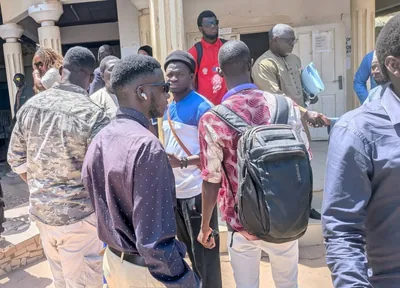
Defence Counsel L.S. Camara, representing the accused, and Commissioner Sanneh, representing the Inspector General of Police (IGP), locked horns as the defence argued that the prosecution failed to establish criminal intent or an unlawful assembly, whilst, the prosecution insisted that a prima facie case had been made.
The three accused persons Kemo Fatty, Alieu Bah, and Omar Camara are facing charges of unlawful assembly and common nuisance in connection with the 15th September 2025 incident at the National Audit Office.
The defence counsel, L.S. Camara, has filed a formal “No-Case to Answer” submission, arguing the prosecution’s case is so hollow it does not warrant a defence.
Counsel L.S. Camara opened his submission by reminding the court that the burden of proof rests solely on the prosecution and “never shifts.” He questioned the very foundation of the prosecution’s evidence, asking, “Where is the evidence to support the mens rea (criminal intent) and actus reus (the criminal act)?”
Counsel Camara stated that, having analysed all the witnesses who testified before the court, the question begged to be answered: where is the evidence in support of the mens rea?
Counsel Camara reminded the court that the accused were charged with unlawful assembly against the removal of the Auditor General and common nuisance contrary to Section 137. He said the prosecution, therefore, has an obligation to prove that the accused committed a protest without a permit or caused inconvenience to the public.
“Your Worship, there’s absolutely no evidence to demonstrate that the accused had an unlawful assembly or protest,” he argued.
Citing the Nigerian locus classic of Ibeziako v. Commissioner of Police (1963) 1 All NLR 61, Counsel Camara outlined the three established grounds on which a no-case submission must succeed: where the prosecution has failed to establish the essential elements of an offence; where the prosecution’s evidence has been so discredited under cross-examination that no reasonable tribunal could safely rely on it; or where the evidence is so manifestly unreliable that a conviction would be unsafe.
“There is absolutely no evidence from the entire prosecution’s witnesses to support count one.” Defence Counsel L.S. Camara
Camara also drew on the English authority of R v. Galbraith (1981) 1 All ER 448, where Lord Lane CJ held that a no-case submission should succeed where there is no evidence that the accused committed the offence, or where the evidence is so weak or inconsistent that no reasonable tribunal could convict it.
He further cited the Gambian Supreme Court’s decision in Batch Samba Faye v. The State and the Ghanaian case of The State v. Ali Kassena (1962) as courts of persuasive jurisdiction that have adopted the same principles.
On the substance of the charges, Camara argued that the prosecution’s own witnesses described the accused as standing outside the National Audit Office in a public space to hold a press conference, not a protest.
Counsel Camara submitted that prosecution witnesses stated the accused wanted to hold a press conference without a permit and that, while many people were at the National Audit Office on that day, the accused persons were standing outside in a public space and the police had access to the National Audit Office both inside and outside.
Finally, Counsel Camara urged the court to uphold the no-case submission and discharge the accused persons.
Commissioner Sanneh, representing the Inspector General of Police, urged the court to dismiss the no-case submission, arguing that a prima facie case had been established meaning the evidence is sufficient to require the accused to open their defence.
Commissioner Sanneh informed the court that to prove the charges of unlawful assembly and common nuisance, the prosecution called four witnesses, all of whom are police officers.
Sanneh relied heavily on the testimonies of three witnesses. Police Officer Dawda Jallow (PW1) testified that upon receiving a call to visit the National Audit Office, he found the place “chaotic” with journalists waiting for a press conference.
He dispatched them, but when the accused arrived with the intent to hold a press conference and refused to leave the premises, he summoned Police Intervention Unit (PIU) officers.
Regarding Landing Bojang (PW2), Commissioner Sanneh said the officer testified he was the head of the section deployed to the National Audit Office because the accused insisted on holding a protest.
Officer Bojang testified that upon arrival, he found the accused persons on the ground and the place was so chaotic that he attempted to tell them they could not hold a press conference or protest without a permit. He stated that they refused, and tear gas was used to disperse them before arrests were made.
The third witness, Officer Colley (PW4), did not attend the scene but participated in the subsequent investigation, interviewing individuals in connection with the case.
Commissioner Sanneh’s submission was punctuated by objections from the defence. When Sanneh submitted that PW1 testified the accused came in the name of the Gambians Against Looted Assets (GALA), Counsel Camara objected. Magistrate Sallah Mbye reviewed the court record and confirmed the claim had not been captured in the proceedings.
A similar objection arose when Sanneh stated that the accused had confirmed during interviews that they were members of GALA. Again, a review of the record did not support the submission, and the Commissioner was obliged to reframe, stating instead that Officer Colley had interviewed three GALA members.
Commissioner Sanneh relied on Section 62, which defines unlawful assembly as a gathering of three or more persons with a common purpose, conducted in a manner that causes surrounding persons to reasonably fear a breach of peace. He argued that the accused numbered three, had a common purpose, and by their refusal to leave, had created a chaotic situation.
He also invoked Section 5 of the Public Order Act, which requires a permit for public processions and assemblies, and cited the Supreme Court’s ruling in State v. Ousainou Darboe in support of the permit requirement. He added that Section 25 of the 1997 Constitution does not grant absolute freedom of speech, referring the court to Section 25(4), which points to other laws of the country such as the Public Order Act.
Regarding the common nuisance, Commissioner Sanneh submitted that the actions of the accused caused obstruction and inconvenience, satisfying the definition of the offence under Section 137 of the Criminal Code. He concluded that the prosecution believes a prima facie case is established and urged the court to order the accused to open their defence.
In a reply on the law, Counsel Camara maintained that the charge before the court was an “unlawful protest without a permit,” yet the prosecution’s own evidence suggested the accused were there to hold a press conference, not a protest. He reiterated that none of the prosecution witnesses had testified to facts that met the conditions for unlawful assembly under Section 62.
“What is before the court is a charge of holding an unlawful protest without a permit, yet the evidence only suggests they were trying to hold a press conference,” Camara concluded.
He added that Section 5 of the Public Order Act, which the prosecution sought to rely on, was irrelevant because the accused had not been charged under that Act. Furthermore, he accused the prosecution of misquoting Section 137 regarding common nuisance.
Magistrate Sallah Mbye has adjourned the matter to rule on whether the accused must open their defence or if they will be discharged. The ruling is scheduled for 18th June 2026.

According to our insider: “Following your publication, the station officer DSP Demba promptly visited the Gener and Child Welfare Office to verify the facts as the case had not been recorded in the station’s dairy. Subsequently, both the victim and the alleged perpetrator were summoned to the station, where they remained until 4pm. The situation is curently tense as developments continue to unfold.”
+
Awa is a maid from Mali who was working for a family in Brusubi Phase 2. She was allegedly subjected to inhuman treatment and was not even allowed to sleep inside the house.
A woman identified as Fatoumatta Krubally allegedly brought her to The Gambia. She is related to the family Awa was working for and was responsible for managing Awa’s wages.
The matter is currently at the Brusubi Police Station, but there are allegations that the police are attempting to brush the case under the carpet.
As of now, it remains unclear whether Awa has been sent back to the same household or taken to a place of safety.
We would like to inform the Station Officer at Brusubi that if anything happens to the young woman, he will be held responsible.
2026.2.11 The Banjul High Court has acquitted and discharged Abdoulie Sanyang of arson and contempt of court charges
Justice Ebrima Jaiteh ruled that the prosecution failed to prove the charges beyond a reasonable doubt.
The court found that the prosecution’s case relied heavily on alleged admissions made by Sanyang, but these statements were not supported by independent evidence. The sole eyewitness to the arson incident did not identify Sanyang as one of the perpetrators, and there was no forensic or documentary evidence linking him to the crime.
According to the Court’s Findings, The Accused Person, Abdoulie Sanyang, stood trial on two counts, namely: Count One – Arson, contrary to section 305(a) of the Criminal Code; and Count Two – Interference with Judicial Proceedings, contrary to section 99(1)(d)(i) of the Criminal Offences Act, 2025.
The Presiding Judge Justice Ebrima Jaiteh stated that, The Court has thoroughly examined the evidence presented by both parties, the addresses of learned counsel, and the relevant principles of law. It remains emphasised that the burden lies solely on the Prosecution to prove the Accused’s guilt beyond a reasonable doubt, a burden that never shifts and must be met with credible, cogent, and compelling evidence.
On the first count, the Prosecution alleged that the Accused either directly committed, or aided and abetted, the burning of the APRC Bureau in Kanifing in August 2016. The Court finds that while the fact that the building was burnt is not in serious dispute, the Prosecution failed to establish, beyond a reasonable doubt, the criminal responsibility of the Accused for that act.
The sole eyewitness to the incident, PW6, Omar Touray a police testified that the perpetrators were masked, unknown to him, and could not be identified. Omar’s testimony, though credible as to the occurrence of the fire, did not in any way link the Accused to the commission of the offence. No forensic, documentary, or circumstantial evidence was led to place the Accused at the scene or to establish his participation in the planning or execution of the arson.
The Prosecution’s case on complicity rested almost entirely on alleged admissions contained in the Accused’s cautionary statement and remarks made during a radio interview. However, the Court finds that these utterances, when considered carefully and in context, fall short of a clear, voluntary, and unequivocal confession within the meaning of the Evidence Act.
Crucially, the Prosecution failed to produce any independent corroborative evidence, such as financial records, witness testimony, or transactional proof, to substantiate the allegation that the Accused financed or procured the burning of the building.
According to Justice Jaiteh, it is settled law that while an admission may be relied upon, a disputed or retracted extra-judicial statement, standing alone and unsupported by independent evidence, is unsafe as the sole basis for a conviction for a serious offence such as arson. He added that, The Court is not persuaded that the Prosecution established either the actus reus or the mens rea of arson against the Accused beyond a reasonable doubt.
Accordingly, the Court finds that Count One was not proved.
Findings on Count Two: Interference with Judicial Proceedings With respect to the second count, the Prosecution alleged that the Accused interfered with judicial proceedings by making statements during a radio interview which allegedly misrepresented ongoing court proceedings and undermined public confidence in the judiciary.
However, The Court finds, as a matter of fact, that judicial proceedings were pending at the material time and that the Accused did make comments touching on those proceedings. However, the offence created under section 99(1)(d)(i) of the Criminal Offences Act, 2025 requires far more than mere criticism or intemperate speech. The Prosecution was required to prove intentional conduct calculated to obstruct, prejudice, or undermine the administration of justice.
According to Justice Jaiteh, Having carefully reviewed the content of the impugned statements, the Court finds that although the Accused’s language may be described as ill-advised or provocative, the Prosecution failed to demonstrate that the statements were capable of prejudicing any party to the proceedings or that they posed a real risk to the fair administration of justice.
“No evidence was led to show that the remarks influenced judicial officers, interfered with the conduct of the proceedings, or impeded justice in any tangible manner” Jaiteh noted.
He stated that, The Court is guided by the enduring principle enunciated in Ambard vs Attorney-General for Trinidad and Tobago [1936] AC 322, that justice is not a cloistered virtue and that fair, even robust, criticism of judicial proceedings is permissible, provided it does not obstruct justice. In a nonjury system, the threshold for establishing prejudice is necessarily high, and that threshold was not met in this case.
“Most importantly, the Prosecution failed to establish the essential mens rea of the offence. There is no evidence that the Accused intended, by his statements, to interfere with judicial proceedings or to show intentional disrespect in the criminal sense contemplated by the statute. The Court is not prepared to equate controversial public commentary with criminal interference, as to do so would unduly curtail constitutionally protected expression” Justice Jaiteh stated.
The Court therefore finds that Count Two was likewise not proved beyond a reasonable doubt.
In conclusion, the Presiding Judge stated that, In criminal proceedings, suspicion, conjecture, or public disapproval, no matter how strong, cannot take the place of proof. Where the Prosecution fails to establish the essential ingredients of an offence beyond a reasonable doubt, the Court has no discretion but to acquit.
“For the reasons stated above, the Court finds that the Prosecution failed to prove its case against the Accused Person, Abdoulie Sanyang, on both counts.
Accordingly, the Accused Person is hereby Acquitted AND Discharged on Count Both counts.” Justice Jaiteh Delivered his final Judgement.
Immediately upon the pronouncement of the acquittal and discharge, Learned Counsel S. L. Jobarteh for the State orally notified the court of the prosecution’s intention to appeal against the acquittal pursuant to section 325 of the Criminal Procedure Act, 2025. Counsel for the State further applied that the accused person be kept in custody pending the intended appeal, noting that Abdoulie Sanyang is not a resident of The Gambia.
At this stage, Learned Counsel K. Jallow rose and informed the court that she had been instructed to represent the accused person. The prosecution objected to her participation on the grounds that she had not previously appeared in the matter
In his ruling Justice Jaiteh stated that, This objection is misconceived and without merit. Counsel K. Jallow is a knowledgeable member of the Gambian Bar, and once properly instructed, she is entitled to enter appearance at any stage of the proceedings. The 1997 Constitution of The Gambia guarantees the right of an accused person to legal representation of their choice, and this constitutional right cannot be curtailed by the prosecution. The objection was therefore overruled.
Learned Counsel K. Jallow for Abdoulie Sanyang opposed the state’s the Application to Detain the Accused pending appeal and submitted that section 325(3) of the Criminal Procedure Act grants the court discretion to either detain or admit the acquitted person to bail. She further referred this court to its own earlier decision, whereby the court, after acquitting Muhammed Cesay and two others on a charge of murder, granted bail when a similar application was made by the State.
Counsel K. Jallow urged this court to adopt the same approach, arguing that Abdoulie Sanyang is now a free man in law following his acquittal.
In his Ruling, Jaiteh stated that, The court has thoroughly considered the submissions of both counsel. Section 24 of the 1997 Constitution entrenches the presumption of innocence, and although the accused has already been acquitted, this presumption continues to operate in his favour. The court is also aware that an acquittal restores the liberty of the accused, and any further deprivation of liberty must be strictly justified and exercised sparingly.
Jaiteh added that, Section 325(3) of the Criminal Procedure Act, 2025, states that when oral notice of intention to appeal is given, the court shall either order the person to be detained or, upon application, admit the person to bail pending the appeal hearing. The provision clearly grants a judicial discretion, which must be exercised judiciously and in accordance with constitutional principles.
In the circumstances of this case, and considering that Abdoulie Sanyang has been acquitted, that he is a resident within the jurisdiction, and that no exceptional circumstances have been demonstrated by the prosecution to justify further detention, this court declines to remand him. Instead, this court invokes its discretionary powers under section 325(3) and section 355 of the Criminal Procedure Act to grant him bail.
Accordingly, Abdoulie Sanyang is hereby admitted to bail on the following terms and conditions:
1.He shall enter into a bail bond in the sum of D50,000 (Fifty Thousand Dalasis).
2.He shall provide one Gambian surety.
3.The surety shall deposit his or her National Identity card with the Principal Registrar of the High Court
4.The surety shall swear and file an affidavit of means confirming the ability to meet the bail sum.
5.This bail shall lapse after thirty (30) days if the State fails to file a competent petition of appeal in accordance with section 325(4) of the Criminal Procedure Act
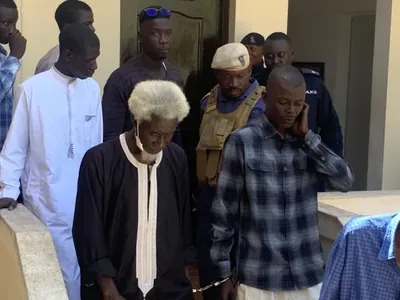
Counsel Francis C Anyanwu, the lawyer representing 56-year-old Ass Malick Njie (the accused), informed the court that he was planning to tender CCTV footage in the rape trial.
Ass Malick Njie is charged with rape, contrary to Section 3(1) (a) of the Sexual Offences Act, 2013 and punishable under Section 4(1) (a) (lI) (bb) of the Sexual Offences Act, 2013.
The prosecution alleged that on the 5th day of February 2022, around Qcell building in the Kanifing, Municipality, in the Republic of The Gambia, within the jurisdiction of the High Court, Ass Malick Njie intentionally and under coercive circumstances had sexual intercourse with a 12-year-old boy and thereby committed an offence.Gambia travel guide
When the case was called for the testimony of the First Defence Witness (DW1), Counsel Anyanwu informed the court that he did not have a witness but had evidence to tender.
“My lord, I do not have a witness in this case but I have evidence to show this court. I have CCTV footage dated on the day of the alleged incident. I have written to Qcell but they have yet to respond to my request,” Counsel Anyanwu told the court.
Counsel Anyanwu informed the court that he sent the letter to Qcell on the 26th of January 2026.
Counsel Anyanwu then applied for an adjournment to secure the CCTV footage from Qcell.
Hon. Justice Ebrima Jaiteh then asked Counsel Anyanwu whether he copied the court of the request letter sent to Qcell to retrieve the CCTV footage.
Counsel Anyanwu responded negatively, telling the court that he did not but would provide the court with a copy.
“If you send your letter there and you did not follow up, they will not use their credit to call you. You should go there and ask them. If they have it, or they don’t have it, I think that will be better than waiting for their response,” Hon. Justice Jaiteh told Counsel Anyanwu.
Hon. Justice Jaiteh further said that time is running out. He urged the defence counsel to close his case if he cannot secure witnesses or the CCTV footage as evidence.
“Your cases are all at the defence stage. If your witnesses are not forthcoming, I think you should close your cases and we go for the address, then judgment. Because all your cases are now at the defence stage,” Hon. Justice Jaiteb told Counsel Anyanwu.
Counsel Anyanwu responded that by the next adjourned date, he would close his cases including the rape case involving Ass Malick Njie, if he failed to secure witnesses or the CCTV footage from Qcell.

+
Amie Fandeh, widely known as Mamundow, a resident of Barra, is going through every mother’s worst nightmare. Earlier today, she received an urgent call informing her that her sister was in labour at EFSTH and desperately needed a blood donation.
Without hesitation, Mamundow rushed to Banjul, carrying her 7-month-old baby, determined to save her sister’s life. At the Banjul ferry terminal, she entered a taxi that was already full, with only the front seat available. But the driver refused to allow her to sit in front with her baby.
One of the passengers sitting behind offered to hold the child. When the taxi arrived at the garage, Mamundow stepped out to collect her change from the driver. In that short moment, the woman vanished with her baby.
Mamundow searched everywhere in panic and tears, but the woman and the child were nowhere to be found. What began as a journey to save a life has turned into an unimaginable tragedy.
The family is urgently appealing to the public for help in finding the missing baby.
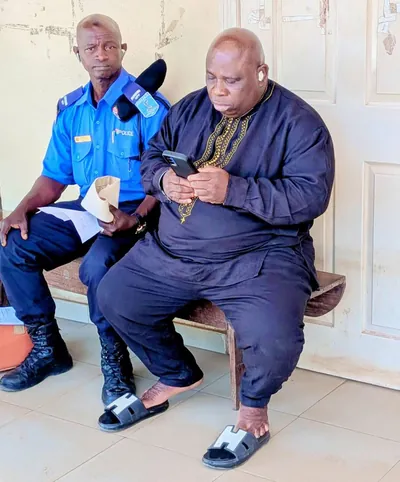
2026.1.16 First jungler trial in Gambia: Hitman Sanna Manjang pleads not guilty to murder
Sanna Manjang, an alleged notorious hitman from former president Yahya Jammeh’s dreaded ‘Junglers’ death squad, has become the first of the group to face trial in The Gambia.
Standing before Justice Sidi K. Jobarteh at the High Court in Banjul, Manjang pleaded not guilty to two counts of murder, charges that mark a historic moment in the nation’s pursuit of justice.
The accused appeared before the High Court with legal presence on both sides. The State was represented by E. R. Dougan, alongside P. Gomez, F. Drammeh, M. Jammeh, and A. Badjie. Counsel for the defence included S. K. Jobe and F. Jammeh.
Sanna Manjang is charged with two counts of murder under Section 187 of the Criminal Code, Cap 10, Volume III, Laws of The Gambia 2009.Gambia travel guide
According to the particulars presented before the court, Count One alleges that Manjang unlawfully caused the death of Kajali Jammeh, also known as “Le Cock,” in 2006 at Kanilai in the West Coast Region.
The prosecution claims the victim’s neck was cut with a knife, an act said to have been carried out with malice aforethought.
Count Two relates to the alleged murder of Samba Wurry, also in 2006 at Kanilai.
The particulars of offence stated that Manjang stabbed the victim in the chest with a knife, resulting in his death. Manjang, however pleaded not guilty to both charges.
It would be recalled that Manjang was previously arraigned before Principal Magistrate Isatou Sallah-M’bai at the Kanifing Magistrates’ Court, where he was charged in connection with the murders of journalist Deyda Hydara, Ndongo Mboob, and Haruna Jammeh.
However, Commissioner A. Sanneh, representing the Inspector General of Police alongside Deputy Commissioner Badjie and Officer Manga, informed the magistrates’ court that the offence was capital in nature and therefore outside its jurisdiction.
As a result, the case was transferred to the High Court for proper adjudication.
The matter was adjourned until February 9, 2026.

Police investigations into the recent fatal stabbing incident at a forex bureau in Brusubi involving the late Isatou Fatty have registered significant progress. During the course of the investigation, a key witness positively identified an individual of interest, prompting further investigative action.
Following this development, the individual of interest was formally cautioned, interviewed, and a statement obtained. Investigators are currently verifying the information provided, including reviewing the stated alibis to either substantiate or refute them as part of due process.
The Gambia Police Force reiterates that no conclusions have been reached at this stage. The investigation remains active, and all inquiries are being pursued professionally to ensure accuracy, fairness, and full adherence to legal procedures.
Further updates will be shared as the investigation progresses. Members of the public with relevant information are encouraged to contact the nearest police station or call 9968885.

They chose Jinack because it is the only village in the country where the Police and Immigration are afraid to set foot.
x1200

(BANJUL, the Gambia) – Three Senegalese siblings, who were detained in the Casamance region following their arrest alongside fugitive former Gambian soldier Lt. Col. Sanna Manjang, have been released from custody. Their subsequent freedom aligns with the Gambian government’s official assessment that the trio poses no security threat.
The Badjie siblings, identified as Modou Badji (alias Gassama), Famara Badji, and Ansoumana Badji, were involved in the charcoal business in Bassène, a village in Senegal near the border with The Gambia, when they were detained by the Senegalese military.
Purely a Business Partnership, Says Family
Relatives of the trio spoke to The Gambia Journal, clarifying the nature of their relationship with Manjang. The family strongly asserted that the connection was purely commercial, linked to the trade in logs and charcoal.
“Sanna was just a partner in the charcoal business,” a relative explained, dismissing any suggestion of political or armed collaboration. The family member added that the brothers were unaware of Manjang’s dark past as an alleged hitman and member of former President Yahya Jammeh’s notorious “Junglers” unit.
The family initially suspected the detention was linked to their charcoal operations, which involve cutting timber—an activity sometimes subject to regulation in Senegal.
Gambian Authorities Downplay Threat
Following the arrest, the family reported being informed by Senegalese security forces that the three siblings and Manjang had all been handed over to Gambian authorities, a claim reportedly echoed by an APRC diaspora activist.
However, The Gambia’s National Security Adviser, Abubacarr Sulayman Jeng, provided clarity, telling The Standard that the Badjie siblings arrested with Manjang are “not of interest to The Gambia.” This official position corroborates the family’s account of the siblings’ limited involvement.
The release of the Badjie trio clearly indicates that the Senegalese authorities concur with The Gambia’s assessment. While the Badjie siblings are now free, Manjang, wanted for crimes including murder and torture under the Jammeh administration, remains the focus of an international manhunt, and his current status is undisclosed.
发表回复